Colbert

Contents
Description
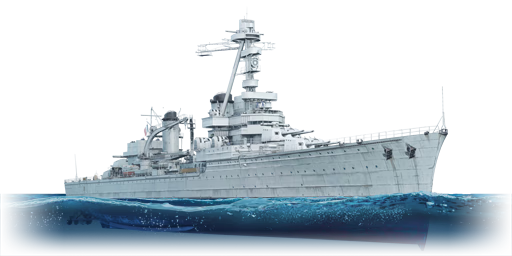
The Suffren-class, Colbert, 1942 is a rank French heavy cruiser with a battle rating of (AB), (RB), and (SB). It was introduced in Update "La Royale".
General info
Survivability and armour
With a maximum armour thickness of 50 mm, Colbert is outclassed by all of the foregin heavy cruisers in the similar BR and majority of the light cruisers, including the likes of USS Atlanta or RN Eugenio di Savoia. This is not helped by only an average crew count for the vessel in her BR, making Colbert one of the most fragile cruisers.
At the close range she has an slight advantage in the magazines being located below the water line, with even the top edge of the magazines being about 2-3 meters below, making them a little bit less likely to explode.
Mobility
In terms of mobility, Colbert is rather typical for the cruisers in its BR. Power, turn rate, rudder turning time and engine mode changing time all are within 10% of average comparable vessels
| Mobility Characteristics | |||
|---|---|---|---|
| Game Mode | Upgrade Status | Maximum Speed (km/h) | |
| Forward | Reverse | ||
| AB | Stock | 52 | 25 |
| Upgraded | |||
| RB/SB | Stock | 52 | 25 |
| Upgraded | |||
Modifications and economy
Armament
Primary armament
Main guns feature an exceptionally potent SAP shell, able to do much more damage than the foreign equivalents. But the main issue with the main guns is the lack of the dedicated AP shells, making it impossible to counter heavily armoured targets. In fact, Colbert will struggle to penetrate most of the heavy cruisers and even some of the light cruisers, making it preferable to focus on fighting the soft targets, and rewarding knowledge of the armour on the enemy vessels.
| Penetration statistics | |||||||
|---|---|---|---|---|---|---|---|
| Ammunition | Type of warhead |
Penetration @ 0° Angle of Attack (mm) | |||||
| 1,000 m | 2,500 m | 5,000 m | 7,500 m | 10,000 m | 15,000 m | ||
| OEA Mle 1927 HE | HE | 61 | 61 | 61 | 61 | 61 | 61 |
| OPF Mle 1927 SAPBC | SAPBC | 151 | 140 | 123 | 109 | 97 | 79 |
| Shell details | ||||||||||||
|---|---|---|---|---|---|---|---|---|---|---|---|---|
| Ammunition | Type of warhead |
Velocity (m/s) |
Projectile mass (kg) |
Fuse delay (s) |
Fuse sensitivity (mm) |
Explosive mass (TNT equivalent) (kg) |
Ricochet | |||||
| 0% | 50% | 100% | ||||||||||
| OEA Mle 1927 HE | HE | 850 | 123.82 | 0 | 0.1 | 9.13 | 79° | 80° | 81° | |||
| OPF Mle 1927 SAPBC | SAPBC | 850 | 123.1 | 0.03 | 9 | 8.88 | 48° | 63° | 71° | |||
Secondary armament
Eight, single-mount 90 mm secondary guns are primarily an anti-air weapons, being able to engage even the dive bombers thanks to +80° vertical guidance. HE-TF rounds are a preferable first choice for the secondaries, as they maximise the chance of damaging an enemy airplane, either by a direct hit or a shrapnel from a nearby explosion. HE-TF rounds can also be used against coastal vessels, as in a short range they will work like a regular HE shells, though switching to an anti-air armament can be a better choice when dealing with a small, manoeuvring torpedo boats.
| Penetration statistics | |||||||
|---|---|---|---|---|---|---|---|
| Ammunition | Type of warhead |
Penetration @ 0° Angle of Attack (mm) | |||||
| 100 m | 1,000 m | 2,000 m | 3,000 m | 4,000 m | 5,000 m | ||
| OEA Mle 1925 HE | HE | 13 | 13 | 13 | 13 | 13 | 13 |
| OEA Mle 1925 HE-TF | HE-TF | 13 | 13 | 13 | 13 | 13 | 13 |
| Shell details | ||||||||||||
|---|---|---|---|---|---|---|---|---|---|---|---|---|
| Ammunition | Type of warhead |
Velocity (m/s) |
Projectile mass (kg) |
Fuse delay (m) |
Fuse sensitivity (mm) |
Explosive mass (TNT equivalent) (g) |
Ricochet | |||||
| 0% | 50% | 100% | ||||||||||
| OEA Mle 1925 HE | HE | 850 | 9.5 | 0 | 0.1 | 905 | 79° | 80° | 81° | |||
| OEA Mle 1925 HE-TF | HE-TF | 850 | 9.5 | 0 | 0.1 | 905 | 79° | 80° | 81° | |||
Anti-aircraft armament
Nearly all the anti-air armament is concentrated around the bridge superstructure and on the aft superstructure - between the aft funnels and rear main guns. 37 mm guns are excellent, able to engage incoming airplanes at a significant distance, with even a single hit being enough to cripple single-engined planes and do significant damage to larger bombers. In contrast, 13.2 mm machine guns really struggle to deal with both: aerial and surface targets alike, lacking both: the stopping power and range to effectively counter hostiles. Overall capabilities of the anti-air guns can be described as adequate, though on a low end of the capabilities.
It's worth noting that the 37 mm is an excellent calibre to deal with a light, fast motor torpedo boats, being able to stop them at a sagnificant range and counter ambushes.
Additional armament
Divided between one triple-launcher on each side, there are six torpedoes in total, with additional 4 in the reloads for the total of 10 torpedoes onboard. The torpedoes themselves offer a great combination of speed and range, complemented by a substantial warhead. As a result, they prove effective for both short-range engagements and long-range area denial.
Scout plane
Loire 130С is a significant improvement over a much more common French hydroplane - GL.832HY. Loire has a higher speed, manoeuvrability, better defensive armament and exceptionally high bomb load for a shipboard reconnaissance aircraft - two 75 kg bombs, for a total of 46.27 kg of explosives, nearly double of some of the more common hydroplanes. Still, being as fragile as all the other hydroplanes, Loire shouldn't be used for bombing, and even the weakest coastal vessels have more than enough armament to shred it into pieces.
The ability to carry two vessels at a time effectively translates to being able to capture multiple enemy cap points, making it a great utility, especially when using boosters, to secure the wins even against an enemy fleet superior in firepower.
Due to the relatively low survivability of the cruiser, it might be advised to use airplane-deployed smoke screen in order to cover the retreat, or even simply hide the vessel from a specific enemy for the 30 seconds that the smoke lasts.
Usage in battles
Colbert is a challenging heavy cruiser to play, owning it to a poor survivability and no means of countering enemy heavy cruisers or battleships. She has to cherry-pick targets below her in the pecking order, while avoiding contact. This is best assisted by carefully using islands as a hard cover or smoke screens - either from the cruiser or its hydroplanes. And, of course, spawning after the first few friendlies are already in the match, then keeping in the second line rather than rushing forward, in order to avoid attention.
That said, when Colbert has an opportunity to fight with the enemies on her terms, she will outgun a majority of the soft targets, being able to easily blow up enemy destroyers at range and pick off softer light cruisers, often crippling their offensive capabilities with a single broadside on target.
Pros and cons
Pros:
- High top speed
- Exceptional SAP shells
- Very good torpedoes
- Two decent float planes
Cons:
- Very poor survivability, more comparable to the light cruisers than heavy.
- No access to the AP shells
History
Describe the history of the creation and combat usage of the ship in more detail than in the introduction. If the historical reference turns out to be too long, take it to a separate article, taking a link to the article about the ship and adding a block "/History" (example: https://wiki.warthunder.com/(Ship-name)/History) and add a link to it here using the main template. Be sure to reference text and sources by using <ref></ref>, as well as adding them at the end of the article with <references />. This section may also include the ship's dev blog entry (if applicable) and the in-game encyclopedia description (under === In-game description ===, also if applicable).
Media
- Skins
See also
External links
- [Devblog] Colbert heavy cruiser: The Contender
- [Wikipedia] French cruiser Colbert (1928)
- [Wikipedia] Suffren-class cruiser
- [uboat.net] FR Colbert of the French Navy - French Heavy cruiser of the Suffren class - Allied Warships of WWII
- [Navypedia] SUFFREN heavy cruisers (1930 - 1932)
| Arsenal de Brest | |
|---|---|
| Avisos | |
| Arras-class | Arras |
| Light Cruisers | |
| Duguay-Trouin-class | Duguay-Trouin · Primauguet |
| Heavy Cruisers | |
| Suffren-class | Colbert · Dupleix |
| Battleships | |
| Bretagne-class | Bretagne |
| Dunkerque-class | Dunkerque |
| France heavy cruisers | |
|---|---|
| Suffren-class | Colbert · Dupleix |