IJN Kurama

Contents
Description
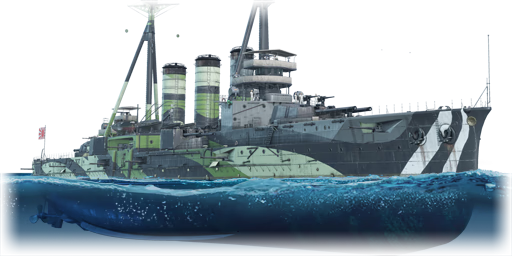
The Kurama-class, IJN Kurama, 1920 is a gift rank Japanese battlecruiser with a battle rating of (AB), (RB), and (SB). It was introduced during Update "Sons of Attila" as a reward for the 2023 Tokushu Heiki event.
General info
Survivability and armour
Talk about the vehicle's armour. Note the most well-defended and most vulnerable zones, e.g. the ammo magazine. Evaluate the composition of components and assemblies responsible for movement and manoeuvrability. Evaluate the survivability of the primary and secondary armaments separately. Don't forget to mention the size of the crew, which plays an important role in fleet mechanics. Save tips on preserving survivability for the "Usage in battles" section. If necessary, use a graphical template to show the most well-protected or most vulnerable points in the armour.
Mobility
Write about the ship's mobility. Evaluate its power and manoeuvrability, rudder rerouting speed, stopping speed at full tilt, with its maximum forward and reverse speed.
| Mobility Characteristics | |||
|---|---|---|---|
| Game Mode | Upgrade Status | Maximum Speed (km/h) | |
| Forward | Reverse | ||
| AB | |||
| Upgraded | |||
| RB/SB | |||
| Upgraded | |||
Modifications and economy
Armament
Primary armament
Provide information about the characteristics of the primary armament. Evaluate their efficacy in battle based on their reload speed, ballistics and the capacity of their shells. Add a link to the main article about the weapon: {{main|Weapon name (calibre)}}. Broadly describe the ammunition available for the primary armament, and provide recommendations on how to use it and which ammunition to choose.
| Penetration statistics | |||||||
|---|---|---|---|---|---|---|---|
| Ammunition | Type of warhead |
Penetration @ 0° Angle of Attack (mm) | |||||
| 1,000 m | 2,500 m | 5,000 m | 7,500 m | 10,000 m | 15,000 m | ||
| 12-inch/45 HE | HE | 69 | 69 | 69 | 69 | 69 | 69 |
| 12-inch/45 APC | APC | 496 | 432 | 345 | 278 | 229 | 172 |
| Shell details | ||||||||||||
|---|---|---|---|---|---|---|---|---|---|---|---|---|
| Ammunition | Type of warhead |
Velocity (m/s) |
Projectile mass (kg) |
Fuse delay (s) |
Fuse sensitivity (mm) |
Explosive mass (TNT equivalent) (kg) |
Ricochet | |||||
| 0% | 50% | 100% | ||||||||||
| 12-inch/45 HE | HE | 825 | 400.06 | 0 | 0.1 | 37.82 | 79° | 80° | 81° | |||
| 12-inch/45 APC | APC | 825 | 400.06 | 0.035 | 17 | 13.64 | 48° | 63° | 71° | |||
Secondary armament
Some ships are fitted with weapons of various calibres. Secondary armaments are defined as weapons chosen with the control Select secondary weapon. Evaluate the secondary armaments and give advice on how to use them. Describe the ammunition available for the secondary armament. Provide recommendations on how to use them and which ammunition to choose. Remember that any anti-air armament, even heavy calibre weapons, belong in the next section. If there is no secondary armament, remove this section.
| Penetration statistics | |||||||
|---|---|---|---|---|---|---|---|
| Ammunition | Type of warhead |
Penetration @ 0° Angle of Attack (mm) | |||||
| 1,000 m | 2,500 m | 5,000 m | 7,500 m | 10,000 m | 15,000 m | ||
| 200 mm Type 3 HE common | HE | 63 | 63 | 63 | 63 | 63 | 63 |
| 200 mm Type 3 APC | APC | 291 | 241 | 178 | 134 | 105 | 86 |
| Shell details | ||||||||||||
|---|---|---|---|---|---|---|---|---|---|---|---|---|
| Ammunition | Type of warhead |
Velocity (m/s) |
Projectile mass (kg) |
Fuse delay (s) |
Fuse sensitivity (mm) |
Explosive mass (TNT equivalent) (kg) |
Ricochet | |||||
| 0% | 50% | 100% | ||||||||||
| 200 mm Type 3 HE common | HE | 790 | 115.3 | 0 | 0.1 | 11.25 | 79° | 80° | 81° | |||
| 200 mm Type 3 APC | APC | 790 | 115.3 | 0.03 | 9 | 3.49 | 48° | 63° | 71° | |||
Anti-aircraft armament
An important part of the ship's armament responsible for air defence. Anti-aircraft armament is defined by the weapon chosen with the control Select anti-aircraft weapons. Talk about the ship's anti-air cannons and machine guns, the number of guns and their positions, their effective range, and about their overall effectiveness – including against surface targets. If there are no anti-aircraft armaments, remove this section.
Additional armament
Describe the available additional armaments of the ship: depth charges, mines, torpedoes. Talk about their positions, available ammunition and launch features such as dead zones of torpedoes. If there is no additional armament, remove this section.
Usage in battles
The Kurama can either be the lead attacker ship or a support ship, it all depends on what you are facing. It is able to tear appart destroyers and cruisers with it's 305mm cannons. While the main cannons are reloading it can use it's secondary's to continuesly bombard enemies. The Kurama's armor is not the best, therefore if you are facing battleships or battlecruisers then you should keep your distance and try to snipe the enemy.
Pros and cons
Summarise and briefly evaluate the vehicle in terms of its characteristics and combat effectiveness. Mark its pros and cons in the bulleted list. Try not to use more than 6 points for each of the characteristics. Avoid using categorical definitions such as "bad", "good" and the like - use substitutions with softer forms such as "inadequate" and "effective".
Pros:
Effective main armament
Biggest secondary's armament of any ships (Bigger than some heavy cruisers main armament)
Torpedo launchers
Often underestimated because of WW1 looks
Cons:
Overall poor mobility
Secondary's turrets are easily taken out
Torpedo's have poor travel distance
Ineffective AA armament
History
Describe the history of the creation and combat usage of the ship in more detail than in the introduction. If the historical reference turns out to be too long, take it to a separate article, taking a link to the article about the ship and adding a block "/History" (example: https://wiki.warthunder.com/(Ship-name)/History) and add a link to it here using the main template. Be sure to reference text and sources by using <ref></ref>, as well as adding them at the end of the article with <references />. This section may also include the ship's dev blog entry (if applicable) and the in-game encyclopedia description (under === In-game description ===, also if applicable).
Media
- Skins
See also
Links to articles on the War Thunder Wiki that you think will be useful for the reader, for example:
- reference to the series of the ship;
- links to approximate analogues of other nations and research trees.
External links
| Yokosuka Naval Arsenal (横須賀海軍工廠) | |
|---|---|
| Destroyers (DD) | |
| Momi-class | IJN Momi |
| Light Cruisers (CL) | |
| Mogami-class | IJN Suzuya |
| Heavy Cruisers (CA) | |
| Myōkō-class | IJN Myoko |
| Battlecruisers (BC) | |
| Kurama-class | IJN Kurama |
| Amagi-class | IJN Amagi |
| Battleships (BB) | |
| Fusō-class | IJN Yamashiro |
| Nagato-class | IJN Mutsu |
| Tanks | Ka-Mi · Ka-Chi · Chi-Ha LG |
| See also | Yokosuka Naval Air Technical Arsenal |
| Japan battlecruisers | |
|---|---|
| Tsukuba-class | IJN Ikoma |
| Kurama-class | IJN Kurama |
| Amagi-class | IJN Amagi |