M.S.410


Contents
Description
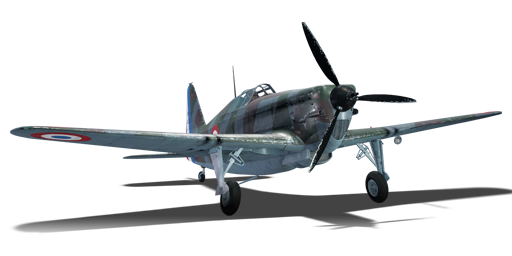
The M.S.410 was meant to be an upgrade over the M.S.406 after its introduction in 1939. The engineers included a new wing designed, improved offensive armament and a new fixed radiator, among other minor upgrades. The changes were minor and the airplane was not much different compared to its predecessor, the aircraft never managed to be used by the French Air Force since its production started just before France's capitulation in June 1940. The aircraft was however, was produced in limited numbers under German supervision in Vichy France, also a few M.S.406 airframes were converted to the 410.
It was introduced in Update 1.73 "Vive la France". The M.S.410 behaves like many other French Aircrafts of its rank and BR, it has a relatively mediocre armament and good agility at the cost of top speed and durability. The M.S.410 has an acceptable climb rate that should be used to maintain initiative and energy fight slower opponents, since many fighters, specially German and American fighters will be able to outrun you. Due to its armament, the M.S.410is not well suited to pursuit bombers, instead, try saving the ammo of your 20 mm cannon for fighters and critical shots.
General info
Flight performance
| Characteristics | Max Speed (km/h at 4,000 m) |
Max altitude (metres) |
Turn time (seconds) |
Rate of climb (metres/second) |
Take-off run (metres) | |||
|---|---|---|---|---|---|---|---|---|
| AB | RB | AB | RB | AB | RB | |||
| Stock | 459 | 447 | 21.0 | 21.9 | 9.4 | 9.4 | 300 | |
| Upgraded | 497 | 477 | 19.0 | 20.0 | 14.9 | 11.9 | ||
Details
| Features | ||||
|---|---|---|---|---|
| Combat flaps | Take-off flaps | Landing flaps | Air brakes | Arrestor gear |
| X | X | ✓ | X | X |
| Limits | ||||||
|---|---|---|---|---|---|---|
| Wings (km/h) | Gear (km/h) | Flaps (km/h) | Max Static G | |||
| Combat | Take-off | Landing | + | - | ||
| N/A | N/A | 270 | ~13 | ~8 | ||
| Optimal velocities (km/h) | |||
|---|---|---|---|
| Ailerons | Rudder | Elevators | Radiator |
| < 310 | < 320 | < 330 | > 330 |
Survivability and armour
- 70 mm Bulletproof glass in front of pilot.
- 6 mm Steel plates behind the pilot's head.
Modifications and economy
Armaments
Offensive armament
The M.S.410 is armed with:
- 1 x 20 mm Hispano 404 cannon, nose-mounted (60 rpg)
- 4 x 7.5 mm MAC 1934 machine guns, wing-mounted (500 rpg = 2,000 total)
The four machine guns are arranged in bundles of two mounted in each wing. Each are armed with the same amount of ammunition, which means that all guns will fire together until empty. The Hispano 404 cannon is nose-mounted, terminating at the prop spinner.
Usage in battles
The M.S.410 is a respectably balanced fighter, able to both turn and energy fight with reasonable performance in both roles. The typical French combo of 7.5 mm MGs and 20 mm Hispano cannon though the spinner allows you to take on even the toughest of targets at your rank with little issue in landing hard-hitting knock-outs.
Some aircraft will be able to outrun you, such as the early German air superiority fighters, and others like the Japanese will be able to outturn you, but very few planes will be able to do both. Use this to your advantage to gain the upper hand in the furball.
Manual Engine Control
| MEC elements | ||||||
|---|---|---|---|---|---|---|
| Mixer | Pitch | Radiator | Supercharger | Turbocharger | ||
| Oil | Water | Type | ||||
| Controllable | Controllable Not auto controlled |
Not controllable Not auto controlled |
Controllable Not auto controlled |
Combined | Not controllable 1 gear |
Not controllable |
Pros and cons
Pros:
- Effective dive speed
- Decent ammo count in armaments
- Acceptable flat line speed
Cons:
- Low amount of cannon rounds (60 rpg)
- Low energy retention
- Terrible low speed control
- Extremely difficult to extinguish on-plane fires
History
As the M.S.406 began entering squadron service in 1939, engineers at Morane-Saulnier continued working on the design, aiming to improve it. Several changes were made to the base design, which included the replacement of the old wing design with a new one, increased and improved offensive capabilities and the replacement of the old retractable radiator with a fixed one, among others. The applied changes resulted in the new M.S.410 being able to achieve somewhat better performance than its predecessor, namely reaching a slightly higher top speed. Right after the M.S.410 entered production, France capitulated in June 1940, halting the production of the aircraft after the fifth machine was constructed.
Production of the M.S.410 was temporarily halted after the German occupation, but resumed shortly after under German supervision. Before France's capitulation, an order for 500 M.S.410s was placed. Needless to say, this production quota was never met, even under German supervision. In the end, only around 70 examples of the M.S.410 were manufactured, most of which consisted of M.S.406 airframes being converted to the 410 standard. Even then, a large number of these machines were only partially upgraded to the 410 standard, leaving many examples as hybrid models.
- From Devblog
Media
- Skins
 Market
See also
Links to the articles on the War Thunder Wiki that you think will be useful for the reader, for example:
- reference to the series of the aircraft;
- links to approximate analogues of other nations and research trees.
External links
| Morane-Saulnier Aeroplanes (Aéroplanes Morane-Saulnier) | |
|---|---|
| Fighters | M.S.405C1 |
| M.S.406C1 | |
| M.S.410 | |
| See Also | Valtion Lentokonetehdas |
| France fighters | |
|---|---|
| Dewoitine | D.371 · D.371 H.S.9 · D.373 · D.500 · D.501 · Pallier's D.510 · D.520 |
| Morane-Saulnier | M.S.405C1 · M.S.406C1 · M.S.410 |
| Arsenal | V.G.33C-1 |
| Bloch | M.B.152C1 · M.B.157 |
| Caudron | C.R.714 |
| Sud-Ouest | S.O.8000 Narval |
| American | H-75A-1 · H-75A-4 · ▄P-39Q-25 · ▄P-40F-5 Lafayette · ▄P-47D-22-RE · ▄P-63C-5 · F-6C-10-NA |
| ▄F6F-5 · ▄F6F-5N · F4U-7 · ▄F8F-1B | |
| Other countries | ▄Seafire LF Mk.III · ▄Yak-3 · Challe's ▄Yak-9T · NC.900 |
| Belgium | ▄Gladiator Mk I · ▄Spitfire FR Mk XIVe |
| Netherlands | ◘Sea Fury FB 51 |