HMS Colossus

Contents
Description
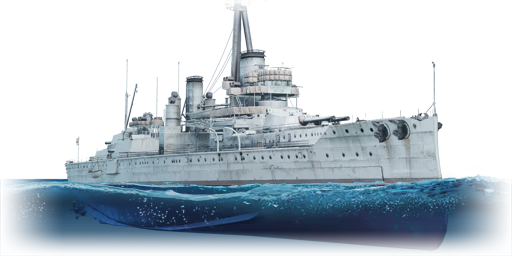
The Colossus-class, HMS Colossus (24), 1918 is a rank British battleship with a battle rating of (AB), (RB), and (SB). It was introduced in Update "New Power".
General info
Survivability and armour
Talk about the vehicle's armour. Note the most well-defended and most vulnerable zones, e.g. the ammo magazine. Evaluate the composition of components and assemblies responsible for movement and manoeuvrability. Evaluate the survivability of the primary and secondary armaments separately. Don't forget to mention the size of the crew, which plays an important role in fleet mechanics. Save tips on preserving survivability for the "Usage in battles" section. If necessary, use a graphical template to show the most well-protected or most vulnerable points in the armour.
Mobility
Write about the ship's mobility. Evaluate its power and manoeuvrability, rudder rerouting speed, stopping speed at full tilt, with its maximum forward and reverse speed.
| Mobility Characteristics | |||
|---|---|---|---|
| Game Mode | Upgrade Status | Maximum Speed (km/h) | |
| Forward | Reverse | ||
| AB | |||
| Upgraded | |||
| RB/SB | |||
| Upgraded | |||
Modifications and economy
Armament
Primary armament
| Penetration statistics | |||||||
|---|---|---|---|---|---|---|---|
| Ammunition | Type of warhead |
Penetration @ 0° Angle of Attack (mm) | |||||
| 1,000 m | 2,500 m | 5,000 m | 7,500 m | 10,000 m | 15,000 m | ||
| Mark IIa HE | HE | 72 | 72 | 72 | 72 | 72 | 72 |
| Mark VIa APC | APC | 525 | 466 | 382 | 316 | 264 | 198 |
| Mark VIIa SAPCBC | SAPCBC | 282 | 250 | 205 | 169 | 141 | 105 |
| Shell details | |||||||||
|---|---|---|---|---|---|---|---|---|---|
| Ammunition | Type of warhead |
Velocity (m/s) |
Projectile mass (kg) |
Fuse delay (s) |
Fuse sensitivity (mm) |
Explosive mass (TNT equivalent) (kg) |
Ricochet | ||
| 0% | 50% | 100% | |||||||
| Mark IIa HE | HE | 869 | 386 | 0 | 0.1 | 53.13 | 79° | 80° | 81° |
| Mark VIa APC | APC | 869 | 389.8 | 0.025 | 17 | 13.64 | 48° | 63° | 71° |
| Mark VIIa SAPCBC | SAPCBC | 869 | 386 | 0.035 | 17 | 36.3 | 48° | 63° | 71° |
Secondary armament
| Penetration statistics | |||||||
|---|---|---|---|---|---|---|---|
| Ammunition | Type of warhead |
Penetration @ 0° Angle of Attack (mm) | |||||
| 1,000 m | 2,500 m | 5,000 m | 7,500 m | 10,000 m | 15,000 m | ||
| 4 inch HE | HE | 11 | 11 | 11 | 11 | 11 | 11 |
| 4 inch CPC | SAPBC | 102 | 84 | 60 | 45 | 34 | 26 |
| Shell details | |||||||||
|---|---|---|---|---|---|---|---|---|---|
| Ammunition | Type of warhead |
Velocity (m/s) |
Projectile mass (kg) |
Fuse delay (s) |
Fuse sensitivity (mm) |
Explosive mass (TNT equivalent) (g) |
Ricochet | ||
| 0% | 50% | 100% | |||||||
| 4 inch HE | HE | 873 | 14.06 | 0 | 0.1 | 700 | 79° | 80° | 81° |
| 4 inch CPC | SAPBC | 873 | 14.06 | 0.015 | 5 | 420 | 48° | 63° | 71° |
Anti-aircraft armament
An important part of the ship's armament responsible for air defence. Anti-aircraft armament is defined by the weapon chosen with the control Select anti-aircraft weapons. Talk about the ship's anti-air cannons and machine guns, the number of guns and their positions, their effective range, and about their overall effectiveness – including against surface targets. If there are no anti-aircraft armaments, remove this section.
Additional armament
Describe the available additional armaments of the ship: depth charges, mines, torpedoes. Talk about their positions, available ammunition and launch features such as dead zones of torpedoes. If there is no additional armament, remove this section.
Usage in battles
Describe the technique of using this ship, the characteristics of her use in a team and tips on strategy. Abstain from writing an entire guide – don't try to provide a single point of view, but give the reader food for thought. Talk about the most dangerous opponents for this vehicle and provide recommendations on fighting them. If necessary, note the specifics of playing with this vehicle in various modes (AB, RB, SB).
Pros and cons
Pros:
- Solid main battery of ten 305 mm guns is a major threat to any warship.
- Superior armour penetration than the 305 mm guns of HMS Invincible and HMS Dreadnought.
- Access to SAP rounds that can deal heavy damage to lightly armoured vessels such as destroyers and cruisers.
- Secondary battery of thirteen 102 mm guns can easily thwart attacks from small unarmoured craft and destroyers.
- Strong vertical belt armour and well protected magazines, even better with angling.
- Has access to underwater torpedoes with 11 km range.
Cons:
- Slow top speed, lacklustre mobility and large size makes it an easy target for shells, bombs and torpedoes alike.
- Overall thin deck armour, extremely vulnerable to aircraft bombs and long range plunging hits.
- Weak main battery turret roof armour will often lead to damage to the gun breeches and turret rotation when hit.
- Somewhat weak athwartship armour leaves the ship potentially vulnerable to penetrating hits from the front.
- The 305 mm APC shells, while better than other British 6.0 ships, will struggle to penetrate battleship armour beyond 10 km, and have weak post-penetration damage.
- 102 mm SAPBC shells have very low penetration, making the secondary battery essentially useless against any ship larger than a destroyer.
- Virtually non-existent anti-aircraft armament makes the ship a prime target for enemy bombers.
- Like all underwater torpedo tubes, the torpedo armament has limited firing angles which makes the torpedoes largely situational.
History

HMS Colossus was the lead-ship of the two-member Colossus-class, the 5th class of dreadnought battleships constructed for the Royal Navy. Named after the Colossus of Rhodes, she was launched in 1910 and commissioned in 1911. She served in training activities before the start of the First World War, and served as part of the First Battle Squadron for the majority of the war. She participated in the Battle of Jutland, and became a training ship following the war. She was hulked in 1923, and scrapped in 1928.[1][2]
Design and development
The HMS Colossus was of a similar design to the other dreadnoughts of its era. It displaced over 20 thousand tons standard and was 166 metres long;[1] similar to its predecessors, it was capable of making 21 knots (39 km/h). The Colossus was armed with a main armament of five dual 305 mm (12-inch) guns, with three mounted on the centreline and two at beam positions.[1] However, unlike the preceding dreadnoughts, one of its beam turrets faced backwards. The ship was also equipped with numerous secondary guns,[1] though its anti-aircraft guns were sparse with just a single mount. The Colossus was the last British dreadnought to carry a 12-inch main armament, as future designs switched to the more potent 13.5-inch (343 mm) guns.[1]
The HMS Colossus was ordered in 1909, and laid down in the summer of that year. It was launched in April of 1910, and completed in early 1911.[1][2]
Service history
Following her sea trials, the HMS Colossus served with the British 2nd Battle Squadron and participated in the Fleet Review of July 1912.[2] Following the start of the First World War, Colossus participated in the Battle of Jutland; she was hit by two German shells, making her the only British dreadnought to be damaged.[2] The battle was tactically inconclusive, but served as a strategic victory for the Allies as the German fleet would never sail again. In 1917, Colossus was recalled for a refit; she rejoined the British grand fleet in 1918 but the war had drawn to a close.[1] As a result, Colossus was placed into reserve as the flagship of the reserve fleet; she later served as a training ship for the Royal Navy Cadets.[2] Following the Washington naval treaty, Colossus was sold for scrapping, and was eventually scrapped in 1928.[2]
Media
- Skins
See also
Links to articles on the War Thunder Wiki that you think will be useful for the reader, for example:
- reference to the series of the ship;
- links to approximate analogues of other nations and research trees.
External links
References
- Citations
- Bibliography
- Staff Writer. (2016, December 17). HMS Colossus Dreadnought Battleship. Retrieved November 28, 2020, from https://www.militaryfactory.com/ships/detail.asp?ship_id=hms-colossus-united-kingdom
- Naval Encyclopedia. (2019, March 31). Colossus Class Battleships (1909). Retrieved November 28, 2020, from https://www.naval-encyclopedia.com/ww1/UK/colossus-class
| Scotts Shipbuilding and Engineering Company | |
|---|---|
| Battleships | |
| Colossus-class | HMS Colossus |
| Britain battleships | |
|---|---|
| HMS Dreadnought* | |
| Colossus-class | HMS Colossus |
| Orion-class | HMS Orion |
| Iron Duke-class | HMS Iron Duke · HMS Marlborough |
| Queen Elizabeth-class | HMS Barham |
| * Unique ship | |