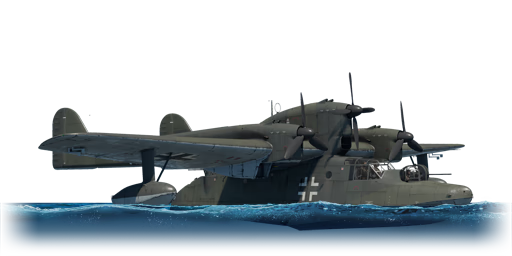
BV 138 C-1


Contents
Description
The BV 138 C-1 is a rank German bomber with a battle rating of (AB), (RB), and (SB). It was introduced in Update "Direct Hit".
General info
Flight performance
Even though the plane has 3 engines, it is very slow and its top speed is not high enough to escape from enemies.
| Characteristics | Max Speed (km/h at sea level) |
Max altitude (metres) |
Turn time (seconds) |
Rate of climb (metres/second) |
Take-off run (metres) | |||
|---|---|---|---|---|---|---|---|---|
| AB | RB | AB | RB | AB | RB | |||
| Stock | 266 | 253 | 41.0 | 44.2 | 0.6 | 0.6 | 700 | |
| Upgraded | 302 | 283 | 37.3 | 39.0 | 4.0 | 2.2 | ||
Details
| Features | ||||
|---|---|---|---|---|
| Combat flaps | Take-off flaps | Landing flaps | Air brakes | Arrestor gear |
| X | ✓ | ✓ | X | X |
| Limits | ||||||
|---|---|---|---|---|---|---|
| Wings (km/h) | Gear (km/h) | Flaps (km/h) | Max Static G | |||
| Combat | Take-off | Landing | + | - | ||
| ___ | ___ | ___ | ~__ | ~__ | ||
| Optimal velocities (km/h) | |||
|---|---|---|---|
| Ailerons | Rudder | Elevators | Radiator |
| < ___ | < ___ | < ___ | > ___ |
Survivability and armour
The plane has no dedicated armour, but its sturdy airframe makes it pretty survivable. When one of the engines is damaged, the plane can keep flying with the two remaining engines. A hit to the self-sealing fuel tanks will cause a fire and some damage to the airframe but the fire will not last long enough to destroy the plane.
Modifications and economy
Armaments
Suspended armament
The BV 138 C-1 can be outfitted with the following ordnance:
- 6 x 50 kg SC50JA bombs (300 kg total)
Defensive armament
The BV 138 C-1 is defended by:
- 1 x 20 mm MG 151 cannon, nose turret (1,000 rpg)
- 1 x 20 mm MG 151 cannon, tail turret (900 rpg)
- 1 x 13 mm MG 131 machine gun, dorsal turret (1,450 rpg)
Usage in battles
Describe the tactics of playing in the aircraft, the features of using aircraft in a team and advice on tactics. Refrain from creating a "guide" - do not impose a single point of view, but instead, give the reader food for thought. Examine the most dangerous enemies and give recommendations on fighting them. If necessary, note the specifics of the game in different modes (AB, RB, SB).
Pros and cons
Pros:
- Excellent defensive armament
- Spare engine
- Effective glider, even with all engines knocked down
Cons:
- Small bomb load
- Can't land on runways since it is a hydroplane
- Poor climb rate
- No offensive armement
History
Not immediately obvious, the BV 138 is one of the more unique vehicles in game: a twin boom fuselage is very rare for a seaplane design, the Sikorsky S-38 the closest analogue and possibly inspiration for this one. The little known but brilliant aircraft designer Dr Richard Vogt was hired away from Kawasaki Aircraft in Japan to join the Hamburger Flugzeugbau (HFB), bringing with him some highly innovative aircraft technologies. One of his first projects was the Ha 138, a twin-engine seaplane with gull wing similar to the PBM or the Be-6 but with twin booms to the tail plane, all to keep them high above the water. Unfortunately, the also highly innovative Jumo 205 diesel engines were underperforming so a third engine was mounted on the fuselage as an expedient modification. The first Ha 138 (V1) was, well, a failure. The fact it did not crash in tests was a minor miracle. The next one (V2) redesigned to be a straight wing with integrated middle engine was not much better, but the lessons from these early experiments were learned and V3 was scrapped half started.
With the company now called "Abteilung Flugzeugbau der Schiffswerft Blohm & Voss", "Blohm & Voss" for short, the manufacturer prefix was changed from "Ha" to "BV" (the only all capital letter Reichsluftfahrtministerium code) and the completely redesigned BV 138A-0 (V4) was built. All the shortcomings from the first two designs were eliminated and the Reichsluftfahrtministerium (RLM) and the Luftwaffe (LW) was happy with the design and ordered it into production. There were still shortcomings with the underpowered engine, so to compensate mounting points for the HWK 109-500 booster rockets where added.
The original 138 was well armed aircraft for the period, sporting an early 20 mm cannon in the nose turret, very likely to attack boats and ships. Interestingly the bomb racks were added much later in the B version. It was literally a rack bolted under the right wing (and only the right wing), and could also carry small depth charges too. This was clearly an afterthought, and possibly a field modification for older units. The B version also sported standardized with MG 151 cannons (not clear if 15 mm was used at one time), the top turret being MG 15 or with the C model the MG 131. The BV138 also enjoyed an armoured fuel tank! The signature "Dr Vogt steel tube spar" was the main fuel tank, the wall was thick enough to resist machine gun rounds short of heavy AP cannon shells.
Called the "Flying Clog" for its wooden shoe-like hull shape, the plane was well liked by the crews. With an exceptionally long range and a comfortable cabin to work in, it was the eyes of the Kriegsmarine. Because the engines were diesel, it was common for the Flying Clogs to refuel from submarines at very distant locations.
Media
- Skins
See also
External links
| Germany bombers | |
|---|---|
| Arado | Ar 196 A-3 |
| Blohm & Voss | BV 138 C-1 · BV 238 |
| Dornier | Do 17 E-1 · Do 17 Z-2 · Do 217 E-2 · Do 217 E-4 · Do 217 K-1 · Do 217 M-1 |
| Focke-Wulf | Fw 189 A-1 · Fw 200 C-1 |
| Henschel | Hs 123 A-1 |
| Heinkel | He 111 H-3 · He 111 H-6 · He 111 H-16 · He 115 C-1 · He 177 A-3 · He 177 A-5 |
| Junkers | Ju 87 B-2 · Ju 87 R-2 · Ju 87 R-2 Libya · Ju 87 D-3 · Ju 87 D-5 · Ju 88 A-1 · Ju 88 A-4 · Ju 188 A-2 · Ju 288 C |
| Messerschmitt | Me 264 |
| Savoia-Marchetti | ▀S.M.79 serie 1 · ▀S.M.79 B · ▀S.M.79 serie 4 · ▀S.M.79 serie 8 |
| ▀S.M.79 AS · ▀S.M.79 bis/N · ▀S.M.79 bis/T.M | |
| Trophies | ▀Wellington Mk Ic |