PB4Y-2 (China)
| This page is about the bomber PB4Y-2 (China). For other versions, see B-24/PB4Y (Family). |
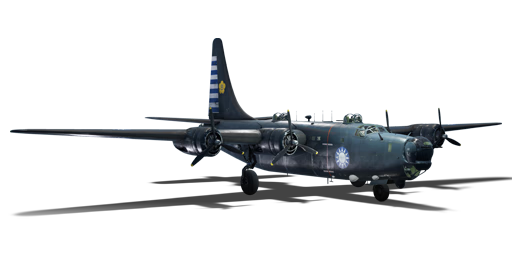
.jpg)
Contents
Description
The ␗PB4Y-2 Privateer is a rank Chinese bomber with a battle rating of (AB), (RB), and (SB). It was introduced in Update 1.91 "Night Vision".
General info
Flight performance
| Characteristics | Max Speed (km/h at 7,620 m) |
Max altitude (metres) |
Turn time (seconds) |
Rate of climb (metres/second) |
Take-off run (metres) | |||
|---|---|---|---|---|---|---|---|---|
| AB | RB | AB | RB | AB | RB | |||
| Stock | 385 | 370 | 39.4 | 41.0 | 1.3 | 1.3 | 950 | |
| Upgraded | 427 | 404 | 36.7 | 38.0 | 6.5 | 3.5 | ||
Details
| Features | ||||
|---|---|---|---|---|
| Combat flaps | Take-off flaps | Landing flaps | Air brakes | Arrestor gear |
| X | ✓ | ✓ | X | X |
| Limits | ||||||
|---|---|---|---|---|---|---|
| Wings (km/h) | Gear (km/h) | Flaps (km/h) | Max Static G | |||
| Combat | Take-off | Landing | + | - | ||
| N/A | 360 | 263 | ~4 | ~2 | ||
| Optimal velocities (km/h) | |||
|---|---|---|---|
| Ailerons | Rudder | Elevators | Radiator |
| < 200 | < 180 | < 180 | > 300 |
Survivability and armour

The PB4Y has a lot of armour and also has self-sealing fuel tanks. The self-sealing tanks are located where the wings and fuselage meet.
Modifications and economy
Armaments
Suspended armament
The PB4Y-2 (China) can be outfitted with the following ordnance:
- 20 x 100 lb AN-M30A1 bombs (2,000 lb total)
- 8 x 500 lb AN-M64A1 bombs (4,000 lb total)
- 4 x 1,000 lb AN-M65A1 bombs (4,000 lb total)
- 8 x 1,000 lb AN-M65A1 bombs (8,000 lb total)
- 4 x 2,000 lb AN-M66A2 bombs (8,000 lb total)
- 4 x Type A Mark I mines
- 8 x Type A Mark I mines
Defensive armament
The PB4Y-2 (China) is defended by six turrets each equipped with dual-mounted M2 Browning machine guns.
| 12.7 mm M2 Browning | |||||
|---|---|---|---|---|---|
| Mount | Ammo per gun | Fire rate | Vertical guidance | Horizontal guidance | |
| Nose | 600 | 750 | -55°/+70° | ±80° | |
| 2 x Dorsal | 380 | -0°/+67° | ±180° | ||
| 2 x Beam | 400 | -95°/+55° | -55°/+80° | ||
| Tail | 400 | ±70° | -41°/+70° | ||
Usage in battles
There are two ways you can go about playing the ␗PB4Y-2 Privateer, side climbing or diving.
- Side climbing
Side climbing is the safest way of going about. Start by spawning with your Heavy Bomber air spawn, and climb away from the battle. This will give your fighters enough to time to climb up and duel with the enemies. After you see most of the enemies at low alt, you are safe to go in and bomb a point and return-to-base. With side-climbing, the chance to reaching the bombing point is significantly higher as altitude is gained and it becomes less likely the enemy fighters will locate the PB4Y-2. However, side climbing will take up a lot of time and can end with the game ending before reaching the bombing point, or the team decimated.
- Diving
Shallow diving:
Diving is probably the most risky way of trying to bomb but it is the quickest if you do it right. Start by spawning in then dive at about -10 degrees. This will make sure you will not overspeed before reaching the bombing point. However enemy interceptors with air spawn can potentially catch you in a head on, which is an extremely dangerous situation.
Steep diving:
Upon spawning, dive at an angle of about -40 degrees. The PB4Y will gradually pick up speed to around 500 km/h. Once you reach 580 km/h, cut throttle to avoid over speeding. If you are close to the bomb base, turn into shallow diving or level out and prepare for the bombing. Once bombs are out, bank towards your airfield while keep diving, you should fly at no more than 100 m above the ground.
Diving will also remove the defensive blind spot on the belly when staying low, as it is less likely a fighter will intercept from below. If a fighter decides to come down and attack, they lose their altitude and so friendly fighters can pounce on them more easily. However, the last point of fighters coming down may end up attracting the whole enemy team, and dealing with a swarm of enemy fighters is no one's desired outcome. At a low altitude, ground elements like anti-aircraft could also have a better chance of hitting the plane.
During an encounter with enemy aircraft, if you have time to adjust your position, try putting the enemy plane at your 10 / 2 o'clock. This way you can utilise up to 8 M2 Brownings scattered across your fuselage (2 x dorsal turrets, beam turret & nose turret) against the enemy, at the price of presenting a huge silhouette to it. This is a very dangerous tactic, but sometimes it is worth a try.
Overall, this usage is more risky than maintaining altitude and bombing, but it could be rewarding if pulled off successfully.
Enemies worth noting:
- Do 335: this interceptor posts a huge threat to the PB4Y due to its destructive firepower. An experienced Do 335 player might open fire from a far distance of 2.5 km away, at this range its MK108/MK103 shells still have adequate accuracy and damage to cripple the PB4Y, while the PB4Y's M2 Brownings can barely do any damage. The PB4Y's tail is also prone to being blown off by a few HE cannon shells.
Manual Engine Control
| MEC elements | ||||||
|---|---|---|---|---|---|---|
| Mixer | Pitch | Radiator | Supercharger | Turbocharger | ||
| Oil | Water | Type | ||||
| Controllable | Controllable Auto control available |
Not controllable Not auto controlled |
Controllable Not auto controlled |
Combined | Controllable 2 gears |
Not controllable |
Pros and cons
Pros:
- Great defensive armament
- Good payload, can carry small, medium, or large bombs
- Almost full coverage from the turrets
- Most vital parts such as gunners and cooling systems are protected by armour plates which can resist shrapnel/small calibre bullets
- Impressive rear, sideways, and top turret coverage makes it a very tough target in simulator
- Has two pilots who are protected by multiple layers of armour behind, meaning it is hard to pilot snipe it from behind
- Tricycle landing gear allows continuous breaking until full stop, without having to worry about flipping over
- Critical parts such as gunners/cooling systems are quite spread out, which helps to soak up damage
Cons:
- Inadequate stock payload options
- Poor climb rate
- Extremely slow, especially when stock
- Tail can break off when landing and can be easily shot off
- Low dive limit and turn limit
- No gun coverage under the fuselage
History
Describe the history of the creation and combat usage of the aircraft in more detail than in the introduction. If the historical reference turns out to be too long, take it to a separate article, taking a link to the article about the vehicle and adding a block "/History" (example: https://wiki.warthunder.com/(Vehicle-name)/History) and add a link to it here using the main template. Be sure to reference text and sources by using <ref></ref>, as well as adding them at the end of the article with <references />. This section may also include the vehicle's dev blog entry (if applicable) and the in-game encyclopedia description (under === In-game description ===, also if applicable).
Media
Excellent additions to the article would be video guides, screenshots from the game, and photos.
See also
Links to the articles on the War Thunder Wiki that you think will be useful for the reader, for example:
- reference to the series of the aircraft;
- links to approximate analogues of other nations and research trees.
External links
| Consolidated Aircraft Corporation | |
|---|---|
| Bombers | PBY-5 Catalina · PBY-5A Catalina |
| PB4Y-2 | |
| B-24D-25-CO | |
| Export | ▄Catalina Mk IIIa · ▂PBY-5A Catalina · ▄PBY-5A Late · ␗PB4Y-2 · ▄PB4Y-2 |
| China bombers | |
|---|---|
| American | Martin 139WC*(␗B-10B) · ␗A-29 · ␗B-25J-30 · ␗PB4Y-2 |
| German | ␗Hs 123 A-1 |
| Soviet | ␗SB 2M-103U · ␗DB-3A · ␗Tu-2S-44 · ␗Tu-4 |
| Japanese | ␗P1Y1 mod. 11 |
| *Export Name | |