HMNZS Leander

Contents
Description
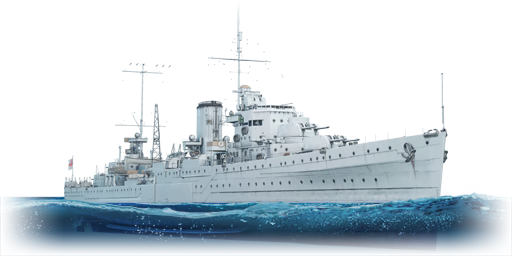
The Leander-class, HMNZS Leander (75), 1942 is a rank British light cruiser with a battle rating of (AB), (RB), and (SB). It was introduced in Update 1.87 "Locked On".
General info
Survivability and armour
Talk about the vehicle's armour. Note the most well-defended and most vulnerable zones, e.g. the ammo magazine. Evaluate the composition of components and assemblies responsible for movement and manoeuvrability. Evaluate the survivability of the primary and secondary armaments separately. Don't forget to mention the size of the crew, which plays an important role in fleet mechanics. Save tips on preserving survivability for the "Usage in battles" section. If necessary, use a graphical template to show the most well-protected or most vulnerable points in the armour.
Mobility
Write about the ship's mobility. Evaluate its power and manoeuvrability, rudder rerouting speed, stopping speed at full tilt, with its maximum forward and reverse speed.
| Mobility Characteristics | |||
|---|---|---|---|
| Game Mode | Upgrade Status | Maximum Speed (km/h) | |
| Forward | Reverse | ||
| AB | |||
| Upgraded | |||
| RB/SB | |||
| Upgraded | |||
Modifications and economy
Armament
Primary armament
| 152 mm 6 inch/50 Mark BL XXIII (x8) | |||||
|---|---|---|---|---|---|
| Turrets (Bow to stern) | |||||
| Turret 1 (x2) | Turret 2 (x2) | Turret 3 (x2) | Turret 4 (x2) | ||
| Vertical guidance | -5°/+60° | ||||
| Horizontal guidance | ±145° | ||||
| Total ammo capacity | 1,600 | ||||
Ammunition
| Penetration statistics | |||||||
|---|---|---|---|---|---|---|---|
| Ammunition | Type of warhead |
Penetration @ 0° Angle of Attack (mm) | |||||
| 1,000 m | 2,500 m | 5,000 m | 7,500 m | 10,000 m | 15,000 m | ||
| 6 inch HE | HE | 37 | 37 | 37 | 37 | 37 | 37 |
| 6 inch CPBC | SAPBC | 224 | 194 | 161 | 139 | 125 | 107 |
| 6 inch HE-TF | HE-TF | 37 | 37 | 37 | 37 | 37 | 37 |
| 6 inch HE-VT | HE-VT | 37 | 37 | 37 | 37 | 37 | 37 |
| Shell details | |||||||||
|---|---|---|---|---|---|---|---|---|---|
| Ammunition | Type of warhead |
Velocity (m/s) |
Projectile Mass (kg) |
Fuse delay (m) |
Fuse sensitivity (mm) |
Explosive Mass (TNT equivalent) (g) |
Ricochet | ||
| 0% | 50% | 100% | |||||||
| 6 inch HE | HE | 841 | 50.8 | 0.02 | 0.1 | 3,960 | 79° | 80° | 81° |
| 6 inch CPBC | SAPBC | 841 | 50.8 | 5.5 | 7 | 1,870 | 48° | 63° | 71° |
| 6 inch HE-TF | HE-TF | 841 | 50.8 | 0 | 0.1 | 3,960 | 79° | 80° | 81° |
| 6 inch HE-VT | HE-VT | 841 | 50.8 | 0 | 0.1 | 3,960 | 79° | 80° | 81° |
Secondary armament
| 102 mm 4 inch/45 Mark XVI (x8) | |||||
|---|---|---|---|---|---|
| Turrets (Bow to stern) | |||||
| Front port turret (x2) | Front starboard turret (x2) | Rear port turret (x2) | Rear starboard turret (x2) | ||
| Vertical guidance | -90°/+80° | -80°/+90° | ±90° | ||
| Horizontal guidance | -10°/+80° | ||||
| Total ammo capacity | 2,000 | ||||
Ammunition
| Penetration statistics | |||||||
|---|---|---|---|---|---|---|---|
| Ammunition | Type of warhead |
Penetration @ 0° Angle of Attack (mm) | |||||
| 1,000 m | 2,500 m | 5,000 m | 7,500 m | 10,000 m | 15,000 m | ||
| 4 inch HE | HE | 20 | 20 | 20 | 20 | 20 | 20 |
| 4 inch SAP | SAP | 101 | 86 | 70 | 60 | 54 | 47 |
| 4 inch HE-TF | HE-TF | 20 | 20 | 20 | 20 | 20 | 20 |
| 4 inch HE-VT | HE-VT | 20 | 20 | 20 | 20 | 20 | 20 |
| Shell details | |||||||||
|---|---|---|---|---|---|---|---|---|---|
| Ammunition | Type of warhead |
Velocity (m/s) |
Projectile Mass (kg) |
Fuse delay (m) |
Fuse sensitivity (mm) |
Explosive Mass (TNT equivalent) (g) |
Ricochet | ||
| 0% | 50% | 100% | |||||||
| 4 inch HE | HE | 811 | 15.88 | 0 | 0.1 | 1,550 | 79° | 80° | 81° |
| 4 inch SAP | SAP | 811 | 17.35 | 3 | 3 | 600 | 47° | 60° | 65° |
| 4 inch HE-TF | HE-TF | 811 | 15.88 | 0 | 0.1 | 1,550 | 79° | 80° | 81° |
| 4 inch HE-VT | HE-VT | 811 | 15.88 | 0 | 0.1 | 1,550 | 79° | 80° | 81° |
Anti-aircraft armament
| 20 mm Oerlikon Mk.II (x5) | |||||
|---|---|---|---|---|---|
| Turrets (Bow to stern) | |||||
| Front turret | Middle port turret | Middle starboard turret | Rear port turret | Rear starboard turret | |
| Vertical guidance | -5°/+65° | -0°/+65° | |||
| Horizontal guidance | ±180 | -60°/+90° | -90°/+60° | ±180 | |
| Total ammo capacity | 9,000 | ||||
| 12.7 mm Vickers Mk.V (x12) | |||
|---|---|---|---|
| Turrets (Bow to stern) | |||
| Front port turret (x4) | Front starboard turret (x4) | Rear turret (x4) | |
| Vertical guidance | +25°/+75° | ||
| Horizontal guidance | ±90° | ||
| Total ammo capacity | 24,000 | ||
Additional armament
| 533 mm steam turbined Mk.V torpedo | ||||||||
|---|---|---|---|---|---|---|---|---|
| # on ship | Mass (kg) | Maximum speed in water (km/h) |
Travel distance (km) | Depth stroke (m) | Arming distance (m) |
Explosive type | Explosive mass (kg) | |
| 8 | 1,736 | 74 | 4.57 | 1.0 | 50 | TNT | 305 | |
Usage in battles
Describe the technique of using this ship, the characteristics of her use in a team and tips on strategy. Abstain from writing an entire guide – don't try to provide a single point of view, but give the reader food for thought. Talk about the most dangerous opponents for this vehicle and provide recommendations on fighting them. If necessary, note the specifics of playing with this vehicle in various modes (AB, RB, SB).
Pros and cons
Summarise and briefly evaluate the vehicle in terms of its characteristics and combat effectiveness. Mark its pros and cons in the bulleted list. Try not to use more than 6 points for each of the characteristics. Avoid using categorical definitions such as "bad", "good" and the like - use substitutions with softer forms such as "inadequate" and "effective".
Pros:
Cons:
History
The Leander-class light cruisers were designed in the late 1920s under the influence of the York-class heavy cruisers. However, the Leander-class differed from previous light cruisers by placing a higher emphasis on seaworthiness and operating range, rather than on protection and firepower. This was done with the aim to make the Leander-class light cruisers more suitable for the commerce protection role.
Initially, five ships of the Leander-class were ordered in the early 1930s, with HMS Leader as the lead ship being laid down in September 1930. Leander was completed a year later and commissioned into service in March 1933. Initially, the warship served with the New Zealand Division of the Royal Navy, before being transferred to the Royal New Zealand Navy after its formation in 1941. From there onwards, the ship sailed under its new designation HMNZS Leander.
Leander primarily served in the Pacific theatre during WW2, taking part in several smaller operations during her early service life. Leander was also briefly stationed in the Mediterranean, supporting allied troops in actions against Vichy France during the Syria-Lebanon campaign. After that, Leander once again returned to the Pacific, where she was severely damaged after an engagement with a small Japanese task force in July 1943. The damage suffered from a torpedo hit was so severe that it rendered Leander inoperable for the remainder of the war, until she was repaired in August 1945.
HMNZS Leander only had a very short post-war service life. The warship was officially decommissioned in 1948 and sold for scrap in 1950.
- From Devblog
Media
Excellent additions to the article would be video guides, screenshots from the game, and photos.
See also
Links to articles on the War Thunder Wiki that you think will be useful for the reader, for example:
- reference to the series of the ship;
- links to approximate analogues of other nations and research trees.
External links
| Britain light cruisers | |
|---|---|
| Emerald-class | HMS Enterprise |
| Dido-class | HMS Dido |
| Leander-class | HMNZS Leander |
| Arethusa-class | HMS Arethusa |
| Town-class | HMS Belfast · HMS Liverpool · HMS Southampton |
| Tiger-class | HMS Tiger |
| Abdiel-class* | HMS Abdiel |