USS Baltimore

Contents
Description
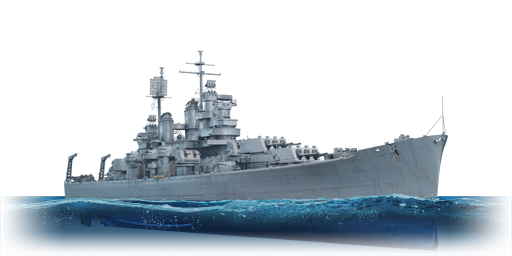
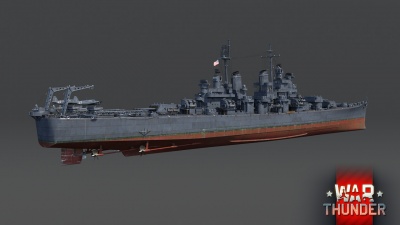
The Baltimore-class,USS Baltimore (CA-68), 1943 is a gift rank American heavy cruiser with a battle rating of (AB), (RB), and (SB). It was introduced during Update "Hot Tracks" as a reward for the 2020 Operation W.I.N.T.E.R. event.
General info
Survivability and armour
Baltimore does not have as much armour as a Hipper-class heavy cruiser, it is somewhat on par with IJN counterparts such as the Mogami.
Having lots of AA also means lots of crew. However, lots of crew can also be lost due to the AA being repeatedly destroyed. It is not recommended to repair the ship unless major damage has been sustained.
Mobility
Baltimore's speed is a bit slower than other heavy cruisers. Her agility is better however, displacing 30% less than a Mogami.
She is unlikely to evade a torpedo, but being a heavy cruiser, she should survive a hit or two.
| Mobility Characteristics | |||
|---|---|---|---|
| Game Mode | Upgrade Status | Maximum Speed (km/h) | |
| Forward | Reverse | ||
| AB | |||
| Upgraded | |||
| RB/SB | |||
| Upgraded | |||
Modifications and economy
Armament
Primary armament
Baltimore, being a WW2 US cruiser, shoots super-heavy AP shells out of her 203 mm guns. These shells are heavier than others, weighing over 150 kg. Most other nations' shells weigh usually 110 kg. This gives them a longer flight time, but a steeper angle. The idea was that, at long ranges, the shells would penetrate battleship's decks from above instead of hitting the much thicker side armour.
Secondary armament
Her secondaries are found on most WW2 US ships. Dual purpose, dual 127 mm turrets. She has six of them. Those turrets are her first line of defence against PT boats and aircraft.
Anti-aircraft armament
As with most WW2 US ships, AA armament is where she shines. Compared to a Cleveland-class light cruiser, Baltimore has many more 40 mm Bofors emplacements. She has twelve quadruple 40 mm Bofors turrets, and twenty-four 20 mm Oerlikon single guns. This is much stronger than what could be mounted on light cruisers, giving her awesome close range firepower.
Unlike the Cleveland-class, she cannot fire Variable Time-Fuse shells out of her main guns, giving her slightly less long range AA power compared to a Cleveland.
Usage in battles
Baltimore feels right at home when protecting allies from aircraft. Her 203 mm guns have a difficult time killing dreadnoughts, she should shoot first at other cruisers and destroyers.
Her super-heavy 203 mm shells are useful to shoot above islands while avoiding incoming fire.
She can count on close range AA to protect her from most air attacks while staying near islands.
Pros and cons
Pros:
- Amazing AA defences
- Super-heavy AP shells
Cons:
- Rather small for a heavy cruiser
- Small crew amount compared to other heavy cruisers
History
Devblog
The development of new heavy cruisers for the US Navy began after the outbreak of World War II. The restrictions of the London and Washington Treaties ceased to be relevant, so the United States enthusiastically began to refine the projects built within the limits of the restrictions. Based on the heavy cruisers of the USS Wichita class, a new cruiser was developed to correct the issues of its predecessor, namely low stability and a shortage of anti-aircraft weapons, and also with improved seaworthiness, protection and range. The lead ship of the new series, the heavy cruiser USS Baltimore, was laid down in 1941. The distinctive features of the new large series of cruisers are extremely powerful and versatile anti-aircraft weapons and an increased hull width for increased stability. The USS Baltimore entered service in 1943 and immediately began performing combat missions in the Pacific. Until the end of World War II, Baltimore was in the midst of naval war, taking part in a number of US operations. After a short "vacation" it was re-commissioned in 1951, but did not take part in the new, Korean War. The ship was decommissioned from service in May 1956.
Media
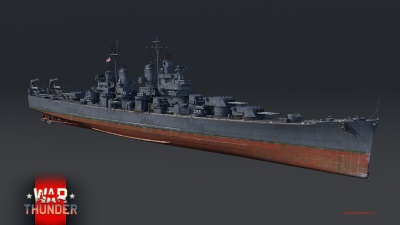
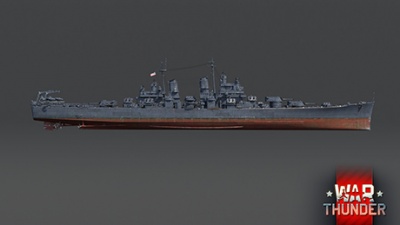
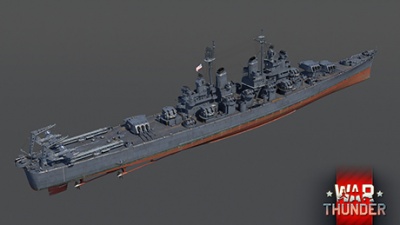
- USS Baltimore (CA-68) Devblog Images


See also
Links to articles on the War Thunder Wiki that you think will be useful for the reader, for example:
- reference to the series of the ship;
- links to approximate analogues of other nations and research trees.
External links
| USA heavy cruisers | |
|---|---|
| Pensacola-class | USS Pensacola |
| Northampton-class | USS Northampton |
| Portland-class | USS Portland |
| New Orleans-class | USS New Orleans |
| Baltimore-class | USS Baltimore · USS Pittsburgh |
| Des Moines-class | USS Des Moines · USS Newport News |