SMS Elbing

Contents
Description
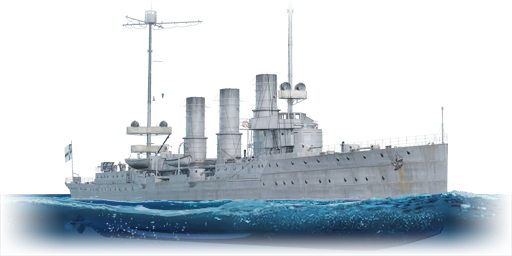
The Pillau-class, SMS Elbing, 1915 is a rank German light cruiser with a battle rating of (AB), (RB), and (SB). It was introduced in Update "Drone Age".
General info
Survivability and armour
SMS Elbing is a well protected ship, having a turtleback armour scheme (40 mm thick, with 80 mm panels at the front and rear), like many other heavier German ships. Additionally, it has coal bunkers, which can provide a bit of extra protection at times. Main batteries are shielded by 50 mm of armour, which will protect them from most, if not all, HE shells that will come their way. Secondary cannons have no protection, but they aren't very useful anyway. The bridge is protected by 75 mm of armour on all sides. It is a well-protected ship for its BR.
Mobility
Write about the ship's mobility. Evaluate its power and manoeuvrability, rudder rerouting speed, stopping speed at full tilt, with its maximum forward and reverse speed.
| Mobility Characteristics | |||
|---|---|---|---|
| Game Mode | Upgrade Status | Maximum Speed (km/h) | |
| Forward | Reverse | ||
| AB | |||
| Upgraded | |||
| RB/SB | |||
| Upgraded | |||
Modifications and economy
Armament
Primary armament
| Penetration statistics | |||||||
|---|---|---|---|---|---|---|---|
| Ammunition | Type of warhead |
Penetration @ 0° Angle of Attack (mm) | |||||
| 1,000 m | 2,500 m | 5,000 m | 7,500 m | 10,000 m | 15,000 m | ||
| Sprgr. L/4.1 Kz | HE | 21 | 21 | 21 | 21 | 21 | 21 |
| Sprgr. L/4.1 Bdz | SAPBC | 95 | 80 | 61 | 47 | 37 | 28 |
| Psgr. L/3.7 | APCBC | 238 | 201 | 153 | 117 | 93 | 71 |
| Shell details | |||||||||
|---|---|---|---|---|---|---|---|---|---|
| Ammunition | Type of warhead |
Velocity (m/s) |
Projectile mass (kg) |
Fuse delay (s) |
Fuse sensitivity (mm) |
Explosive mass (TNT equivalent) (g) |
Ricochet | ||
| 0% | 50% | 100% | |||||||
| Sprgr. L/4.1 Kz | HE | 835 | 45.3 | 0 | 0.1 | 1,600 | 79° | 80° | 81° |
| Sprgr. L/4.1 Bdz | SAPBC | 835 | 45.3 | 0.01 | 7 | 1,050 | 48° | 63° | 71° |
| Psgr. L/3.7 | APCBC | 835 | 45.3 | 0.015 | 7 | 990 | 48° | 63° | 71° |
Secondary armament
| Penetration statistics | |||||||
|---|---|---|---|---|---|---|---|
| Ammunition | Type of warhead |
Penetration @ 0° Angle of Attack (mm) | |||||
| 10 m | 100 m | 500 m | 1,000 m | 1,500 m | 2,000 m | ||
| 52-mm HE | HE | 4 | 4 | 4 | 4 | 4 | 4 |
| Shell details | |||||||||
|---|---|---|---|---|---|---|---|---|---|
| Ammunition | Type of warhead |
Velocity (m/s) |
Projectile mass (kg) |
Fuse delay (mm) |
Fuse sensitivity (mm) |
Explosive mass (TNT equivalent) (g) |
Ricochet | ||
| 0% | 50% | 100% | |||||||
| 52-mm HE | HE | 850 | 1.75 | 0 | 0.1 | 87 | 79° | 80° | 81° |
Additional armament
Describe the available additional armaments of the ship: depth charges, mines, torpedoes. Talk about their positions, available ammunition and launch features such as dead zones of torpedoes. If there is no additional armament, remove this section.
Usage in battles
Describe the technique of using this ship, the characteristics of her use in a team and tips on strategy. Abstain from writing an entire guide – don't try to provide a single point of view, but give the reader food for thought. Talk about the most dangerous opponents for this vehicle and provide recommendations on fighting them. If necessary, note the specifics of playing with this vehicle in various modes (AB, RB, SB).
Pros and cons
Pros:
- Good torpedo launcher angles (only lacks coverage to the direct front/rear)
- Good armour protection for its BR
Cons:
- Minimal amount of secondary armament, ineffective against medium and long-range aircraft and smaller ships
- Only 2 very slow torpedoes
- Sluggish
History
SMS Elbing was a light cruiser originally ordered by the Imperial Russian Navy with the name Admiral Nevelskoy. However, after the start of WW1 she was confiscated and launched in 1914 as SMS Elbing, being commissioned into the High Seas Fleet in September 1915.
She only partook in 2 major operations, the first of which being the Bombardment of Yarmouth and Lowestoft, which were of some military importance with the main aim of the raid being to draw out defensive ships to be picked off by the German battlecruiser squadron or full High Seas Fleet if necessary. Elbing herself along with light cruiser Rostock attempted to draw the defensive force of cruisers and destroyers into the waiting guns of the German battlecruisers, but after seeing them, the British ships turned away. Light cruiser HMS Conquest and destroyer HMS Laertes still received heavy damage, as well as an unnamed light cruiser being slightly damaged. The result was inconclusive as the nearby British forces were too small to challenge the German ships and the attackers withdrew before significant forces like the British fast response battlecruiser squadron or Grand Fleet could arrive. Her second and final battle would be as part of the Battle of Jutland in May/June 1916, the only full scale battleship clash during the war and the last naval battle mainly fought by battleships. On 31st May Elbing was part of Scouting Group II - also containing her only sister ship SMS Pillau - where after first sighting the British 1st Light Cruiser Squadron after they opened fire on German torpedo boats, Elbing scored the first hit of the battle against light cruiser HMS Galatea at extreme range. After disengaging and a brief attempt to shoot down a British seaplane, Scouting Group II encountered and engaged HMS Chester, scoring several hits. British battlecruisers intervened, disabling a light cruiser but scoring no hits on Elbing despite a torpedo passing under her without detonating. Elbing was later hit by a single shot from the 2nd Light Cruiser Squadron, knocking out her wireless station, killing 4 and wounding 12. After midnight, the German fleet found the British rear destroyer screen, at which time Elbing was on the port side of the line and opened fire just after dreadnought SMS Westfalen began the engagement. The destroyers launched a torpedo attack, forcing the 3 cruisers to turn starboard, straight towards the German line.
Elbing would not return from the Battle of Jutland, as during the turn to starboard she attempted to slot between battleships Nassau and Posen, but Posen's captain did not realise this until it was too late to avoid a collision. Posen turned hard to starboard, but still collided with Elbing's starboard quarter, holing it below the waterline and flooding the starboard engine first. She took on a list of 18 degrees allowing the water to spread to the port engine room, forcing all engines to be shut down, causing the ship to lose all electrical power. She was immobilised but not in danger of sinking, so after a torpedo boat took off most of her crew, her commander and a few officers rigged an improvised sail to bring her closer to shore. This was short-lived, however, as British destroyers were sighted nearby and the order to scuttle the ship was given. The remaining men set off in the ship's cutter, rescuing a surgeon from HMS Tipperary before being met by a Dutch trawler which took them to Holland.
Over the Battle of Jutland, Elbing expended 230 rounds of 15 cm ammunition and 1 torpedo, with only 4 men killed and 12 wounded.
Media
Excellent additions to the article would be video guides, screenshots from the game, and photos.
See also
Links to articles on the War Thunder Wiki that you think will be useful for the reader, for example:
- reference to the series of the ship;
- links to approximate analogues of other nations and research trees.
External links
| F. Schichau GmbH | |
|---|---|
| Minesweepers | |
| M-class Type 1943 | M-802 |
| Torpedo Boats | |
| Type 1939 | T22 · T31 |
| Light Cruisers | |
| Pillau-class | SMS Elbing |
| Battleships | |
| Bayern-class | SMS Baden |
| Germany light cruisers | |
|---|---|
| Pillau-class | SMS Elbing |
| Emden* | |
| Königsberg-class | Karlsruhe · Köln |
| Leipzig-class | Leipzig · Nürnberg |
| * Unique ship | |