Strela-10M2

Contents
Description
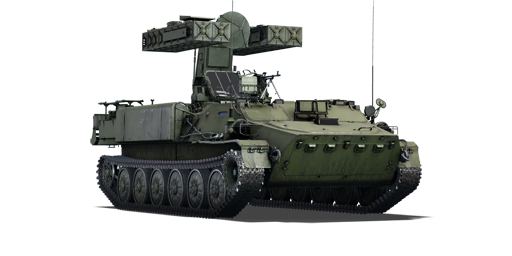
The 9A35M2 "Strela-10M2" is a rank Soviet SPAA with a battle rating of (AB), (RB), and (SB). It was introduced in Update "Apex Predators".
General info
Survivability and armour
The survivability of the 10M2 is lacking, which is expected of a small SPAA vehicle. However, it is not without some quirks that can keep a player alive here and there.
The thickest armor on the vehicle is only 14mm, the rest is 7mm. This is barely enough to protect the crew from stray low-caliber MG fire and more distant shrapnel, and will not provide any protection against higher-caliber MGs, rocket and bomb explosions, or even the odd HE shell.
The interesting part of the 10M2 is its relatively uncluttered interior that can make hasty enemy shots ineffective. Two of the three crew members sit in the very front of the hull (commander and driver), with the third (gunner) towards the rear underneath the launcher assembly. The engine sits in the middle of the vehicle, with the rear section holding a few spare missiles. Therefore, oftentimes when enemy fire strikes the middle of the vehicle (which many players instinctively aim for), it will knock out the gunner and/or the turret assembly but leave the front two crew members, and sometimes even the engine, unscathed, allowing the 10M2 to get away.
Armour type:
| Armour | Front (Slope angle) | Sides | Rear | Roof |
|---|---|---|---|---|
| Hull | ___ mm | ___ mm Top ___ mm Bottom |
___ mm | ___ - ___ mm |
| Turret | ___ - ___ mm Turret front ___ mm Gun mantlet |
___ - ___ mm | ___ - ___ mm | ___ - ___ mm |
| Cupola | ___ mm | ___ mm | ___ mm | ___ mm |
Notes:
Mobility
The 10M2’s mobility is solidly average. The engine can propel the little vehicle at a decent speed but takes a while to do so, and is not happy when climbing hills. A not often used but still valuable feature is the 10M2’s amphibious capability, allowing it to reach a few places and take some shorter routes that other vehicles cannot. In all, while the 10M2 will not win many races against other vehicles, it is still fast enough to do its job well.
| Game Mode | Max Speed (km/h) | Weight (tons) | Engine power (horsepower) | Power-to-weight ratio (hp/ton) | |||
|---|---|---|---|---|---|---|---|
| Forward | Reverse | Stock | Upgraded | Stock | Upgraded | ||
| Arcade | Expression error: Unexpected * operator. | _,___ | __.__ | __.__ | |||
| Realistic | _,___ | __.__ | __.__ | ||||
Modifications and economy
Armaments
Main armament
The 9M37M missile is a worthy analogue to the Stinger-type missiles found on Western IR SAM vehicles such as the Ozelot, Type 93, and LAV-AD. It doesn’t have as good lock characteristics, notably in frontal aspect engagements, but makes up for it with an overload of 20g, double any contemporary ground-based IR SAM system except for the SIDAM 25 (Mistral) and the SANTAL, both of which still only have 12g missiles. Against highly maneuverable targets, these missiles are far easier to score hits with.
There are no missile upgrades available, the stock missile is the top missile. The proximity fuse and warhead weight are both sufficient for destroying or crippling any aerial target it connects with, with the only drawback being the seeker head - it is easily decoyed by flares, a feature familiar to users of Russian aerial infrared missiles.
An long-existing bug that also affects the 10M2 concerns the missile not firing when target lock is achieved, leading to the missile being lost from the ammunition pool. This affects many ground-based IR SAMs but for the Strela with only four missile in the launchers at once, it is vital to be careful to only fire when there is a strong, close lock on the enemy target.
| 9M37M missile | Turret rotation speed (°/s) | Reloading rate (seconds) | |||||||||||
|---|---|---|---|---|---|---|---|---|---|---|---|---|---|
| Mode | Capacity (Belt) | Vertical | Horizontal | Stabilizer | Stock | Upgraded | Full | Expert | Aced | Stock | Full | Expert | Aced |
| Arcade | 8 (4) | -5°/+80° | ±180° | N/A | __._ | __._ | __._ | __._ | __._ | _.__ | _.__ | _.__ | _.__ |
| Realistic | __._ | __._ | __._ | __._ | __._ | ||||||||
Ammunition
| Missile details | |||||||||||
|---|---|---|---|---|---|---|---|---|---|---|---|
| Ammunition | Type of warhead |
Velocity (m/s) |
Range (m) |
Projectile mass (kg) |
Fuse delay (m) |
Fuse sensitivity (mm) |
Trigger radius (m) |
Explosive mass (TNT equivalent) (g) |
Ricochet | ||
| 0% | 50% | 100% | |||||||||
| 9M37M | SAM | 700 | 5,000 | 39.2 | 1 | 0.1 | 4 | 1.69 | 79° | 80° | 81° |
Ammo racks
| Full ammo |
1st rack empty |
2nd rack empty |
3rd rack empty |
4th rack empty |
5th rack empty |
6th rack empty |
Visual discrepancy |
|---|---|---|---|---|---|---|---|
| 2 | __ (+__) | __ (+__) | __ (+__) | __ (+__) | __ (+__) | __ (+__) | __ |
Machine guns
The 7.62mm MG on the 10M2 is pretty much an afterthought, given that open-top vehicles are exceedingly rare at this BR. However, it is very handy to have around for clearing small fences or obstacles in front of the vehicle, something other IR SAM vehicles like the Type 93 and Ozelot cannot do. It is not recommended to use this as an offensive weapon against air targets given its limited firing arcs and the fact that the 10M2 already has very nice missiles for that exact purpose.
| 7.62 mm PKMB | ||||
|---|---|---|---|---|
| Mount | Capacity (Belt) | Fire rate | Vertical | Horizontal |
| ___ (___) | ___ | __° | __° | |
Usage in battles
The best way to use the 10M2 is a short-range surprise weapon against enemy aircraft and sometimes helicopters. The missiles cannot reach as far as many of the radar missile-equipped SPAA vehicles you will often be playing alongside, but they have very good overload and do not usually give the enemy a red warning diamond. Engaging aircraft that are busy with other targets or just starting to exit the battlefield is the best way to engage, as distracted enemies are less likely to see the missile and dump flares.
The worst enemy of this vehicle is helicopters, at any range. At long range, they are outside the lock range of the 10M2’s missile while being well within the range of their own ATGMs. At closer range (below about 1 mile), the missile is often unable to track enemy helicopters due to its launch characteristics. Helicopters around the 10M2’s BR also start to get IRCM equipment, making IR lock impossible. High-altitude aircraft are more of the same thing, with them being able to loft missiles and bombs at ground targets from above your missile’s lock-on distance.
Pros and cons
Pros
- The missiles have a high overload factor, more than any other ground-launched IR
- Small size, it can easily hide behind rocks, bushes, or buildings
- Except for the launcher assembly, the rest of the vehicle is very low to the ground
- Amphibious, can reach a few places other vehicles cannot
- More survivable than it seems due to crew placement and empty space in the rear of the vehicle
Cons:
- Can't engage helicopters equipped with ATGMs because of the 9M37's short range
- No search function, either IRST or radar. A 3-mile range tracking radar is all you get
- Engine suffers on inclines, hills are not your friend
- Often uptiered into 10.0/10.3 due to high usage of top tier premium tanks
- Suffers from the IR SAM launch bug, often making your missiles useless
History
The ZRK 9A35M2 ‘Strela-10M2’ was built to be the successor of the 9K31 ‘Strela-1’ built on the BRDM-2 wheeled chassis, and is able to use the older missile from that platform if needed. Development of the new vehicle began on July 24th of 1969, with the decision being made to continue developing a new IR SAM system in spite of the 9K22 ‘Tunguska’ also being developed at the same time, economical reasons often being cited as the main deciding factor to continue with both. The faster reaction time of the Strela missile system, as well as its immunity to radar jamming, were also highly desired by the Soviet Army’s anti-aircraft forces.
Unlike the previous Strela system, being mounted on a lightly-armored amphibious car, the new vehicle would be mounted on the newer and more mobile MT-LB, an infantry transport vehicle from the late 1950s. This would provide far more room for equipment and extra ammunition, among other things.
The 9M37 missile went through testing from 1973 to 1974, but disappointing results forced a delay while the kinks were ironed out. Designers of the Strela system used this time to introduce improved equipment onto the MT-LB base vehicle, such as more modern radios and provisioning for easier connection to the Soviet integrated air defense system in use at the time.
The vehicle was first introduced in 1976 and has been in service ever since. Combat usage first occurred in 1988 during the Angolan Civil War, with the first large-scale use of the system being Operation Desert Storm, during which it is believed 27 coalition aircraft were hit by Iraqi missiles, with 14 of those being lost. A few other small conflicts have featured the system, with Russia’s 2022 invasion of Ukraine being the latest - also the first time that both combatants have used the Strela system.
Media
Excellent additions to the article would be video guides, screenshots from the game, and photos.
See also
External links
| USSR anti-aircraft vehicles | |
|---|---|
| GAZ-AAA | GAZ-AAA (4M) · GAZ-AAA (DShK) |
| BTR-152 | BTR-152A · BTR-152D |
| Wheeled/Half-tracked | GAZ-MM (72-K) · ZiS-12 (94-KM) · ZiS-43 |
| Radar SPAAG | ZSU-23-4 · ZSU-37-2 |
| SAM | ZSU-23-4M4 · Strela-10M2 · 2S6 · Pantsir-S1 |
| Other | ZSU-23-4M2 · ZUT-37 · ZSU-37 · BTR-ZD · ZSU-57-2 |
| Czechoslovakia | M53/59 |
| North Vietnam | ▂Phòng không T-34 |