IJN Kongo

Contents
Description
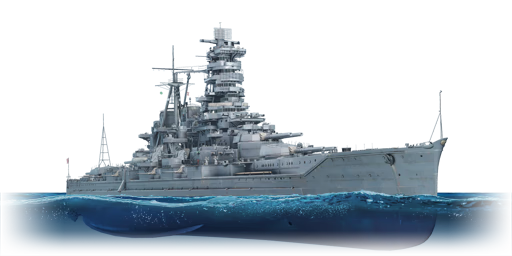
The Kongo-class, IJN Kongo, 1944 (金剛, namesake: Mount Kongō) is a rank Japanese battleship with a battle rating of (AB), (RB), and (SB). It was introduced in Update "Wind of Change".
The Kongō was the lead ship of the Kongō-class and would be the last Japanese capital ship built outside Japan. Designed by the British naval engineer George Thurston and laid down in 1911 initially as a battlecruiser she would see 2 major refits that would reclassify her as a fast battleship.
First commissioned in 1913, patrolling the Chinese coast during WWI, she would see many major naval actions in the Pacific War until November 1944 when she would sink while in transit by a submarine.
General info
Survivability and armour
Talk about the vehicle's armour. Note the most well-defended and most vulnerable zones, e.g. the ammo magazine. Evaluate the composition of components and assemblies responsible for movement and manoeuvrability. Evaluate the survivability of the primary and secondary armaments separately. Don't forget to mention the size of the crew, which plays an important role in fleet mechanics. Save tips on preserving survivability for the "Usage in battles" section. If necessary, use a graphical template to show the most well-protected or most vulnerable points in the armour.
Mobility
Write about the ship's mobility. Evaluate its power and manoeuvrability, rudder rerouting speed, stopping speed at full tilt, with its maximum forward and reverse speed.
| Mobility Characteristics | |||
|---|---|---|---|
| Game Mode | Upgrade Status | Maximum Speed (km/h) | |
| Forward | Reverse | ||
| AB | |||
| Upgraded | |||
| RB/SB | |||
| Upgraded | |||
Modifications and economy
Armament
Primary armament
Provide information about the characteristics of the primary armament. Evaluate their efficacy in battle based on their reload speed, ballistics and the capacity of their shells. Add a link to the main article about the weapon: {{main|Weapon name (calibre)}}. Broadly describe the ammunition available for the primary armament, and provide recommendations on how to use it and which ammunition to choose.
| Penetration statistics | |||||||
|---|---|---|---|---|---|---|---|
| Ammunition | Type of warhead |
Penetration @ 0° Angle of Attack (mm) | |||||
| 1,000 m | 2,500 m | 5,000 m | 7,500 m | 10,000 m | 15,000 m | ||
| Ordinary SAP | SAPCBC | 301 | 280 | 248 | 222 | 199 | 168 |
| Type 91 APC | APCBC | 635 | 593 | 476 | 476 | 431 | 366 |
| Type 0 Common | HE | 85 | 85 | 85 | 85 | 85 | 85 |
| Shell details | |||||||||
|---|---|---|---|---|---|---|---|---|---|
| Ammunition | Type of warhead |
Velocity (m/s) |
Projectile Mass (kg) |
Fuse delay (m) |
Fuse sensitivity (mm) |
Explosive Mass (TNT equivalent) (g) |
Ricochet | ||
| 0% | 50% | 100% | |||||||
| Ordinary SAP | SAPCBC | 780 | 635.6 | 0 | 12 | 68,640 | 48° | 63° | 71° |
| Type 91 APC | APCBC | 771 | 671.3 | 18 | 12 | 12,210 | 48° | 63° | 71° |
| Type 0 Common | HE | 805 | 621.0 | 0 | 0.1 | 32,450 | 79° | 80° | 81° |
Secondary armament
Some ships are fitted with weapons of various calibres. Secondary armaments are defined as weapons chosen with the control Select secondary weapon. Evaluate the secondary armaments and give advice on how to use them. Describe the ammunition available for the secondary armament. Provide recommendations on how to use them and which ammunition to choose. Remember that any anti-air armament, even heavy calibre weapons, belong in the next section. If there is no secondary armament, remove this section.
| Penetration statistics | |||||||
|---|---|---|---|---|---|---|---|
| Ammunition | Type of warhead |
Penetration @ 0° Angle of Attack (mm) | |||||
| 1,000 m | 2,500 m | 5,000 m | 7,500 m | 10,000 m | 15,000 m | ||
| Type 0 HE | HE | 35 | 35 | 35 | 35 | 35 | 35 |
| Type 4 SAP | SAP | 81 | 68 | 52 | 40 | 34 | 34 |
| Shell details | |||||||||
|---|---|---|---|---|---|---|---|---|---|
| Ammunition | Type of warhead |
Velocity (m/s) |
Projectile Mass (kg) |
Fuse delay (m) |
Fuse sensitivity (mm) |
Explosive Mass (TNT equivalent) (g) |
Ricochet | ||
| 0% | 50% | 100% | |||||||
| Type 0 HE | HE | 850 | 45.26 | 0 | 0.1 | 3,170 | 79° | 80° | 81° |
| Type 4 SAP | SAP | 850 | 45.26 | 8 | 7 | 2,920 | 47° | 60° | 65° |
Anti-aircraft armament
An important part of the ship's armament responsible for air defence. Anti-aircraft armament is defined by the weapon chosen with the control Select anti-aircraft weapons. Talk about the ship's anti-air cannons and machine guns, the number of guns and their positions, their effective range, and about their overall effectiveness – including against surface targets. If there are no anti-aircraft armaments, remove this section.
Scout plane
Usage in battles
Describe the technique of using this ship, the characteristics of her use in a team and tips on strategy. Abstain from writing an entire guide – don't try to provide a single point of view, but give the reader food for thought. Talk about the most dangerous opponents for this vehicle and provide recommendations on fighting them. If necessary, note the specifics of playing with this vehicle in various modes (AB, RB, SB).
Pros and cons
Summarise and briefly evaluate the vehicle in terms of its characteristics and combat effectiveness. Mark its pros and cons in the bulleted list. Try not to use more than 6 points for each of the characteristics. Avoid using categorical definitions such as "bad", "good" and the like - use substitutions with softer forms such as "inadequate" and "effective".
Pros:
Cons:
History
Devblog
After the Royal Navy commissioned the battlecruiser HMS Invincible into service in 1908, the IJN was quick to react with a plan to expand its fighting force with modern warships being approved already by the end of the decade. However, the problem persisted that Japanese shipyards simply lacked the technological know-how to build such warships at the time. As a result, taking advantage of the existing naval cooperation agreement with Great Britain, Japan sought assistance from the Vickers company, who besides helping design a matching warship, also agreed to manufacture the lead ship, to be named Kongō, while the remaining ones would be built in Japan.
IJN Kongō was laid down in January 1911 as the lead ship of its class of modern battlecruisers to be built for the Imperial Japanese Navy. It was launched in May 1912 and completed in April 1913, subsequently entering service in August as the most advanced Japanese warship of its time. During WWI, IJN Kongō took part in minor operations but was quickly placed in reserve after the conflict. With international agreements limiting naval power after WWI, Japan was forced to upgrade existing warships in order to maintain its fighting power. As a result, Kongō was extensively upgraded on two occasions in the interwar period, not only vastly improving its characteristics but also noticeably changing its visual appearance.
During WWII however, Kongō had a rather illustrious service record. It took part in several major operations, including the Invasion of the Dutch East Indies, the Battle of Midway and also supported Japanese forces at Guadalcanal. After taking part in the famous Battle of Leyte Gulf, Kongō would serve until November 1944 when it was sunk by a successful torpedo attack by the American submarine USS Sealion.
Media
Excellent additions to the article would be video guides, screenshots from the game, and photos.
See also
Links to articles on the War Thunder Wiki that you think will be useful for the reader, for example:
- reference to the series of the ship;
- links to approximate analogues of other nations and research trees.
External links
| Vickers-Armstrongs Limited | |
|---|---|
| Ships | |
| Tribal-class | HMS Eskimo · HMCS Haida |
| Invincible-class | HMS Invincible* |
| Kongō-class | IJN Kongo** |
| Tanks | |
| Light Tanks | VFM5*** · Vickers Mk.11*** |
| Light Tank Mk VI | Light AA Mk I |
| Light Tank Mk VII | Tetrarch I |
| Light Tank Mk VIII | Alecto I |
| Tank, Infantry, Valentine | Valentine I · Valentine IX · Valentine XI · Archer |
| Vickers MBT | Vickers Mk.1 · Vickers Mk.3 · Vickers Mk.7*** |
| Heavy Tanks | Independent**** |
| Export | ▂МК-IX "Valentine" · Vickers Mk.E**** |
| See also | Vickers-Armstrongs Aircraft Limited |
| *Previously Armstrong Whitworth | |
| **Built for Japan | |
| ***Vickers Defence Systems | |
| ****Previously Vickers Limited | |
| Japan battleships | |
|---|---|
| Kawachi-class | IJN Settsu |
| Fusō-class | IJN Fuso · IJN Yamashiro |
| Ise-class | IJN Ise · IJN Hyuga |
| Kongō-class | IJN Kongo · IJN Haruna |
| Nagato-class | IJN Mutsu |