Difference between revisions of "Ro-Go Exp."
U107001428 (talk | contribs) m (→Pros and cons) (Tag: Visual edit) |
U107001428 (talk | contribs) m (Armament change) (Tag: Visual edit) |
||
| Line 49: | Line 49: | ||
<!-- ''Give the reader information about the characteristics of the main gun. Assess its effectiveness in a battle based on the reloading speed, ballistics and the power of shells. Do not forget about the flexibility of the fire, that is how quickly the cannon can be aimed at the target, open fire on it and aim at another enemy. Add a link to the main article on the gun: <code><nowiki>{{main|Name of the weapon}}</nowiki></code>. Describe in general terms the ammunition available for the main gun. Give advice on how to use them and how to fill the ammunition storage.'' --> | <!-- ''Give the reader information about the characteristics of the main gun. Assess its effectiveness in a battle based on the reloading speed, ballistics and the power of shells. Do not forget about the flexibility of the fire, that is how quickly the cannon can be aimed at the target, open fire on it and aim at another enemy. Add a link to the main article on the gun: <code><nowiki>{{main|Name of the weapon}}</nowiki></code>. Describe in general terms the ammunition available for the main gun. Give advice on how to use them and how to fill the ammunition storage.'' --> | ||
{{main|Schneider-Canet 1898 (120 mm)}} | {{main|Schneider-Canet 1898 (120 mm)}} | ||
| − | The 120 mm main armament of the Ji-Ro will penetrate almost everything at it's BR within a reasonable distance. The cannon, while designed in 1898, fires a Semi-Armor-Piercing Ballistic Capped round, which penetrates a maximum of 68 mm of armor at 10 m. The round has a relatively low muzzle velocity and an average firing arc. The HE round has a significant amount of filler but does not have one shot potential like the HE round of the [[Ho-Ro]] or the [[S.I.G.33 (150 mm)]]. | + | The 120 mm main armament of the Ji-Ro will penetrate almost everything at it's BR within a reasonable distance. The cannon, while designed in 1898, fires a Semi-Armor-Piercing-Capped Ballistic Capped round, which penetrates a maximum of 68 mm of armor at 10 m. The round has a relatively low muzzle velocity and an average firing arc. The HE round has a significant amount of filler but does not have one shot potential like the HE round of the [[Ho-Ro]] or the [[S.I.G.33 (150 mm)]]. |
{| class="wikitable" style="text-align:center" width="100%" | {| class="wikitable" style="text-align:center" width="100%" | ||
|- | |- | ||
Revision as of 01:17, 11 March 2021

Contents
Description
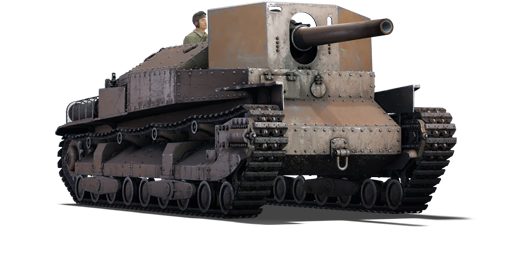
The Type 95 Experimental 12cm Self Propelled Gun is a rank Japanese tank destroyer with a battle rating of (AB), (RB), and (SB). It was introduced in Update "Ixwa Strike". The Ji-Ro is a modification of the Type 95 Heavy Tank (Ro-Go) platform. It features a French model 120 mm Schneider-Canet cannon as its main armament.
General info
Survivability and armour
Similar to the Ro-Go it is based off of, the Ji-Ro's armor is mostly comprised of large flat armor plates, though some are slightly angled. Front armor maxes out at 30 mm, with the angled sections such as the upper glacis being 25 mm thick. The shield surrounding the cannon, and by extension the crew, is 12 mm thick. Given the mostly flat shape of the Ji-Ro's hull and relatively average armor thickness for its battle rating, a majority of incoming fire will be taken with full force, especially if it hits the flat plates at the front of the vehicle. Slightly angling the front of the Ji-Ro may result in some shell ricochets, however. Much like it's predecessor, the Ho-Ro, the Ji-Ro can be easily penetrated by most other vehicles at its Battle Rating, but it does feature some odd angles that may result in lucky bounces.
Armour type:
| Armour | Front (Slope angle) | Sides | Rear | Roof |
|---|---|---|---|---|
| Hull | 30 mm | ___ mm Top ___ mm Bottom |
___ mm | ___ - ___ mm |
| Turret | 12 mm Turret front ___ mm Gun mantlet |
___ - ___ mm | ___ - ___ mm | ___ - ___ mm |
| Cupola | ___ mm | ___ mm | ___ mm | ___ mm |
Notes:
Mobility
The Ji-Ro shares the same drivetrain as the Ro-Go.
| Game Mode | Max Speed (km/h) | Weight (tons) | Engine power (horsepower) | Power-to-weight ratio (hp/ton) | |||
|---|---|---|---|---|---|---|---|
| Forward | Reverse | Stock | Upgraded | Stock | Upgraded | ||
| Arcade | Expression error: Unexpected * operator. | _,___ | __.__ | __.__ | |||
| Realistic | _,___ | __.__ | __.__ | ||||
Modifications and economy
Armaments
Main armament
The 120 mm main armament of the Ji-Ro will penetrate almost everything at it's BR within a reasonable distance. The cannon, while designed in 1898, fires a Semi-Armor-Piercing-Capped Ballistic Capped round, which penetrates a maximum of 68 mm of armor at 10 m. The round has a relatively low muzzle velocity and an average firing arc. The HE round has a significant amount of filler but does not have one shot potential like the HE round of the Ho-Ro or the S.I.G.33 (150 mm).
| 120 mm Schneider-Canet 1898 | Turret rotation speed (°/s) | Reloading rate (seconds) | |||||||||||
|---|---|---|---|---|---|---|---|---|---|---|---|---|---|
| Mode | Capacity | Vertical | Horizontal | Stabilizer | Stock | Upgraded | Full | Expert | Aced | Stock | Full | Expert | Aced |
| Arcade | 16 | -10°/+15° | ±12° | N/A | __._ | __._ | __._ | __._ | __._ | _.__ | _.__ | _.__ | _.__ |
| Realistic | __._ | __._ | __._ | __._ | __._ | ||||||||
Ammunition
| Penetration statistics | |||||||
|---|---|---|---|---|---|---|---|
| Ammunition | Type of warhead |
Penetration @ 0° Angle of Attack (mm) | |||||
| 10 m | 100 m | 500 m | 1,000 m | 1,500 m | 2,000 m | ||
| Schneider-Canet HE | HE | 25 | 25 | 25 | 25 | 25 | 25 |
| Schneider-Canet SAP | SAPCBC | 63 | 62 | 58 | 53 | 49 | 45 |
| Shell details | |||||||||
|---|---|---|---|---|---|---|---|---|---|
| Ammunition | Type of warhead |
Velocity (m/s) |
Projectile Mass (kg) |
Fuse delay (m) |
Fuse sensitivity (mm) |
Explosive Mass (TNT equivalent) (g) |
Ricochet | ||
| 0% | 50% | 100% | |||||||
| Schneider-Canet HE | HE | 580 | _.__ | __ | _._ | ___ | __° | __° | __° |
| Schneider-Canet SAP | SAPCBC | 580 | _.__ | __ | _._ | ___ | __° | __° | __° |
Ammo racks
| Full ammo |
1st rack empty |
2nd rack empty |
3rd rack empty |
4th rack empty |
5th rack empty |
6th rack empty |
Visual discrepancy |
|---|---|---|---|---|---|---|---|
| 16 | __ (+__) | __ (+__) | __ (+__) | __ (+__) | __ (+__) | __ (+__) | __ |
Machine guns
Offensive and anti-aircraft machine guns not only allow you to fight some aircraft but also are effective against lightly armoured vehicles. Evaluate machine guns and give recommendations on its use.
| 7.7 mm Type 97 | ||||
|---|---|---|---|---|
| Mount | Capacity (Belt) | Fire rate | Vertical | Horizontal |
| ___ (___) | ___ | __° | __° | |
Usage in battles
The Ji-Ro plays like its predecessor on the tech tree, the Ho-Ro, but with some key differences. It has a faster reload time, but is noticeably less mobile and a larger target, a trait inherited from its basis on the Ro-Go chassis. Also unlike the Ho-Ro, the SAPCBC round has very good penetration and does not rely solely on HE filler to cause damage. It is completely open topped and the gun shield is only 12 mm thick, making the exposed crew extremely vulnerable to CAS and heavy machine gun fire. However, the Ji-Ro does have some tricks up it's sleeve - specifically the rear machine gunner. Like the Ro-Go, this crewman is largely useless in terms of offense, but will rarely be the first to be knocked out in a fight, essentially giving the player a somewhat guaranteed crew replacement. Play the Ji-Ro like you would other Rank I and II Japanese Tank Destroyers, either freelance and find a good spot to get the jump on opponents, or stay back with other players and support from the rear. Like other Japanese SPG's, you are somewhat of a glass cannon. Remember that you can only spawn with 20 rounds maximum.
Pros and cons
Pros:
- Fantastic main armament for the BR.
- Low penetration fall off even at extreme ranges.
- One shot potential against most matchups.
- Faster reload than the Ho-Ro.
- More crew members than other tank destroyers in the lower rank Japanese tree (Ho-Ro and Ho-Ni series).
- Rear machine gun position provides opportunities for a "free" crew replacement.
Cons:
- Overall the armor is average at best, poor at worst.
- The crew is mostly exposed and is at the mercy of .50 calibers, aircraft, artillery and if flanked LMG fire.
- Mobility is overall worse compared to the majority of Chi-Ha based tank destroyers, the Ji-Ro is comparatively sluggish.
- 20 shell maximum ammo count.
- Mediocre top speed of 25 km/h.
- Somewhat slow shell velocity can be hard to aim.
History
The Ji-Ro (sometimes referred to as the Ji-Ro Sha, or incorrectly, the Hi-Ro or Hiro-Sha), was a prototypical modification to the Type 95 Heavy Tank. The Type 95 was in itself a low production experiment, but its hull was the basis for a few other trials, namely for its use as an SPG. Allegedly a few different configurations were brought to the drawing board. The Ji-Ro was the result of using the Type 95 hull as an SPG, replacing the two turrets with a 120 mm Schneider-Canet cannon. Both a long and a short version of the cannon were tested. These cannons were originally of French origin and built under license by the Japanese. The project was also dubbed the "Experimental 12 cm Self Propelled Gun".
Media
Excellent additions to the article would be video guides, screenshots from the game, and photos.
See also
Links to the articles on the War Thunder Wiki that you think will be useful for the reader, for example:
- reference to the series of the vehicles;
- links to approximate analogues of other nations and research trees.
External links
Paste links to sources and external resources, such as:
- topic on the official game forum;
- other literature.
| Japan tank destroyers | |
|---|---|
| Ro-Go Derivatives | Ro-Go Exp. |
| Chi-Ha Derivatives | Ho-Ni I · Ho-Ni III · Ho-Ro · Chi-Ha LG |
| Ho-Ri | Ho-Ri Prototype · Ho-Ri Production |
| Other | Na-To |
| JGSDF | |
| SPRG | Type 60 (C) |
| SPH | Type 75 · Type 99 |
| ATGM | Type 60 ATM |
| Rocket | Type 75 MLRS |
| USA | ▅M36 |