Difference between revisions of "Imperatritsa Mariya"
U102970415 (talk | contribs) (Tag: Visual edit) |
|||
| Line 1: | Line 1: | ||
| − | {{Specs-Card|code=ussr_battleship_imperatritsa_mariya}} | + | {{Specs-Card |
| + | |code=ussr_battleship_imperatritsa_mariya | ||
| + | |images={{Specs-Card-Image|GarageImage_{{PAGENAME}}.jpg}} | ||
| + | }} | ||
== Description == | == Description == | ||
| Line 9: | Line 12: | ||
== General info == | == General info == | ||
=== Survivability and armour === | === Survivability and armour === | ||
| + | {{Specs-Fleet-Armour}} | ||
<!-- ''Talk about the vehicle's armour. Note the most well-defended and most vulnerable zones, e.g. the ammo magazine. Evaluate the composition of components and assemblies responsible for movement and manoeuvrability. Evaluate the survivability of the primary and secondary armaments separately. Don't forget to mention the size of the crew, which plays an important role in fleet mechanics. Save tips on preserving survivability for the "Usage in battles" section. If necessary, use a graphical template to show the most well-protected or most vulnerable points in the armour.'' --> | <!-- ''Talk about the vehicle's armour. Note the most well-defended and most vulnerable zones, e.g. the ammo magazine. Evaluate the composition of components and assemblies responsible for movement and manoeuvrability. Evaluate the survivability of the primary and secondary armaments separately. Don't forget to mention the size of the crew, which plays an important role in fleet mechanics. Save tips on preserving survivability for the "Usage in battles" section. If necessary, use a graphical template to show the most well-protected or most vulnerable points in the armour.'' --> | ||
''Talk about the vehicle's armour. Note the most well-defended and most vulnerable zones, e.g. the ammo magazine. Evaluate the composition of components and assemblies responsible for movement and manoeuvrability. Evaluate the survivability of the primary and secondary armaments separately. Don't forget to mention the size of the crew, which plays an important role in fleet mechanics. Save tips on preserving survivability for the "Usage in battles" section. If necessary, use a graphical template to show the most well-protected or most vulnerable points in the armour.'' | ''Talk about the vehicle's armour. Note the most well-defended and most vulnerable zones, e.g. the ammo magazine. Evaluate the composition of components and assemblies responsible for movement and manoeuvrability. Evaluate the survivability of the primary and secondary armaments separately. Don't forget to mention the size of the crew, which plays an important role in fleet mechanics. Save tips on preserving survivability for the "Usage in battles" section. If necessary, use a graphical template to show the most well-protected or most vulnerable points in the armour.'' | ||
=== Mobility === | === Mobility === | ||
| + | {{Specs-Fleet-Mobility}} | ||
<!-- ''Write about the ship's mobility. Evaluate its power and manoeuvrability, rudder rerouting speed, stopping speed at full tilt, with its maximum forward and reverse speed.'' --> | <!-- ''Write about the ship's mobility. Evaluate its power and manoeuvrability, rudder rerouting speed, stopping speed at full tilt, with its maximum forward and reverse speed.'' --> | ||
''Write about the ship's mobility. Evaluate its power and manoeuvrability, rudder rerouting speed, stopping speed at full tilt, with its maximum forward and reverse speed.'' | ''Write about the ship's mobility. Evaluate its power and manoeuvrability, rudder rerouting speed, stopping speed at full tilt, with its maximum forward and reverse speed.'' | ||
{{NavalMobility}} | {{NavalMobility}} | ||
| + | |||
| + | === Modifications and economy === | ||
| + | {{Specs-Economy}} | ||
== Armament == | == Armament == | ||
| + | {{Specs-Fleet-Armaments}} | ||
=== Primary armament === | === Primary armament === | ||
| + | {{Specs-Fleet-Primary}} | ||
<!-- ''Provide information about the characteristics of the primary armament. Evaluate their efficacy in battle based on their reload speed, ballistics and the capacity of their shells. Add a link to the main article about the weapon: <code><nowiki>{{main|Weapon name (calibre)}}</nowiki></code>. Broadly describe the ammunition available for the primary armament, and provide recommendations on how to use it and which ammunition to choose.'' --> | <!-- ''Provide information about the characteristics of the primary armament. Evaluate their efficacy in battle based on their reload speed, ballistics and the capacity of their shells. Add a link to the main article about the weapon: <code><nowiki>{{main|Weapon name (calibre)}}</nowiki></code>. Broadly describe the ammunition available for the primary armament, and provide recommendations on how to use it and which ammunition to choose.'' --> | ||
{{main|12-inch/52 pattern 1907 (305 mm)}} | {{main|12-inch/52 pattern 1907 (305 mm)}} | ||
| Line 26: | Line 36: | ||
=== Secondary armament === | === Secondary armament === | ||
| + | {{Specs-Fleet-Secondary}} | ||
<!-- ''Some ships are fitted with weapons of various calibres. Secondary armaments are defined as weapons chosen with the control <code>Select secondary weapon</code>. Evaluate the secondary armaments and give advice on how to use them. Describe the ammunition available for the secondary armament. Provide recommendations on how to use them and which ammunition to choose. Remember that any anti-air armament, even heavy calibre weapons, belong in the next section. If there is no secondary armament, remove this section.'' --> | <!-- ''Some ships are fitted with weapons of various calibres. Secondary armaments are defined as weapons chosen with the control <code>Select secondary weapon</code>. Evaluate the secondary armaments and give advice on how to use them. Describe the ammunition available for the secondary armament. Provide recommendations on how to use them and which ammunition to choose. Remember that any anti-air armament, even heavy calibre weapons, belong in the next section. If there is no secondary armament, remove this section.'' --> | ||
{{main|130 mm/50 pattern 1913 (130 mm)}} | {{main|130 mm/50 pattern 1913 (130 mm)}} | ||
| Line 32: | Line 43: | ||
=== Anti-aircraft armament === | === Anti-aircraft armament === | ||
| + | {{Specs-Fleet-AA}} | ||
<!-- ''An important part of the ship's armament responsible for air defence. Anti-aircraft armament is defined by the weapon chosen with the control <code>Select anti-aircraft weapons</code>. Talk about the ship's anti-air cannons and machine guns, the number of guns and their positions, their effective range, and about their overall effectiveness – including against surface targets. If there are no anti-aircraft armaments, remove this section.'' --> | <!-- ''An important part of the ship's armament responsible for air defence. Anti-aircraft armament is defined by the weapon chosen with the control <code>Select anti-aircraft weapons</code>. Talk about the ship's anti-air cannons and machine guns, the number of guns and their positions, their effective range, and about their overall effectiveness – including against surface targets. If there are no anti-aircraft armaments, remove this section.'' --> | ||
{{main|75 mm/50 Canet patt.1892 (75 mm)}} | {{main|75 mm/50 Canet patt.1892 (75 mm)}} | ||
| Line 42: | Line 54: | ||
''Torpedo launchers are standard equipment on many ships and boats. Torpedoes are a significant means of defeating an opponent. Evaluate the position of the torpedo launchers, discuss the ammunition available, firing specifics such as dead zones, features of the torpedoes themselves, etc. If there is no torpedo armament, remove this section.'' | ''Torpedo launchers are standard equipment on many ships and boats. Torpedoes are a significant means of defeating an opponent. Evaluate the position of the torpedo launchers, discuss the ammunition available, firing specifics such as dead zones, features of the torpedoes themselves, etc. If there is no torpedo armament, remove this section.'' | ||
| + | |||
| + | === Additional armament === | ||
| + | {{Specs-Fleet-Additional}} | ||
| + | ''Describe the available additional armaments of the ship: depth charges, mines, torpedoes. Talk about their positions, available ammunition and launch features such as dead zones of torpedoes.'' | ||
| + | |||
| + | ''If there is no additional armament, remove this section.'' | ||
== Usage in battles == | == Usage in battles == | ||
Revision as of 12:00, 29 December 2020

Contents
Description
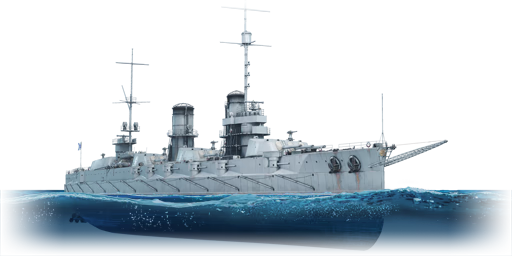
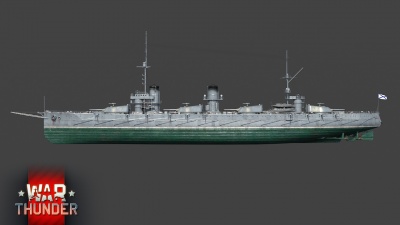
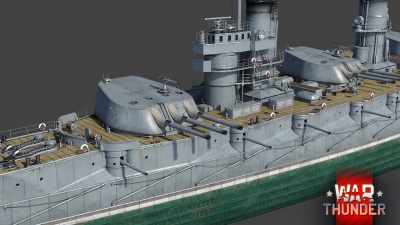
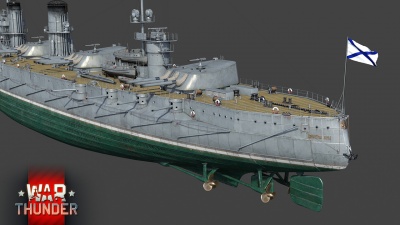
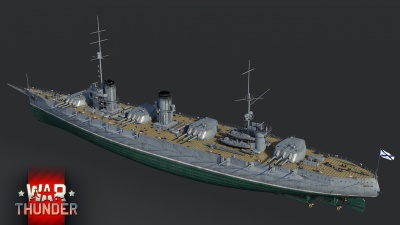
The Imperatritsa Mariya-class, Imperatritsa Mariya, 1916 is a rank Soviet battleship
with a battle rating of (AB), (RB), and (SB). It was introduced in Update "New Power".
General info
Survivability and armour
Talk about the vehicle's armour. Note the most well-defended and most vulnerable zones, e.g. the ammo magazine. Evaluate the composition of components and assemblies responsible for movement and manoeuvrability. Evaluate the survivability of the primary and secondary armaments separately. Don't forget to mention the size of the crew, which plays an important role in fleet mechanics. Save tips on preserving survivability for the "Usage in battles" section. If necessary, use a graphical template to show the most well-protected or most vulnerable points in the armour.
Mobility
Write about the ship's mobility. Evaluate its power and manoeuvrability, rudder rerouting speed, stopping speed at full tilt, with its maximum forward and reverse speed.
| Mobility Characteristics | |||
|---|---|---|---|
| Game Mode | Upgrade Status | Maximum Speed (km/h) | |
| Forward | Reverse | ||
| AB | |||
| Upgraded | |||
| RB/SB | |||
| Upgraded | |||
Modifications and economy
Armament
Primary armament
Provide information about the characteristics of the primary armament. Evaluate their efficacy in battle based on their reload speed, ballistics and the capacity of their shells. Add a link to the main article about the weapon: {{main|Weapon name (calibre)}}. Broadly describe the ammunition available for the primary armament, and provide recommendations on how to use it and which ammunition to choose.
Secondary armament
Some ships are fitted with weapons of various calibres. Secondary armaments are defined as weapons chosen with the control Select secondary weapon. Evaluate the secondary armaments and give advice on how to use them. Describe the ammunition available for the secondary armament. Provide recommendations on how to use them and which ammunition to choose. Remember that any anti-air armament, even heavy calibre weapons, belong in the next section. If there is no secondary armament, remove this section.
Anti-aircraft armament
An important part of the ship's armament responsible for air defence. Anti-aircraft armament is defined by the weapon chosen with the control Select anti-aircraft weapons. Talk about the ship's anti-air cannons and machine guns, the number of guns and their positions, their effective range, and about their overall effectiveness – including against surface targets. If there are no anti-aircraft armaments, remove this section.
Torpedo armament
Torpedo launchers are standard equipment on many ships and boats. Torpedoes are a significant means of defeating an opponent. Evaluate the position of the torpedo launchers, discuss the ammunition available, firing specifics such as dead zones, features of the torpedoes themselves, etc. If there is no torpedo armament, remove this section.
Additional armament
Describe the available additional armaments of the ship: depth charges, mines, torpedoes. Talk about their positions, available ammunition and launch features such as dead zones of torpedoes.
If there is no additional armament, remove this section.
Usage in battles
Describe the technique of using this ship, the characteristics of her use in a team and tips on strategy. Abstain from writing an entire guide – don't try to provide a single point of view, but give the reader food for thought. Talk about the most dangerous opponents for this vehicle and provide recommendations on fighting them. If necessary, note the specifics of playing with this vehicle in various modes (AB, RB, SB).
Modules
| Tier | Seakeeping | Unsinkability | Firepower | |||
|---|---|---|---|---|---|---|
| I | Dry-Docking | Tool Set | 12-inch AP patt.1911 | Anti-Air Armament Targeting | 130 mm AP patt.1911 | |
| II | Rudder Replacement | Fire Protection System | 12-inch SAP patt.1911 | Auxiliary Armament Targeting | ||
| III | Propeller Replacement | Shrapnel Protection | Ventilation | Primary Armament Targeting | Improved Rangefinder | |
| IV | Engine Maintenance | New Pumps | Ammo Wetting | Torpedo Mode | ||
Pros and cons
Pros:
- Heavy firepower, augmented by torpedoes
- Heavily armored against most threats
Cons:
- Poor mobility, huge profile
- Poor anti-air defense
- Secondary guns are located on between-deck mounts, cannot be fully traversed to meet threats on both sides
History
Devblog
The first battleships of the "dreadnought" type in the Russian Empire entered service with the Baltic Fleet, they were battleships of the Sevastopol type, laid down back in 1909. The proximity of a world war and information about the serious strengthening of the Turkish fleet forced the Tsarist government to start building three battleships similar to the ones in the Baltic for the Black Sea Fleet. The general architecture, key technical units, three-gun turrets were borrowed from the battleships "Sevastopol". Three battleships for the Black Sea Fleet were laid down in 1911, all new ships were named after the Russian monarchs. Tests of the battleship Imperatritsa Mariya (Russian for “Empress Mariya”) ended in 1915, the ship was immediately put into service and began to perform combat missions.
With the advent of Russian dreadnoughts, the situation on the Black Sea changed dramatically in favor of the Russian Empire. Imperatritsa Mariya provided support to the 2nd brigade of battleships near the Turkish coastline in the fall of 1915, at the end of winter it took part in the Trebizond landing operation, and in the summer of 1916 became the flagship of the Russian Black Sea Fleet.On October 20th, a powder storage detonated and a fire occurred on the ship, the subsequent series of explosions caused the destruction of the battleship. More than 200 sailors perished, the ship sank near Sevastopol. With great effort in 1918 the ship was lifted and transferred to dry dock, but restoration work was never completed due to the social and political crisis in post-war Russia. In 1927, the battleship Imperatritsa Mariya was dismantled for its metal.
Media
- Skins
- Images
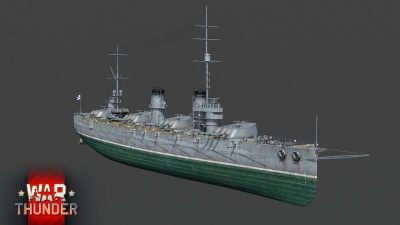
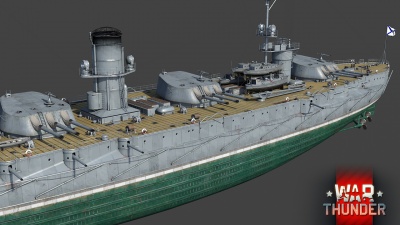
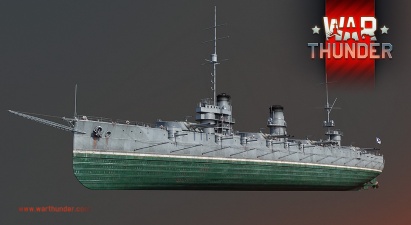
- Imperatritsa Mariya Devblog Images


- Videos
See also
Links to articles on the War Thunder Wiki that you think will be useful for the reader, for example:
- reference to the series of the ship;
- links to approximate analogues of other nations and research trees.
External links
| USSR battleships | |
|---|---|
| Imperial Russia | |
| Sevastopol-class | Marat* · Parizhskaya Kommuna** · Poltava |
| Imperatritsa Mariya-class | Imperatritsa Mariya |
| * Laid down as Petropavlovsk; renamed and remodeled by the USSR ** Laid down as Sevastopol; renamed and remodeled by the USSR | |
| Trophies | Italy |
| Conte di Cavour-class | Novorossiysk* |
| * Laid down as RN Giulio Cesare for the Regia Marina | |