Difference between revisions of "J-10A"
(→Flight performance: I added: Stock flight characteristics; Some engine information (some others are missing that I don't know how to collect in the game); and I also added pros and cons;) (Tag: Visual edit) |
m (Added some text in survivability and armour, and added some basic flight information. I do not have the proper tools to get the rest of the flight information, such as optimal engine thrust with the afterburner at a certain speed, optimal velocities, etc.) (Tag: Visual edit) |
||
| Line 6: | Line 6: | ||
== Description == | == Description == | ||
<!-- ''In the description, the first part should be about the history of and the creation and combat usage of the aircraft, as well as its key features. In the second part, tell the reader about the aircraft in the game. Insert a screenshot of the vehicle, so that if the novice player does not remember the vehicle by name, he will immediately understand what kind of vehicle the article is talking about.'' --> | <!-- ''In the description, the first part should be about the history of and the creation and combat usage of the aircraft, as well as its key features. In the second part, tell the reader about the aircraft in the game. Insert a screenshot of the vehicle, so that if the novice player does not remember the vehicle by name, he will immediately understand what kind of vehicle the article is talking about.'' --> | ||
| − | The '''{{Specs|name}}''' | + | The '''{{Specs|name}}''' is a rank {{Specs|rank}} Chinese jet fighter {{Battle-rating}}. It was introduced in [[Update "Dance of Dragons"]]. |
| − | |||
| − | It was introduced in [[Update "Dance of Dragons"]] | ||
== General info == | == General info == | ||
| Line 30: | Line 28: | ||
|- | |- | ||
! Upgraded | ! Upgraded | ||
| − | | | + | | 2238 || 2146 || 18.7 || 19.7 || 316.3 || 270.0 |
|- | |- | ||
|} | |} | ||
| Line 41: | Line 39: | ||
! Combat flaps !! Take-off flaps !! Landing flaps !! Air brakes !! Arrestor gear !! Drogue chute | ! Combat flaps !! Take-off flaps !! Landing flaps !! Air brakes !! Arrestor gear !! Drogue chute | ||
|- | |- | ||
| − | | | + | | X || X || X || ✔ || X || ✔ |
|- | |- | ||
|} | |} | ||
| Line 56: | Line 54: | ||
! Combat !! Take-off !! Landing !! + !! - | ! Combat !! Take-off !! Landing !! + !! - | ||
|- | |- | ||
| − | | | + | | 1543 || {{Specs|destruction|gear}} || N/A || N/A || N/A || ~13 || ~7 |
|- | |- | ||
|} | |} | ||
| Line 88: | Line 86: | ||
! _m fuel || __m fuel || __m fuel | ! _m fuel || __m fuel || __m fuel | ||
|- | |- | ||
| − | | | + | | 1520 kg || colspan="2" | Afterburning low-bypass turbofan |
| − | |||
| − | | colspan="2" |Afterburning low-bypass turbofan | ||
| − | |||
| _,___ kg || _,___ kg || _,___ kg || _,___ kg | | _,___ kg || _,___ kg || _,___ kg || _,___ kg | ||
|- | |- | ||
| Line 100: | Line 95: | ||
! _m fuel || __m fuel || __m fuel || MGW | ! _m fuel || __m fuel || __m fuel || MGW | ||
|- | |- | ||
| − | | ''Stationary'' || | + | | ''Stationary'' || 7230 kgf || 12020 kgf |
| _.__ || _.__ || _.__ || _.__ | | _.__ || _.__ || _.__ || _.__ | ||
|- | |- | ||
| − | | ''Optimal'' || | + | | ''Optimal'' || 7230 kgf<br>(0 km/h) || ___ kgf<br>(_ km/h) |
| _.__ || _.__ || _.__ || _.__ | | _.__ || _.__ || _.__ || _.__ | ||
|- | |- | ||
| Line 111: | Line 106: | ||
{{Specs-Avia-Armour}} | {{Specs-Avia-Armour}} | ||
<!-- ''Examine the survivability of the aircraft. Note how vulnerable the structure is and how secure the pilot is, whether the fuel tanks are armoured, etc. Describe the armour, if there is any, and also mention the vulnerability of other critical aircraft systems.'' --> | <!-- ''Examine the survivability of the aircraft. Note how vulnerable the structure is and how secure the pilot is, whether the fuel tanks are armoured, etc. Describe the armour, if there is any, and also mention the vulnerability of other critical aircraft systems.'' --> | ||
| − | '' | + | ''By the 1980s, to further reduce weight, most fighters and interceptors were not equipped with extra armor plates for both the pilot and critical components; this is no exception for the Firebird series. Similar to its sibling interceptor, the [[J-11A]], the pilot can face fatal hits from both autocannons and missile shrapnel.'' |
| + | |||
| + | ''Meanwhile, all 5 fuel tanks onboard are self-sealed, meaning that, with the help of researchable fire extinguishers, the J-10A can sometimes prevent fatal structural failure in case of a fire.'' | ||
=== Modifications and economy === | === Modifications and economy === | ||
| Line 171: | Line 168: | ||
'''Pros:''' | '''Pros:''' | ||
| − | |||
| − | |||
| − | |||
| − | |||
| − | |||
| − | |||
| − | |||
* | * | ||
'''Cons:''' | '''Cons:''' | ||
| − | |||
| − | |||
| − | |||
| − | |||
* | * | ||
| Line 210: | Line 196: | ||
* ''topic on the official game forum;'' | * ''topic on the official game forum;'' | ||
* ''other literature.'' --> | * ''other literature.'' --> | ||
| + | ''Paste links to sources and external resources, such as:'' | ||
| − | * | + | * ''topic on the official game forum;'' |
| + | * ''other literature.'' | ||
| − | |||
{{China jet aircraft}} | {{China jet aircraft}} | ||
Revision as of 18:46, 15 October 2024

Contents
Description
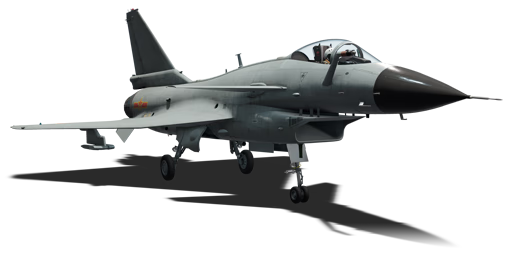
The J-10A (Early) is a rank Chinese jet fighter with a battle rating of (AB), (RB), and (SB). It was introduced in Update "Dance of Dragons".
General info
Flight performance
Describe how the aircraft behaves in the air. Speed, manoeuvrability, acceleration and allowable loads - these are the most important characteristics of the vehicle.
| Characteristics | Max speed (km/h at _,___ m) |
Max altitude (metres) |
Turn time (seconds) |
Rate of climb (metres/second) |
Take-off run (metres) | |||
|---|---|---|---|---|---|---|---|---|
| AB | RB | AB | RB | AB | RB | |||
| Stock | 2058 | 2006 | 20.9 | 21.3 | 227.1 | 215.5 | 850 | |
| Upgraded | 2238 | 2146 | 18.7 | 19.7 | 316.3 | 270.0 | ||
Details
| Features | |||||
|---|---|---|---|---|---|
| Combat flaps | Take-off flaps | Landing flaps | Air brakes | Arrestor gear | Drogue chute |
| X | X | X | ✔ | X | ✔ |
| Limits | ||||||
|---|---|---|---|---|---|---|
| Wings (km/h) | Gear (km/h) | Flaps (km/h) | Max Static G | |||
| Combat | Take-off | Landing | + | - | ||
| 1543 | N/A | N/A | N/A | ~13 | ~7 | |
| Optimal velocities (km/h) | |||
|---|---|---|---|
| Ailerons | Rudder | Elevators | Radiator |
| < ___ | < ___ | < ___ | - |
Engine performance
| Engine | Aircraft mass | |||||
|---|---|---|---|---|---|---|
| Engine name | Number | Basic mass | Wing loading (full fuel) | |||
| Saturn AL-31FN | 1 | _,___ kg | ___ kg/m2 | |||
| Engine characteristics | Mass with fuel (no weapons load) | Max Gross Weight | ||||
| Weight (each) | Type | _m fuel | __m fuel | __m fuel | ||
| 1520 kg | Afterburning low-bypass turbofan | _,___ kg | _,___ kg | _,___ kg | _,___ kg | |
| Maximum engine thrust @ 0 m (RB/SB) | Thrust to weight ratio @ 0 m (___%/WEP) | |||||
| Condition | 100% | ___%/WEP | _m fuel | __m fuel | __m fuel | MGW |
| Stationary | 7230 kgf | 12020 kgf | _.__ | _.__ | _.__ | _.__ |
| Optimal | 7230 kgf (0 km/h) |
___ kgf (_ km/h) |
_.__ | _.__ | _.__ | _.__ |
Survivability and armour
By the 1980s, to further reduce weight, most fighters and interceptors were not equipped with extra armor plates for both the pilot and critical components; this is no exception for the Firebird series. Similar to its sibling interceptor, the J-11A, the pilot can face fatal hits from both autocannons and missile shrapnel.
Meanwhile, all 5 fuel tanks onboard are self-sealed, meaning that, with the help of researchable fire extinguishers, the J-10A can sometimes prevent fatal structural failure in case of a fire.
Modifications and economy
Armaments
| Ballistic Computer | ||||
|---|---|---|---|---|
| CCIP (Guns) | CCIP (Rockets) | CCIP (Bombs) | CCRP (Bombs) | EEGS |
 |
|
|
|
|
Offensive armament
The J-10A is armed with:
- 1 x 23 mm Type 23-3 cannon, belly-mounted (200 rpg)
- 72 x large calibre countermeasures
Suspended armament
Describe the aircraft's suspended armament: additional cannons under the wings, bombs, rockets and torpedoes. This section is especially important for bombers and attackers. If there is no suspended weaponry remove this subsection.
| Default weapon presets | |
|---|---|
| |
Usage in battles
Describe the tactics of playing in the aircraft, the features of using aircraft in a team and advice on tactics. Refrain from creating a "guide" - do not impose a single point of view, but instead, give the reader food for thought. Examine the most dangerous enemies and give recommendations on fighting them. If necessary, note the specifics of the game in different modes (AB, RB, SB).
Pros and cons
Summarise and briefly evaluate the vehicle in terms of its characteristics and combat effectiveness. Mark its pros and cons in the bulleted list. Try not to use more than 6 points for each of the characteristics. Avoid using categorical definitions such as "bad", "good" and the like - use substitutions with softer forms such as "inadequate" and "effective".
Pros:
Cons:
History
Describe the history of the creation and combat usage of the aircraft in more detail than in the introduction. If the historical reference turns out to be too long, take it to a separate article, taking a link to the article about the vehicle and adding a block "/History" (example: https://wiki.warthunder.com/(Vehicle-name)/History) and add a link to it here using the main template. Be sure to reference text and sources by using <ref></ref>, as well as adding them at the end of the article with <references />. This section may also include the vehicle's dev blog entry (if applicable) and the in-game encyclopedia description (under === In-game description ===, also if applicable).
Media
Excellent additions to the article would be video guides, screenshots from the game, and photos.
See also
Links to the articles on the War Thunder Wiki that you think will be useful for the reader, for example:
- reference to the series of the aircraft;
- links to approximate analogues of other nations and research trees.
External links
Paste links to sources and external resources, such as:
- topic on the official game forum;
- other literature.
| China jet aircraft | |
|---|---|
| Fighters | J-2 · J-4 · J-6A · J-7II · J-7D · J-7E · J-8B · J-8F · J-10A · J-11 · J-11A |
| Strike aircraft | Q-5 early · Q-5A · Q-5L · JH-7A |
| Bombers | H-5 |
| France | ␗Mirage 2000-5Ei |
| USA | ␗F-84G-21-RE · ␗F-84G-31-RE · ␗F-86F-30 · ␗F-86F-40 · ␗F-100A · ␗F-100F · ␗F-104A · ␗F-104G · ␗F-5A · ␗F-5E · ␗F-16A MLU |
| USSR | ␗MiG-9 · ␗MiG-9 (l) |
| North Korea | Shenyang F-5 |
| Pakistan | A-5C · JF-17 |