Difference between revisions of "Fw 200 C-1"
(→Suspended armament: Updated) |
U173579228 (talk | contribs) (Tag: Visual edit) |
||
| Line 150: | Line 150: | ||
* Slow acceleration | * Slow acceleration | ||
* Weak airframe gets damaged easily | * Weak airframe gets damaged easily | ||
| − | * Large fuel capacity increases chances of fire | + | * Large fuel capacity increases chances of fire; aircraft is prone to them and they are almost always fatal due to lack of extinguishers |
| + | * Terrible stock rate of climb | ||
| + | * Riddled with fuel tanks | ||
== History == | == History == | ||
Revision as of 23:47, 14 June 2024


Contents
Description
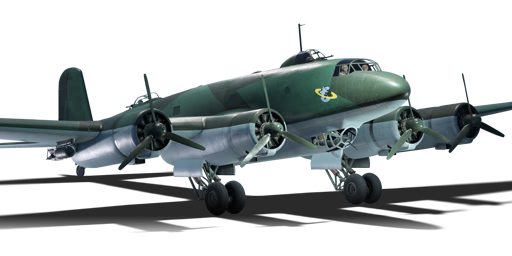
The Fw 200 C-1 "Condor" was the first military production variant of the Condor. It featured four supercharged BMW 132H engines each producing over 800 hp. Although the airframe was reinforced from the pre-production version, Condors had a habit of the fuselage splitting in two just behind where the wings meet during landings. Eight Condors were lost this way until the C-3 variant which had more reinforcement. The Condors were first delivered to Kampfgeshwader 40 (KG 40) who used the Condors for anti-shipping duties. Crews of the C-1 complained about the lack of defensive armament and protection for the fuel system. Nonetheless, the Fw 200 C-1 was quite dangerous when it made its debut. The Allies didn't have a good counter against the Condors until more CAM (catapult aircraft merchant) ships were sailing.
Introduced in Update 1.47 "Big Guns", the Fw 200 C-1 is a decent bomber. The Condor is a very big aircraft which allows it to carry a large bomb load, but is also very heavy. Its manoeuvrability leaves much to be desired as well as the overall flight performance. The Condor's top speed is decent although the structural limit is very low at only 450 km/h (279 mph), so players should be wary of diving. The Condor also lacks sufficient defensive armament with only four 7.92 mm turrets defending the entire plane.
General info
Flight performance
The Condor handles, as all long range bombers, like a flying brick. Its turns are cumbersome and it is best to climb gradually, slowly gathering speed. Once at an altitude of 4,000-5,000 metres it is best to fly straight and level to the target. Always keep a significant distance between yourself and any enemies. If you miss a base always fly for a short distance before turning to have another go, as the large turning circle could cause you to miss again. Once you have expended all your bombs, reduce throttle to 0% and gradually descend towards your base. Keep an eye on your speed so you don't rip your wings off. Despite its size the Condor is surprisingly easy to land, but make sure you aren't going too fast and you have enough runway.
| Characteristics | Max Speed (km/h at 1,500 m) |
Max altitude (metres) |
Turn time (seconds) |
Rate of climb (metres/second) |
Take-off run (metres) | |||
|---|---|---|---|---|---|---|---|---|
| AB | RB | AB | RB | AB | RB | |||
| Stock | 363 | 350 | 30.7 | 31.3 | 1.7 | 1.7 | 700 | |
| Upgraded | 396 | 378 | 29.3 | 30 | 6.9 | 4.0 | ||
Details
| Features | ||||
|---|---|---|---|---|
| Combat flaps | Take-off flaps | Landing flaps | Air brakes | Arrestor gear |
| ✓ | ✓ | ✓ | X | X |
| Limits | ||||||
|---|---|---|---|---|---|---|
| Wings (km/h) | Gear (km/h) | Flaps (km/h) | Max Static G | |||
| Combat | Take-off | Landing | + | - | ||
| 450 | 333 | 311 | 200 | ~2 | ~2 | |
| Optimal velocities (km/h) | |||
|---|---|---|---|
| Ailerons | Rudder | Elevators | Radiator |
| < 260 | < 230 | < 260 | > 290 |
Survivability and armour
- 8 mm steel - pilots seat
- Fuel tanks located between wing root and out-most engine, as well as taking up most of the fuselage
Modifications and economy
First, obtain the bomb upgrade (ITC PVC/II). This will allow the installation of 6 x 500 kg bombs, the best payload for base bombing, since it allows the destruction of two bases in one pass. There will be no need to hurry with the second upgrade. The 2 x 1,000 kg + 2 x 500 kg loadout is only ideal for taking out airfields or carriers. Flight performance upgrades come next in the priority list, as the aircraft is heavy and slow. The ammo belts are of a lesser priority, since the upgraded belts don't make a considerable difference.
Armaments
Suspended armament
The Fw 200 C-1 can be outfitted with the following ordnance:
- 6 x 250 kg SC250JA bombs (1,500 kg total)
- 6 x 500 kg SC500K bombs (3,000 kg total)
- 2 x 1,000 kg SC1000L2 bombs (2,000 kg total)
- 2 x 1,000 kg SC1000L2 bombs + 4 x 250 kg SC250JA bombs (3,000 kg total)
- 2 x 1,000 kg SC1000L2 bombs + 2 x 500 kg SC500K bombs (3,000 kg total)
- 6 x 500 kg PC500 bombs (3,000 kg total)
- 2 x 1,000 kg PC1000 bombs (2,000 kg total)
Defensive armament
The Fw 200 C-1 is defended by:
- 1 x 7.92 mm MG 15 machine gun, nose turret (2,250 rpg)
- 1 x 7.92 mm MG 15 machine gun, chin turret (1,500 rpg)
- 1 x 7.92 mm MG 15 machine gun, dorsal turret (1,125 rpg)
- 1 x 7.92 mm MG 15 machine gun, ventral turret (1,125 rpg)
Usage in battles
The graceful looks of the Condor belie a very vulnerable and slow aircraft. Essentially a converted civilian airliner, the Condor has a very weak airframe and large fuel tanks scattered throughout the aircraft, making it vulnerable to even rifle-calibre bullets.
To make things worse, the Condor is rather underpowered, despite having four engines. It is outrun by biplane fighters and has a very poor climb rate. The defensive armament is also very poor, consisting of only 7.92 mm machine guns with blind spots in the coverage. If caught by enemy fighters, it has virtually no chance of survival.
The one redeeming factor of the Condor is its massive payload of 3,000 kg bombs. It is one of the heaviest bomb loads carried by any non-premium German bomber, except for the Dornier Do 217 series, the Messerschmitt Me 264, and the He 177. If the Condor can penetrate enemy air defences, it is capable of inflicting massive damage to bases.
Manual Engine Control
| MEC elements | ||||||
|---|---|---|---|---|---|---|
| Mixer | Pitch | Radiator | Supercharger | Turbocharger | ||
| Oil | Water | Type | ||||
| Not controllable | Controllable Not auto controlled |
Not controllable Not auto controlled |
Controllable Not auto controlled |
Combined | Not controllable 1 gear |
Auto controlled |
Pros and cons
Pros:
- Large bomb payloads
- Large fuel capacity
Cons:
- Very slow top speed
- Ineffective defensive weaponry
- Slow acceleration
- Weak airframe gets damaged easily
- Large fuel capacity increases chances of fire; aircraft is prone to them and they are almost always fatal due to lack of extinguishers
- Terrible stock rate of climb
- Riddled with fuel tanks
History
The Focke-Wulf Fw 200 Condor is best remembered as a long-range reconnaissance aircraft that searched for Allied convoys over the North Atlantic during World War II. Its mission was to either attack the convoys directly with bombs or communicate their location to the packs of German U-boats below. The Condor started as a transatlantic airliner that first flew in July of 1937. By September of 1939, over 250 Condors had entered military service. The Condor spawned many sub-variants that included different armament, radar, missile carriage and guidance systems, and transport. A handful of these aircraft were used for VIP transports (it was the private plane german chancellor Adolf Hitler that used it for his travel for meetings with other leaders in WWII).
Media
- Skins
- Videos
See also
Links to the articles on the War Thunder Wiki that you think will be useful for the reader, for example:
- reference to the series of the aircraft;
- links to approximate analogues of other nations and research trees.
External links
Paste links to sources and external resources, such as:
- topic on the official game forum;
- other literature.
| Focke-Wulf Aircraft Corporation (Focke-Wulf Flugzeugbau Aktiengesellschaft) | |
|---|---|
| Fighters | Fw 190 A-1 · Fw 190 A-4 · Fw 190 A-5 · Fw 190 A-5/U2 · Fw 190 A-5/U12 · Fw 190 A-5/U14 · Fw 190 A-8 |
| Fw 190 C | |
| Fw 190 D-9 · Fw 190 D-12 · Fw 190 D-13 | |
| Fw 190 F-8 | |
| Ta 152 C-3* · Ta 152 H-1* · Ta 154 A-1* | |
| Bombers | Fw 189 A-1 · Fw 200 C-1 |
| Export | ▅Fw 190 A-5 |
| Captured | ▃Fw 190 A-8 · ▂Fw 190 D-9 |
| * In 1944, the Germany Air Ministry changed new fighter aircraft designation to that of the chief designer. Kurt Tank was the chief designer at Focke-Wulf and later aircraft he designed were given the prefix of Ta. | |
| Germany bombers | |
|---|---|
| Arado | Ar 196 A-3 |
| Blohm & Voss | BV 138 C-1 · BV 238 |
| Dornier | Do 17 E-1 · Do 17 Z-2 · Do 217 E-2 · Do 217 E-4 · Do 217 K-1 · Do 217 M-1 |
| Focke-Wulf | Fw 189 A-1 · Fw 200 C-1 |
| Henschel | Hs 123 A-1 |
| Heinkel | He 111 H-3 · He 111 H-6 · He 111 H-16 · He 115 C-1 · He 177 A-3 · He 177 A-5 |
| Junkers | Ju 87 B-2 · Ju 87 R-2 · Ju 87 R-2 Libya · Ju 87 D-3 · Ju 87 D-5 · Ju 88 A-1 · Ju 88 A-4 · Ju 188 A-2 · Ju 288 C |
| Messerschmitt | Me 264 |
| Savoia-Marchetti | ▀S.M.79 serie 1 · ▀S.M.79 B · ▀S.M.79 serie 4 · ▀S.M.79 serie 8 |
| ▀S.M.79 AS · ▀S.M.79 bis/N · ▀S.M.79 bis/T.M | |
| Trophies | ▀Wellington Mk Ic |