Difference between revisions of "Imp.Chaparral"
(Added About template) |
(→See also: Edits) |
||
| Line 136: | Line 136: | ||
* ''reference to the series of the vehicles;'' | * ''reference to the series of the vehicles;'' | ||
* ''links to approximate analogues of other nations and research trees.'' --> | * ''links to approximate analogues of other nations and research trees.'' --> | ||
| − | |||
| − | + | ;Related development | |
| − | * | + | * [[Imp.Chaparral (Israel)]] |
== External links == | == External links == | ||
Revision as of 18:21, 29 December 2023
| This page is about the US SPAA Imp.Chaparral. For the other version, see Imp.Chaparral (Israel). |

Contents
Description
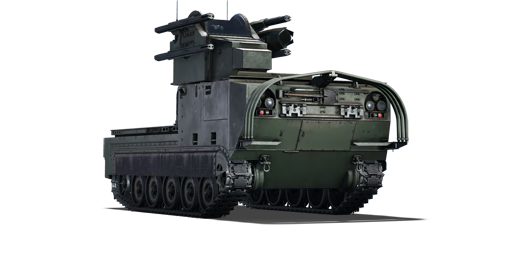
The Chaparral was an SPAA used by the United States between 1969 and the early 2000s. It was a cheap way to adapt an already existing and trusted platform like the M113 to provide close- to medium-range air defence. For this, the AIM-9 Sidewinder missile was used, with different seekers and engines being installed over the years in order to provide better target acquisition, range, and reliability. The Chaparral also saw medium success in international markets, serving with Ecuador, Chile, Egypt, Morocco, Taiwan, and Israel. Its only confirmed kill was a MiG-17 shot down by Israel over the Golan Heights.
Introduced in Update "Sons of Attila", the Chaparral comes with the benefit of using IR-guided missiles, these can be flared away with countermeasures and a couple of manoeuvres, but it makes it so that no radar is required, which means no ground clutter or lock warning for the pilots. Many jets at the BR lack countermeasures, so its most major opponents are modern ground attack aircraft like the A-10 and Su-25 that have armament capable of outranging the Chaparral and also have countermeasures. The other problem the Chaparral suffers is the lack of a gun; since it has no cannon or HMG, it is not able to shoot down helicopters or jets that are too close for the missile to get a lock.
General info
Survivability and armour
Describe armour protection. Note the most well protected and key weak areas. Appreciate the layout of modules as well as the number and location of crew members. Is the level of armour protection sufficient, is the placement of modules helpful for survival in combat? If necessary use a visual template to indicate the most secure and weak zones of the armour.
Armour type:
| Armour | Front (Slope angle) | Sides | Rear | Roof |
|---|---|---|---|---|
| Hull | ___ mm | ___ mm Top ___ mm Bottom |
___ mm | ___ - ___ mm |
| Turret | ___ - ___ mm Turret front ___ mm Gun mantlet |
___ - ___ mm | ___ - ___ mm | ___ - ___ mm |
| Cupola | ___ mm | ___ mm | ___ mm | ___ mm |
Notes:
Mobility
| Game Mode | Max Speed (km/h) | Weight (tons) | Engine power (horsepower) | Power-to-weight ratio (hp/ton) | |||
|---|---|---|---|---|---|---|---|
| Forward | Reverse | Stock | Upgraded | Stock | Upgraded | ||
| Arcade | Expression error: Unexpected * operator. | 206 | Expression error: Unexpected round operator. | __.__ | |||
| Realistic | 128 | Expression error: Unexpected round operator. | __.__ | ||||
Modifications and economy
Armaments
Main armament
| MIM-72 missile | Turret rotation speed (°/s) | Reloading rate (seconds) | |||||||||||
|---|---|---|---|---|---|---|---|---|---|---|---|---|---|
| Mode | Capacity (Belt) | Vertical | Horizontal | Stabilizer | Stock | Upgraded | Full | Expert | Aced | Stock | Full | Expert | Aced |
| Arcade | 12 (4) | -9°/+90° | ±180° | - | 79.3 | 109.7 | 133.2 | 147.3 | 156.7 | 19.50 | 17.25 | 15.90 | 15.00 |
| Realistic | 53.6 | 63.0 | 76.5 | 84.6 | 90.0 | ||||||||
Ammunition
| Shell details | ||||||||||||
|---|---|---|---|---|---|---|---|---|---|---|---|---|
| Ammunition | Type of warhead |
Velocity (m/s) |
Range (m) |
Projectile mass (kg) |
Fuse delay (m) |
Fuse sensitivity (mm) |
Arming distance (m) |
Trigger radius (m) |
Explosive mass (TNT equivalent) (kg) |
Ricochet | ||
| 0% | 50% | 100% | ||||||||||
| MIM-72C | SAM | 720 | 6,000 | 86.3 | 1 | 0.3 | 0 | 5 | 4.31 | 79° | 80° | 81° |
| MIM-72E | SAM | 720 | 6,000 | 86.3 | 1 | 0.3 | 0 | 5 | 4.31 | 79° | 80° | 81° |
Ammo racks
| Full ammo |
1st rack empty |
2nd rack empty |
3rd rack empty |
4th rack empty |
5th rack empty |
6th rack empty |
Visual discrepancy |
|---|---|---|---|---|---|---|---|
| 3 | __ (+__) | __ (+__) | __ (+__) | __ (+__) | __ (+__) | __ (+__) | __ |
Usage in battles
Describe the tactics of playing in the vehicle, the features of using vehicles in the team and advice on tactics. Refrain from creating a "guide" - do not impose a single point of view but instead give the reader food for thought. Describe the most dangerous enemies and give recommendations on fighting them. If necessary, note the specifics of the game in different modes (AB, RB, SB).
Pros and cons
Pros:
- IRST tracking (undetected by RWR)
- Infrared missile guidance provides more stealthy attacks compared to missiles that rely on radar (fire and forget, no painting to alert enemy RWR)
- Harder-hitting and more manoeuvrable missiles compared to its successor LAV-AD
- Can perform scout functions for extra team assistance
- Thermal imaging to assist with target acquisition
Cons:
- Missile armament lacks IRCCM
- Absolutely no defensive armament, strictly anti-air
- No armour
- Lacks search radar (must rely on visual and sound to find enemies)
History

The Chaparral was an anti-aircraft system developed by the United States during the 1960s to offer short-range air defence capabilities to soldiers and armoured units. The Chaparral employs variants of the AIM-9 Sidewinder missile instead of traditional radar-guided missiles and it was meant to be used together with the M163 VADS.
The Chaparral's predecessor was the Mauler, developed during the Advanced Air Defence Program and using the MIM-46 Mauler missile. It was equipped with a total of 9 missiles and no gun, the system was mounted in the M113 chassis and also had 2 radars available. The Mauler was abandoned in 1963 after many problems were discovered with the system, but many of its characteristics were inherited by the Chaparral.
For example, the attempts to modify the M113 to add an SPAA system to it continued in the following years, with the MIM-72 Chaparral going into service in 1969. The Chaparral was a cheap and quick solution to the lack of short-medium range air defence options in the army. This was result of the Provisional Advanced Air Defence program, that evaluated the AIM-9 missile as an option for ground-based AA platforms. However issues started to appear when it was evident that the AIM-9 would not have enough time to react if the enemy aircraft was too close, thus, an M113 was equipped with an M61 Vulcan 20 mm cannon and a radar was to be used in complement to the Chaparral. A separated radar set was developed to be used with both the Chaparral and Vulcan system, however this system is transported by a separate unarmed vehicle and was not suited for frontline combat.
Different versions of the Chaparral appeared in later years, especially during the 1970s and '80s. The Chaparral was seen as a cheap alternative for air defence platforms and was exported to several nations. Most upgrades consisted in improvements to the fire control system and armament, with better missiles adapted to be used in the Chaparral. All-aspect seekers were installed in 1974, and even a naval version was exported to Taiwan after not being of interest to the army.
The MIM-72D was an export variant with improved warhead, the MIM-72E was used during the 1970s and '80s and included a smokeless engine. The most modern variant was the MIM-72G, that used the seeker of the FIM-92 Stinger missile, with deliveries of this new version starting in 1982, and all missiles being modified with the new seeker. After 1981, the system started to be phased out from the regular army, but it was still used during the Gulf War. In the end, all systems were handed over to the US national guard.
Media
Excellent additions to the article would be video guides, screenshots from the game, and photos.
See also
- Related development
External links
Paste links to sources and external resources, such as:
- topic on the official game forum;
- other literature.
| USA anti-aircraft vehicles | |
|---|---|
| M3 Half-track derivatives | M13 MGMC · M15 CGMC · M16 MGMC |
| M24 derivative | M19A1 |
| M41 derivative | M42 |
| Radar SPAAG | M163 · M247 |
| Missile SPAA | ADATS · Imp.Chaparral · LAV-AD · XM975 |