Difference between revisions of "Machbet"
m (→Description: Revision of sentence to previous edit) (Tag: Visual edit) |
(Edits) |
||
| Line 11: | Line 11: | ||
== Description == | == Description == | ||
<!-- ''In the description, the first part should be about the history of the creation and combat usage of the vehicle, as well as its key features. In the second part, tell the reader about the ground vehicle in the game. Insert a screenshot of the vehicle, so that if the novice player does not remember the vehicle by name, he will immediately understand what kind of vehicle the article is talking about.'' --> | <!-- ''In the description, the first part should be about the history of the creation and combat usage of the vehicle, as well as its key features. In the second part, tell the reader about the ground vehicle in the game. Insert a screenshot of the vehicle, so that if the novice player does not remember the vehicle by name, he will immediately understand what kind of vehicle the article is talking about.'' --> | ||
| − | The '''{{Specs|name}}''' | + | The '''{{Specs|name}}''' (מחבט; lit. Racquet) was an upgrade of the fleet of [[Hovet]]s (M163 VADS) in service with the Israel Air Defense Command in the late 1990s to modernize the vehicle. The upgrade featured 4 all-aspect infrared-tracking Stinger missiles that allow it to engage long-range targets, and an IRST tracker that was more reliable than the [[AN/VPS-2]] and also doesn't trigger aircraft RWR. These vehicles replaced the Hovet in service by 1998, and were deployed along the Purple Line (post-Six-Day War ceasefire line between Israel/Syria, ''de facto'' border line) until the Israel Air Defense Command was disbanded in 2006. |
| − | Introduced in [[Update "Wind of Change"]] alongside | + | Introduced in [[Update "Wind of Change"]] alongside the initial Israeli tech tree, the overall dimensions of the Machbet is mostly identical to the Hovet. While players will quickly notice the disappearance of the radar rangefinder, the overall capability is now ensured by the new FLIR tracker with optical tracking capability and 4 FIM-92 Stingers to handle long-range (relative to the gun's <2 km range) targets. Players will soon get used to the performance of the Machbet, while enemies might underestimate the potential of these upgrades allowing the joint use of both surface-air missiles and a powerful rotary cannon. |
== General info == | == General info == | ||
| Line 161: | Line 161: | ||
== History == | == History == | ||
<!-- ''Describe the history of the creation and combat usage of the vehicle in more detail than in the introduction. If the historical reference turns out to be too long, take it to a separate article, taking a link to the article about the vehicle and adding a block "/History" (example: <nowiki>https://wiki.warthunder.com/(Vehicle-name)/History</nowiki>) and add a link to it here using the <code>main</code> template. Be sure to reference text and sources by using <code><nowiki><ref></ref></nowiki></code>, as well as adding them at the end of the article with <code><nowiki><references /></nowiki></code>. This section may also include the vehicle's dev blog entry (if applicable) and the in-game encyclopedia description (under <code><nowiki>=== In-game description ===</nowiki></code>, also if applicable).'' --> | <!-- ''Describe the history of the creation and combat usage of the vehicle in more detail than in the introduction. If the historical reference turns out to be too long, take it to a separate article, taking a link to the article about the vehicle and adding a block "/History" (example: <nowiki>https://wiki.warthunder.com/(Vehicle-name)/History</nowiki>) and add a link to it here using the <code>main</code> template. Be sure to reference text and sources by using <code><nowiki><ref></ref></nowiki></code>, as well as adding them at the end of the article with <code><nowiki><references /></nowiki></code>. This section may also include the vehicle's dev blog entry (if applicable) and the in-game encyclopedia description (under <code><nowiki>=== In-game description ===</nowiki></code>, also if applicable).'' --> | ||
| − | As the world entered the last decade of 20th Century, Hovet | + | As the world entered the last decade of the 20th Century, the [[Hovet]] had already become obsolete against new aerial threats due to its inferior FCS and lack of missiles. Thus, IAI planned for an upgrade to the fleet of Hovets with modernized FLIR tracking systems and FIM-92 Stinger MANPADS; this upgrade also introduced GPS and the "Hermit" (הרמיט) computerized command system for battery vehicles with all-in-one display of radar signals and video display from command systems via a military-grade briefcase laptop. |
| − | The upgraded vehicles replaced Hovet in | + | The upgraded vehicles replaced Hovet in border air-defense by 1998 and served with the Israel Air Defense Command until its disbandment in 2006. <ref>https://web.archive.org/web/20110514104344/http://www.iaf.org.il/241-18138-he/IAF.aspx?indx=1</ref> |
=== [[wt:en/news/7601-development-machbet-desert-vulcan-en|Devblog]] === | === [[wt:en/news/7601-development-machbet-desert-vulcan-en|Devblog]] === | ||
Revision as of 17:15, 3 September 2023
| This page is about the Israeli SPAA Machbet. For other versions, see M113 (Family). |

Contents
Description
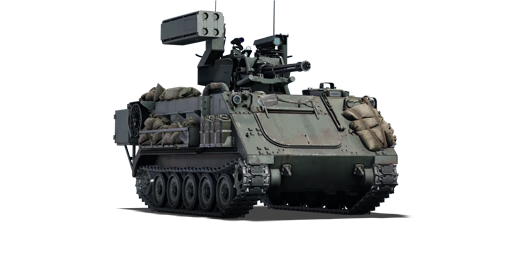
The Machbet (מחבט; lit. Racquet) was an upgrade of the fleet of Hovets (M163 VADS) in service with the Israel Air Defense Command in the late 1990s to modernize the vehicle. The upgrade featured 4 all-aspect infrared-tracking Stinger missiles that allow it to engage long-range targets, and an IRST tracker that was more reliable than the AN/VPS-2 and also doesn't trigger aircraft RWR. These vehicles replaced the Hovet in service by 1998, and were deployed along the Purple Line (post-Six-Day War ceasefire line between Israel/Syria, de facto border line) until the Israel Air Defense Command was disbanded in 2006.
Introduced in Update "Wind of Change" alongside the initial Israeli tech tree, the overall dimensions of the Machbet is mostly identical to the Hovet. While players will quickly notice the disappearance of the radar rangefinder, the overall capability is now ensured by the new FLIR tracker with optical tracking capability and 4 FIM-92 Stingers to handle long-range (relative to the gun's <2 km range) targets. Players will soon get used to the performance of the Machbet, while enemies might underestimate the potential of these upgrades allowing the joint use of both surface-air missiles and a powerful rotary cannon.
General info
Survivability and armour
Despite its thin armour, the Machbet has the particularity of being able to withstand some misplaced shots, but pay attention to HE shells that are able to destroy instantly the vehicle .
Beware also of tanks equipped with machine guns above 7.62 mm calibre, these tanks can easily penetrate the sides of the vehicle.
Armour type:
- Aluminium Alloy 5083
| Armour | Front (Slope angle) | Sides | Rear | Roof |
|---|---|---|---|---|
| Hull | 29-38 mm (44°) Front glacis 38 mm (26°) Lower glacis |
44 mm Top 32 mm Bottom |
38 mm (9°) | 10-38 mm |
| Turret | 17 mm (17-18°) Turret front 150 mm Gun mantlet |
17 mm (12-19°) | 17 mm (0-20°) | N/A |
Notes:
Mobility
While not being the fastest vehicle, especially while stock, the Machbet lack power in slope but on flat ground , he can handle himself pretty easily.
| Game Mode | Max Speed (km/h) | Weight (tons) | Engine power (horsepower) | Power-to-weight ratio (hp/ton) | |||
|---|---|---|---|---|---|---|---|
| Forward | Reverse | Stock | Upgraded | Stock | Upgraded | ||
| Arcade | Expression error: Unexpected * operator. | 301 | Expression error: Unexpected round operator. | __.__ | |||
| Realistic | 188 | Expression error: Unexpected round operator. | __.__ | ||||
Modifications and economy
Armaments
Main armament
The Machbet is equipped like the M163 with a 20 mm M168 VADS, or Vulcan air defence system. The M168 is a variant of the M61 cannon, which can be found in-game on vehicles such as the Japanese T-2, and the American F-4C Phantom II. Used initially during the Vietnam war, the M168 was a 20 mm air-cooled rotary cannon attached to a small turret on the Machbet. Dangerous to anything in the sky below 2 km, it will lock on and rip through anything in its path. Helicopter and plane will be crippled effectively.
| 20 mm M168 | Turret rotation speed (°/s) | Reloading rate (seconds) | ||||||||||||
|---|---|---|---|---|---|---|---|---|---|---|---|---|---|---|
| Mode | Capacity (Belt) | Fire rate | Vertical | Horizontal | Stabilizer | Stock | Upgraded | Full | Expert | Aced | Stock | Full | Expert | Aced |
| Arcade | 2,200 (1,100) | 3,000 | -5°/+80° | ±180° | N/A | 66.0 | 91.4 | 111.0 | 122.8 | 130.6 | 26.00 | 23.00 | 21.20 | 20.00 |
| Realistic | 44.6 | 52.5 | 63.8 | 70.5 | 75.0 | |||||||||
Ammunition
- Default: AP-I · HEI-T · API-T
- HEI: HEI-T · HEF-I · API-T · HEF-I
- AP-I: AP-I · API-T · HEF-I · API-T
| Penetration statistics | |||||||
|---|---|---|---|---|---|---|---|
| Ammunition | Penetration @ 0° Angle of Attack (mm) | ||||||
| 10 m | 100 m | 500 m | 1,000 m | 1,500 m | 2,000 m | ||
| HEI-T | 5 | 5 | 3 | 2 | 2 | 2 | |
| AP-I | 40 | 36 | 22 | 12 | 6 | 3 | |
| API-T | 40 | 36 | 22 | 12 | 6 | 3 | |
| HEF-I | 5 | 5 | 3 | 2 | 2 | 2 | |
| Shell details | ||||||||||||
|---|---|---|---|---|---|---|---|---|---|---|---|---|
| Ammunition | Velocity (m/s) |
Projectile mass (kg) |
Fuse delay (m) |
Fuse sensitivity (mm) |
Explosive mass (TNT equivalent) (g) |
Ricochet | ||||||
| 0% | 50% | 100% | ||||||||||
| HEI-T | 1,030 | 0.1 | 0.1 | 0.1 | 12 | 79° | 80° | 81° | ||||
| AP-I | 1,030 | 0.1 | - | - | - | 47° | 56° | 65° | ||||
| API-T | 1,030 | 0.1 | - | - | - | 47° | 60° | 65° | ||||
| HEF-I | 1,030 | 0.1 | 0.1 | 0.1 | 17.12 | - | - | - | ||||
Ammo racks
| Full ammo |
1st rack empty |
2nd rack empty |
Visual discrepancy |
|---|---|---|---|
| 2 | 1 (+1) | 0 (+2) | No |
Additional armament
The FIM-92 E and K are effective weapons but only under certain conditions. With turns at 10 G maximum, the missile will not be able to follow some aircraft unless the angle is favourable. Opportune moments to hit an aircraft are when it is facing directly towards the missile launcher or flying directly away from it. The K upgrade of the missile is more likely to hit due to its proximity fuse with a trigger radius of 5 m. Helicopters, on the other hand, have a good chance of being hit due to their low altitude. Without the use of countermeasures, the missile can be sure to hit a helicopter. However, missiles may have a hard time acquiring helicopters if they are low to the ground, and helicopters may use the terrain to mask themselves or evade incoming missiles.
| FIM-92 Stinger missile | Turret rotation speed (°/s) | Reloading rate (seconds) | |||||||||||
|---|---|---|---|---|---|---|---|---|---|---|---|---|---|
| Mode | Capacity | Vertical | Horizontal | Stabilizer | Stock | Upgraded | Full | Expert | Aced | Stock | Full | Expert | Aced |
| Arcade | 4 | -10°/+70° | ±180° | N/A | 66.0 | 91.4 | 111.0 | 122.8 | 130.6 | 19.5 | 17.2 | 15.9 | 15.0 |
| Realistic | 44.6 | 52.5 | 63.8 | 70.5 | 75.0 | ||||||||
Ammunition
| Missile details | ||||||||||||
|---|---|---|---|---|---|---|---|---|---|---|---|---|
| Ammunition | Type of warhead |
Velocity (m/s) |
Range (m) |
Projectile mass (kg) |
Fuse delay (m) |
Fuse sensitivity (mm) |
Arming distance (m) |
Trigger radius (m) |
Explosive mass (TNT equivalent) (g) |
Ricochet | ||
| 0% | 50% | 100% | ||||||||||
| FIM-92E | SAM | 670 | 5,000 | 10.1 | 1 | 0.1 | - | - | 540 | 79° | 80° | 81° |
| FIM-92K | SAM | 670 | 5,000 | 10.1 | 1 | 0.1 | 0 | 1 | 540 | 79° | 80° | 81° |
Ammo racks
| Full ammo |
1st rack empty |
Visual discrepancy |
|---|---|---|
| 4 | 0 (+4) | No |
Usage in battles
The Machbet is a very good anti-aircraft vehicle if its capabilities and limitations are managed. It excels in many areas behind the front lines, either directly supporting allies during an assault or back towards spawn or capture points to maintain security.
Difficulties will be met around BR 10.0 matches as multiple aircraft types will have access to countermeasures able to defeat the FIM-92 Stinger missiles.
Pros and cons
Pros:
- Access to capable FIM-92 Stinger missiles even when stock.
- FIM-92K missile an upgradeable option to enhance lethality due to proximity fuze.
- Have powerful 20 mm M168 for close-range protection against aircraft.
- Lightweight with good horsepower for good mobility
- Access to thermal imager
- Access to a laser rangefinder
Cons:
- Armour is thin and basically non-existent except against machine gun calibre rounds
- 20 mm only useful within 2 km firing distance
History
As the world entered the last decade of the 20th Century, the Hovet had already become obsolete against new aerial threats due to its inferior FCS and lack of missiles. Thus, IAI planned for an upgrade to the fleet of Hovets with modernized FLIR tracking systems and FIM-92 Stinger MANPADS; this upgrade also introduced GPS and the "Hermit" (הרמיט) computerized command system for battery vehicles with all-in-one display of radar signals and video display from command systems via a military-grade briefcase laptop.
The upgraded vehicles replaced Hovet in border air-defense by 1998 and served with the Israel Air Defense Command until its disbandment in 2006. [1]
Devblog
After the M163 VADS began being decommissioned from American service, the vehicle was heavily exported to foreign operators. Israel was one of several states which adopted the M163 VADS into its own military under the name 'Hovet' in the early 1980s. By the early 1990s however, it was realized that the system required modernization. As such, the IAI company was tasked with developing an upgrade package.
Together with General Dynamics, IAI upgraded the Hovet's fire control system and equipped the vehicle with a Stinger missile launcher, in an effort to increase the vehicle's effectiveness against low-flying jet aircraft. Following successful testing of the prototype in 1997, the vehicle was formally accepted into service with the IDF under the name 'Machbet' in 1998. In the upcoming years, several of the older Hovets were modernized to the Machbet standard. However, the Machbet only saw a short service life with the IDF. Because of changing tasks and requirements, the Machbet was officially withdrawn from active service in 2006.
Media
- Skins
See also
- Related development
External links
| Israel Aerospace Industries (התעשייה האווירית לישראל) | |
|---|---|
| Jet Fighters | Nesher · Kfir Canard · Kfir C.2 · Kfir C.7 |
| SPAAs | Machbet |
| Israel anti-aircraft vehicles | |
|---|---|
| Half-track | TCM-20 |
| M163 derivatives | Hovet · Machbet · Imp.Chaparral |
| Captured | ZSU-57-2 · ZSU-23-4 |