Difference between revisions of "Spitfire Mk IXc (Israel)"
(Undo revision 157122 by U65912523 (talk) Plagiarism from wikipedia:Operation Velvetta and https://www.machal.org.il/1947-49/the-israel-air-force-spitfires-over-israel/) |
U121164631 (talk | contribs) (→History) (Tag: Visual edit) |
||
| Line 114: | Line 114: | ||
'''Pros:''' | '''Pros:''' | ||
| + | |||
* | * | ||
'''Cons:''' | '''Cons:''' | ||
| + | |||
* | * | ||
== History == | == History == | ||
<!-- ''Describe the history of the creation and combat usage of the aircraft in more detail than in the introduction. If the historical reference turns out to be too long, take it to a separate article, taking a link to the article about the vehicle and adding a block "/History" (example: <nowiki>https://wiki.warthunder.com/(Vehicle-name)/History</nowiki>) and add a link to it here using the <code>main</code> template. Be sure to reference text and sources by using <code><nowiki><ref></ref></nowiki></code>, as well as adding them at the end of the article with <code><nowiki><references /></nowiki></code>. This section may also include the vehicle's dev blog entry (if applicable) and the in-game encyclopedia description (under <code><nowiki>=== In-game description ===</nowiki></code>, also if applicable).'' --> | <!-- ''Describe the history of the creation and combat usage of the aircraft in more detail than in the introduction. If the historical reference turns out to be too long, take it to a separate article, taking a link to the article about the vehicle and adding a block "/History" (example: <nowiki>https://wiki.warthunder.com/(Vehicle-name)/History</nowiki>) and add a link to it here using the <code>main</code> template. Be sure to reference text and sources by using <code><nowiki><ref></ref></nowiki></code>, as well as adding them at the end of the article with <code><nowiki><references /></nowiki></code>. This section may also include the vehicle's dev blog entry (if applicable) and the in-game encyclopedia description (under <code><nowiki>=== In-game description ===</nowiki></code>, also if applicable).'' --> | ||
| − | + | Although there were wartime conversions of the Spitfire into a two-seat trainer including the one-off modification of a Mk Vc by RAF no. 261 Squadron and a Mk IX converted for use as a trainer by the Soviets, the two-seat Spitfire trainer was primarily a postwar programme. In 1946, a Mk VIII (''MT818'') was the first Vickers-built trainer built as a demonstrator, but in 1948, 10 '''Spitfire T Mk IX'''s, were exported to India. In 1951, a further six '''TR 9''' trainers were converted from the standard Mk IX to train pilots for the Irish Air Corps (IAC) Seafire fleet. The Spitfires provided transition training that included gunnery practice since the type was equipped with two .303 Browning machine guns, one in each outer wing bay. Most of the TR 9 aircraft passed to the ground technical training school at Baldonnel where they were used as instructional airframes for the training of aircraft engineers for the Air Corps. Four of the IAC aircraft survived and two went on to join the warbird fleet in the 1970s and later. | |
| + | |||
| + | In total, 5,656 Mk IXs were built, 561 by Supermarine and 5,095 by Castle Bromwich. Production of the Mk IX ended in April 1945 and, in combination with the Mk XVI this "compromise" was produced in larger numbers than any other Spitfire variant. | ||
== Media == | == Media == | ||
| Line 127: | Line 131: | ||
;Skins | ;Skins | ||
| + | |||
* [https://live.warthunder.com/feed/camouflages/?vehicle=spitfire_mk9c_iaf Skins and camouflages for the {{PAGENAME}} from live.warthunder.com.] | * [https://live.warthunder.com/feed/camouflages/?vehicle=spitfire_mk9c_iaf Skins and camouflages for the {{PAGENAME}} from live.warthunder.com.] | ||
| Line 135: | Line 140: | ||
;Related development | ;Related development | ||
| + | |||
* [[Spitfire (Family)]] | * [[Spitfire (Family)]] | ||
| Line 142: | Line 148: | ||
* ''other literature.'' --> | * ''other literature.'' --> | ||
''Paste links to sources and external resources, such as:'' | ''Paste links to sources and external resources, such as:'' | ||
| + | |||
* ''topic on the official game forum;'' | * ''topic on the official game forum;'' | ||
* ''other literature.'' | * ''other literature.'' | ||
Revision as of 22:37, 28 April 2023
| This page is about the fighter Spitfire Mk IXc (Israel). For other versions, see Spitfire (Family). |
.jpg)
Contents
Description
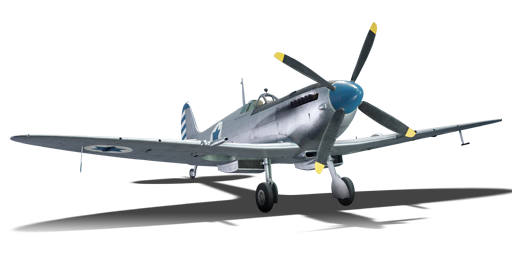
The Spitfire Mk IXc is a rank Israeli fighter with a battle rating of (AB), (RB), and (SB). It was introduced in Update "Winged Lions".
General info
Flight performance
Describe how the aircraft behaves in the air. Speed, manoeuvrability, acceleration and allowable loads - these are the most important characteristics of the vehicle.
| Characteristics | Max Speed (km/h at 8,537 m) |
Max altitude (metres) |
Turn time (seconds) |
Rate of climb (metres/second) |
Take-off run (metres) | |||
|---|---|---|---|---|---|---|---|---|
| AB | RB | AB | RB | AB | RB | |||
| Stock | 627 | 609 | 18.1 | 18.7 | 15.8 | 15.8 | 380 | |
| Upgraded | 676 | 650 | 16.4 | 17.2 | 24.4 | 19.5 | ||
Details
| Features | ||||
|---|---|---|---|---|
| Combat flaps | Take-off flaps | Landing flaps | Air brakes | Arrestor gear |
| X | X | ✓ | X | X |
| Limits | ||||||
|---|---|---|---|---|---|---|
| Wings (km/h) | Gear (km/h) | Flaps (km/h) | Max Static G | |||
| Combat | Take-off | Landing | + | - | ||
| N/A | N/A | 230 | ~12 | ~7 | ||
| Optimal velocities (km/h) | |||
|---|---|---|---|
| Ailerons | Rudder | Elevators | Radiator |
| < 321 | < 400 | < 350 | > 450 |
Survivability and armour
Examine the survivability of the aircraft. Note how vulnerable the structure is and how secure the pilot is, whether the fuel tanks are armoured, etc. Describe the armour, if there is any, and also mention the vulnerability of other critical aircraft systems.
Modifications and economy
Armaments
Offensive armament
The Spitfire Mk IXc (Israel) is armed with:
- 2 x 20 mm Hispano Mk.II cannons, wing-mounted (120 rpg = 240 total)
- 4 x 7.7 mm Browning machine guns, wing-mounted (350 rpg = 1,400 total)
Suspended armament
The Spitfire Mk IXc (Israel) can be outfitted with the following ordnance:
- Without load
- 2 x 250 lb AN-M57 bombs (500 lb total)
- 2 x 250 lb AN-M57 bombs + 16 x Flz.-Rakete Oerlikon rockets (500 lb total)
- 16 x Flz.-Rakete Oerlikon rockets
Usage in battles
Describe the tactics of playing in the aircraft, the features of using aircraft in a team and advice on tactics. Refrain from creating a "guide" - do not impose a single point of view, but instead, give the reader food for thought. Examine the most dangerous enemies and give recommendations on fighting them. If necessary, note the specifics of the game in different modes (AB, RB, SB).
Pros and cons
Summarise and briefly evaluate the vehicle in terms of its characteristics and combat effectiveness. Mark its pros and cons in the bulleted list. Try not to use more than 6 points for each of the characteristics. Avoid using categorical definitions such as "bad", "good" and the like - use substitutions with softer forms such as "inadequate" and "effective".
Pros:
Cons:
History
Although there were wartime conversions of the Spitfire into a two-seat trainer including the one-off modification of a Mk Vc by RAF no. 261 Squadron and a Mk IX converted for use as a trainer by the Soviets, the two-seat Spitfire trainer was primarily a postwar programme. In 1946, a Mk VIII (MT818) was the first Vickers-built trainer built as a demonstrator, but in 1948, 10 Spitfire T Mk IXs, were exported to India. In 1951, a further six TR 9 trainers were converted from the standard Mk IX to train pilots for the Irish Air Corps (IAC) Seafire fleet. The Spitfires provided transition training that included gunnery practice since the type was equipped with two .303 Browning machine guns, one in each outer wing bay. Most of the TR 9 aircraft passed to the ground technical training school at Baldonnel where they were used as instructional airframes for the training of aircraft engineers for the Air Corps. Four of the IAC aircraft survived and two went on to join the warbird fleet in the 1970s and later.
In total, 5,656 Mk IXs were built, 561 by Supermarine and 5,095 by Castle Bromwich. Production of the Mk IX ended in April 1945 and, in combination with the Mk XVI this "compromise" was produced in larger numbers than any other Spitfire variant.
Media
- Skins
See also
- Related development
External links
Paste links to sources and external resources, such as:
- topic on the official game forum;
- other literature.
| Supermarine | |
|---|---|
| Spitfires | |
| Merlin engine | Spitfire Mk Ia · Spitfire Mk IIa · Spitfire Mk.IIa Venture I · Spitfire Mk IIb |
| Spitfire Mk Vb · Spitfire Mk Vb/trop · Spitfire Mk Vc · Spitfire Mk Vc/trop | |
| Spitfire F Mk IX · Spitfire F Mk IXc · Spitfire F Mk XVI | |
| Spitfire LF Mk IX · Plagis' Spitfire LF Mk IXc | |
| Griffon engine | Spitfire F Mk XIVc · Spitfire F Mk XIVe · Prendergast's Spitfire FR Mk XIVe · Spitfire F Mk XVIIIe · Spitfire F Mk 22 · Spitfire F Mk 24 |
| Export | ▄Spitfire Mk Vb/trop · ▃Spitfire LF Mk IXc · ▂Spitfire Mk IXc · Spitfire Mk IXc · Spitfire Mk.IX (CW) · Weizman's Spitfire LF Mk.IXe · ▄Spitfire FR Mk XIVe |
| Seafires | Seafire LF Mk.III · Seafire F Mk XVII · Seafire FR 47 |
| Export | ▄Seafire LF Mk.III |
| Jet fighters | Attacker FB 1 · Attacker FB.2 · Scimitar F Mk.1 · Swift F.1 · Swift F.7 |
| Hydroplanes | Walrus Mk.I |
| Israel fighters | |
|---|---|
| Bf 109 | Sakeen |
| P-51 | P-51D-20-NA |
| Spitfires | Spitfire Mk IXc · Weizman's Spitfire LF Mk.IXe · Spitfire Mk.IX (CW) |