Difference between revisions of "RN Andrea Doria"
(→Primary armament) |
(→Secondary armament: added penetration chart) |
||
| Line 71: | Line 71: | ||
''Some ships are fitted with weapons of various calibres. Secondary armaments are defined as weapons chosen with the control <code>Select secondary weapon</code>. Evaluate the secondary armaments and give advice on how to use them. Describe the ammunition available for the secondary armament. Provide recommendations on how to use them and which ammunition to choose. Remember that any anti-air armament, even heavy calibre weapons, belong in the next section. If there is no secondary armament, remove this section.'' | ''Some ships are fitted with weapons of various calibres. Secondary armaments are defined as weapons chosen with the control <code>Select secondary weapon</code>. Evaluate the secondary armaments and give advice on how to use them. Describe the ammunition available for the secondary armament. Provide recommendations on how to use them and which ammunition to choose. Remember that any anti-air armament, even heavy calibre weapons, belong in the next section. If there is no secondary armament, remove this section.'' | ||
| + | |||
| + | {| class="wikitable sortable" style="text-align:center" width="100%" | ||
| + | ! colspan="8" | Penetration statistics | ||
| + | |- | ||
| + | ! rowspan="2" data-sort-type="text" | Ammunition | ||
| + | ! rowspan="2" | Type of<br>warhead | ||
| + | ! colspan="6" | Penetration @ 0° Angle of Attack (mm) | ||
| + | |- | ||
| + | ! 1,000 m !! 2,500 m !! 5,000 m !! 7,500 m !! 10,000 m !! 15,000 m | ||
| + | |- | ||
| + | | 152 mm HE Dirompente || HE || 44 || 44 || 44 || 44 || 44 || 4 | ||
| + | |- | ||
| + | | 152 mm APHE Perforante || APHE || 199 || 164 || 120 || 90 || 70 || 55 | ||
| + | |- | ||
| + | | 152 mm APHE Perforante da 152/45-50 || APHE || 198 || 164 || 120 || 90 || 69 || 55 | ||
| + | |- | ||
| + | |} | ||
| + | {| class="wikitable sortable" style="text-align:center" width="100%" | ||
| + | ! colspan="10" | Shell details | ||
| + | |- | ||
| + | ! rowspan="2" data-sort-type="text" | Ammunition | ||
| + | ! rowspan="2" | Type of<br>warhead | ||
| + | ! rowspan="2" | Velocity<br>(m/s) | ||
| + | ! rowspan="2" | Projectile<br>mass (kg) | ||
| + | ! rowspan="2" | Fuse delay<br>(s) | ||
| + | ! rowspan="2" | Fuse sensitivity<br>(mm) | ||
| + | ! rowspan="2" | Explosive mass<br>(TNT equivalent) (kg) | ||
| + | ! colspan="3" | Ricochet | ||
| + | |- | ||
| + | ! 0% !! 50% !! 100% | ||
| + | |- | ||
| + | | 152 mm HE Dirompente || HE || 830 || 46.3 || 0 || 0.1 || 5.4 || 79° || 80° || 81° | ||
| + | |- | ||
| + | | 152 mm APHE Perforante || APHE || 830 || 47.1 || 0.03 || 7 || 2.62 || 47° || 60° || 65° | ||
| + | |- | ||
| + | | 152 mm APHE Perforante da 152/45-50 || APHE || 830 || 47 || 0.03 || 7 || 3.1 || 47° || 60° || 65° | ||
| + | |- | ||
| + | |} | ||
=== Anti-aircraft armament === | === Anti-aircraft armament === | ||
Revision as of 22:39, 27 October 2022

Contents
Description
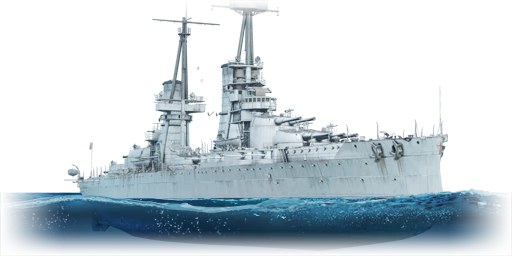
The Duilio-class, RN Andrea Doria, 1930 is a rank Italian battleship with a battle rating of (AB), (RB), and (SB). It was introduced in Update "Drone Age".
General info
Survivability and armour
Talk about the vehicle's armour. Note the most well-defended and most vulnerable zones, e.g. the ammo magazine. Evaluate the composition of components and assemblies responsible for movement and manoeuvrability. Evaluate the survivability of the primary and secondary armaments separately. Don't forget to mention the size of the crew, which plays an important role in fleet mechanics. Save tips on preserving survivability for the "Usage in battles" section. If necessary, use a graphical template to show the most well-protected or most vulnerable points in the armour.
Mobility
Write about the ship's mobility. Evaluate its power and manoeuvrability, rudder rerouting speed, stopping speed at full tilt, with its maximum forward and reverse speed.
| Mobility Characteristics | |||
|---|---|---|---|
| Game Mode | Upgrade Status | Maximum Speed (km/h) | |
| Forward | Reverse | ||
| AB | |||
| Upgraded | |||
| RB/SB | |||
| Upgraded | |||
Modifications and economy
Armament
Primary armament
| Penetration statistics | |||||||
|---|---|---|---|---|---|---|---|
| Ammunition | Type of warhead |
Penetration @ 0° Angle of Attack (mm) | |||||
| 1,000 m | 2,500 m | 5,000 m | 7,500 m | 10,000 m | 15,000 m | ||
| 305 mm SAP | SAP | 418 | 375 | 314 | 264 | 224 | 172 |
| 305 mm APCBC | APCBC | 673 | 611 | 521 | 447 | 387 | 303 |
| Shell details | |||||||||
|---|---|---|---|---|---|---|---|---|---|
| Ammunition | Type of warhead |
Velocity (m/s) |
Projectile mass (kg) |
Fuse delay (s) |
Fuse sensitivity (mm) |
Explosive mass (TNT equivalent) (kg) |
Ricochet | ||
| 0% | 50% | 100% | |||||||
| 305 mm SAP | SAP | 861 | 401.2 | 0.03 | 17 | 31 | 47° | 60° | 65° |
| 305 mm APCBC | APCBC | 861 | 452.37 | 0.035 | 17 | 5.66 | 48° | 63° | 71° |
Secondary armament
Some ships are fitted with weapons of various calibres. Secondary armaments are defined as weapons chosen with the control Select secondary weapon. Evaluate the secondary armaments and give advice on how to use them. Describe the ammunition available for the secondary armament. Provide recommendations on how to use them and which ammunition to choose. Remember that any anti-air armament, even heavy calibre weapons, belong in the next section. If there is no secondary armament, remove this section.
| Penetration statistics | |||||||
|---|---|---|---|---|---|---|---|
| Ammunition | Type of warhead |
Penetration @ 0° Angle of Attack (mm) | |||||
| 1,000 m | 2,500 m | 5,000 m | 7,500 m | 10,000 m | 15,000 m | ||
| 152 mm HE Dirompente | HE | 44 | 44 | 44 | 44 | 44 | 4 |
| 152 mm APHE Perforante | APHE | 199 | 164 | 120 | 90 | 70 | 55 |
| 152 mm APHE Perforante da 152/45-50 | APHE | 198 | 164 | 120 | 90 | 69 | 55 |
| Shell details | |||||||||
|---|---|---|---|---|---|---|---|---|---|
| Ammunition | Type of warhead |
Velocity (m/s) |
Projectile mass (kg) |
Fuse delay (s) |
Fuse sensitivity (mm) |
Explosive mass (TNT equivalent) (kg) |
Ricochet | ||
| 0% | 50% | 100% | |||||||
| 152 mm HE Dirompente | HE | 830 | 46.3 | 0 | 0.1 | 5.4 | 79° | 80° | 81° |
| 152 mm APHE Perforante | APHE | 830 | 47.1 | 0.03 | 7 | 2.62 | 47° | 60° | 65° |
| 152 mm APHE Perforante da 152/45-50 | APHE | 830 | 47 | 0.03 | 7 | 3.1 | 47° | 60° | 65° |
Anti-aircraft armament
An important part of the ship's armament responsible for air defence. Anti-aircraft armament is defined by the weapon chosen with the control Select anti-aircraft weapons. Talk about the ship's anti-air cannons and machine guns, the number of guns and their positions, their effective range, and about their overall effectiveness – including against surface targets. If there are no anti-aircraft armaments, remove this section.
Additional armament
Describe the available additional armaments of the ship: depth charges, mines, torpedoes. Talk about their positions, available ammunition and launch features such as dead zones of torpedoes. If there is no additional armament, remove this section.
Usage in battles
Describe the technique of using this ship, the characteristics of her use in a team and tips on strategy. Abstain from writing an entire guide – don't try to provide a single point of view, but give the reader food for thought. Talk about the most dangerous opponents for this vehicle and provide recommendations on fighting them. If necessary, note the specifics of playing with this vehicle in various modes (AB, RB, SB).
Pros and cons
Summarise and briefly evaluate the vehicle in terms of its characteristics and combat effectiveness. Mark its pros and cons in the bulleted list. Try not to use more than 6 points for each of the characteristics. Avoid using categorical definitions such as "bad", "good" and the like - use substitutions with softer forms such as "inadequate" and "effective".
Pros:
Cons:
History
Devblog History
While Italy was ramping up its construction of dreadnought battleships in the early 1910s, the decision was made to construct another two battleships in order to meet its naval rearmament goals. As ships of the Conte di Cavour class were already under construction at the time, shipbuilders decided to base the new class off the design of the former, while only applying some minor changes. This design was completed within six months and construction was ordered in September 1911.
Andrea Doria was laid down in March of 1912 in the Spezia dockyards and was subsequently launched the following year. However, it wouldn't be until 1916 before the warship was considered complete. This was due to numerous delays in the fitting out period, primarily due to difficulties in the supply of the ship's primary battery guns which caused significant delays. Nonetheless, the ship did see completion and officially joined the ranks of the Regia Marina in August 1916.
Despite entering service in the middle of WWI, Andrea Doria didn't see much combat action as the primary adversary - the Austro-Hungarian navy - operated in the Adriatic. However, as the Italian navy deemed the danger of submarines and minelayers for capital ships to be too great in the narrow waters of the Adriatic, most ended up not being deployed for extensive combat operations in that particular theater.
As a result, Andrea Doria survived The Great War without great incident and continued its service into the postwar period. In this time, it helped suppress a rebellion in Fiume and undertook several diplomatic missions to a number of ports in the Mediterranean and Black Sea. In August 1932 however, Andrea Doria was withdrawn from active service and placed in reserve. Starting in 1937 and going into 1940, Andrea Doria underwent a full reconstruction, which drastically changed the warship's visual appearance and combat capabilities.
Media
Excellent additions to the article would be video guides, screenshots from the game, and photos.
See also
Links to articles on the War Thunder Wiki that you think will be useful for the reader, for example:
- reference to the series of the ship;
- links to approximate analogues of other nations and research trees.
External links
| Arsenale militare marittimo della Spezia | |
|---|---|
| Battleships | |
| Conte di Cavour-class | RN Conte di Cavour |
| Duilio-class | RN Andrea Doria |
| Italy battleships | |
|---|---|
| RN Dante Alighieri* | |
| Conte di Cavour-class | RN Conte di Cavour · RN Leonardo da Vinci |
| Duilio-class | RN Duilio · RN Andrea Doria |
| Francesco Caracciolo-class | RN Francesco Caracciolo |
| * = Unique ship | |