Difference between revisions of "IJN Furutaka"
(Edits) |
|||
| Line 1: | Line 1: | ||
| − | {{Specs-Card|code=jp_cruiser_furutaka}} | + | {{Specs-Card |
| + | |code=jp_cruiser_furutaka | ||
| + | |images={{Specs-Card-Image|GarageImage_{{PAGENAME}}.jpg}} | ||
| + | }} | ||
{{About | {{About | ||
| about = Japanese heavy cruiser '''{{PAGENAME}}''' | | about = Japanese heavy cruiser '''{{PAGENAME}}''' | ||
| Line 14: | Line 17: | ||
== General info == | == General info == | ||
=== Survivability and armour === | === Survivability and armour === | ||
| + | {{Specs-Fleet-Armour}} | ||
''Talk about the vehicle's armour. Note the most well-defended and most vulnerable zones, e.g. the ammo magazine. Evaluate the composition of components and assemblies responsible for movement and manoeuvrability. Evaluate the survivability of the primary and secondary armaments separately. Don't forget to mention the size of the crew, which plays an important role in fleet mechanics. Save tips on preserving survivability for the "Usage in battles" section. If necessary, use a graphical template to show the most well-protected or most vulnerable points in the armour.'' | ''Talk about the vehicle's armour. Note the most well-defended and most vulnerable zones, e.g. the ammo magazine. Evaluate the composition of components and assemblies responsible for movement and manoeuvrability. Evaluate the survivability of the primary and secondary armaments separately. Don't forget to mention the size of the crew, which plays an important role in fleet mechanics. Save tips on preserving survivability for the "Usage in battles" section. If necessary, use a graphical template to show the most well-protected or most vulnerable points in the armour.'' | ||
=== Mobility === | === Mobility === | ||
| + | {{Specs-Fleet-Mobility}} | ||
''Write about the ship's mobility. Evaluate its power and manoeuvrability, rudder rerouting speed, stopping speed at full tilt, with its maximum forward and reverse speed.'' | ''Write about the ship's mobility. Evaluate its power and manoeuvrability, rudder rerouting speed, stopping speed at full tilt, with its maximum forward and reverse speed.'' | ||
{{NavalMobility}} | {{NavalMobility}} | ||
| + | |||
| + | === Modifications and economy === | ||
| + | {{Specs-Economy}} | ||
== Armament == | == Armament == | ||
| + | {{Specs-Fleet-Armaments}} | ||
=== Primary armament === | === Primary armament === | ||
| + | {{Specs-Fleet-Primary}} | ||
{{main|20 cm/50 3rd year type No.2 (203 mm)}} | {{main|20 cm/50 3rd year type No.2 (203 mm)}} | ||
| Line 28: | Line 38: | ||
=== Secondary armament === | === Secondary armament === | ||
| + | {{Specs-Fleet-Secondary}} | ||
{{main|120 mm/45 10th year type (120 mm)}} | {{main|120 mm/45 10th year type (120 mm)}} | ||
| Line 33: | Line 44: | ||
=== Anti-aircraft armament === | === Anti-aircraft armament === | ||
| + | {{Specs-Fleet-AA}} | ||
{{main|25 mm/60 Type 96 (25 mm)|Type 93 (13.2 mm)}} | {{main|25 mm/60 Type 96 (25 mm)|Type 93 (13.2 mm)}} | ||
| Line 41: | Line 53: | ||
''Torpedo launchers are standard equipment on many ships and boats. Torpedoes are a significant means of defeating an opponent. Evaluate the position of the torpedo launchers, discuss the ammunition available, firing specifics such as dead zones, features of the torpedoes themselves, etc. If there is no torpedo armament, remove this section.'' | ''Torpedo launchers are standard equipment on many ships and boats. Torpedoes are a significant means of defeating an opponent. Evaluate the position of the torpedo launchers, discuss the ammunition available, firing specifics such as dead zones, features of the torpedoes themselves, etc. If there is no torpedo armament, remove this section.'' | ||
| + | |||
| + | === Additional armament === | ||
| + | {{Specs-Fleet-Additional}} | ||
| + | ''Describe the available additional armaments of the ship: depth charges, mines, torpedoes. Talk about their positions, available ammunition and launch features such as dead zones of torpedoes.'' | ||
| + | |||
| + | ''If there is no additional armament, remove this section.'' | ||
== Usage in battles == | == Usage in battles == | ||
Revision as of 11:55, 29 December 2020

Contents
| This page is about the Japanese heavy cruiser IJN Furutaka. For other uses, see Furutaka (Family). |
Description
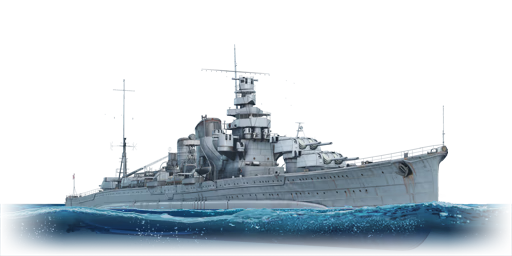
The Furutaka-class, IJN Furutaka, 1942 is a rank Japanese heavy cruiser
with a battle rating of (AB), (RB), and (SB). It was introduced in Update 1.89 "Imperial Navy".
General info
Survivability and armour
Talk about the vehicle's armour. Note the most well-defended and most vulnerable zones, e.g. the ammo magazine. Evaluate the composition of components and assemblies responsible for movement and manoeuvrability. Evaluate the survivability of the primary and secondary armaments separately. Don't forget to mention the size of the crew, which plays an important role in fleet mechanics. Save tips on preserving survivability for the "Usage in battles" section. If necessary, use a graphical template to show the most well-protected or most vulnerable points in the armour.
Mobility
Write about the ship's mobility. Evaluate its power and manoeuvrability, rudder rerouting speed, stopping speed at full tilt, with its maximum forward and reverse speed.
| Mobility Characteristics | |||
|---|---|---|---|
| Game Mode | Upgrade Status | Maximum Speed (km/h) | |
| Forward | Reverse | ||
| AB | |||
| Upgraded | |||
| RB/SB | |||
| Upgraded | |||
Modifications and economy
Armament
Primary armament
Provide information about the characteristics of the primary armament. Evaluate their efficacy in battle based on their reload speed, ballistics and the capacity of their shells. Add a link to the main article about the weapon: {{main|Weapon name (calibre)}}. Broadly describe the ammunition available for the primary armament, and provide recommendations on how to use it and which ammunition to choose.
Secondary armament
Some ships are fitted with weapons of various calibres. Secondary armaments are defined as weapons chosen with the control Select secondary weapon. Evaluate the secondary armaments and give advice on how to use them. Describe the ammunition available for the secondary armament. Provide recommendations on how to use them and which ammunition to choose. Remember that any anti-air armament, even heavy calibre weapons, belong in the next section. If there is no secondary armament, remove this section.
Anti-aircraft armament
An important part of the ship's armament responsible for air defence. Anti-aircraft armament is defined by the weapon chosen with the control Select anti-aircraft weapons. Talk about the ship's anti-air cannons and machine guns, the number of guns and their positions, their effective range, and about their overall effectiveness – including against surface targets. If there are no anti-aircraft armaments, remove this section.
Torpedo armament
Torpedo launchers are standard equipment on many ships and boats. Torpedoes are a significant means of defeating an opponent. Evaluate the position of the torpedo launchers, discuss the ammunition available, firing specifics such as dead zones, features of the torpedoes themselves, etc. If there is no torpedo armament, remove this section.
Additional armament
Describe the available additional armaments of the ship: depth charges, mines, torpedoes. Talk about their positions, available ammunition and launch features such as dead zones of torpedoes.
If there is no additional armament, remove this section.
Usage in battles
Describe the technique of using this ship, the characteristics of her use in a team and tips on strategy. Abstain from writing an entire guide – don't try to provide a single point of view, but give the reader food for thought. Talk about the most dangerous opponents for this vehicle and provide recommendations on fighting them. If necessary, note the specifics of playing with this vehicle in various modes (AB, RB, SB).
Modules
| Tier | Seakeeping | Unsinkability | Firepower | |||
|---|---|---|---|---|---|---|
| I | Dry-Docking | Tool Set | 20.3 cm Type 91 AP | 20.3 cm Type 0 HE-TF | Anti-Air Armament Targeting | |
| II | Rudder Replacement | Fire Protection System | Smokescreen | 120 mm Type 0 HE | Auxiliary Armament Targeting | |
| III | Propeller Replacement | Shrapnel Protection | Ventilation | Improved Rangefinder | Primary Armament Targeting | |
| IV | Engine Maintenance | New Pumps | Ammo Wetting | |||
Pros and cons
Pros:
- 6 x 203 mm (8 inch) cannons
- Very durable against destroyers
- Excellent torpedoes
Cons:
- Early war Japanese fit
- Weak anti-air capability
- Slow turret traverse
- As for a heavy cruiser
- Torpedo turrets can't both be used at once and has to turn the whole hull to make use of the other
- Large target and usually priority targeted over other vessels
History
Furutaka, although being the lead ship of her class, was laid down after her sister ship Kako in December 1922 at the Mitsubishi shipyard in Nagasaki. Despite construction on Furutaka starting later than on her sister ship, she was completed sooner and was commissioned into service with the IJN in March 1926.
During the interwar period, Furutaka served alongside her sistership before being assigned as a reserve in the early 1930s. During this time, Furutaka underwent overhaul work which, amongst other changes, modernized her anti-air armament. Following the completion of the modernization effort, Furutaka was recommissioned into active service.
However, by 1937 Furutaka found herself once again in drydock for another major overhaul. This time around, Furutaka received upgrades in almost all aspects. Most notably, her primary armament was upgraded to three dual 8-inch guns, a number of smaller calibre AA weapons were added and the previously integrated torpedo launchers were replaced with two quadruple launchers abaft of the funnels. This increased Furutaka's overall displacement significantly, prompting the addition of bulges to the hull in order to preserve stability and also act as an additional layer of torpedo protection.
Modernized for war, Furutaka began her service career by taking part in the invasion of Guam in December 1941 and later, Wake Island. In early 1942, Furutaka assisted in Japanese landings in New Guinea and the Solomon Islands.
Furutaka also took part in the Battle of the Coral Sea in May 1942, securing the capture of Tulai island, escorting the Shōhō carrier, and then escorting the damaged aircraft carrier Shōkaku back to Truk. After reorganization in the Japanese navy, Furutaka participated in the successful Battle of Savo Island, witnessing the sinking of her sister ship Kako while Japanese forces returned to Rabaul. However, Furutaka joined her sister ship in the deep shortly afterwards, being sunk by American fire during the Battle of Cape Esperance later in October 1942.
- From Devblog
Media
Excellent additions to the article would be video guides, screenshots from the game, and photos.
See also
Links to articles on the War Thunder Wiki that you think will be useful for the reader, for example:
- reference to the series of the ship;
- links to approximate analogues of other nations and research trees.
External links
| Japan heavy cruisers | |
|---|---|
| Furutaka-class | IJN Furutaka · IJN Kako |
| Aoba-class | IJN Aoba |
| Myōkō-class | IJN Myoko · IJN Haguro |
| Mogami-class | IJN Mogami |
| Tone-class | IJN Tone |