Difference between revisions of "Challenger 2 OES"
m (Reverted edits by U140848286 (talk) to last revision by U44629479) |
(→Description) |
||
| Line 11: | Line 11: | ||
== Description == | == Description == | ||
<!-- ''In the description, the first part should be about the history of the creation and combat usage of the vehicle, as well as its key features. In the second part, tell the reader about the ground vehicle in the game. Insert a screenshot of the vehicle, so that if the novice player does not remember the vehicle by name, he will immediately understand what kind of vehicle the article is talking about.'' --> | <!-- ''In the description, the first part should be about the history of the creation and combat usage of the vehicle, as well as its key features. In the second part, tell the reader about the ground vehicle in the game. Insert a screenshot of the vehicle, so that if the novice player does not remember the vehicle by name, he will immediately understand what kind of vehicle the article is talking about.'' --> | ||
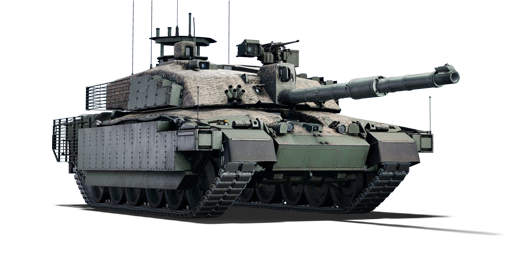
| − | The Challenger 2 OES is a modification for the tank made to improve its survivability in high intensity battles. With the introduction of ERA blocks covering the sides and front of the vehicle, this protection | + | The '''Challenger 2 OES''' is a modification for the Challenger 2 tank made to improve its survivability in high intensity battles. With the introduction of ERA blocks covering the sides and front of the vehicle, this protection was meant to deal specially with RPGs and ATGMs in urban combat. The vehicle also received updated protection against IEDs. The upgrade started development based on the [[Challenger 2 TES]], which is almost identical; this upgrade was created as a response to the asymmetric warfare scenario of Iraq 2002, in which IEDs and urban combat doomed many NATO tanks due to their poor protection on the sides. The US developed a similar upgrade with the [[M1A2 SEP|TUSK ERA]] package for their M1 Abrams tanks. |
| − | Introduced in [[Update "Air Superiority"]], the Challenger 2 OES is very similar to other Challenger 2 tanks. However the increased weight due to the ERA and added composite screens does not include an upgraded engine, which means that the mobility of the Challenger 2 OES is mediocre when compared to earlier Challenger 2s. However, this comes with increased protection against both APFSDS projectiles and ATGMs, the ERA and composite screens are enough to increase the protection against other tanks in critical areas, while they also increase the chances of enemy ATGMs not penetrating the vehicle on the sides of the tank and the turret. However the weak spot in the lower front plate is still present so take that into consideration and hide your hull whenever possible. | + | Introduced in [[Update "Air Superiority"]], the Challenger 2 OES is very similar to other Challenger 2 tanks. However, the increased weight due to the ERA and added composite screens does not include an upgraded engine, which means that the mobility of the Challenger 2 OES is mediocre when compared to earlier Challenger 2s. However, this comes with increased protection against both APFSDS projectiles and ATGMs, the ERA and composite screens are enough to increase the protection against other tanks in critical areas, while they also increase the chances of enemy ATGMs not penetrating the vehicle on the sides of the tank and the turret. However, the weak spot in the lower front plate is still present so take that into consideration and hide your hull whenever possible. |
== General info == | == General info == | ||
Revision as of 21:06, 11 July 2024
| This page is about the premium British medium tank Challenger 2 OES. For other versions, see Challenger 2 (Family). |

Contents
Description
The Challenger 2 OES is a modification for the Challenger 2 tank made to improve its survivability in high intensity battles. With the introduction of ERA blocks covering the sides and front of the vehicle, this protection was meant to deal specially with RPGs and ATGMs in urban combat. The vehicle also received updated protection against IEDs. The upgrade started development based on the Challenger 2 TES, which is almost identical; this upgrade was created as a response to the asymmetric warfare scenario of Iraq 2002, in which IEDs and urban combat doomed many NATO tanks due to their poor protection on the sides. The US developed a similar upgrade with the TUSK ERA package for their M1 Abrams tanks.
Introduced in Update "Air Superiority", the Challenger 2 OES is very similar to other Challenger 2 tanks. However, the increased weight due to the ERA and added composite screens does not include an upgraded engine, which means that the mobility of the Challenger 2 OES is mediocre when compared to earlier Challenger 2s. However, this comes with increased protection against both APFSDS projectiles and ATGMs, the ERA and composite screens are enough to increase the protection against other tanks in critical areas, while they also increase the chances of enemy ATGMs not penetrating the vehicle on the sides of the tank and the turret. However, the weak spot in the lower front plate is still present so take that into consideration and hide your hull whenever possible.
General info
Survivability and armour
Describe armour protection. Note the most well protected and key weak areas. Appreciate the layout of modules as well as the number and location of crew members. Is the level of armour protection sufficient, is the placement of modules helpful for survival in combat? If necessary use a visual template to indicate the most secure and weak zones of the armour.
Armour type:
| Armour | Front (Slope angle) | Sides | Rear | Roof |
|---|---|---|---|---|
| Hull | ___ mm | ___ mm Top ___ mm Bottom |
___ mm | ___ - ___ mm |
| Turret | ___ - ___ mm Turret front ___ mm Gun mantlet |
___ - ___ mm | ___ - ___ mm | ___ - ___ mm |
| Cupola | ___ mm | ___ mm | ___ mm | ___ mm |
Notes:
Mobility
Write about the mobility of the ground vehicle. Estimate the specific power and manoeuvrability, as well as the maximum speed forwards and backwards.
| Game Mode | Max Speed (km/h) | Weight (tons) | Engine power (horsepower) | Power-to-weight ratio (hp/ton) | |||
|---|---|---|---|---|---|---|---|
| Forward | Reverse | Stock | Upgraded | Stock | Upgraded | ||
| Arcade | Expression error: Unexpected * operator. | 1,886 | Expression error: Unexpected round operator. | __.__ | |||
| Realistic | 1,076 | Expression error: Unexpected round operator. | __.__ | ||||
Modifications and economy
Armaments
Main armament
Give the reader information about the characteristics of the main gun. Assess its effectiveness in a battle based on the reloading speed, ballistics and the power of shells. Do not forget about the flexibility of the fire, that is how quickly the cannon can be aimed at the target, open fire on it and aim at another enemy. Add a link to the main article on the gun: {{main|Name of the weapon}}. Describe in general terms the ammunition available for the main gun. Give advice on how to use them and how to fill the ammunition storage.
| 120 mm L30A1 | Turret rotation speed (°/s) | Reloading rate (seconds) | |||||||||||
|---|---|---|---|---|---|---|---|---|---|---|---|---|---|
| Mode | Capacity | Vertical | Horizontal | Stabilizer | Stock | Upgraded | Full | Expert | Aced | Stock | Full | Expert | Aced |
| Arcade | 49 | -10°/+20° | ±180° | Two-plane | 29.5 | 40.8 | 49.6 | 54.9 | 58.4 | 6.50 | 5.75 | 5.30 | 5.00 |
| Realistic | 18.4 | 21.7 | 26.4 | 29.2 | 31.0 | ||||||||
Ammunition
| Penetration statistics | |||||||
|---|---|---|---|---|---|---|---|
| Ammunition | Type of warhead |
Penetration @ 0° Angle of Attack (mm) | |||||
| 10 m | 100 m | 500 m | 1,000 m | 1,500 m | 2,000 m | ||
| Shot L23A1 | APFSDS | 396 | 394 | 387 | 376 | 367 | 357 |
| Shell L31A7 | HESH | 152 | 152 | 152 | 152 | 152 | 152 |
| L26 | APFSDS | 493 | 491 | 487 | 481 | 474 | 468 |
| L27A1 | APFSDS | 564 | 562 | 557 | 551 | 545 | 538 |
| Shell details | ||||||||||||
|---|---|---|---|---|---|---|---|---|---|---|---|---|
| Ammunition | Type of warhead |
Velocity (m/s) |
Projectile mass (kg) |
Fuse delay (m) |
Fuse sensitivity (mm) |
Explosive mass (TNT equivalent) (kg) |
Ricochet | |||||
| 0% | 50% | 100% | ||||||||||
| Shot L23A1 | APFSDS | 1,535 | 3.89 | - | - | - | 78° | 80° | 81° | |||
| Shell L31A7 | HESH | 670 | 17.34 | 0.1 | 4 | 6.53 | 73° | 77° | 80° | |||
| L26 | APFSDS | 1,650 | 4.3 | - | - | - | 78° | 80° | 81° | |||
| L27A1 | APFSDS | 1,650 | 4.3 | - | - | - | 78° | 80° | 81° | |||
| Smoke shell characteristics | ||||||
|---|---|---|---|---|---|---|
| Ammunition | Velocity (m/s) |
Projectile mass (kg) |
Screen radius (m) |
Screen deploy time (s) |
Screen hold time (s) |
Explosive mass (TNT equivalent) (g) |
| L34 | 670 | 17.1 | 20 | 5 | 25 | 50 |
Ammo racks
| Full ammo |
1st rack empty |
2nd rack empty |
3rd rack empty |
4th rack empty |
5th rack empty |
6th rack empty |
Visual discrepancy |
|---|---|---|---|---|---|---|---|
| 49 | __ (+__) | __ (+__) | __ (+__) | __ (+__) | __ (+__) | __ (+__) | __ |
Machine guns
Offensive and anti-aircraft machine guns not only allow you to fight some aircraft but also are effective against lightly armoured vehicles. Evaluate machine guns and give recommendations on its use.
| 12.7 mm M2HB | ||||
|---|---|---|---|---|
| Mount | Capacity (Belt) | Fire rate | Vertical | Horizontal |
| Pintle | 1,000 (200) | 575 | -10°/+50° | ±180° |
| 7.62 mm L94A1 | ||||
|---|---|---|---|---|
| Mount | Capacity (Belt) | Fire rate | Vertical | Horizontal |
| Coaxial | 2,000 (2,000) | 600 | - | - |
Usage in battles
Describe the tactics of playing in the vehicle, the features of using vehicles in the team and advice on tactics. Refrain from creating a "guide" - do not impose a single point of view but instead give the reader food for thought. Describe the most dangerous enemies and give recommendations on fighting them. If necessary, note the specifics of the game in different modes (AB, RB, SB).
Pros and cons
Pros:
- Retains pros from previous challenger 2:
- Impressive chemical protection on the front and sides
- Impressive kinetic protection on either side of the cannon breech, allowing for efficient hull down combat
- Access to unique and powerful HESH round
- Very accurate L30A1 120 mm gun, can even fire HESH accurately at a range of several kilometres
- Fast reload
- Roof mounted machine gun has access to thermal and can be used as a makeshift CITV for scouting (but not firing, unfortunately)
- Access to 12.7 mm machine gun, a rare luxury on British tanks
- Since it is a premium tank, its RP and SL gains are doubled and it can research any British tanks currently in the game
Cons:
- The jammer is useless in-game and begs other tanks to scout it out or use HE on it
- Heaviest MBT in the game with a very poor hp/ton ratio; very poor acceleration
- Slow turret traverse speed for the BR
- Very poor steering, turning is slow and costs a great deal of speed, which takes a long time to regain
- In most situations, can only reach around 40 km/h (25 mph)
- Also retains weaknesses of previous challenger 2 models:
- Same ammunition options as the previous Challengers
- Frontal armour is weak at the lower frontal plate, drivers port, and cannon breech
- L27A1 has low penetration compared to other top rank NATO ammunition, however reload speed does compensate for this
- Cannot maintain the short reload time after the first-stage ammo rack (4 rounds) has been depleted
History
Describe the history of the creation and combat usage of the vehicle in more detail than in the introduction. If the historical reference turns out to be too long, take it to a separate article, taking a link to the article about the vehicle and adding a block "/History" (example: https://wiki.warthunder.com/(Vehicle-name)/History) and add a link to it here using the main template. Be sure to reference text and sources by using <ref></ref>, as well as adding them at the end of the article with <references />. This section may also include the vehicle's dev blog entry (if applicable) and the in-game encyclopedia description (under === In-game description ===, also if applicable).
Media
- Skins
See also
- Related development
External links
Paste links to sources and external resources, such as:
- topic on the official game forum;
- other literature.
| Britain medium tanks | |
|---|---|
| Valentine | Valentine I · Valentine IX · Valentine XI |
| Cromwell | Cromwell I · Cromwell V · Cromwell V (RP-3) |
| Cromwell derivatives | Challenger · Avenger · Comet I · Comet I "Iron Duke IV" · Charioteer Mk VII |
| Centurion | Centurion Mk 1 · Centurion Mk.2 · Centurion Mk 3 · Centurion Mk.5 AVRE · Centurion Mk 10 · Centurion Action X · FV4202 |
| Vickers MBT | Vickers Mk.1 · Vickers Mk.3 · Vickers Mk.7 |
| Chieftain | Chieftain Mk 3 · Chieftain Mk 5 · Chieftain Mk 10 |
| Challenger 1 | Challenger Mk.2 · Challenger Mk.3 · Challenger DS |
| Challenger 2 | Challenger 2 · Challenger 2 (2F) · Challenger 2 TES · Challenger 2 OES · Challenger 2E · Challenger 2 Black Night |
| Challenger 3 | Challenger 3 TD |
| Australia | A.C.I · A.C.IV · Centurion Mk.5/1 |
| South Africa | Olifant Mk.1A · Olifant Mk.2 · TTD |
| India | Vijayanta · Bhishma TWMP |
| Israel | ▄Sho't Kal Dalet |
| Jordan | Khalid |
| Sweden | ▄Strv 81 (RB 52) |
| USA | Grant I · Sherman II · Sherman Firefly · Sherman IC "Trzyniec" |
| Britain premium ground vehicles | |
|---|---|
| Light tanks | A13 Mk I (3rd R.T.R.) · A13 Mk II 1939 · AEC Mk II · Crusader "The Saint" · Rooikat 105 |
| Medium tanks | A.C.I · Grant I · Cromwell V (RP-3) · Sherman IC "Trzyniec" · A.C.IV · Comet I "Iron Duke IV" |
| Centurion Mk.2 · ▄Strv 81 (RB 52) · Centurion Mk.5 AVRE · Centurion Mk.5/1 · ▄Sho't Kal Dalet · Centurion Action X | |
| Vijayanta · Khalid · Challenger DS · Challenger 2 OES | |
| Heavy tanks | Independent · Matilda Hedgehog · Excelsior · TOG II · Churchill Crocodile · Black Prince |
| Tank destroyers | Alecto I · Achilles (65 Rg.) · QF 3.7 Ram |