Difference between revisions of "Z43"
(→History: pretty condensed history added) (Tag: Visual edit) |
(→Survivability and armour: as well as secondary armament) (Tag: Visual edit) |
||
| Line 11: | Line 11: | ||
=== Survivability and armour === | === Survivability and armour === | ||
{{Specs-Fleet-Armour}} | {{Specs-Fleet-Armour}} | ||
| − | + | The Z43 has very little armor on top of its 8mm and 16mm of structural steel on the superstructure and hull, respectively. This is typical of destroyers of all nations, save for certain American destroyers with additional hull antifragmentation plating. The gunshields for the main armament of 12.8cm cannons as well as for the 2cm anti-aircraft autocannons are 8mm. This gun armor is only capable of stopping .50 caliber/12.7mm AP rounds, or up to 30mm HE rounds. However, against other destroyers there is effectively no armor protection on the Z43 that can stop incoming fire. | |
| + | |||
| + | Overall, the survivability of the Z43 is moderate, though there are some particularly worrisome areas. The boilers and propulsion stretches the entirety of the midships, and enemy fire that strikes this wide area will easily reduce the Z43's crew count as well as slow the ship down. Additionally, most of the ammunition stowage is nominally under the waterline, but the farthest forward magazine does protrude above the waterline. This makes the fore of the Z43 more vulnerable to ammunition detonation. | ||
=== Mobility === | === Mobility === | ||
| Line 41: | Line 43: | ||
{{main|SK C/30 (37 mm)}} | {{main|SK C/30 (37 mm)}} | ||
| − | + | The secondary armament of the Z43 consists of two dual 3.7cm SK C/30 cannons, to the port and starboard sides of the aft-most funnel. These guns are manually loaded, and suffer from an anemic firerate of 30 rounds per minute. This, in addition to a lack of timed-fuze ammunition and unimpressive traverse speed, makes the 37mm guns unable to reliably combat air targets. Though these guns fare marginally better against surface targets, the 37mm shells are still largely impotent against destroyers or even large coastal vessels. | |
{{:SK C/30 (37 mm)/Ammunition|37 mm Spgr L/4.1 Lh 37, 37 mm Psgr L'spur Zerl}} | {{:SK C/30 (37 mm)/Ammunition|37 mm Spgr L/4.1 Lh 37, 37 mm Psgr L'spur Zerl}} | ||
| Line 49: | Line 51: | ||
{{main|2 cm/65 C/38 (20 mm)|2 cm/65 Flakvierling 38 (20 mm)}} | {{main|2 cm/65 C/38 (20 mm)|2 cm/65 Flakvierling 38 (20 mm)}} | ||
| − | + | The dedicated anti-aircraft suite of the Z43 consists of 14 total 20mm/65 automatic cannons, divided into three quadruple mounts and two single mounts. This armament is somewhat impacted by the placement of the quadruple mounts, which generally only allow two out of three mounts to fire at a single target at a time, though the armament is still generally sufficient to deter unmaneuverable aircraft. More agile aircraft or high-altitude bombers will be able to avoid this relatively low caliber air defense, though, and pose a greater threat to the Z43. | |
=== Additional armament === | === Additional armament === | ||
| Line 55: | Line 57: | ||
{{main|G7a (533 mm)|WBG depth charge}} | {{main|G7a (533 mm)|WBG depth charge}} | ||
| − | + | The Z43 is capable of carrying eight G7a torpedoes and four WBG depth charges launched out of a bomb mortar. The G7a torpedoes are satisfactory, with a good explosive filler of more than 350kg of TNT equivalent, as well as a good top speed of 80km/h and manageable range of 6km without the "Torpedo Mode" modification. These torpedoes are most effective against other destroyers in their base form, as longer range but slower torpedoes are more unwieldy against destroyers. That being said, the range of 6km is not particularly impressive, so the G7a torpedoes should be treated as a close-range weapon rather than anything else in order to get the most out of their characteristics. | |
| + | |||
| + | The WBG depth charges are less impressive, with an explosive filler of 100kg of TNT equivalency and practically zero range. Against surface targets, these depth charges will be ineffective since it is exceedingly unlikely for any engagement to get close enough to be able to use the depth charges. | ||
== Usage in battles == | == Usage in battles == | ||
| Line 72: | Line 76: | ||
== History == | == History == | ||
| − | Z43 was a Type 1936B destroyer built for Nazi Germany's Kriegsmarine during World War 2. As a Type 1936B, Z43 possessed specifications commonly seen in German destroyers of her class from this period, including an armament of five 12. | + | The Z43 was a Type 1936B destroyer built for Nazi Germany's Kriegsmarine during World War 2. As a Type 1936B, Z43 possessed specifications commonly seen in German destroyers of her class from this period, including an armament of five 12.8cm main guns supported by lighter anti-aircraft weapons. She was completed in mid-1944 at the AG Weser shipyard in Bremen. During the war, Z43 spent her time operating in the Baltic Sea. Her duties included escorting German ships, laying defensive minefields, and providing artillery support by shelling Soviet forces ashore. In December 1944, Z43 participated in a minelaying operation with her sister ships Z35 and Z36. This mission resulted in a disaster when Z35 and Z36 accidentally sailed into a German minefield and were both sunk. |
Z43 suffered damage herself on April 10, 1945 when she struck a mine, which blasted a large hole in her hull. Despite temporary repairs, she was deemed beyond saving. On May 3rd, with Allied forces closing in, Z43 was scuttled near Flensburg to prevent her from being seized by the advancing Allies. In her final months, Z43 provided fire support during evacuations from coastal cities like Kolberg and Danzig Bay. Badly damaged by the mine hit in April, Z43 expended her last ammunition before scuttling to avoid capture just two weeks later, bringing her war service to an end. | Z43 suffered damage herself on April 10, 1945 when she struck a mine, which blasted a large hole in her hull. Despite temporary repairs, she was deemed beyond saving. On May 3rd, with Allied forces closing in, Z43 was scuttled near Flensburg to prevent her from being seized by the advancing Allies. In her final months, Z43 provided fire support during evacuations from coastal cities like Kolberg and Danzig Bay. Badly damaged by the mine hit in April, Z43 expended her last ammunition before scuttling to avoid capture just two weeks later, bringing her war service to an end. | ||
Revision as of 23:10, 18 November 2023

Contents
Description
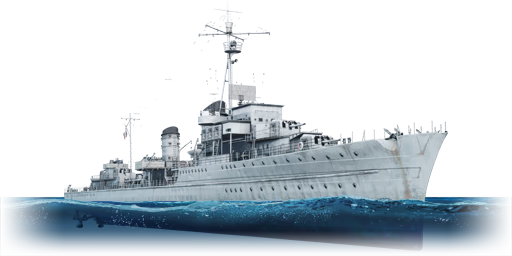
The Type 1936B, Z43, 1944 is a rank German destroyer with a battle rating of (AB), (RB), and (SB). It was introduced in Update 1.93 "Shark Attack".
General info
Survivability and armour
The Z43 has very little armor on top of its 8mm and 16mm of structural steel on the superstructure and hull, respectively. This is typical of destroyers of all nations, save for certain American destroyers with additional hull antifragmentation plating. The gunshields for the main armament of 12.8cm cannons as well as for the 2cm anti-aircraft autocannons are 8mm. This gun armor is only capable of stopping .50 caliber/12.7mm AP rounds, or up to 30mm HE rounds. However, against other destroyers there is effectively no armor protection on the Z43 that can stop incoming fire.
Overall, the survivability of the Z43 is moderate, though there are some particularly worrisome areas. The boilers and propulsion stretches the entirety of the midships, and enemy fire that strikes this wide area will easily reduce the Z43's crew count as well as slow the ship down. Additionally, most of the ammunition stowage is nominally under the waterline, but the farthest forward magazine does protrude above the waterline. This makes the fore of the Z43 more vulnerable to ammunition detonation.
Mobility
Write about the ship's mobility. Evaluate its power and manoeuvrability, rudder rerouting speed, stopping speed at full tilt, with its maximum forward and reverse speed.
| Mobility Characteristics | |||||
|---|---|---|---|---|---|
| Game Mode | Upgrade Status | Maximum Speed (km/h) | Turn Time (s) | Turn Radius (m) | |
| Forward | Reverse | ||||
| AB | Stock | 62 | 23 | ~135.9 | ~264.36 |
| Upgraded | ___ | ___ | |||
| RB/SB | |||||
| Upgraded | ___ | ___ | |||
Modifications and economy
Armament
Primary armament
Provide information about the characteristics of the primary armament. Evaluate their efficacy in battle based on their reload speed, ballistics and the capacity of their shells. Add a link to the main article about the weapon: {{main|Weapon name (calibre)}}. Broadly describe the ammunition available for the primary armament, and provide recommendations on how to use it and which ammunition to choose.
| Penetration statistics | |||||||
|---|---|---|---|---|---|---|---|
| Ammunition | Type of warhead |
Penetration @ 0° Angle of Attack (mm) | |||||
| 1,000 m | 2,500 m | 5,000 m | 7,500 m | 10,000 m | 15,000 m | ||
| Sprgr. L/4.4 Kpf.Z | HE | 24 | 24 | 24 | 24 | 24 | 24 |
| Sprgr. L/4.4 Bd.Z | HE | 59 | 50 | 38 | 30 | 24 | 18 |
| Sprgr. L/4.4 Zt.Z | HE-TF | 24 | 24 | 24 | 24 | 24 | 24 |
| Shell details | ||||||||||||
|---|---|---|---|---|---|---|---|---|---|---|---|---|
| Ammunition | Type of warhead |
Velocity (m/s) |
Projectile mass (kg) |
Fuse delay (s) |
Fuse sensitivity (mm) |
Explosive mass (TNT equivalent) (kg) |
Ricochet | |||||
| 0% | 50% | 100% | ||||||||||
| Sprgr. L/4.4 Kpf.Z | HE | 830 | 28 | 0 | 0.1 | 1.91 | 79° | 80° | 81° | |||
| Sprgr. L/4.4 Bd.Z | HE | 830 | 28 | 0.015 | 5 | 1.4 | 79° | 80° | 81° | |||
| Sprgr. L/4.4 Zt.Z | HE-TF | 830 | 28 | 0 | 0.1 | 1.91 | 79° | 80° | 81° | |||
Secondary armament
The secondary armament of the Z43 consists of two dual 3.7cm SK C/30 cannons, to the port and starboard sides of the aft-most funnel. These guns are manually loaded, and suffer from an anemic firerate of 30 rounds per minute. This, in addition to a lack of timed-fuze ammunition and unimpressive traverse speed, makes the 37mm guns unable to reliably combat air targets. Though these guns fare marginally better against surface targets, the 37mm shells are still largely impotent against destroyers or even large coastal vessels.
| Penetration statistics | |||||||
|---|---|---|---|---|---|---|---|
| Ammunition | Type of warhead |
Penetration @ 0° Angle of Attack (mm) | |||||
| 10 m | 100 m | 500 m | 1,000 m | 1,500 m | 2,000 m | ||
| Spgr L/4.1 Lh 37 | HE | 2 | 2 | 2 | 2 | 2 | 2 |
| Psgr L'spur Zerl | APCBC | 87 | 84 | 71 | 58 | 48 | 39 |
| Shell details | ||||||||||||
|---|---|---|---|---|---|---|---|---|---|---|---|---|
| Ammunition | Type of warhead |
Velocity (m/s) |
Projectile mass (kg) |
Fuse delay (m) |
Fuse sensitivity (mm) |
Explosive mass (TNT equivalent) (g) |
Ricochet | |||||
| 0% | 50% | 100% | ||||||||||
| Spgr L/4.1 Lh 37 | HE | 1,000 | 0.75 | 0 | 0.1 | 27.4 | 79° | 80° | 81° | |||
| Psgr L'spur Zerl | APCBC | 1,000 | 0.82 | 1.3 | 15 | 37.4 | 48° | 63° | 71° | |||
Anti-aircraft armament
The dedicated anti-aircraft suite of the Z43 consists of 14 total 20mm/65 automatic cannons, divided into three quadruple mounts and two single mounts. This armament is somewhat impacted by the placement of the quadruple mounts, which generally only allow two out of three mounts to fire at a single target at a time, though the armament is still generally sufficient to deter unmaneuverable aircraft. More agile aircraft or high-altitude bombers will be able to avoid this relatively low caliber air defense, though, and pose a greater threat to the Z43.
Additional armament
The Z43 is capable of carrying eight G7a torpedoes and four WBG depth charges launched out of a bomb mortar. The G7a torpedoes are satisfactory, with a good explosive filler of more than 350kg of TNT equivalent, as well as a good top speed of 80km/h and manageable range of 6km without the "Torpedo Mode" modification. These torpedoes are most effective against other destroyers in their base form, as longer range but slower torpedoes are more unwieldy against destroyers. That being said, the range of 6km is not particularly impressive, so the G7a torpedoes should be treated as a close-range weapon rather than anything else in order to get the most out of their characteristics.
The WBG depth charges are less impressive, with an explosive filler of 100kg of TNT equivalency and practically zero range. Against surface targets, these depth charges will be ineffective since it is exceedingly unlikely for any engagement to get close enough to be able to use the depth charges.
Usage in battles
Describe the technique of using this ship, the characteristics of her use in a team and tips on strategy. Abstain from writing an entire guide – don't try to provide a single point of view, but give the reader food for thought. Talk about the most dangerous opponents for this vehicle and provide recommendations on fighting them. If necessary, note the specifics of playing with this vehicle in various modes (AB, RB, SB).
Pros and cons
Summarise and briefly evaluate the vehicle in terms of its characteristics and combat effectiveness. Mark its pros and cons in the bulleted list. Try not to use more than 6 points for each of the characteristics. Avoid using categorical definitions such as "bad", "good" and the like - use substitutions with softer forms such as "inadequate" and "effective".
Pros:
Cons:
History
The Z43 was a Type 1936B destroyer built for Nazi Germany's Kriegsmarine during World War 2. As a Type 1936B, Z43 possessed specifications commonly seen in German destroyers of her class from this period, including an armament of five 12.8cm main guns supported by lighter anti-aircraft weapons. She was completed in mid-1944 at the AG Weser shipyard in Bremen. During the war, Z43 spent her time operating in the Baltic Sea. Her duties included escorting German ships, laying defensive minefields, and providing artillery support by shelling Soviet forces ashore. In December 1944, Z43 participated in a minelaying operation with her sister ships Z35 and Z36. This mission resulted in a disaster when Z35 and Z36 accidentally sailed into a German minefield and were both sunk.
Z43 suffered damage herself on April 10, 1945 when she struck a mine, which blasted a large hole in her hull. Despite temporary repairs, she was deemed beyond saving. On May 3rd, with Allied forces closing in, Z43 was scuttled near Flensburg to prevent her from being seized by the advancing Allies. In her final months, Z43 provided fire support during evacuations from coastal cities like Kolberg and Danzig Bay. Badly damaged by the mine hit in April, Z43 expended her last ammunition before scuttling to avoid capture just two weeks later, bringing her war service to an end.
Media
- Skins
See also
- Related development
External links
Paste links to sources and external resources, such as:
- topic on the official game forum;
- other literature.
| Deutsche Schiff- und Maschinenbau Aktiengesellschaft | |
|---|---|
| Destroyers | |
| Type 1934A | Kleber** |
| Type 1936 | Z20 Karl Galster · Z22 Anton Schmitt |
| Type 1936A | Z25 · Marceau*** · Z32 |
| Type 1936B | Z43 |
| Type 1936C | Z46 · Z47 |
| Battleships | |
| Nassau-class | SMS Westfalen* |
| *Previously Aktien-Gesellschaft „Weser" | |
| **Z6 Theodor Riedel before war reparation to France | |
| ***Z31 before war reparation to France | |
| Germany destroyers | |
|---|---|
| Torpedo boats | |
| Type 1924 | Jaguar · Leopard · Luchs |
| Type 1939 | T22 · T31 |
| Destoyers | |
| Type 1934A | Z12 Erich Giese · Z15 Erich Steinbrinck |
| Type 1936 | Z20 Karl Galster · Z22 Anton Schmitt |
| Type 1936A | Z25 · Z32 |
| Type 1936B | Z43 |
| Type 1936C | Z46 · Z47 |