Difference between revisions of "MiG-15bis (Germany)"
(→Description: New Description Project) (Tag: Visual edit) |
(→Description) |
||
| Line 11: | Line 11: | ||
== Description == | == Description == | ||
<!-- ''In the description, the first part should be about the history of and the creation and combat usage of the aircraft, as well as its key features. In the second part, tell the reader about the aircraft in the game. Insert a screenshot of the vehicle, so that if the novice player does not remember the vehicle by name, he will immediately understand what kind of vehicle the article is talking about.'' --> | <!-- ''In the description, the first part should be about the history of and the creation and combat usage of the aircraft, as well as its key features. In the second part, tell the reader about the aircraft in the game. Insert a screenshot of the vehicle, so that if the novice player does not remember the vehicle by name, he will immediately understand what kind of vehicle the article is talking about.'' --> | ||
| − | During the early '50s, a design | + | During the early '50s, a design proposal for an upgraded MiG-15, titled the MiG-15bis (second), was issued. The main upgrade was the new VK-1 engine, offering a lot more thrust. The East German air force would start receiving the upgraded MiG-15bis not long after it entered service with the USSR and proved itself there. The MiG-15bis would serve as the frontline fighter of the NVA, being later supplemented by the MiG-17 and its licensed copy, the [[Lim-5P (Germany)|Lim-5]], before being ultimately replaced by proper 3rd generation fighters such as the MiG-21F in the late '60s and early '70s. |
| − | Introduced in [[Update 1.39]], | + | Introduced in [[Update 1.39]], the '''{{Specs|name}}''' is a German operated copy of the [[MiG-15bis]] and performs identically to it. Having the powerful VK-1 engine and strong firepower, the MiG-15bis shines with its overall performance against a majority of jets that it faces, though it still requires attention to enemy missiles and strong trigger discipline for the limited ammunition onboard. Alternatively, in full uptiers, it can form the backmarker of the team rather than the tip of the spear, picking off distracted targets and being able to fight back against even some supersonic jets in close-in dogfights. |
== General info == | == General info == | ||
Revision as of 09:05, 20 October 2023
| This page is about the German jet fighter MiG-15bis (Germany). For other versions, see MiG-15 (Family). |
.jpg)
.png)
Contents
Description
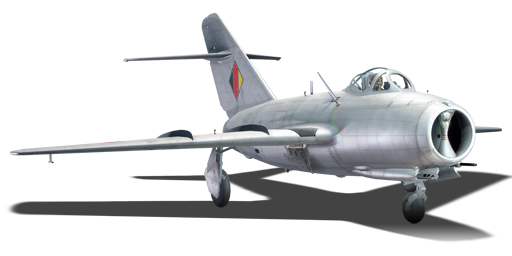
During the early '50s, a design proposal for an upgraded MiG-15, titled the MiG-15bis (second), was issued. The main upgrade was the new VK-1 engine, offering a lot more thrust. The East German air force would start receiving the upgraded MiG-15bis not long after it entered service with the USSR and proved itself there. The MiG-15bis would serve as the frontline fighter of the NVA, being later supplemented by the MiG-17 and its licensed copy, the Lim-5, before being ultimately replaced by proper 3rd generation fighters such as the MiG-21F in the late '60s and early '70s.
Introduced in Update 1.39, the ◊MiG-15bis is a German operated copy of the MiG-15bis and performs identically to it. Having the powerful VK-1 engine and strong firepower, the MiG-15bis shines with its overall performance against a majority of jets that it faces, though it still requires attention to enemy missiles and strong trigger discipline for the limited ammunition onboard. Alternatively, in full uptiers, it can form the backmarker of the team rather than the tip of the spear, picking off distracted targets and being able to fight back against even some supersonic jets in close-in dogfights.
General info
Flight performance

The MiG-15bis has a great thrust to weight ratio, allowing for amazing acceleration and energy retention. Players will soon discover that the MiG-15bis is able to almost out climb any other jet fighter within their battle rating. Likewise, players would also notice that the rudder locks up at high speeds, soon followed by the ailerons, and elevators . The MiG is also sluggish in low speed combat, especially in terms of roll rate.
| Characteristics | Max Speed (km/h at 0 m - sea level) |
Max altitude (metres) |
Turn time (seconds) |
Rate of climb (metres/second) |
Take-off run (metres) | |||
|---|---|---|---|---|---|---|---|---|
| AB | RB | AB | RB | AB | RB | |||
| Stock | 1,062 | 1,046 | 21.0 | 22.0 | 41.4 | 39.8 | 475 | |
| Upgraded | 1,087 | 1,076 | 20.4 | 20.7 | 59.7 | 50.0 | ||
Details
| Features | |||||
|---|---|---|---|---|---|
| Combat flaps | Take-off flaps | Landing flaps | Air brakes | Arrestor gear | Drogue chute |
| X | ✓ | ✓ | ✓ | X | X |
| Limits | ||||||
|---|---|---|---|---|---|---|
| Wings (km/h) | Gear (km/h) | Flaps (km/h) | Max Static G | |||
| Combat | Take-off | Landing | + | - | ||
| 1,269 | N/A | 598 | 450 | ~12 | ~7 | |
| Optimal velocities (km/h) | |||
|---|---|---|---|
| Ailerons | Rudder | Elevators | Radiator |
| < 600 | < 700 | < 750 | N/A |
Engine performance
| Engine | Aircraft mass | |||||
|---|---|---|---|---|---|---|
| Engine name | Number | Empty mass | Wing loading (full fuel) | |||
| Klimov VK-1 | 1 | 3,648 kg | 233 kg/m2 | |||
| Engine characteristics | Mass with fuel (no weapons load) | Max Takeoff Weight | ||||
| Weight (each) | Type | 8m fuel | 20m fuel | 28m fuel | ||
| 892 kg | Centrifugal-flow turbojet | 3,980 kg | 4,478 kg | 4,810 kg | 5,485 kg | |
| Maximum engine thrust @ 0 m (RB / SB) | Thrust to weight ratio @ 0 m (100%) | |||||
| Condition | 100% | WEP | 8m fuel | 20m fuel | 28m fuel | MTOW |
| Stationary | 2,450 kgf | N/A | 0.62 | 0.55 | 0.51 | 0.45 |
| Optimal | 2,450 kgf (0 km/h) |
N/A | 0.62 | 0.55 | 0.51 | 0.45 |
Survivability and armour
- 10 mm steel armour plates in front of the cockpit and behind the pilot's headrest.
- 6 mm steel armour under the pilot's seat.
- 64 mm bulletproof front windshield.
- Self-sealing fuel tanks behind the pilot and under the jet engine nozzle.
- Jet engine located in the rear of the aircraft, pilot seated in front.
Modifications and economy
Armaments
Offensive armament
The MiG-15bis (Germany) is armed with:
- 1 x 37 mm N-37D cannon, chin-mounted (40 rpg)
- 2 x 23 mm NR-23 cannons, chin-mounted (80 rpg = 160 total)
Suspended armament
The MiG-15bis (Germany) can be outfitted with the following ordnance:
- Without load
- 2 x 100 kg FAB-100M-43 bombs (200 kg total)
- 16 x S-5K rockets
- 16 x S-5M rockets
- 2 x S-21 rockets
Usage in battles
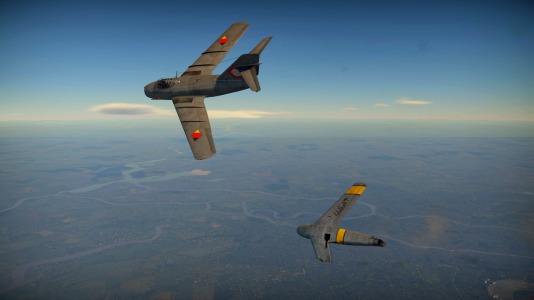
The most common enemies of the MiG-15bis are, of course, the F-86 Sabres, although the Banshee/Panther/Cougar line is also a threat. The MiG's main disadvantage is that its wing is vulnerable to ripping in the rolling turn. The Sabre doesn't have this same issue so don't try to out-roll the Sabre, use your extremely good energy retention to zoom back up to higher altitude and then re-engage in a dive.
The MiG's hard-hitting cannons (2 x 23 mm and 1 x 37 mm) are a hard learning curve if the players are untrained in the low velocity cannons. Although the damage output is a large benefit.
Pros and cons
Pros:
- Great acceleration
- Superior climb rate
- Powerful armament, combination 37 mm and 23 mm cannons devastate targets
- Low wing loading which results in great manoeuvrability
- Great in vertical manoeuvres
- Good flaps that allow them to be deployed even at high speeds (up to 670 km/h IAS)
- High service ceiling
- Excellent high altitude performance especially against aircraft such as Sabres
- S-21 rockets with good fuse time (1,000 m) result in a very high chance of head-on winning
- Unguided rockets can be used as flares when uptiered and don't hurt aircraft performance much
Cons:
- Low roll rate especially at high speeds
- Control surfaces are highly stiffening at high speeds
- Hard to aim due to low-velocity guns and curved trajectory
- Guns can spark frequently, especially with stock belts
- Low amount of ammo
- No air-to-air missiles
- Long turn times at high speeds
- Poor forward visibility in simulator, as a large canopy frame and the gunsight block the top and bottom
History
| Archive of the in-game description | |
|---|---|
|
After World War II was over, the leaders of the USSR realized that they were behind the leading states of the world in the sphere of jet aircraft construction, most notably in the full-scale production of turbojet engines. Consequently, a delegation including the designers A. I. Mikoyan and V. Y. Klimov was sent to Great Britain towards the end of 1946. Their negotiations were successful, resulting in the purchase of two of the most advanced turbojet engines at that time: the Rolls-Royce Derwent Mk.V and the Rolls-Royce Nene I/Nene II. The British consented to sell their newest strategic designs easily enough since they believed that the Soviet industrial/technological apparatus could not handle the mass production of sophisticated assemblies. However, very soon that the Rolls-Royce engines were launched into full-scale Soviet production under the designations RD-500 and RD-45. The emergence of the new engines led to the creation of Soviet jet fighters able to compete with the leading models of the world. In 1947, the Mikoyan Design Bureau started the development of a front line fighter with a Nene (RD-45) turbojet engine and an airtight cockpit: the I-310 (""S""). The first S-01 prototype aircraft made its first flight on December 30, 1947, and, after working on the test results, was launched into full-scale production in 1948 under the designation MiG-15. The plane's airframe was an all-metal monoplane configuration with mid-swept wings and empennage. Thus the MiG-15 became the first production swept-wing fighter. The MiG-15 was equipped with an RD-45F single-shaft turbojet engine rated at 2,270 kg of thrust with a double-entry centrifugal compressor. The plane's armament included a 37 mm Nudelman N-37D cannon with 40 rounds and two 23 mm Nudelman-Suranov NS-23KM guns with 160 rounds in total. The cannons were mounted in the forward fuselage on a lowerable carriage. Two 100 kg or 50 kg bombs could be suspended under the wings. To increase its flight range, the aircraft could carry two external fuel tanks with a capacity ranging from 250 to 600 litres. The MiG-15 fighter was notable for its simple and reliable structure, high flight and operating characteristics, and powerful armament. Its maximum speed, rate of climb, ceiling, and flight range were the best among Soviet fighters at the time and superior to many foreign aircraft, as well. The first production MiG-15s with RD-45F engines began to leave the factory floor in early 1949. In 1950, more advanced MiG-15bis fighters replaced them in the factory assembly lines. | |
Media
- Skins
- Images
The German MiG-15bis shooting down a rival F-86F-2 Sabre

See also
- Other MiG-15 vehicles
External links
| Mikoyan-Gurevich Design Bureau (Микоя́н и Гуре́вич Опытное конструкторское бюро) | |
|---|---|
| Fighters | MiG-3-15 · MiG-3-15 (BK) · MiG-3-34 |
| I-225 | |
| Jet fighters | MiG-9 · MiG-9 (l) |
| MiG-15 · MiG-15bis · MiG-15bis ISh | |
| MiG-17 | |
| MiG-19PT | |
| MiG-21F-13 · MiG-21PFM · MiG-21S (R-13-300) · MiG-21SMT · MiG-21bis | |
| MiG-23M · MiG-23ML · MiG-23MLD | |
| MiG-27M · MiG-27K | |
| MiG-29 · MiG-29SMT | |
| Export/Licensed | ␗MiG-9 · ␗MiG-9 (l) |
| ◊MiG-15bis · ◔MiG-15bis · J-2* | |
| MiG-17AS · ◔MiG-17PF · J-4* · Shenyang F-5* | |
| ◊MiG-19S · J-6A* | |
| ◄MiG-21 SPS-K · ◊MiG-21MF · ◔MiG-21MF · ▄MiG-21bis · ◔MiG-21bis-SAU · ◊MiG-21bis-SAU · ◊MiG-21 "Lazur-M" · ▄MiG-21 Bison · J-7II** | |
| ◊MiG-23BN · ◊MiG-23MF · ◔MiG-23MF · ◊MiG-23MLA | |
| ◔MiG-29 · ◊MiG-29 · ◄MiG-29G | |
| *Licensed and domesticated with Chinese designations. | |
| **Unlicensed, reverse-engineered and domesticated with Chinese designations. | |
| See Also | Shenyang · Chengdu |
| Germany jet aircraft | |
|---|---|

|
Luftwaffe |
| He 162 | He 162 A-1 · He 162 A-2 |
| Me 163 | Me 163 B · Me 163 B-0 |
| Ho 229 | Ho 229 V3 |
| Ar 234 | Ar 234 B-2 · Ar 234 C-3 |
| Me 262 | Me 262 A-1a · Me 262 A-1a/Jabo · Me 262 A-1a/U1 · Me 262 A-1/U4 · Me 262 A-2a |
| Me 262 C-1a · Me 262 C-2b | |

|
LSK |
| Fighters | ◊MiG-15bis · ◊Lim-5P · ◊MiG-19S |
| ◊MiG-21MF · ◊MiG-21bis-SAU · ◊MiG-21 "Lazur-M" | |
| ◊MiG-29 | |
| Attackers | ◊MiG-23BN · ◊MiG-23MF · ◊MiG-23MLA |
| ◊Su-22UM3K · ◊Su-22M4 | |
| ◊IL-28 | |

|
Luftwaffe |
| F-84 | ◄F-84F |
| F-86 | ◄CL-13A Mk 5 · ◄CL-13B Mk.6 · ◄F-86K |
| F-104 | ◄F-104G |
| F-4 | ◄F-4F Early · ◄F-4F · ◄F-4F KWS LV |
| G.91 | ◄G.91 R/3 · ◄G.91 R/4 |
| Tornado | ◄Tornado IDS WTD61 · ◄Tornado IDS MFG · ◄Tornado IDS ASSTA1 |
| Other | Alpha Jet A · ◄Sea Hawk Mk.100 |
| Ex-LSK | ◄MiG-21 SPS-K · ◄MiG-29G · ◄Su-22M4 WTD61 |

|
Swiss Air Force |
| ◌Hunter F.58 · FFA P-16 | |