Difference between revisions of "J-2"
(Revised description to current standards) (Tag: Visual edit) |
(→Description) |
||
| Line 6: | Line 6: | ||
== Description == | == Description == | ||
<!-- ''In the description, the first part should be about the history of and the creation and combat usage of the aircraft, as well as its key features. In the second part, tell the reader about the aircraft in the game. Insert a screenshot of the vehicle, so that if the novice player does not remember the vehicle by name, he will immediately understand what kind of vehicle the article is talking about.'' --> | <!-- ''In the description, the first part should be about the history of and the creation and combat usage of the aircraft, as well as its key features. In the second part, tell the reader about the aircraft in the game. Insert a screenshot of the vehicle, so that if the novice player does not remember the vehicle by name, he will immediately understand what kind of vehicle the article is talking about.'' --> | ||
| − | The '''{{Specs|name}}''' | + | The '''{{Specs|name}}''' represents the [[MiG-15bis]] in PLAAF service during the Korean War; MiG-15s were supplied to the PLAAF (as the PVAF) during the war to defend Mainland China from USAF bombings as well as intercepting air threats over the skies of now-North Korea. Although having some losses, some PLAAF pilots also marked their names in the history books by either shooting down enemy aces or becoming an ace themselves. These jets served in the PLAAF for another decade before the licensed domestic-built J-5 replaced them in the 1960s. |
| − | Introduced in [[Update 1.91 "Night Vision"]] | + | Introduced in [[Update 1.91 "Night Vision"]], the J-2 is a Chinese [[MiG-15bis]] and performs identically to it. Having a powerful VK-1 engine and devastating firepower, the J-2 shines with its overall performance against earlier jets, though it still requires attention to enemy missiles and the limited ammunition onboard. Alternatively, it can be a makeshift attacker to take out some valuable ground targets while being able to fight back against even some supersonic jets. |
== General info == | == General info == | ||
| Line 176: | Line 176: | ||
* Armament difficult to use (low velocities, low ammo and two different trajectories) | * Armament difficult to use (low velocities, low ammo and two different trajectories) | ||
* Guns tend to spark a lot (the N-37 in particular) | * Guns tend to spark a lot (the N-37 in particular) | ||
| − | * Low ammo count. | + | * Low ammo count. |
== History == | == History == | ||
Revision as of 09:24, 29 June 2023

Contents
Description
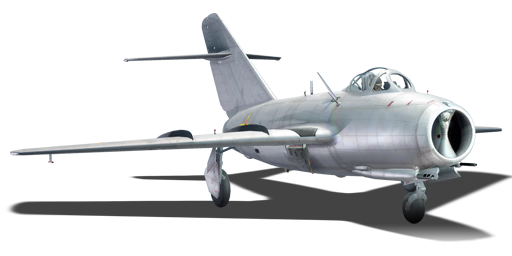
The J-2 represents the MiG-15bis in PLAAF service during the Korean War; MiG-15s were supplied to the PLAAF (as the PVAF) during the war to defend Mainland China from USAF bombings as well as intercepting air threats over the skies of now-North Korea. Although having some losses, some PLAAF pilots also marked their names in the history books by either shooting down enemy aces or becoming an ace themselves. These jets served in the PLAAF for another decade before the licensed domestic-built J-5 replaced them in the 1960s.
Introduced in Update 1.91 "Night Vision", the J-2 is a Chinese MiG-15bis and performs identically to it. Having a powerful VK-1 engine and devastating firepower, the J-2 shines with its overall performance against earlier jets, though it still requires attention to enemy missiles and the limited ammunition onboard. Alternatively, it can be a makeshift attacker to take out some valuable ground targets while being able to fight back against even some supersonic jets.
General info
Flight performance
| Characteristics | Max Speed (km/h at 0 m - sea level) |
Max altitude (metres) |
Turn time (seconds) |
Rate of climb (metres/second) |
Take-off run (metres) | |||
|---|---|---|---|---|---|---|---|---|
| AB | RB | AB | RB | AB | RB | |||
| Stock | 1,061 | 1,046 | 21.0 | 22.0 | 41.4 | 39.8 | 475 | |
| Upgraded | 1,087 | 1,076 | 20.4 | 20.7 | 59.7 | 50.0 | ||
Details
| Features | |||||
|---|---|---|---|---|---|
| Combat flaps | Take-off flaps | Landing flaps | Air brakes | Arrestor gear | Drogue chute |
| X | ✓ | ✓ | ✓ | X | X |
| Limits | ||||||
|---|---|---|---|---|---|---|
| Wings (km/h) | Gear (km/h) | Flaps (km/h) | Max Static G | |||
| Combat | Take-off | Landing | + | - | ||
| 1,132 | - | 598 | 450 | ~12 | ~7 | |
| Optimal velocities (km/h) | |||
|---|---|---|---|
| Ailerons | Rudder | Elevators | Radiator |
| < 600 | < 700 | < 750 | - |
Engine performance
| Engine | Aircraft mass | |||||
|---|---|---|---|---|---|---|
| Engine name | Number | Empty mass | Wing loading (full fuel) | |||
| Klimov VK-1 | 1 | 3,648 kg | 233 kg/m2 | |||
| Engine characteristics | Mass with fuel (no weapons load) | Max Takeoff Weight | ||||
| Weight (each) | Type | 8m fuel | 20m fuel | 28m fuel | ||
| 872 kg | Centrifugal-flow turbojet | 3,980 kg | 4,478 kg | 4,810 kg | 5,485 kg | |
| Maximum engine thrust @ 0 m (RB / SB) | Thrust to weight ratio @ 0 m (100%) | |||||
| Condition | 100% | WEP | 8m fuel | 20m fuel | 28m fuel | MTOW |
| Stationary | 2,450 kgf | - | 0.62 | 0.55 | 0.51 | 0.45 |
| Optimal | 2,450 kgf (0 km/h) |
- | 0.62 | 0.55 | 0.51 | 0.45 |
Survivability and armour
- 10 mm steel armour plates in front of the cockpit and behind the pilot's head rest.
- 64 mm bulletproof glass front windshield.
- Self-sealing fuel tanks behind the pilot and under the jet engine nozzle.
- Jet engine located in the rear of the aircraft, pilot seated in front.
Modifications and economy
Armaments
Offensive armament
The J-2 is armed with:
- 1 x 37 mm N-37D cannon, chin-mounted (40 rpg)
- 2 x 23 mm NR-23 cannons, chin-mounted (80 rpg = 160 total)
Suspended armament
The J-2 can be outfitted with the following ordnance:
- Without load
- 2 x 100 kg FAB-100M-43 bombs (200 kg total)
- 2 x 250 kg FAB-250M-46 bombs (500 kg total)
- 16 x S-5K rockets
- 16 x S-5M rockets
- 2 x S-21 rockets
Usage in battles
At higher ranks of the Chinese aviation line is the J-2, a Chinese MiG-15bis. It one of the most iconic jet fighter aircraft designs from after the Second World War. Earning its reputation on fame over the skies of Korea against its US contemporary, the F-86 Sabre.
The J-2 features a powerful cannon arrangement of 2 x 23 mm and 1 x 37 mm, excellent high altitude performance and is highly effective in vertical manoeuvres. Unlike the MiG-9 that comes before it, the J-2 is also the first jet aircraft in the Chinese tree to feature an air brake which is extremely useful in combat situations. The jet fighter does have its downsides. The lack of an "all-flying tailplane" (such as that featured on the Sabre) leads to less control over the aircraft at higher speeds approaching 1,000 km/h. While the J-2 is initially faster in acceleration by comparison to the Sabre, this does mean that once both aircraft are up at higher speeds, the Sabre will hold some advantages over the J-2. If you load 8 minutes of fuel instead of the regular (for most pilots) 20, it drastically improves your performance. However, this is not recommended to be done at the beginning of the match as most matches last longer than 8 minutes, and should instead be done when you land mid-match.
The combination of 37 mm and 23 mm cannons creates aiming issues for pilots not familiar with their ballistic properties or velocity. Due to the size of these cannons, ammunition pools are restricted by comparison to other top tier jet aircraft. To help compensate the two different trajectories of the armament, it is recommended to use 'rolling' manoeuvres, as the rudder may lock in high speeds. To aim with these cannons, it is best to estimate the lead with the experience built up with planes beforehand (e.g. La-9) and add extra distance over the estimated lead (about double from the estimated).
Once pilots have learned to use the J-2's excellent rate of climb, acceleration and high altitude capabilities to their advantage, the downsides of the aircraft are far less significant than the positives. In the right hands, the J-2 can be a devastating combatant, capable of dealing with any aircraft in-game swiftly. Teamwork, squads, and communication will also be beneficial when flying the J-2 as effective coordination between multiple pilots allow you to use this aircraft to its maximum potential. After mastering the J-2, you can research its improved variant, the J-4 (a license-built MiG-17). The J-2 shares much of its performance abilities and deficiencies.
Pros and cons
Pros:
- Flaps can be deployed at high speeds
- Capable and useful air brake
- High rate of climb
- Great acceleration
- Deadly armament capable of making snapshots and quick deflection shots
- Excellent energy retention
- Has a gyro gunsight, allowing more accurate lead
- Good performance even when stock
- Has a G-suit, which is useful at high speeds
Cons:
- Abysmal roll rate
- Poor turning circle
- Compression at high speeds
- Poor forward visibility in Simulator, as a large canopy frame and the gunsight block the top and bottom
- Armament difficult to use (low velocities, low ammo and two different trajectories)
- Guns tend to spark a lot (the N-37 in particular)
- Low ammo count.
History
PLAAF operating history
The People's Republic of China received the first batch of MiG-15bis jet fighters in late 1952, only 6 months before the end of Korean War. A total of about 1,500 MiG-15bis were aided to China during 1952-1955 and a few of these aircraft took part in the Korean War.

According to the Agreement on the Union of Soviet Socialist Republics to grant the People's Republic of China technical assistance in organizing the repair of aircraft and the engines and the organization of aircraft factories signed in October of 1951, the MiG-15bis was chosen to be China's first license-produced fighter jet. The Factory No. 112 (later Shenyang Aircraft Corporation) would produce the airframe while the Shenyang Engine Overhaul Factory (later Shenyang Liming Motor Company) would produce the WP-5 turbojet engine ("渦噴-5", domestic license-built VK-1 engine). Both factories received guidance and instructions from Soviet experts.
However, the two factories would not be ready for mass production until 1955 when the more advanced MiG-17F fighter jets were already in active service. The MiG-15bis was becoming outdated, and therefore there was no need to build MiG-15bis fighter jets and the PRC started to produce the J-5 (license-built MiG-17F) in Shenyang instead, though it is sometimes claimed that trial production of the J-2 had commenced before the switch to J-5 production. MiG-15bis damaged in air battles of the Korean War were sent to Factory 112 for repair and overhaul. Overhauled aircraft using parts and avionics of MiG-17F/J-5 were unofficially called J-2 ("殲-2", which never become official name of the hybrid fighters). The MiG-15bis/J-2 served in PLAAF until late 1970s.
Although the single-seated MiG-15bis never saw domestic production, the two-seated trainer version, the UTI-MiG-15, was license-built under the name of JJ-2 ("殲教-2", Pursuit Aircraft Trainer-2), some of these trainers were exported to other countries operating MiG-15/17s, such as North Korea, Sudan and Tanzania as FT-2 (Fighter Trainer-2).
Media
- Skins
See also
External links
- [Smithsonian National Air and Space Museum] Mikoyan-Gurevich MiG-15 (Ji-2)
- [GlobalSecurity.org] JJ-2 (Jiaolianji Jian-2 Trainer Fighter aircraft 2)
- [Flying Leathernecks] MiG-15
| Shenyang Aircraft Corporation (中航工业沈阳飞机工业(集团)有限公司) | |
|---|---|
| Jet Fighters | |
| MiG-15 | J-2* |
| MiG-17 | J-4* |
| MiG-19 | J-6A* |
| J-8 | J-8B · J-8F |
| Su-27 variants | J-11* · J-11A* |
| Export | Shenyang F-5* |
| *Licensed Note: "J-2" and "J-4" are not official designations | |
| See Also | Mikoyan-Gurevich Design Bureau |
| China jet aircraft | |
|---|---|
| Fighters | J-2 · J-4 · J-6A · J-7II · J-7D · J-7E · J-8B · J-8F · J-10A · J-11 · J-11A |
| Strike aircraft | Q-5 early · Q-5A · Q-5L · JH-7A |
| Bombers | H-5 |
| France | ␗Mirage 2000-5Ei |
| USA | ␗F-84G-21-RE · ␗F-84G-31-RE · ␗F-86F-30 · ␗F-86F-40 · ␗F-100A · ␗F-100F · ␗F-104A · ␗F-104G · ␗F-5A · ␗F-5E · ␗F-16A MLU |
| USSR | ␗MiG-9 · ␗MiG-9 (l) |
| North Korea | Shenyang F-5 |
| Pakistan | A-5C · JF-17 |