Difference between revisions of "Firefly FR Mk V"
(Edits) |
(Filled out the Usage in battles section) (Tag: Visual edit) |
||
| Line 78: | Line 78: | ||
{{Specs-Avia-Armour}} | {{Specs-Avia-Armour}} | ||
<!-- ''Examine the survivability of the aircraft. Note how vulnerable the structure is and how secure the pilot is, whether the fuel tanks are armoured, etc. Describe the armour, if there is any, and also mention the vulnerability of other critical aircraft systems.'' --> | <!-- ''Examine the survivability of the aircraft. Note how vulnerable the structure is and how secure the pilot is, whether the fuel tanks are armoured, etc. Describe the armour, if there is any, and also mention the vulnerability of other critical aircraft systems.'' --> | ||
| + | |||
* 42.8 mm Bulletproof glass in cockpit front. | * 42.8 mm Bulletproof glass in cockpit front. | ||
* 12.7 mm Steel plate behind the pilot. | * 12.7 mm Steel plate behind the pilot. | ||
| Line 92: | Line 93: | ||
The '''''{{PAGENAME}}''''' is armed with: | The '''''{{PAGENAME}}''''' is armed with: | ||
| + | |||
* 4 x 20 mm Hispano Mk.V cannons, wing-mounted (175 rpg outer + 145 rpg inner = 640 total) | * 4 x 20 mm Hispano Mk.V cannons, wing-mounted (175 rpg outer + 145 rpg inner = 640 total) | ||
| Line 110: | Line 112: | ||
== Usage in battles == | == Usage in battles == | ||
| − | + | The Firefly FR Mk V is one of the least maneuverable aircrafts in its grade, especially before upgrades. The engine is severely limited by the aerodynamic drag, with the wings loosing a lot of performance at lower speeds. The lack of turn-fighting capabilities makes engaging in a fight with the enemy ill-advised. In a straight line, the plane can somewhat retain its speed, but it can't outrun its contemporaries at the rank. | |
| + | |||
| + | The 4 wing-mounted Hispano Mk Vs are as powerful as they are difficult to use. The guns are very inaccurate, causing shots at ranges of over 600 meters to be fairly ineffective versus small to medium targets. This is made up for by the extremely long burst duration of the cannons, with a very high fire rate. You should watch your trigger though, as while the ammo count is rather sizeable, you can chew through it very quickly. | ||
| + | |||
| + | Engaging planes is all in all made difficult. Surviving mostly relies on support from your teammates, or not letting the enemy get on your tail in the first place. If you find yourself in a head-on fight, you may be able to overpower the enemy, as long as you can keep the target in your sight. Overcompensating and letting the enemy fly into your line of fire will be the most important here. | ||
| + | |||
| + | The interceptor spawn of the plane lets it reach the enemy ground targets very quickly, where the plane really starts to shine. Only a very short burst is needed to destroy most of anything with no or little armour, meaning you can drain a lot of tickets of the enemy team very efficiently. | ||
| + | |||
| + | Although the plane can be surprisingly sound structurally, any damage to the radiators has the possibility of instantly draining all the water coolant, causing the engine to overheat and knocking it out of fight. If you need to engage in a fight, try to keep altitude so that you have enough potential energy to return to the airfield for repairs even if the engine dies. Any damage to the engine also causes a massive loss of power, even if the engine is spinning you can find yourself stalling. | ||
=== Manual Engine Control === | === Manual Engine Control === | ||
| Line 133: | Line 143: | ||
'''Pros:''' | '''Pros:''' | ||
| + | |||
* Faster than the Firefly Mk I with a better roll rate thanks to its more powerful engine and clipped wings | * Faster than the Firefly Mk I with a better roll rate thanks to its more powerful engine and clipped wings | ||
* One of the earliest planes with Hispano Mk.V cannons. Much larger ammo load with much less of a tendency to overheat than the [[Hispano Mk.II (20 mm)|Mk.II]] | * One of the earliest planes with Hispano Mk.V cannons. Much larger ammo load with much less of a tendency to overheat than the [[Hispano Mk.II (20 mm)|Mk.II]] | ||
| Line 139: | Line 150: | ||
'''Cons:''' | '''Cons:''' | ||
| + | |||
* Less manoeuvrable overall than the Firefly Mk I aside from the roll rate | * Less manoeuvrable overall than the Firefly Mk I aside from the roll rate | ||
* Somewhat large target for a single-engine fighter | * Somewhat large target for a single-engine fighter | ||
| Line 161: | Line 173: | ||
== See also == | == See also == | ||
''Links to the articles on the War Thunder Wiki that you think will be useful for the reader, for example:'' | ''Links to the articles on the War Thunder Wiki that you think will be useful for the reader, for example:'' | ||
| + | |||
* ''reference to the series of the aircraft;'' | * ''reference to the series of the aircraft;'' | ||
* ''links to approximate analogues of other nations and research trees.'' | * ''links to approximate analogues of other nations and research trees.'' | ||
Revision as of 08:53, 21 July 2021
| This page is about the British strike aircraft Firefly FR Mk V. For the other version, see Firefly F Mk I. For other uses, see Firefly (Disambiguation). |

Contents
Description
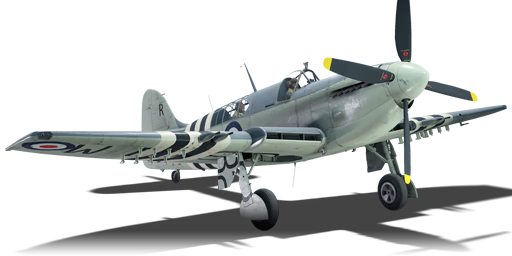
The Firefly FR Mk V is a rank British strike aircraft with a battle rating of (AB), (RB), and (SB). It was introduced in Update 1.49 "Weapons of Victory".
General info
Flight performance
| Characteristics | Max Speed (km/h at 5,181 m) |
Max altitude (metres) |
Turn time (seconds) |
Rate of climb (metres/second) |
Take-off run (metres) | |||
|---|---|---|---|---|---|---|---|---|
| AB | RB | AB | RB | AB | RB | |||
| Stock | 522 | 503 | 29.5 | 30.8 | 9.5 | 9.5 | 450 | |
| Upgraded | 591 | 554 | 26.5 | 28.0 | 19.5 | 13.5 | ||
Details
| Features | ||||
|---|---|---|---|---|
| Combat flaps | Take-off flaps | Landing flaps | Air brakes | Arrestor gear |
| ✓ | ✓ | ✓ | X | ✓ |
| Limits | ||||||
|---|---|---|---|---|---|---|
| Wings (km/h) | Gear (km/h) | Flaps (km/h) | Max Static G | |||
| Combat | Take-off | Landing | + | - | ||
| 600 | 327 | 250 | ~10 | ~6 | ||
| Optimal velocities (km/h) | |||
|---|---|---|---|
| Ailerons | Rudder | Elevators | Radiator |
| < 321 | < 400 | < 410 | > 314 |
Survivability and armour
- 42.8 mm Bulletproof glass in cockpit front.
- 12.7 mm Steel plate behind the pilot.
Modifications and economy
Armaments
Offensive armament
The Firefly FR Mk V is armed with:
- 4 x 20 mm Hispano Mk.V cannons, wing-mounted (175 rpg outer + 145 rpg inner = 640 total)
Suspended armament
The Firefly FR Mk V can be outfitted with the following ordnance:
- Without load
- 2 x 1,000 lb M.C. 1,000 lb Mk.I bombs (2,000 lb total)
- 16 x RP-3 rockets
- 2 x 250 lb G.P. Mk.IV bombs (500 lb total)
- 2 x 500 lb G.P. Mk.IV bombs (1,000 lb total)
- 8 x RP-3 rockets + 2 x 250 lb G.P. Mk.IV bombs (500 lb total)
- 8 x RP-3 rockets + 2 x 500 lb G.P. Mk.IV bombs (1,000 lb total)
Usage in battles
The Firefly FR Mk V is one of the least maneuverable aircrafts in its grade, especially before upgrades. The engine is severely limited by the aerodynamic drag, with the wings loosing a lot of performance at lower speeds. The lack of turn-fighting capabilities makes engaging in a fight with the enemy ill-advised. In a straight line, the plane can somewhat retain its speed, but it can't outrun its contemporaries at the rank.
The 4 wing-mounted Hispano Mk Vs are as powerful as they are difficult to use. The guns are very inaccurate, causing shots at ranges of over 600 meters to be fairly ineffective versus small to medium targets. This is made up for by the extremely long burst duration of the cannons, with a very high fire rate. You should watch your trigger though, as while the ammo count is rather sizeable, you can chew through it very quickly.
Engaging planes is all in all made difficult. Surviving mostly relies on support from your teammates, or not letting the enemy get on your tail in the first place. If you find yourself in a head-on fight, you may be able to overpower the enemy, as long as you can keep the target in your sight. Overcompensating and letting the enemy fly into your line of fire will be the most important here.
The interceptor spawn of the plane lets it reach the enemy ground targets very quickly, where the plane really starts to shine. Only a very short burst is needed to destroy most of anything with no or little armour, meaning you can drain a lot of tickets of the enemy team very efficiently.
Although the plane can be surprisingly sound structurally, any damage to the radiators has the possibility of instantly draining all the water coolant, causing the engine to overheat and knocking it out of fight. If you need to engage in a fight, try to keep altitude so that you have enough potential energy to return to the airfield for repairs even if the engine dies. Any damage to the engine also causes a massive loss of power, even if the engine is spinning you can find yourself stalling.
Manual Engine Control
| MEC elements | ||||||
|---|---|---|---|---|---|---|
| Mixer | Pitch | Radiator | Supercharger | Turbocharger | ||
| Oil | Water | Type | ||||
| Controllable | Controllable Not auto controlled |
Not controllable Not auto controlled |
Controllable Auto control available |
Separate | Controllable 2 gears |
Not controllable |
Pros and cons
Pros:
- Faster than the Firefly Mk I with a better roll rate thanks to its more powerful engine and clipped wings
- One of the earliest planes with Hispano Mk.V cannons. Much larger ammo load with much less of a tendency to overheat than the Mk.II
- Same good bomb load but double the amount of rockets available to the pilot
- Has an interceptor spawn, which can be useful
Cons:
- Less manoeuvrable overall than the Firefly Mk I aside from the roll rate
- Somewhat large target for a single-engine fighter
- Still rather slow in comparison to other fighters at its rank
- Below average climb rate compared to Spitfires
History
In-game description
The Fairey Firefly had entered service in 1943 and served successfully in the closing stages of the Second World War as a multi-role, carrierborne fighter/strike aircraft. In 1944 a Rolls-Royce Griffon 72 was fitted to the Firefly for testing; the resulting improvements led to the Griffon 74 powered Firefly Mk.IV which entered service in 1947. The Mk.IV replaced the earlier three bladed propeller with a four bladed unit fitted to the new engine, and moved the radiators from the chin position to underneath the wings. The wings were also clipped to increase the roll rate. The leading edge of the tail fin was also extended and two under wing fairings carried fuel and a radar scanner in port and starboard respectively.
The Firefly Mk.V built on the success of the previous variant with further modifications. For specialized roles, sub variants of the Firefly included a number of internal changes for the standard day fighter/reconnaissance variant, night fighter and anti-submarine aircraft. Power folding wings were also introduced during the life of the Mk.V which greatly assisted the efficiency of deck operations.
812 Naval Air Squadron was the first front line unit to re-equip with the Mk.V, at Eglinton in July 1948. When the Korean People's Army crossed the 38th Parallel in June 1950, Korea was plunged into war and the carrierborne aircraft of the Fleet Air Arm were in action within days of the outbreak of hostilities. HMS Triumph was the first British carrier in theatre, but the embarked 827 NAS were actually still operating Second World War vintage Firefly Mk.Is. It was the Mk.V which replaced it in theatre which proved to be the most prolific variant of the conflict, being operated by 810, 812, 817, 821 and 825 Naval Air Squadrons. The Firefly was regularly engaged in strikes against key infrastructure such as bridges, railways, harbour installations and industrial sites. Operating in a range of conditions including sub-zero temperatures and storms, the Fireflies served alongside Seafires and Sea Furies to maintain an impressive rate of operations, proving to be resilient to the elements and the rigours of continued deck operations in anger. In 1952 a record-breaking day of operations was achieved from HMS Ocean when Fireflies and Sea Furies flew 123 sorties in a single day. Fireflies of 825 NAS were also involved in ground attack sorties during the 1954 Malayan Emergency.
Post-war, the Firefly served as an export aircraft with Canada, Australia, Denmark, the Netherlands, Ethiopia, Thailand, Sweden and India. The venerable aircraft left the service of the Fleet Air Arm in 1956, after 13 years of operations.
Media
Excellent additions to the article would be video guides, screenshots from the game, and photos.
See also
Links to the articles on the War Thunder Wiki that you think will be useful for the reader, for example:
- reference to the series of the aircraft;
- links to approximate analogues of other nations and research trees.
External links
| Fairey Aviation Company, Limited | |
|---|---|
| Fighters | Firefly F Mk I · Firefly FR Mk V |
| Bombers | Swordfish Mk I · Swordfish Mk II |
| Export | ◘Firefly F.Mk.IV |
| Britain strike aircraft | |
|---|---|
| Blackburn | Firebrand TF Mk IV · Firecrest |
| Bristol | Beaufighter Mk I (40-mm) · Beaufighter Mk VIc · Beaufighter Mk X · Beaufighter Mk 21 |
| CAC | ▄Wirraway |
| Fairey | Firefly F Mk I · Firefly FR Mk V |
| de Havilland | Mosquito FB Mk VI · Mosquito FB Mk XVIII |
| Hawker | Hurricane Mk IV · Tempest Mk V (Vickers P) |
| Westland | Wyvern S4 |