Difference between revisions of "Imp.Chaparral (Israel)"
(Created page) |
U107276241 (talk | contribs) (→Description) (Tag: Visual edit) |
||
| (13 intermediate revisions by 6 users not shown) | |||
| Line 1: | Line 1: | ||
| + | {{About | ||
| + | | about = SPAA '''{{PAGENAME}}''' | ||
| + | | usage = the other version | ||
| + | | link = Imp.Chaparral | ||
| + | }} | ||
{{Specs-Card | {{Specs-Card | ||
|code=il_mim_72_chaparral | |code=il_mim_72_chaparral | ||
| Line 6: | Line 11: | ||
== Description == | == Description == | ||
<!-- ''In the description, the first part should be about the history of the creation and combat usage of the vehicle, as well as its key features. In the second part, tell the reader about the ground vehicle in the game. Insert a screenshot of the vehicle, so that if the novice player does not remember the vehicle by name, he will immediately understand what kind of vehicle the article is talking about.'' --> | <!-- ''In the description, the first part should be about the history of the creation and combat usage of the vehicle, as well as its key features. In the second part, tell the reader about the ground vehicle in the game. Insert a screenshot of the vehicle, so that if the novice player does not remember the vehicle by name, he will immediately understand what kind of vehicle the article is talking about.'' --> | ||
| − | The ''' | + | One of the first foreign customers of the American MIM-72 Chaparral was the IDF, which ordered the first batch of SAMs in 1973, immediately after the Yom Kippur War. The first batteries were delivered to Israel at the end of 1973 under the name Drakon. In total, several dozen Chaparral launch systems entered service with the IDF, and were actively used in the 1970s and '80s to protect Israeli airspace from potential attacks by Syrian aviation. In 1996, Israel concluded a deal with the United States to acquire 36 more modern MIM-72C '''Improved Chaparral''' complexes. They differed from previous versions in an improved guidance system, a Doppler proximity fuze, and a HE fragmentation warhead for the missile. Subsequently, these SAMs also received more advanced missiles, such as the MIM-72E with a smokeless engine and MIM-72G which integrated the seeker head from the FIM-92 Stinger, increasing their resistance to countermeasures. In 2003, all Chaparral units were retired and withdrawn from service by the IDF. |
| + | |||
| + | Introduced in [[Update "Sons of Attila"]], the Israeli Chaparral is equipped with much better missiles than the American version; the MIM-72G features IRCCM and improved engines, allowing it to combat aircraft with countermeasures and compete with SPAAs with advanced radar. The missile uses the same seeker as the one present in the FIM-92 Stinger missile, making it quite hard to dodge, and the improved engine makes it even more lethal. However, the Israeli Chaparral still suffers from a lack of radar and a gun for very close-range engagements, as even the improved missile is not capable of hitting if the locked target is just a few metres away, which is especially dangerous against enemy helicopters. | ||
== General info == | == General info == | ||
| Line 36: | Line 43: | ||
{{Specs-Tank-Mobility}} | {{Specs-Tank-Mobility}} | ||
<!-- ''Write about the mobility of the ground vehicle. Estimate the specific power and manoeuvrability, as well as the maximum speed forwards and backwards.'' --> | <!-- ''Write about the mobility of the ground vehicle. Estimate the specific power and manoeuvrability, as well as the maximum speed forwards and backwards.'' --> | ||
| − | |||
| − | {{tankMobility}} | + | {{tankMobility|abMinHp=206|rbMinHp=128}} |
=== Modifications and economy === | === Modifications and economy === | ||
| Line 49: | Line 55: | ||
<!-- ''Give the reader information about the characteristics of the main gun. Assess its effectiveness in a battle based on the reloading speed, ballistics and the power of shells. Do not forget about the flexibility of the fire, that is how quickly the cannon can be aimed at the target, open fire on it and aim at another enemy. Add a link to the main article on the gun: <code><nowiki>{{main|Name of the weapon}}</nowiki></code>. Describe in general terms the ammunition available for the main gun. Give advice on how to use them and how to fill the ammunition storage.'' --> | <!-- ''Give the reader information about the characteristics of the main gun. Assess its effectiveness in a battle based on the reloading speed, ballistics and the power of shells. Do not forget about the flexibility of the fire, that is how quickly the cannon can be aimed at the target, open fire on it and aim at another enemy. Add a link to the main article on the gun: <code><nowiki>{{main|Name of the weapon}}</nowiki></code>. Describe in general terms the ammunition available for the main gun. Give advice on how to use them and how to fill the ammunition storage.'' --> | ||
{{main|MIM-72}} | {{main|MIM-72}} | ||
| − | |||
| − | |||
{| class="wikitable" style="text-align:center" width="100%" | {| class="wikitable" style="text-align:center" width="100%" | ||
| Line 61: | Line 65: | ||
|- | |- | ||
! ''Arcade'' | ! ''Arcade'' | ||
| − | | rowspan="2" | 12 (4) || rowspan="2" | -9°/+90° || rowspan="2" | ±180° || rowspan="2" | - || | + | | rowspan="2" | 12 (4) || rowspan="2" | -9°/+90° || rowspan="2" | ±180° || rowspan="2" | - || 79.3 || 109.7 || 133.2 || 147.3 || 156.7 || rowspan="2" | 19.50 || rowspan="2" | 17.25 || rowspan="2" | 15.90 || rowspan="2" | 15.00 |
|- | |- | ||
! ''Realistic'' | ! ''Realistic'' | ||
| − | | | + | | 53.6 || 63.0 || 76.5 || 84.6 || 90.0 |
|- | |- | ||
|} | |} | ||
| Line 95: | Line 99: | ||
=== Pros and cons === | === Pros and cons === | ||
<!-- ''Summarise and briefly evaluate the vehicle in terms of its characteristics and combat effectiveness. Mark its pros and cons in a bulleted list. Try not to use more than 6 points for each of the characteristics. Avoid using categorical definitions such as "bad", "good" and the like - use substitutions with softer forms such as "inadequate" and "effective".'' --> | <!-- ''Summarise and briefly evaluate the vehicle in terms of its characteristics and combat effectiveness. Mark its pros and cons in a bulleted list. Try not to use more than 6 points for each of the characteristics. Avoid using categorical definitions such as "bad", "good" and the like - use substitutions with softer forms such as "inadequate" and "effective".'' --> | ||
| − | |||
'''Pros:''' | '''Pros:''' | ||
| − | * | + | |
| + | * Smokeless motor missile makes enemy aircraft unable to detect incoming launch | ||
'''Cons:''' | '''Cons:''' | ||
| − | * | + | |
| + | * 4 exposed crew with only one protected crew inside the turret, susceptible to even 7.62 mm machine gun fire which can lead to a crew knockout | ||
| + | * Open top vehicle, very vulnerable to overpressure from HE shells, rockets, artillery strikes, and bombs | ||
== History == | == History == | ||
<!-- ''Describe the history of the creation and combat usage of the vehicle in more detail than in the introduction. If the historical reference turns out to be too long, take it to a separate article, taking a link to the article about the vehicle and adding a block "/History" (example: <nowiki>https://wiki.warthunder.com/(Vehicle-name)/History</nowiki>) and add a link to it here using the <code>main</code> template. Be sure to reference text and sources by using <code><nowiki><ref></ref></nowiki></code>, as well as adding them at the end of the article with <code><nowiki><references /></nowiki></code>. This section may also include the vehicle's dev blog entry (if applicable) and the in-game encyclopedia description (under <code><nowiki>=== In-game description ===</nowiki></code>, also if applicable).'' --> | <!-- ''Describe the history of the creation and combat usage of the vehicle in more detail than in the introduction. If the historical reference turns out to be too long, take it to a separate article, taking a link to the article about the vehicle and adding a block "/History" (example: <nowiki>https://wiki.warthunder.com/(Vehicle-name)/History</nowiki>) and add a link to it here using the <code>main</code> template. Be sure to reference text and sources by using <code><nowiki><ref></ref></nowiki></code>, as well as adding them at the end of the article with <code><nowiki><references /></nowiki></code>. This section may also include the vehicle's dev blog entry (if applicable) and the in-game encyclopedia description (under <code><nowiki>=== In-game description ===</nowiki></code>, also if applicable).'' --> | ||
| − | + | ||
| + | The United States Army developed the M48 Chaparral in the 1960s as a short-range surface-to-air missile system which would complement the [[M163|M163 Vulcan]]. The system used the MIM-72 Chaparral missile - a unique adaptation of the [[AIM-9 Sidewinder (Family)|AIM-9 Sidewinder]] air-to-air missile which had been entering service in the US Air Force at the time. The Chaparral launch vehicle carried four such missiles on a rotating turret on top of an [[M113 (Family)|M113]] hull, with an enlarged "cabin" at the front containing the fire control system. The unique turret was designed for fast 360-degree rotation as well as a maximum elevation of 90 degrees, allowing the system to engage enemy aircraft quickly and easily. | ||
| + | |||
| + | In 1973, Egypt and Syria performed a surprise attack on Israel (known as the Yom Kippur War) using masses of advanced Soviet weaponry supplied to them in the years since the 1967 Six-Day War. Aerial attacks by MiGs and Soviet helicopters in particular proved very difficult to stop with Israel's small air force and aging short-range AA weaponry. Richard Nixon's administration, fearing a demonstration of Soviet superiority in the Middle East, decided to supply Israel with an aerial train full of American-made weapons, combat vehicles and munitions. As part of one such shipment, Israel received its first two M48 Chaparrals as well as urgent training for a handful of crews. | ||
| + | |||
| + | The two vehicles arrived almost at the very end of the war. Reports indicate that they were made ready just in time to be deployed in the Sinai peninsula, assisting an MIM-23 Hawk battery in hunting for Egyptian helicopters on the eastern side of the Suez Canal in the days immediately following the war. Though the Hawks shot down many enemy helicopters, no Chaparral kills were reported during that particular operation. A much larger number of Chaparrals were purchased, with the first battery becoming operational only a few weeks after the Yom Kippur War. The Chaparral made its first and only kill in world history in 1974, when an Israeli operator shot down a low-flying Syrian [[MiG-17]] attacking Israeli ground forces in the Golan Heights. | ||
| + | |||
| + | In the Israeli Defense Force (IDF), the Chaparral received the codename ''Drakon'' (Dragon), though they kept the purchase a secret for several years after its introduction. The Israeli Air Defense Array was apparently impressed by the vehicle's performance, as it continued to purchase various M48 Chaparral models for the next 25 years, in large quantities. The last purchase was completed in 1999, when Israel received at least several dozen M48 "Improved Chaparral" vehicles from US Army surplus. Reportedly, these systems all came from "block 6" of production, likely equipped with MIM-72G missiles. Though the launch vehicles were essentially identical to the original M113s used in early M48s, the Improved Chaparral's missiles featured several advancements to match the developing lethality of the Sidewinder over the years: all-aspect targeting, a heavier fragmentation-type warhead, a better guidance and tracking system, and an improved ability to ignore enemy countermeasures. | ||
| + | |||
| + | These new Chaparral vehicles would only serve in the IDF for another 4 years after their introduction, after which the entire Chaparral array was finally retired from service in 2003. Today, The IDF relies exclusively on Stinger MANPADS (infantry-operated) for short-range surface-to-air interception. | ||
== Media == | == Media == | ||
<!-- ''Excellent additions to the article would be video guides, screenshots from the game, and photos.'' --> | <!-- ''Excellent additions to the article would be video guides, screenshots from the game, and photos.'' --> | ||
| − | + | ||
| + | ;Skins | ||
| + | |||
| + | * [https://live.warthunder.com/feed/camouflages/?vehicle=il_mim_72_chaparral Skins and camouflages for the {{PAGENAME}} from live.warthunder.com.] | ||
== See also == | == See also == | ||
| Line 115: | Line 133: | ||
* ''reference to the series of the vehicles;'' | * ''reference to the series of the vehicles;'' | ||
* ''links to approximate analogues of other nations and research trees.'' --> | * ''links to approximate analogues of other nations and research trees.'' --> | ||
| − | + | ||
| − | + | ;Related development | |
| − | * | + | |
| + | * [[Imp.Chaparral]] | ||
== External links == | == External links == | ||
| Line 123: | Line 142: | ||
* ''topic on the official game forum;'' | * ''topic on the official game forum;'' | ||
* ''other literature.'' --> | * ''other literature.'' --> | ||
| − | + | ||
| − | * | + | * [[wt:en/news/8445-development-improved-chaparral-oppa-chaparral-style-en|[Devblog] Improved Chaparral: Oppa Chaparral Style!]] |
| − | |||
{{Israel anti-aircraft vehicles}} | {{Israel anti-aircraft vehicles}} | ||
Latest revision as of 18:26, 11 September 2024
| This page is about the SPAA Imp.Chaparral (Israel). For the other version, see Imp.Chaparral. |
.jpg)
Contents
Description
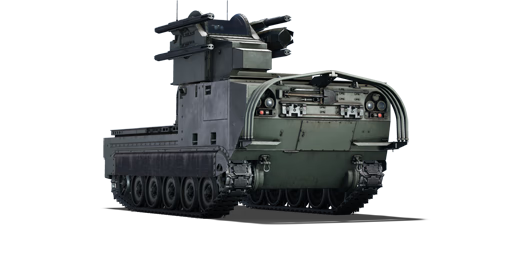
One of the first foreign customers of the American MIM-72 Chaparral was the IDF, which ordered the first batch of SAMs in 1973, immediately after the Yom Kippur War. The first batteries were delivered to Israel at the end of 1973 under the name Drakon. In total, several dozen Chaparral launch systems entered service with the IDF, and were actively used in the 1970s and '80s to protect Israeli airspace from potential attacks by Syrian aviation. In 1996, Israel concluded a deal with the United States to acquire 36 more modern MIM-72C Improved Chaparral complexes. They differed from previous versions in an improved guidance system, a Doppler proximity fuze, and a HE fragmentation warhead for the missile. Subsequently, these SAMs also received more advanced missiles, such as the MIM-72E with a smokeless engine and MIM-72G which integrated the seeker head from the FIM-92 Stinger, increasing their resistance to countermeasures. In 2003, all Chaparral units were retired and withdrawn from service by the IDF.
Introduced in Update "Sons of Attila", the Israeli Chaparral is equipped with much better missiles than the American version; the MIM-72G features IRCCM and improved engines, allowing it to combat aircraft with countermeasures and compete with SPAAs with advanced radar. The missile uses the same seeker as the one present in the FIM-92 Stinger missile, making it quite hard to dodge, and the improved engine makes it even more lethal. However, the Israeli Chaparral still suffers from a lack of radar and a gun for very close-range engagements, as even the improved missile is not capable of hitting if the locked target is just a few metres away, which is especially dangerous against enemy helicopters.
General info
Survivability and armour
Describe armour protection. Note the most well protected and key weak areas. Appreciate the layout of modules as well as the number and location of crew members. Is the level of armour protection sufficient, is the placement of modules helpful for survival in combat? If necessary use a visual template to indicate the most secure and weak zones of the armour.
Armour type:
| Armour | Front (Slope angle) | Sides | Rear | Roof |
|---|---|---|---|---|
| Hull | ___ mm | ___ mm Top ___ mm Bottom |
___ mm | ___ - ___ mm |
| Turret | ___ - ___ mm Turret front ___ mm Gun mantlet |
___ - ___ mm | ___ - ___ mm | ___ - ___ mm |
| Cupola | ___ mm | ___ mm | ___ mm | ___ mm |
Notes:
Mobility
| Game Mode | Max Speed (km/h) | Weight (tons) | Engine power (horsepower) | Power-to-weight ratio (hp/ton) | |||
|---|---|---|---|---|---|---|---|
| Forward | Reverse | Stock | Upgraded | Stock | Upgraded | ||
| Arcade | Expression error: Unexpected * operator. | 206 | Expression error: Unexpected round operator. | __.__ | |||
| Realistic | 128 | Expression error: Unexpected round operator. | __.__ | ||||
Modifications and economy
Armaments
Main armament
| MIM-72 missile | Turret rotation speed (°/s) | Reloading rate (seconds) | |||||||||||
|---|---|---|---|---|---|---|---|---|---|---|---|---|---|
| Mode | Capacity (Belt) | Vertical | Horizontal | Stabilizer | Stock | Upgraded | Full | Expert | Aced | Stock | Full | Expert | Aced |
| Arcade | 12 (4) | -9°/+90° | ±180° | - | 79.3 | 109.7 | 133.2 | 147.3 | 156.7 | 19.50 | 17.25 | 15.90 | 15.00 |
| Realistic | 53.6 | 63.0 | 76.5 | 84.6 | 90.0 | ||||||||
Ammunition
| Shell details | ||||||||||||
|---|---|---|---|---|---|---|---|---|---|---|---|---|
| Ammunition | Type of warhead |
Velocity (m/s) |
Range (m) |
Projectile mass (kg) |
Fuse delay (m) |
Fuse sensitivity (mm) |
Arming distance (m) |
Trigger radius (m) |
Explosive mass (TNT equivalent) (kg) |
Ricochet | ||
| 0% | 50% | 100% | ||||||||||
| MIM-72E | SAM | 720 | 6,000 | 86.3 | 1 | 0.3 | 0 | 5 | 4.31 | 79° | 80° | 81° |
| MIM-72G | SAM | 720 | 6,000 | 86.3 | 1 | 0.3 | 0 | 5 | 4.31 | 79° | 80° | 81° |
Ammo racks
| Full ammo |
1st rack empty |
2nd rack empty |
3rd rack empty |
4th rack empty |
5th rack empty |
6th rack empty |
Visual discrepancy |
|---|---|---|---|---|---|---|---|
| 3 | __ (+__) | __ (+__) | __ (+__) | __ (+__) | __ (+__) | __ (+__) | __ |
Usage in battles
Describe the tactics of playing in the vehicle, the features of using vehicles in the team and advice on tactics. Refrain from creating a "guide" - do not impose a single point of view but instead give the reader food for thought. Describe the most dangerous enemies and give recommendations on fighting them. If necessary, note the specifics of the game in different modes (AB, RB, SB).
Pros and cons
Pros:
- Smokeless motor missile makes enemy aircraft unable to detect incoming launch
Cons:
- 4 exposed crew with only one protected crew inside the turret, susceptible to even 7.62 mm machine gun fire which can lead to a crew knockout
- Open top vehicle, very vulnerable to overpressure from HE shells, rockets, artillery strikes, and bombs
History
The United States Army developed the M48 Chaparral in the 1960s as a short-range surface-to-air missile system which would complement the M163 Vulcan. The system used the MIM-72 Chaparral missile - a unique adaptation of the AIM-9 Sidewinder air-to-air missile which had been entering service in the US Air Force at the time. The Chaparral launch vehicle carried four such missiles on a rotating turret on top of an M113 hull, with an enlarged "cabin" at the front containing the fire control system. The unique turret was designed for fast 360-degree rotation as well as a maximum elevation of 90 degrees, allowing the system to engage enemy aircraft quickly and easily.
In 1973, Egypt and Syria performed a surprise attack on Israel (known as the Yom Kippur War) using masses of advanced Soviet weaponry supplied to them in the years since the 1967 Six-Day War. Aerial attacks by MiGs and Soviet helicopters in particular proved very difficult to stop with Israel's small air force and aging short-range AA weaponry. Richard Nixon's administration, fearing a demonstration of Soviet superiority in the Middle East, decided to supply Israel with an aerial train full of American-made weapons, combat vehicles and munitions. As part of one such shipment, Israel received its first two M48 Chaparrals as well as urgent training for a handful of crews.
The two vehicles arrived almost at the very end of the war. Reports indicate that they were made ready just in time to be deployed in the Sinai peninsula, assisting an MIM-23 Hawk battery in hunting for Egyptian helicopters on the eastern side of the Suez Canal in the days immediately following the war. Though the Hawks shot down many enemy helicopters, no Chaparral kills were reported during that particular operation. A much larger number of Chaparrals were purchased, with the first battery becoming operational only a few weeks after the Yom Kippur War. The Chaparral made its first and only kill in world history in 1974, when an Israeli operator shot down a low-flying Syrian MiG-17 attacking Israeli ground forces in the Golan Heights.
In the Israeli Defense Force (IDF), the Chaparral received the codename Drakon (Dragon), though they kept the purchase a secret for several years after its introduction. The Israeli Air Defense Array was apparently impressed by the vehicle's performance, as it continued to purchase various M48 Chaparral models for the next 25 years, in large quantities. The last purchase was completed in 1999, when Israel received at least several dozen M48 "Improved Chaparral" vehicles from US Army surplus. Reportedly, these systems all came from "block 6" of production, likely equipped with MIM-72G missiles. Though the launch vehicles were essentially identical to the original M113s used in early M48s, the Improved Chaparral's missiles featured several advancements to match the developing lethality of the Sidewinder over the years: all-aspect targeting, a heavier fragmentation-type warhead, a better guidance and tracking system, and an improved ability to ignore enemy countermeasures.
These new Chaparral vehicles would only serve in the IDF for another 4 years after their introduction, after which the entire Chaparral array was finally retired from service in 2003. Today, The IDF relies exclusively on Stinger MANPADS (infantry-operated) for short-range surface-to-air interception.
Media
- Skins
See also
- Related development
External links
| Israel anti-aircraft vehicles | |
|---|---|
| Half-track | TCM-20 |
| M163 derivatives | Hovet · Machbet · Imp.Chaparral |
| Captured | ZSU-57-2 · ZSU-23-4 |