Difference between revisions of "Hs 123 A-1 (China)"
(Edits) |
(Completed several sections. Data is sourced from "https://en.wikipedia.org/wiki/Henschel_Hs_123", the Wiki article itself cites legitimate sources for its info.) (Tag: Visual edit) |
||
| (22 intermediate revisions by 10 users not shown) | |||
| Line 1: | Line 1: | ||
| + | {{Specs-Card|code=hs-123a-1_china}} | ||
{{About | {{About | ||
| about = bomber '''{{PAGENAME}}''' | | about = bomber '''{{PAGENAME}}''' | ||
| usage = the German version | | usage = the German version | ||
| link = Hs 123 A-1 | | link = Hs 123 A-1 | ||
| − | |||
| − | |||
| − | |||
| − | |||
}} | }} | ||
== Description == | == Description == | ||
<!-- ''In the description, the first part should be about the history of and the creation and combat usage of the aircraft, as well as its key features. In the second part, tell the reader about the aircraft in the game. Insert a screenshot of the vehicle, so that if the novice player does not remember the vehicle by name, he will immediately understand what kind of vehicle the article is talking about.'' --> | <!-- ''In the description, the first part should be about the history of and the creation and combat usage of the aircraft, as well as its key features. In the second part, tell the reader about the aircraft in the game. Insert a screenshot of the vehicle, so that if the novice player does not remember the vehicle by name, he will immediately understand what kind of vehicle the article is talking about.'' --> | ||
| − | The '''{{Specs|name}}''' | + | [[File:GarageImage_{{PAGENAME}}.jpg|420px|thumb|left]] |
| − | + | {{break}} | |
| − | + | The '''{{Specs|name}}''' is a rank {{Specs|rank}} Chinese bomber {{Battle-rating}}. It was introduced in [[Update 1.91 "Night Vision"]]. | |
== General info == | == General info == | ||
=== Flight performance === | === Flight performance === | ||
| − | + | ''The plane behaves almost the same as other Interwar-period designed fighter biplanes, relatively slow but highgly maneuverable aircrafts, this in particular being somewhat slower and with a lower climb rate, because of its payload.'' | |
| − | |||
| − | |||
| − | {| class="wikitable" style="text-align:center" | + | {| class="wikitable" style="text-align:center" |
| − | ! | + | |- |
| + | ! colspan="8" | Characteristics | ||
| + | |- | ||
| + | ! colspan="8" | ''Stock'' | ||
| + | |- | ||
! colspan="2" | Max Speed<br>(km/h at 4,000 m) | ! colspan="2" | Max Speed<br>(km/h at 4,000 m) | ||
| − | ! rowspan="2" | Max altitude<br>( | + | ! rowspan="2" | Max altitude<br>(meters) |
! colspan="2" | Turn time<br>(seconds) | ! colspan="2" | Turn time<br>(seconds) | ||
| − | ! colspan="2" | Rate of climb<br>( | + | ! colspan="2" | Rate of climb<br>(meters/second) |
| − | ! rowspan="2" | Take-off run<br>( | + | ! rowspan="2" | Take-off run<br>(meters) |
|- | |- | ||
! AB !! RB !! AB !! RB !! AB !! RB | ! AB !! RB !! AB !! RB !! AB !! RB | ||
|- | |- | ||
| − | + | | 293 || 289 || {{Specs|ceiling}} || 15.8 || 16.5 || 8.2 || 8.2 || 294 | |
| − | | 293 || | + | |- |
| + | ! colspan="8" | ''Upgraded'' | ||
| + | |- | ||
| + | ! colspan="2" | Max Speed<br>(km/h at 4,000 m) | ||
| + | ! rowspan="2" | Max altitude<br>(meters) | ||
| + | ! colspan="2" | Turn time<br>(seconds) | ||
| + | ! colspan="2" | Rate of climb<br>(meters/second) | ||
| + | ! rowspan="2" | Take-off run<br>(meters) | ||
| + | |- | ||
| + | ! AB !! RB !! AB !! RB !! AB !! RB | ||
|- | |- | ||
| − | + | |325||310|| {{Specs|ceiling}} ||14.4||15.0||16.8||12.0|| 294 | |
| − | | 325 || 310 || 14.4 || 15.0 || 16.8 || 12.0 | ||
|- | |- | ||
|} | |} | ||
==== Details ==== | ==== Details ==== | ||
| − | {| class="wikitable" style="text-align:center | + | {| class="wikitable" style="text-align:center" |
|- | |- | ||
! colspan="5" | Features | ! colspan="5" | Features | ||
| Line 46: | Line 53: | ||
! Combat flaps !! Take-off flaps !! Landing flaps !! Air brakes !! Arrestor gear | ! Combat flaps !! Take-off flaps !! Landing flaps !! Air brakes !! Arrestor gear | ||
|- | |- | ||
| − | | ✓ || ✓ || ✓ || X || | + | | ✓ || ✓ || ✓ || X || ✓ <!-- ✓ --> |
|- | |- | ||
|} | |} | ||
| − | {| class="wikitable" style="text-align:center | + | {| class="wikitable" style="text-align:center" |
|- | |- | ||
| − | ! colspan=" | + | ! colspan="5" | Limits |
|- | |- | ||
| − | ! rowspan="2" | | + | ! rowspan="2" | Wing-break speed<br>(km/h) |
| − | ! rowspan="2" | Gear (km/h) | + | ! rowspan="2" | Gear limit<br>(km/h) |
| − | ! | + | ! rowspan="2" | Combat flaps<br>(km/h) |
! colspan="2" | Max Static G | ! colspan="2" | Max Static G | ||
|- | |- | ||
| − | + | ! + !! - | |
|- | |- | ||
| − | | {{Specs|destruction| | + | | {{Specs|destruction|constructions}} || {{Specs|destruction|chassis}} || 320 || ~12 || ~8 |
|- | |- | ||
|} | |} | ||
| Line 67: | Line 74: | ||
{| class="wikitable" style="text-align:center" | {| class="wikitable" style="text-align:center" | ||
|- | |- | ||
| − | ! colspan="4" | Optimal velocities | + | ! colspan="4" | Optimal velocities |
|- | |- | ||
| − | ! Ailerons | + | ! Ailerons<br>(km/h) |
| + | ! Rudder<br>(km/h) | ||
| + | ! Elevators<br>(km/h) | ||
| + | ! Radiator<br>(km/h) | ||
|- | |- | ||
| < 220 || < 220 || < 380 || > 270 | | < 220 || < 220 || < 380 || > 270 | ||
| + | |- | ||
| + | |} | ||
| + | |||
| + | {| class="wikitable" style="text-align:center" | ||
| + | |- | ||
| + | ! colspan="3" | Compressor (RB/SB) | ||
| + | |- | ||
| + | ! colspan="3" | Setting 1 | ||
| + | |- | ||
| + | ! Optimal altitude | ||
| + | ! 100% Engine power | ||
| + | ! WEP Engine power | ||
| + | |- | ||
| + | | 850 m || 660 hp || 747 hp | ||
|- | |- | ||
|} | |} | ||
=== Survivability and armour === | === Survivability and armour === | ||
| − | + | ''As most of Interwar-period designed biplanes, the Hs 123 A-1 has no armour and offers no protection to its pilot nor its critical components (engine, not self-sealing fuel tanks, oil-cooling systems, so the survivability depends on the pilot's skills. Being a metallic-frame, cloth-covered construction and not having self-sealing fuel tanks, regular Ball and AP rounds won't damage it a lot (unless they directly hit the pilot), but it's specially susceptible to Incendiary and Tracer rounds, which can ignite it if hit the fuel tanks or the cloth cover itself.'' | |
| − | |||
| − | As | ||
| − | + | It is recomended to carry the maximum fuel load possible, cause a full tank of liquid fuel will have little to no space to gassified fuel, reducing the fire hazard (incendiary sources ignite the gassified fuel, but liquid fuel in a confined space is not inherently flammable). | |
| − | |||
== Armaments == | == Armaments == | ||
| − | |||
=== Offensive armament === | === Offensive armament === | ||
| − | |||
<!-- ''Describe the offensive armament of the aircraft, if any. Describe how effective the cannons and machine guns are in a battle, and also what belts or drums are better to use. If there is no offensive weaponry, delete this subsection.'' --> | <!-- ''Describe the offensive armament of the aircraft, if any. Describe how effective the cannons and machine guns are in a battle, and also what belts or drums are better to use. If there is no offensive weaponry, delete this subsection.'' --> | ||
{{main|MG 17 (7.92 mm)}} | {{main|MG 17 (7.92 mm)}} | ||
| Line 95: | Line 114: | ||
=== Suspended armament === | === Suspended armament === | ||
| − | |||
<!-- ''Describe the aircraft's suspended armament: additional cannons under the wings, bombs, rockets and torpedoes. This section is especially important for bombers and attackers. If there is no suspended weaponry remove this subsection.'' --> | <!-- ''Describe the aircraft's suspended armament: additional cannons under the wings, bombs, rockets and torpedoes. This section is especially important for bombers and attackers. If there is no suspended weaponry remove this subsection.'' --> | ||
{{main|SC50JA (50 kg)|SC250JA (250 kg)}} | {{main|SC50JA (50 kg)|SC250JA (250 kg)}} | ||
| Line 101: | Line 119: | ||
The '''''{{PAGENAME}}''''' can be outfitted with the following ordnance: | The '''''{{PAGENAME}}''''' can be outfitted with the following ordnance: | ||
| + | * Without load | ||
* 4 x 50 kg SC50JA bombs (200 kg total) | * 4 x 50 kg SC50JA bombs (200 kg total) | ||
* 1 x 250 kg SC250JA bomb + 4 x 50 kg SC50JA bombs (450 kg total) | * 1 x 250 kg SC250JA bomb + 4 x 50 kg SC50JA bombs (450 kg total) | ||
== Usage in battles == | == Usage in battles == | ||
| − | + | ''Being a dive-bomber oriented plane, its main role it´s self explained. Anyway, its frontal armament -like other fighters of its BR- makes it useful to be used in a Fighter role, specially after dropping its bombs, which leaves a lighter and in consequence faster and more maneuverable plane.'' | |
| − | Being a dive-bomber, its main role | ||
| − | + | ''Stealth rounds'' are recommended for ground attack, being Armour Piercing and Incendiary, while Tracers are better suited for air targets (being Armour Piercing and Incendiary thanks to its Tracer component). | |
| − | |||
| − | |||
| − | |||
| − | |||
| − | |||
| − | |||
| − | |||
| − | |||
| − | |||
| − | |||
| − | |||
| − | |||
| − | |||
| − | |||
| − | |||
| − | |||
=== Manual Engine Control === | === Manual Engine Control === | ||
| Line 140: | Line 142: | ||
|- | |- | ||
| Controllable || Not controllable<br>Not auto controlled || Not controllable<br>Not auto controlled || Not controllable<br>Not auto controlled || Combined || Not controllable<br>1 gear || Not controllable | | Controllable || Not controllable<br>Not auto controlled || Not controllable<br>Not auto controlled || Not controllable<br>Not auto controlled || Combined || Not controllable<br>1 gear || Not controllable | ||
| + | |- | ||
| + | |} | ||
| + | |||
| + | === Modules === | ||
| + | {| class="wikitable" | ||
| + | ! Tier | ||
| + | ! colspan="2" | Flight performance | ||
| + | ! Survivability | ||
| + | ! colspan="2" | Weaponry | ||
| + | |- | ||
| + | | I | ||
| + | | Fuselage repair | ||
| + | | Radiator | ||
| + | | | ||
| + | | Offensive 7 mm | ||
| + | | | ||
| + | |- | ||
| + | | II | ||
| + | | | ||
| + | | Compressor | ||
| + | | | ||
| + | | | ||
| + | | ETC 250/IV | ||
| + | |- | ||
| + | | III | ||
| + | | Wings repair | ||
| + | | Engine | ||
| + | | Airframe | ||
| + | | New 7 mm MGs | ||
| + | | | ||
| + | |- | ||
| + | | IV | ||
| + | | | ||
| + | | Engine injection | ||
| + | | Cover | ||
| + | | | ||
| + | | | ||
|- | |- | ||
|} | |} | ||
=== Pros and cons === | === Pros and cons === | ||
| − | + | '''Pros:''' Highly maneuverable, good payload for its BR, MG 17 machine guns are reliable and useful either against ground targets (Stealth rounds) and air targets (Tracer rounds). | |
| − | + | * | |
| − | + | '''Cons:''' Slow, has a lower max altitude compared with monoplane dive-bombers such as British, American and Soviet dive-bombers, no defensive armament makes it vulnerable while diving, has no armour protection and lacks of self-sealing fuel tanks, its rifle-caliber machine guns are useless against fortified artillery pieces, bunkers and tanks, and less effective against armored planes (even on its BR, like the soviet I-153). | |
| − | |||
| − | |||
| − | |||
| − | |||
| − | |||
| − | |||
| − | + | * | |
| − | |||
| − | * | ||
| − | |||
| − | |||
| − | |||
| − | |||
== History == | == History == | ||
| − | + | ''Chinese Nationalist Air Force received twelve of its planes acquired from Germany, which were used it against Imperial Japanese Navy warships in the Yangtze River, during the Second Sino-Japanese War.'' | |
| − | |||
| − | |||
| − | |||
| − | |||
| − | |||
== Media == | == Media == | ||
| − | + | ''Excellent additions to the article would be video guides, screenshots from the game, and photos.'' | |
| − | + | == See also == | |
| + | ''Links to the articles on the War Thunder Wiki that you think will be useful for the reader, for example:'' | ||
| − | |||
| − | |||
| − | |||
| − | |||
* ''reference to the series of the aircraft;'' | * ''reference to the series of the aircraft;'' | ||
| − | * ''links to approximate analogues of other nations and research trees.'' | + | * ''links to approximate analogues of other nations and research trees.'' |
| − | |||
| − | |||
| − | |||
| − | |||
| − | |||
| − | |||
| − | |||
| − | |||
== External links == | == External links == | ||
| − | + | ''Paste links to sources and external resources, such as:'' | |
| − | |||
| − | |||
| − | |||
| − | |||
| − | |||
| − | + | * https://es.wikipedia.org/wiki/Henschel_Hs_123 | |
| − | |||
{{AirManufacturer Henschel}} | {{AirManufacturer Henschel}} | ||
{{China bombers}} | {{China bombers}} | ||
Revision as of 16:54, 12 April 2020
Contents
| This page is about the bomber Hs 123 A-1 (China). For the German version, see Hs 123 A-1. |
Description
.jpg)
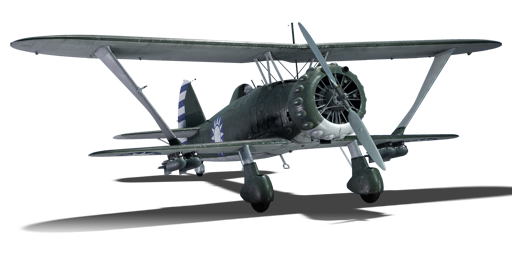
The ␗Hs 123 A-1 is a rank Chinese bomber
with a battle rating of (AB), (RB), and (SB). It was introduced in Update 1.91 "Night Vision".
General info
Flight performance
The plane behaves almost the same as other Interwar-period designed fighter biplanes, relatively slow but highgly maneuverable aircrafts, this in particular being somewhat slower and with a lower climb rate, because of its payload.
| Characteristics | |||||||
|---|---|---|---|---|---|---|---|
| Stock | |||||||
| Max Speed (km/h at 4,000 m) |
Max altitude (meters) |
Turn time (seconds) |
Rate of climb (meters/second) |
Take-off run (meters) | |||
| AB | RB | AB | RB | AB | RB | ||
| 293 | 289 | 15.8 | 16.5 | 8.2 | 8.2 | 294 | |
| Upgraded | |||||||
| Max Speed (km/h at 4,000 m) |
Max altitude (meters) |
Turn time (seconds) |
Rate of climb (meters/second) |
Take-off run (meters) | |||
| AB | RB | AB | RB | AB | RB | ||
| 325 | 310 | 14.4 | 15.0 | 16.8 | 12.0 | 294 | |
Details
| Features | ||||
|---|---|---|---|---|
| Combat flaps | Take-off flaps | Landing flaps | Air brakes | Arrestor gear |
| ✓ | ✓ | ✓ | X | ✓ |
| Limits | ||||
|---|---|---|---|---|
| Wing-break speed (km/h) |
Gear limit (km/h) |
Combat flaps (km/h) |
Max Static G | |
| + | - | |||
| 320 | ~12 | ~8 | ||
| Optimal velocities | |||
|---|---|---|---|
| Ailerons (km/h) |
Rudder (km/h) |
Elevators (km/h) |
Radiator (km/h) |
| < 220 | < 220 | < 380 | > 270 |
| Compressor (RB/SB) | ||
|---|---|---|
| Setting 1 | ||
| Optimal altitude | 100% Engine power | WEP Engine power |
| 850 m | 660 hp | 747 hp |
Survivability and armour
As most of Interwar-period designed biplanes, the Hs 123 A-1 has no armour and offers no protection to its pilot nor its critical components (engine, not self-sealing fuel tanks, oil-cooling systems, so the survivability depends on the pilot's skills. Being a metallic-frame, cloth-covered construction and not having self-sealing fuel tanks, regular Ball and AP rounds won't damage it a lot (unless they directly hit the pilot), but it's specially susceptible to Incendiary and Tracer rounds, which can ignite it if hit the fuel tanks or the cloth cover itself.
It is recomended to carry the maximum fuel load possible, cause a full tank of liquid fuel will have little to no space to gassified fuel, reducing the fire hazard (incendiary sources ignite the gassified fuel, but liquid fuel in a confined space is not inherently flammable).
Armaments
Offensive armament
The Hs 123 A-1 (China) is armed with:
- 2 x 7.92 mm MG 17 machine guns, nose-mounted (500 rpg = 1,000 total)
Suspended armament
The Hs 123 A-1 (China) can be outfitted with the following ordnance:
- Without load
- 4 x 50 kg SC50JA bombs (200 kg total)
- 1 x 250 kg SC250JA bomb + 4 x 50 kg SC50JA bombs (450 kg total)
Usage in battles
Being a dive-bomber oriented plane, its main role it´s self explained. Anyway, its frontal armament -like other fighters of its BR- makes it useful to be used in a Fighter role, specially after dropping its bombs, which leaves a lighter and in consequence faster and more maneuverable plane.
Stealth rounds are recommended for ground attack, being Armour Piercing and Incendiary, while Tracers are better suited for air targets (being Armour Piercing and Incendiary thanks to its Tracer component).
Manual Engine Control
| MEC elements | ||||||
|---|---|---|---|---|---|---|
| Mixer | Pitch | Radiator | Supercharger | Turbocharger | ||
| Oil | Water | Type | ||||
| Controllable | Not controllable Not auto controlled |
Not controllable Not auto controlled |
Not controllable Not auto controlled |
Combined | Not controllable 1 gear |
Not controllable |
Modules
| Tier | Flight performance | Survivability | Weaponry | ||
|---|---|---|---|---|---|
| I | Fuselage repair | Radiator | Offensive 7 mm | ||
| II | Compressor | ETC 250/IV | |||
| III | Wings repair | Engine | Airframe | New 7 mm MGs | |
| IV | Engine injection | Cover | |||
Pros and cons
Pros: Highly maneuverable, good payload for its BR, MG 17 machine guns are reliable and useful either against ground targets (Stealth rounds) and air targets (Tracer rounds).
Cons: Slow, has a lower max altitude compared with monoplane dive-bombers such as British, American and Soviet dive-bombers, no defensive armament makes it vulnerable while diving, has no armour protection and lacks of self-sealing fuel tanks, its rifle-caliber machine guns are useless against fortified artillery pieces, bunkers and tanks, and less effective against armored planes (even on its BR, like the soviet I-153).
History
Chinese Nationalist Air Force received twelve of its planes acquired from Germany, which were used it against Imperial Japanese Navy warships in the Yangtze River, during the Second Sino-Japanese War.
Media
Excellent additions to the article would be video guides, screenshots from the game, and photos.
See also
Links to the articles on the War Thunder Wiki that you think will be useful for the reader, for example:
- reference to the series of the aircraft;
- links to approximate analogues of other nations and research trees.
External links
Paste links to sources and external resources, such as:
| Henschel & Son Corporation (Henschel und Sohn Aktiengesellschaft) | |
|---|---|
| Attackers | Hs 129 B-2 · Hs 129 B-3 |
| Bombers | Hs 123 A-1 |
| Export | ␗Hs 123 A-1 |
| Hs 129 B-2 (Romania) · Hs 129 B-2 (Romania) | |
| China bombers | |
|---|---|
| American | Martin 139WC*(␗B-10B) · ␗A-29 · ␗B-25J-30 · ␗PB4Y-2 |
| German | ␗Hs 123 A-1 |
| Soviet | ␗SB 2M-103U · ␗DB-3A · ␗Tu-2S-44 · ␗Tu-4 |
| Japanese | ␗P1Y1 mod. 11 |
| *Export Name | |