Difference between revisions of "J7W1"
(This page was complained about by some players for being deceptive. I removed 1 dot point from the cons which was stated as not making sense and added context to the sustained turn rate and combat flaps section to hopefully address the complaints) (Tag: Visual edit) |
(→History) (Tag: Visual edit) |
||
| (43 intermediate revisions by 18 users not shown) | |||
| Line 1: | Line 1: | ||
| − | {{Specs-Card | + | {{Specs-Card|code=j7w1}} |
| − | |code=j7w1 | ||
| − | |||
| − | }} | ||
== Description == | == Description == | ||
| − | <!-- ''In the description, the first part | + | <!--''In the description, the first part needs to be about the history of and the creation and combat usage of the aircraft, as well as its key features. In the second part, tell the reader about the aircraft in the game. Insert a screenshot of the vehicle. If the novice player does not remember the vehicle by name, he will immediately understand what kind of vehicle it is talking about.''--> |
| − | |||
| − | + | [[File:GarageImage_{{PAGENAME}}.jpg|420px|thumb|left|The '''{{PAGENAME}}''' in the garage]] | |
| + | {{break}} | ||
| + | The '''{{Specs|name}}''' is a Rank {{Specs|rank}} Japanese fighter {{Battle-rating}}. This aircraft was introduced in Update 1.43. | ||
== General info == | == General info == | ||
| − | === Flight | + | === Flight Performance === |
| − | + | The Shinden has a maximum speed of 750km/h (466 mph), making it quite fast and allowing for steeper dives; however, it's turning rate is very slow, making it very ineffective in dogfights. | |
| − | |||
| − | The | ||
| − | {| class="wikitable" style="text-align:center" | + | {| class="wikitable" style="text-align:center" |
| + | |- | ||
| + | ! colspan="8" | Characteristics | ||
| + | |- | ||
| + | ! colspan="8" | ''Stock'' | ||
|- | |- | ||
| − | |||
! colspan="2" | Max Speed<br>(km/h at 8,500 m) | ! colspan="2" | Max Speed<br>(km/h at 8,500 m) | ||
! rowspan="2" | Max altitude<br>(meters) | ! rowspan="2" | Max altitude<br>(meters) | ||
! colspan="2" | Turn time<br>(seconds) | ! colspan="2" | Turn time<br>(seconds) | ||
! colspan="2" | Rate of climb<br>(meters/second) | ! colspan="2" | Rate of climb<br>(meters/second) | ||
| − | ! rowspan="2" | Take-off run<br>(meters) | + | ! rowspan="2" |Take-off run<br>(meters) |
|- | |- | ||
| − | ! AB | + | ! AB |
| + | ! RB | ||
| + | ! AB | ||
| + | ! RB | ||
| + | ! AB | ||
| + | ! RB | ||
|- | |- | ||
| − | + | | ? || 703 || {{Specs|ceiling}} || ??.? || 32.2 || ??.? || 15.3 || 650 | |
| − | | | ||
|- | |- | ||
| − | !Upgraded | + | ! colspan="8" | ''Upgraded'' |
| − | | | + | |- |
| + | ! colspan="2" | Max Speed<br>(km/h at 8,500 m) | ||
| + | ! rowspan="2" |Max altitude (meters) | ||
| + | ! colspan="2" | Turn time (seconds) | ||
| + | ! colspan="2" | Rate of climb<br>(meters/second) | ||
| + | ! rowspan="2" |Take-off run (meters) | ||
| + | |- | ||
| + | ! AB | ||
| + | ! RB | ||
| + | ! AB | ||
| + | ! RB | ||
| + | ! AB | ||
| + | ! RB | ||
| + | |- | ||
| + | | ? || ? || {{Specs|ceiling}} || ??.? || ??.? || ??.? || ??.? || ??? | ||
|- | |- | ||
|} | |} | ||
| − | ==== Details ==== | + | ====Details==== |
| − | {| class="wikitable" style="text-align:center | + | {| class="wikitable" style="text-align:center" |
|- | |- | ||
! colspan="5" | Features | ! colspan="5" | Features | ||
|- | |- | ||
| − | ! Combat | + | ! Combat flap |
| + | ! Take-off flap | ||
| + | ! Landing flap | ||
| + | ! Air brakes | ||
| + | ! Arrestor gear | ||
|- | |- | ||
| − | | | + | | X || X || X || X || X <!-- ✓ --> |
|- | |- | ||
|} | |} | ||
| − | {| class="wikitable" style="text-align:center | + | {| class="wikitable" style="text-align:center" |
|- | |- | ||
| − | ! colspan=" | + | ! colspan="5" | Limits |
|- | |- | ||
| − | ! rowspan="2" | | + | ! rowspan="2" | Wing-break speed<br>(km/h) |
| − | ! rowspan="2" | Gear (km/h) | + | ! rowspan="2" | Gear limit<br>(km/h) |
| − | ! | + | ! rowspan="2" | Combat flap<br> (km/h) |
! colspan="2" | Max Static G | ! colspan="2" | Max Static G | ||
|- | |- | ||
| − | + | ! + | |
| + | ! - | ||
|- | |- | ||
| − | | {{Specs| | + | | {{Specs|разрушение|конструкции}} || {{Specs|разрушение|шасси}} || ??? || ~?? || ~? |
|- | |- | ||
|} | |} | ||
| Line 63: | Line 85: | ||
{| class="wikitable" style="text-align:center" | {| class="wikitable" style="text-align:center" | ||
|- | |- | ||
| − | ! colspan="4" | Optimal velocities | + | ! colspan="4" | Optimal velocities |
|- | |- | ||
| − | ! Ailerons | + | ! Ailerons<br>(km/h) |
| + | ! Rudder<br>(km/h) | ||
| + | ! Elevators<br>(km/h) | ||
| + | ! Radiator<br>(km/h) | ||
|- | |- | ||
| − | | < | + | | < ??? || < ??? || < ??? || > ??? |
|- | |- | ||
|} | |} | ||
| Line 81: | Line 106: | ||
! WEP Engine power | ! WEP Engine power | ||
|- | |- | ||
| − | | | + | | ?,??? m || ??? hp || ?,??? hp |
| + | |- | ||
| + | <!--! colspan="3" | Setting 2 | ||
| + | |- | ||
| + | ! Optimal altitude | ||
| + | ! 100% Engine power | ||
| + | ! WEP Engine power | ||
| + | |- | ||
| + | | ?,??? m || ?,??? hp || ?,??? hp | ||
|- | |- | ||
| + | ! colspan="3" | Setting 3 | ||
| + | |- | ||
| + | ! Optimal altitude | ||
| + | ! 100% Engine power | ||
| + | ! WEP Engine power | ||
| + | |- | ||
| + | | ?,??? m || ?,??? hp || ?,??? hp | ||
| + | |- --> | ||
|} | |} | ||
| − | |||
| − | |||
=== Survivability and armour === | === Survivability and armour === | ||
| − | + | ''Examine the survivability of the aircraft. Note how vulnerable the structure is and how secure the pilot is, whether the fuel tanks are armoured. Describe the armour, if there is any, also mention the vulnerability of other critical aircraft systems.'' | |
| − | |||
| − | |||
| − | |||
| − | |||
| − | |||
| − | |||
| − | |||
| − | |||
| − | |||
== Armaments == | == Armaments == | ||
| − | |||
=== Offensive armament === | === Offensive armament === | ||
| − | + | <!--''Describe the offensive armament of the aircraft, if any. Describe how effective the cannons and machine guns are in a battle, and also what belts or drums are better to use. If there is no offensive weaponry, delete this subsection.''--> | |
| − | <!-- ''Describe the offensive armament of the aircraft, if any. Describe how effective the cannons and machine guns are in a battle, and also what belts or drums are better to use. If there is no offensive weaponry, delete this subsection.'' --> | ||
{{main|Type 5 navy (30 mm)}} | {{main|Type 5 navy (30 mm)}} | ||
The '''''{{PAGENAME}}''''' is armed with: | The '''''{{PAGENAME}}''''' is armed with: | ||
| − | * 4 x 30 mm Type 5 navy cannons | + | * 4 x 30 mm Type 5 navy cannons (60 rpg = 240 total) |
=== Suspended armament === | === Suspended armament === | ||
| − | + | <!--''Describe the aircraft's suspended armament: additional cannons under the wings, bombs, rockets and torpedoes. This section is especially important for bombers and attackers. If there is no suspended weaponry remove this subsection.''--> | |
| − | <!-- ''Describe the aircraft's suspended armament: additional cannons under the wings, bombs, rockets and torpedoes. This section is especially important for bombers and attackers. If there is no suspended weaponry remove this subsection.'' --> | ||
{{main|Navy Type 97 Number 6 (60 kg)}} | {{main|Navy Type 97 Number 6 (60 kg)}} | ||
| − | The '''''{{PAGENAME}}''''' can be outfitted with the following | + | The '''''{{PAGENAME}}''''' can be outfitted with the following ordinance: |
* Without load | * Without load | ||
| Line 122: | Line 149: | ||
== Usage in battles == | == Usage in battles == | ||
| − | + | The Shinden is armed with 4 30 mm frontal cannons, making it quite the slugger. Due to its slow turn time, it is usually best for the pilot to engage enemy fighters head on, or from above and behind since usually a single burst of shots can easily knock even heavy bombers out of the sky. Regarding fire from bomber gunners and head on engagements, the plane's armor enables it to take some beating to the wings, but the pilot is heavily exposed from the front. Should this plane be forced into a turning fight, it will almost certainly lose since its BR means it will face up against faster turning Spitfires and P-51Ds. It's speed might be used to its advantage in order to retreat, or gain some distance before attempting to initiate head on combat. | |
| − | |||
| − | The Shinden is | ||
| − | |||
| − | |||
| − | === Manual Engine Control === | + | ===Manual Engine Control=== |
{| class="wikitable" style="text-align:center" | {| class="wikitable" style="text-align:center" | ||
|- | |- | ||
! colspan="7" | MEC elements | ! colspan="7" | MEC elements | ||
|- | |- | ||
| − | ! rowspan="2" | Mixer | + | ! rowspan="2" |Mixer |
| − | ! rowspan="2" | Pitch | + | ! rowspan="2" |Pitch |
| − | ! colspan="3" | Radiator | + | ! colspan="3" |Radiator |
| − | ! rowspan="2" | Supercharger | + | ! rowspan="2" |Supercharger |
| − | ! rowspan="2" | Turbocharger | + | ! rowspan="2" |Turbocharger |
|- | |- | ||
| − | ! Oil | + | ! Oil |
| + | ! Water | ||
| + | ! Type | ||
|- | |- | ||
| − | | Controllable || | + | | Controllable || rowspan="2" | Not controllable || rowspan="2" | Not controllable || rowspan="2" | Not controllable || rowspan="2" | Separate || rowspan="2" | Not ontrollable || rowspan="2" | Not controllable |
|- | |- | ||
|} | |} | ||
| − | === | + | ===Modules=== |
| − | + | {| class="wikitable" | |
| + | ! colspan="1" | Tier | ||
| + | ! colspan="2" | Flight performance | ||
| + | ! colspan="1" | Survivability | ||
| + | ! colspan="2" | Weaponry | ||
| + | |- | ||
| + | | I | ||
| + | | Fuselage Repair | ||
| + | | Radiator | ||
| + | | | ||
| + | | | ||
| + | |- | ||
| + | | II | ||
| + | | | ||
| + | | Compressor | ||
| + | | Airframe | ||
| + | | | ||
| + | |- | ||
| + | | III | ||
| + | | Wings Repair | ||
| + | | Engine | ||
| + | | | ||
| + | | | ||
| + | |- | ||
| + | | IV | ||
| + | | | ||
| + | | Engine Injection | ||
| + | | Cover | ||
| + | | | ||
| + | |- | ||
| + | |} | ||
| + | === Pros and cons: === | ||
'''Pros:''' | '''Pros:''' | ||
| − | * Pilot has some protection in the back from the engine | + | * Pilot has some protection in the back from the engine. |
| − | + | * 4 30 mm cannons make for some great offensive firepower. | |
| − | + | * Fast | |
| − | + | * Since the engine and propeller are located in the rear, it is not likely to take damage or catch fire from shots landing at its front. | |
| − | * 4 | + | |
| − | * | + | * |
| − | * Since the engine and propeller are located in the rear, it is not likely to take damage or catch fire from shots landing at its front | ||
'''Cons:''' | '''Cons:''' | ||
| − | * | + | * Slow turn rate. |
| − | |||
* Pilot more exposed at the front. | * Pilot more exposed at the front. | ||
| − | * Since the engine is located in the rear, it is especially vulnerable to enemies behind it | + | * Since the engine is located in the rear, it is especially vulnerable to enemies behind it. |
| − | * Shots to the front may damage its "tail" flaps | + | * Shots to the front may damage its "tail" flaps. |
| − | + | ||
| − | + | * | |
| − | * | ||
== History == | == History == | ||
| − | + | The J7W1 ''Shinden'' (震電, "Magnificent Lightning") was a Imperial Japanese fighter of WWII that was built near the end of the war in an attempted response to the American B-29 Superfortress bombers. The aircraft used a canard wing formation, (canard wing formation refers to how the main wings are mounted at the rear of the fuselage and smaller wings are placed at the front. similar to the Curtiss-Wright XP-55 Ascender. Like the Ascender, the J7W1 was never put into mass-production and was abandoned while still in the prototype stage.<ref>“Kyushu J7W1 Shinden (Magnificent Lightning).” ''National Air and Space Museum'', 18 Apr. 2019, airandspace.si.edu/collection-objects/kyushu-j7w1-shinden-magnificent-lightning.</ref> | |
| − | |||
| − | Developed with the intention of intercepting heavy bombers, it was given 4 nose-mounted 30 mm cannons. | + | Developed with the intention of intercepting heavy bombers, it was given 4 nose-mounted 30 mm cannons. |
| − | Development of the aircraft began in 1944, but shortages of manufacturing supplies continued to delay its development and testing and the first prototype wasn't completed until April 1945. The Navy placed high hopes in the new model and it was originally hoped that the Kyushu's Zasshonokuma factory | + | Development of the aircraft began in 1944, but shortages of manufacturing supplies continued to delay its development and testing and the first prototype wasn't completed until April 1945. The Navy placed high hopes in the new model and it was originally hoped that the Kyushu's Zasshonokuma factory Nakajima's Handa plant would be able to produce over a thousand of the aircraft by 1947. |
| − | The prototype first flew on 3 August 1945 from Itazuke Air Base. The plane flew a total of three times, each time as a test flight before it was grounded permanently due to the Japanese surrender and end of the war. | + | The prototype first flew on 3 August 1945, the prototype first flew, from Itazuke Air Base. The plane flew a total of three times, each time as a test flight before it was grounded permanently due to the Japanese surrender and end of the war. |
| − | Various parts of the Shinden survived the end of the war and its fuselage can be seen at the National Air and Space Museum in Washington DC.<ref> | + | Various parts of the Shinden survived the end of the war and its fuselage can be seen at the National Air and Space Museum in Washington DC.<ref>“Kyushu J7W1/2 ‘Shinden.’” ''Kyushu J7W1/2 - Shinden'', tanks45.tripod.com/Jets45/Histories/Shinden/Shinden.htm.</ref> |
== Media == | == Media == | ||
| − | + | ''An excellent addition to the article will be video guides, as well as screenshots from the game and photos.'' | |
| − | + | == See also == | |
| − | + | ''Links to the articles on the War Thunder Wiki that you think will be useful for the reader, for example:'' | |
| − | |||
| − | |||
| − | |||
| − | |||
| − | |||
| − | |||
| − | |||
| − | |||
| − | |||
| − | |||
| − | |||
* ''reference to the series of the aircraft;'' | * ''reference to the series of the aircraft;'' | ||
| − | * ''links to approximate analogues of other nations and research trees.'' | + | * ''links to approximate analogues of other nations and research trees.'' |
| − | + | == External links == | |
| + | ''Paste links to sources and external resources, such as:'' | ||
| − | |||
| − | |||
| − | |||
| − | |||
| − | |||
* ''topic on the official game forum;'' | * ''topic on the official game forum;'' | ||
| − | * ''other literature.'' | + | * ''encyclopedia page on aircraft;'' |
| − | + | * ''other literature.'' | |
| − | |||
| − | |||
| − | |||
| − | |||
| − | |||
| − | |||
| − | |||
{{Japan fighters}} | {{Japan fighters}} | ||
Revision as of 19:55, 19 April 2019
Contents
Description

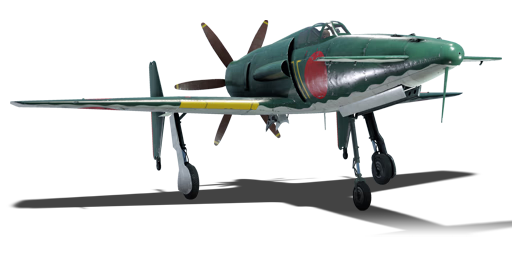
The J7W1 Shinden is a Rank Japanese fighter
with a battle rating of (AB), (RB), and (SB). This aircraft was introduced in Update 1.43.
General info
Flight Performance
The Shinden has a maximum speed of 750km/h (466 mph), making it quite fast and allowing for steeper dives; however, it's turning rate is very slow, making it very ineffective in dogfights.
| Characteristics | |||||||
|---|---|---|---|---|---|---|---|
| Stock | |||||||
| Max Speed (km/h at 8,500 m) |
Max altitude (meters) |
Turn time (seconds) |
Rate of climb (meters/second) |
Take-off run (meters) | |||
| AB | RB | AB | RB | AB | RB | ||
| ? | 703 | ??.? | 32.2 | ??.? | 15.3 | 650 | |
| Upgraded | |||||||
| Max Speed (km/h at 8,500 m) |
Max altitude (meters) | Turn time (seconds) | Rate of climb (meters/second) |
Take-off run (meters) | |||
| AB | RB | AB | RB | AB | RB | ||
| ? | ? | ??.? | ??.? | ??.? | ??.? | ??? | |
Details
| Features | ||||
|---|---|---|---|---|
| Combat flap | Take-off flap | Landing flap | Air brakes | Arrestor gear |
| X | X | X | X | X |
| Limits | ||||
|---|---|---|---|---|
| Wing-break speed (km/h) |
Gear limit (km/h) |
Combat flap (km/h) |
Max Static G | |
| + | - | |||
| ??? | ~?? | ~? | ||
| Optimal velocities | |||
|---|---|---|---|
| Ailerons (km/h) |
Rudder (km/h) |
Elevators (km/h) |
Radiator (km/h) |
| < ??? | < ??? | < ??? | > ??? |
| Compressor (RB/SB) | ||
|---|---|---|
| Setting 1 | ||
| Optimal altitude | 100% Engine power | WEP Engine power |
| ?,??? m | ??? hp | ?,??? hp |
Survivability and armour
Examine the survivability of the aircraft. Note how vulnerable the structure is and how secure the pilot is, whether the fuel tanks are armoured. Describe the armour, if there is any, also mention the vulnerability of other critical aircraft systems.
Armaments
Offensive armament
The J7W1 is armed with:
- 4 x 30 mm Type 5 navy cannons (60 rpg = 240 total)
Suspended armament
The J7W1 can be outfitted with the following ordinance:
- Without load
- 2 x 60 kg Navy Type 97 Number 6 bombs (120 kg total)
- 4 x 60 kg Navy Type 97 Number 6 bombs (240 kg total)
Usage in battles
The Shinden is armed with 4 30 mm frontal cannons, making it quite the slugger. Due to its slow turn time, it is usually best for the pilot to engage enemy fighters head on, or from above and behind since usually a single burst of shots can easily knock even heavy bombers out of the sky. Regarding fire from bomber gunners and head on engagements, the plane's armor enables it to take some beating to the wings, but the pilot is heavily exposed from the front. Should this plane be forced into a turning fight, it will almost certainly lose since its BR means it will face up against faster turning Spitfires and P-51Ds. It's speed might be used to its advantage in order to retreat, or gain some distance before attempting to initiate head on combat.
Manual Engine Control
| MEC elements | ||||||
|---|---|---|---|---|---|---|
| Mixer | Pitch | Radiator | Supercharger | Turbocharger | ||
| Oil | Water | Type | ||||
| Controllable | Not controllable | Not controllable | Not controllable | Separate | Not ontrollable | Not controllable |
Modules
| Tier | Flight performance | Survivability | Weaponry | ||
|---|---|---|---|---|---|
| I | Fuselage Repair | Radiator | |||
| II | Compressor | Airframe | |||
| III | Wings Repair | Engine | |||
| IV | Engine Injection | Cover | |||
Pros and cons:
Pros:
- Pilot has some protection in the back from the engine.
- 4 30 mm cannons make for some great offensive firepower.
- Fast
- Since the engine and propeller are located in the rear, it is not likely to take damage or catch fire from shots landing at its front.
Cons:
- Slow turn rate.
- Pilot more exposed at the front.
- Since the engine is located in the rear, it is especially vulnerable to enemies behind it.
- Shots to the front may damage its "tail" flaps.
History
The J7W1 Shinden (震電, "Magnificent Lightning") was a Imperial Japanese fighter of WWII that was built near the end of the war in an attempted response to the American B-29 Superfortress bombers. The aircraft used a canard wing formation, (canard wing formation refers to how the main wings are mounted at the rear of the fuselage and smaller wings are placed at the front. similar to the Curtiss-Wright XP-55 Ascender. Like the Ascender, the J7W1 was never put into mass-production and was abandoned while still in the prototype stage.[1]
Developed with the intention of intercepting heavy bombers, it was given 4 nose-mounted 30 mm cannons.
Development of the aircraft began in 1944, but shortages of manufacturing supplies continued to delay its development and testing and the first prototype wasn't completed until April 1945. The Navy placed high hopes in the new model and it was originally hoped that the Kyushu's Zasshonokuma factory Nakajima's Handa plant would be able to produce over a thousand of the aircraft by 1947.
The prototype first flew on 3 August 1945, the prototype first flew, from Itazuke Air Base. The plane flew a total of three times, each time as a test flight before it was grounded permanently due to the Japanese surrender and end of the war.
Various parts of the Shinden survived the end of the war and its fuselage can be seen at the National Air and Space Museum in Washington DC.[2]
Media
An excellent addition to the article will be video guides, as well as screenshots from the game and photos.
See also
Links to the articles on the War Thunder Wiki that you think will be useful for the reader, for example:
- reference to the series of the aircraft;
- links to approximate analogues of other nations and research trees.
External links
Paste links to sources and external resources, such as:
- topic on the official game forum;
- encyclopedia page on aircraft;
- other literature.
| Japan fighters | |
|---|---|
| Navy | |
| Carrier-based fighter | |
| A5M | A5M4 · Hagiri's A5M4 |
| A6M | A6M2 mod. 11 · A6M2 · A6M3 · A6M3 mod. 22 · A6M3 mod. 22Ko · A6M5 · A6M5 Ko · A6M5 otsu · A6M5 Hei · A6M6c |
| A7He | A7He1* |
| A7M | A7M1 (NK9H) · A7M2 |
| Land-based Fighter | |
| J2M | J2M2 · J2M3 · J2M4 Kai · J2M5 · J2M5 (30 mm) |
| J6K | J6K1 |
| J7W | J7W1 |
| N1K-J | N1K1-Ja · N1K2-J · N1K2-Ja |
| Fighter seaplane | |
| N1K | N1K1 |
| A6M-N | A6M2-N |
| Army | |
| Ki-10 | Ki-10-I · Ki-10-I C · Ki-10-II · Ki-10-II C |
| Ki-27 | Ki-27 otsu · Ki-27 otsu Tachiarai |
| Ki-43 | Ki-43-I · Ki-43-II · Ki-43-III otsu |
| Ki-44 | Ki-44-I · Ki-44-I 34 · Ki-44-II otsu · Ki-44-II hei |
| Ki-61 | Ki-61-I ko · Ki-61-I otsu · Ki-61-I hei · Tada's Ki-61-I hei · Ki-61-I tei · Ki-61-II Otsu Kai |
| Ki-84 | Ki-84 ko · Ki-84 otsu · Ki-84 hei |
| Ki-87 | Ki-87 |
| Ki-94 | Ki-94-II |
| Ki-100 | Ki-100 · Ki-100-II |
| Other countries | ▅F4U-1A · ▅P-51C-11-NT · ▅Bf 109 E-7 · ▅Fw 190 A-5 |
| *Imported designation of the He 112 (A6M was in development - A7M would take A7 designation after the cancelation of the A7He) | |