Difference between pages "Ho-Ro" and "Dunkerque"
U163826790 (talk | contribs) (→Pros and cons) (Tag: Visual edit) |
(→Description: New Description Project) |
||
| Line 1: | Line 1: | ||
{{Specs-Card | {{Specs-Card | ||
| − | |code= | + | |code=fr_battleship_dunkerque |
| − | |images={{Specs-Card-Image|GarageImage_{{PAGENAME}}.jpg | + | |images={{Specs-Card-Image|GarageImage_{{PAGENAME}}.jpg}} |
}} | }} | ||
== Description == | == Description == | ||
| − | <!-- ''In the description, | + | <!-- ''In the first part of the description, cover the history of the ship's creation and military application. In the second part, tell the reader about using this ship in the game. Add a screenshot: if a beginner player has a hard time remembering vehicles by name, a picture will help them identify the ship in question.'' --> |
| − | + | '''Dunkerque''' was laid down in December 1932 and launched in October 1935. Her trials began in April 1936 before the superstructures were fully complete, with her commissioning taking place in December 1936 after extensive sea trials. Trials continued into 1938, including gunnery training and an endurance cruise to the Caribbean and Senegal from January to March 1938. In September 1938, she became the flagship of the Atlantic Squadron. With the beginning of the Second World War, Dunkerque formed the core of France's Force de Raid, participating in missions such as convoy escorts and operations with British naval forces. Following France's armistice in 1940, Britain arrived at the French naval base at Mers-el-Kébir, demanding the surrender of the French fleet. When the ultimatum was declined, the British fleet opened fire, striking Dunkerque with four 15-inch shells, causing significant damage and casualties. A follow-up British aerial attack caused even more severe damage, with an explosion of the depth charges on a torpedo boat moored to the starboard. Despite severe damage, Dunkerque received temporary repairs and returned to Toulon in February 1942 for full restoration. In November 1942, as German forces advanced into Vichy France, the French Navy scuttled Dunkerque while she was in dry dock to prevent her capture. Post-war, she was deemed beyond repair, officially stricken from the naval register in September 1955, and sold for scrap in 1958. | |
| − | + | The '''{{Specs|name}}''' is an unusual battleship with two quad turrets, introduced in [[Update "Firebirds"]]. She offers easy handling of the guns and can be extremely dangerous against vessels in her BR or lower, particularly against WW1-era battlecruisers and cruisers. Where she struggles the most is in fighting against vessels from the top tier, which can penetrate her directly into the magazines, while she is unable to provide an adequate response. She has relatively modern secondaries, limited only be the lack of AP and HE-VT shells, underwhelming anti-air armament, and in combat she can make use of her hydroplane for capturing points or setting smoke screens. Overall, she is an interesting but challenging vessel to play, with her combat performance being highly dependent on the enemies she encounters. | |
== General info == | == General info == | ||
=== Survivability and armour === | === Survivability and armour === | ||
| − | {{Specs- | + | {{Specs-Fleet-Armour}} |
| − | <!-- '' | + | <!-- ''Talk about the vehicle's armour. Note the most well-defended and most vulnerable zones, e.g. the ammo magazine. Evaluate the composition of components and assemblies responsible for movement and manoeuvrability. Evaluate the survivability of the primary and secondary armaments separately. Don't forget to mention the size of the crew, which plays an important role in fleet mechanics. Save tips on preserving survivability for the "Usage in battles" section. If necessary, use a graphical template to show the most well-protected or most vulnerable points in the armour.'' --> |
| − | '''Armour | + | [[File:Dunkerque Ammoracked.jpg|thumb|Dunkerque's enormous ammo racks prone to being penetrated negate any benefits from otherwise decent armour scheme for her BR]] |
| + | Dunkerque is a relatively interesting design, as far as survivability goes. On paper, her armour scheme is very capable, with fascinating multi-layered design: First the external skin of 25 mm structural steel (which provides marginal protection) covers the armour of 225 mm at -11 to -13° construction angle (that inverse angle makes armor extra-effective against plunging fire, further increasing the impact angle). Then there's a second layer of internal armour, 40 mm at 27° construction angle, and behind that, an additional 40 mm at 0°. Inside the vessel, along most of the length of the hull, there's an additional fuel tank further separated with 25 mm structural steel from the magazines and engines. Decks are protected split in 3 sections: Aft deck has a single layer of 150 - 100 mm. Armour below the main superstructure is 22 - 20 mm top layer, then 115 mm main deck and 40 mm final layer. Main magazines are protected by 125 mm with 40 mm below it. | ||
| − | + | This complex protection, however, creates an illusion of safety. | |
| − | + | In reality, an number of shells can damage magazines with shrapnel going through the bottom deck. Additionally, barbette of the front primary gun turret decreases to 50 mm, making any shell able to penetrate two plates of 220 mm and 50 mm capable of spraying front magazines with shrapnel. Plunging fire is also dangerous, while armor scheme makes it pretty much impossible for cruisers to penetrate it, the battleships armed with AP shells can have a lucky shell dive right into the magazines. | |
| − | |||
| − | |||
| − | |||
| − | |||
| − | |||
| − | |||
| − | |||
| − | |||
| − | |||
| − | + | Finally, the front armour of just 210 mm is a very attractive target for multiple vessels, including some of the heavy cruisers, being able to penetrate it with the AP shells, under a favourable conditions, making it challenging to use Dunkerque in a pursuit role. | |
=== Mobility === | === Mobility === | ||
| − | {{Specs- | + | {{Specs-Fleet-Mobility}} |
| − | <!-- ''Write about the mobility | + | <!-- ''Write about the ship's mobility. Evaluate its power and manoeuvrability, rudder rerouting speed, stopping speed at full tilt, with its maximum forward and reverse speed.'' --> |
| + | For a battleship, Dunkerque is relatively mobile, having good speed in a straight line, acceptable turn rate and a well protected bridge and steering gear, making it more likely for her to maintain high mobility under enemy fire. That said, this mobility is limited by her large size, in effect, making it essential to plan two steps ahead especially when it comes to evading enemy torpedoes. | ||
| − | {{ | + | {{NavalMobility}} |
=== Modifications and economy === | === Modifications and economy === | ||
{{Specs-Economy}} | {{Specs-Economy}} | ||
| − | == | + | == Armament == |
| − | {{Specs- | + | {{Specs-Fleet-Armaments}} |
| − | === | + | === Primary armament === |
| − | {{Specs- | + | {{Specs-Fleet-Primary}} |
| − | <!-- '' | + | <!-- ''Provide information about the characteristics of the primary armament. Evaluate their efficacy in battle based on their reload speed, ballistics and the capacity of their shells. Add a link to the main article about the weapon: <code><nowiki>{{main|Weapon name (calibre)}}</nowiki></code>. Broadly describe the ammunition available for the primary armament, and provide recommendations on how to use it and which ammunition to choose.'' --> |
| − | {{main| | + | {{main|330 mm/52 model 1931 (330 mm)}} |
| + | [[File:Dunkerque 330 mm 52 model 1931.jpg|thumb|Two four-gun turrets make for a unique setup]] | ||
| + | Dunkerque has one of the most unique primary armaments among battleships in the game, being armed with two turrets of 330 mm. The turrets are protected by 310 mm cemented armour over barbettes and a further 330 mm turret face at a 22° construction angle, making them unlikely to stop most of the battleship-grade AP shells, but they are relatively safe from SAP rounds or vessels armed with lower-calibre guns. The guns have an internal bulkhead modelled between each of the pairs of guns, but each Main Calibre Turret behaves as a single unit within the damage model, so even if only one pair of the Main Calibre Guns is damaged, all of them on the turret will be unable to fire. | ||
| − | + | The gun comes with two types of shells: | |
| − | + | * SAPCBC - Despite being named "330 mm OPF", 330 mm Obus Perforant, or Armour Piercing, the shells are modelled as SAPCBC due to their unusually high percentage of explosive filler. This, in the calculation method used for War Thunder's naval mode, gives them 540 mm penetration at 0° at 1000 m, which in effect means that the guns are unfit to deal with the top-tier battleships Dunkerque will commonly encounter in battles. That said, the large explosive filler, high muzzle velocity, and average spread make them perfectly capable of dealing with lower BR battleships and heavy cruisers with ease. | |
| − | + | * HE - With an impressive filler, equivalent to 66 kg, or over triple that of SAP, the high-explosive rounds are able to easily overwhelm any soft target, with even a single shell being capable of inflicting a crippling amount of damage. With an average of over 1 tonne of TNT fired every minute, Dunkerque's sustained TNT equivalent on target is comparable to [[IJN Mutsu]] or [[USS Tennessee]], making her relatively efficient at stripping the crew off exposed positions and initiating fires. | |
| − | |||
| − | |||
| − | |||
| − | |||
| − | |||
| − | |||
| − | |||
| − | |||
| − | |||
| − | |||
| − | |||
| − | |||
| − | + | {{:330 mm/52 model 1931 (330 mm)/Ammunition|330 mm OEA Mle 1935 HE, 330 mm OPF Mle 1935 SAPCBC}} | |
| − | {{: | ||
| − | === | + | === Secondary armament === |
| − | + | {{Specs-Fleet-Secondary}} | |
| − | <!-- '' | + | <!-- ''Some ships are fitted with weapons of various calibres. Secondary armaments are defined as weapons chosen with the control <code>Select secondary weapon</code>. Evaluate the secondary armaments and give advice on how to use them. Describe the ammunition available for the secondary armament. Provide recommendations on how to use them and which ammunition to choose. Remember that any anti-air armament, even heavy calibre weapons, belong in the next section. If there is no secondary armament, remove this section.'' --> |
| − | {| | + | {{main|130 mm/45 model 1932 (130 mm)}} |
| − | + | [[File:Dunkerque 130 mm 45 model 1932.jpg|thumb|Three turrets of [[130 mm/45 model 1932 (130 mm)]] (front: twin-mount, aft: quad-mount)]] | |
| − | + | Quite unusually, the secondary armament is split into two types of 130 mm turrets - an aft cluster of three quad-gun turrets and an additional set of twin-gun turrets on each side of the main superstructure. Sharing very good firing angles and an unusually high rate of fire for the secondaries on a battleship, these guns are effective counters to torpedo boats and destroyers alike. With the secondaries being able to easily fire five times for each full reload cycle of the main guns, it is possible to effectively use them in manual control, ensuring maximum accuracy and the ability to deal with multiple targets simultaneously. | |
| − | |||
| − | |||
| − | |||
| − | |||
| − | |||
| − | |||
| − | |||
| − | |||
| − | |||
| − | |||
| − | + | {{:130 mm/45 model 1932 (130 mm)/Ammunition|130 mm OEA Mle 1934 HE, 130 mm OPF Mle 1933 SAP, 130 mm OEA Mle 1934 HE-TF}} | |
| − | |||
| − | |||
| − | === | + | === Anti-aircraft armament === |
| − | {{Specs- | + | {{Specs-Fleet-AA}} |
| − | <!-- '' | + | <!-- ''An important part of the ship's armament responsible for air defence. Anti-aircraft armament is defined by the weapon chosen with the control <code>Select anti-aircraft weapons</code>. Talk about the ship's anti-air cannons and machine guns, the number of guns and their positions, their effective range, and about their overall effectiveness – including against surface targets. If there are no anti-aircraft armaments, remove this section.'' --> |
| − | {{main| | + | {{main|37 mm/50 model 1933 (37 mm)|Hotchkiss (13.2 mm)}} |
| + | ''An important part of the ship's armament responsible for air defence. Anti-aircraft armament is defined by the weapon chosen with the control <code>Select anti-aircraft weapons</code>. Talk about the ship's anti-air cannons and machine guns, the number of guns and their positions, their effective range, and about their overall effectiveness – including against surface targets. If there are no anti-aircraft armaments, remove this section.'' | ||
| − | + | === Scout plane === | |
| − | + | {{Specs-Fleet-Plane}} | |
| − | |||
| − | |||
| − | |||
| − | |||
| − | |||
| − | |||
| − | |||
== Usage in battles == | == Usage in battles == | ||
| − | <!-- ''Describe the | + | <!-- ''Describe the technique of using this ship, the characteristics of her use in a team and tips on strategy. Abstain from writing an entire guide – don't try to provide a single point of view, but give the reader food for thought. Talk about the most dangerous opponents for this vehicle and provide recommendations on fighting them. If necessary, note the specifics of playing with this vehicle in various modes (AB, RB, SB).'' --> |
| − | + | ''Describe the technique of using this ship, the characteristics of her use in a team and tips on strategy. Abstain from writing an entire guide – don't try to provide a single point of view, but give the reader food for thought. Talk about the most dangerous opponents for this vehicle and provide recommendations on fighting them. If necessary, note the specifics of playing with this vehicle in various modes (AB, RB, SB).'' | |
| − | |||
| − | |||
| − | |||
| − | |||
=== Pros and cons === | === Pros and cons === | ||
| − | <!-- ''Summarise and briefly evaluate the vehicle in terms of its characteristics and combat effectiveness. Mark its pros and cons in | + | <!-- ''Summarise and briefly evaluate the vehicle in terms of its characteristics and combat effectiveness. Mark its pros and cons in the bulleted list. Try not to use more than 6 points for each of the characteristics. Avoid using categorical definitions such as "bad", "good" and the like - use substitutions with softer forms such as "inadequate" and "effective".'' --> |
'''Pros:''' | '''Pros:''' | ||
| − | + | * Excellent firing angles for both primary and secondary weapons | |
| − | * | + | * Very high sustained TNT equivalent per minute for the HE and {{Annotation|SAP|Semi-armour-piercing}} shells (if they manage to penetrate the target) |
| − | * | + | * Multiple redundant fire directors along with a well-protected bridge and steering gear |
| − | |||
| − | |||
| − | |||
| − | |||
| − | * | ||
'''Cons:''' | '''Cons:''' | ||
| + | * Main gun magazines are prone to exploding | ||
| + | * Penetrating a turret will cut down the firepower by half | ||
| + | * Inadequate penetration of the SAP shells and no dedicated {{Annotation|AP|Armour-piercing}} rounds | ||
| + | * Lack of radar, {{Annotation|HE-VT|High-explosive variable time fuse}} shells, along with very poor [[37 mm/50 model 1933 (37 mm)|37 mm autocannons]] and a small number of [[Hotchkiss (13.2 mm)|low-calibre]] guns, are resulting in relatively poor anti-air armament | ||
| + | * Very large vessel makes for an attractive target to surface vessels and bombers alike | ||
| − | + | == History == | |
| − | + | <!-- ''Describe the history of the creation and combat usage of the ship in more detail than in the introduction. If the historical reference turns out to be too long, take it to a separate article, taking a link to the article about the ship and adding a block "/History" (example: <nowiki>https://wiki.warthunder.com/(Ship-name)/History</nowiki>) and add a link to it here using the <code>main</code> template. Be sure to reference text and sources by using <code><nowiki><ref></ref></nowiki></code>, as well as adding them at the end of the article with <code><nowiki><references /></nowiki></code>. This section may also include the ship's dev blog entry (if applicable) and the in-game encyclopedia description (under <code><nowiki>=== In-game description ===</nowiki></code>, also if applicable).'' --> | |
| − | + | [[File:Dunkerque docked.jpg|thumb|Dunkerque during her visit in Liverpool, May 1939]] | |
| − | + | Dunkerque's keel was laid down in 24 December 1932 at the Arsenal de Brest, with construction initially constrained to the Le Salou No. 4 dock. Upon her launch on 2 October 1935, she lacked the first 17 metres of her bow, which was later completed at the Laninon graving docks. Her initial sea trials began in April 1936, even before her superstructures were fully complete, and with some of her secondary and light anti-aircraft guns not yet installed. Dunkerque attained a speed of 29.43 knots during trials on 15 May. Fully commissioned in December 1936, her trials extended into 1938, marked by extensive machinery tests and gunnery evaluations, with minor modifications made throughout the testing period. In May 1937, she represented France at the Naval Review at Portsmouth, United Kingdom, for the coronation of King George VI, which was followed by a French naval review off the Île de Sein later that month. Throughout 1937 and into 1938, she conducted extensive gunnery trials and fleet exercises off the coast of Brittany and in the Morgat area. From 20 January 1938 until 6 March 1938, she embarked on an endurance cruise, visiting the Caribbean and Senegal. On 1 September 1938, Dunkerque officially became the flagship of the Atlantic Squadron and began exercises with the rest of the squadron, including operations with the aircraft carrier Béarn and gunnery exercises against the hulk of the Danton-class battleship Voltaire. | |
| − | |||
| − | |||
| − | |||
| − | |||
| − | |||
| − | |||
| − | |||
| − | + | At the onset of the Second World War, Dunkerque, alongside her sister ship Strasbourg, formed the core of France's Force de Raid, an elite squadron tasked with hunting German surface raiders and protecting Allied shipping routes. Throughout 1939 and early 1940, she participated in several missions, including convoy escorts across the Atlantic and collaborative operations with British naval forces. | |
| − | |||
| − | + | In June 1940, following France's armistice with Germany, concerns grew within the British government about the fate of the French fleet potentially falling into Axis hands. This led to Operation Catapult, aimed at neutralising the French naval assets. On 3 July 1940, British forces arrived at Mers-el-Kébir and issued an ultimatum to the French fleet, including Dunkerque. After negotiations failed, the British opened fire. Dunkerque was struck by four 15-inch shells: the first ricocheted off Turret II; the second penetrated an unarmoured section of the aft hull without detonating, causing only minor damage; and the final two penetrated through the main belt into the engine and boiler rooms, killing 180 crew members and causing flooding and significant internal damage, which forced her to be beached to prevent sinking. During the action, Dunkerque opened fire at the British vessels but failed to score any hits. | |
| + | [[File:Dunkerque damage.jpg|thumb|Damage from the explosion of the Terre-Neuve]] | ||
| + | Three days later, on 6 July, the British launched a follow-up attack with [[Swordfish Mk II|Swordfish]] torpedo bombers. While the attack resulted in no direct hits to Dunkerque, a torpedo struck the motor torpedo boat Terre-Neuve, moored on Dunkerque’s starboard side near the superfiring main gun turret. Moments later, the depth charges stored on the MTB detonated in an enormous explosion equivalent to 1,400 kg of TNT. This caused far more damage than the earlier hits from the 15-inch guns, bending internal torpedo bulkheads, decks, and double-bottom plates, dislodging two of the main belt armour plates and two fire directors, tearing off external plating, and killing a further 30 sailors. | ||
| − | + | Despite the severe damage, magazines stayed intact and the efforts were made to repair Dunkerque. Temporary repairs allowed her to be refloated, and eventually, in February 1942, she returned to Toulon for full restoration. | |
| − | |||
| − | + | In November 1942, as German forces advanced to occupy Vichy France, the French Navy decided to scuttle its fleet to prevent it from falling into German hands. Dunkerque was scuttled in dry dock by her crew. As German soldiers entered the docks in Toulon, the crew began flooding the dock, and explosive charges set inside the vessel were detonated. Germans soldiers stood, watching as seawater flooded the crippled vessel. When Italian forces, who were interested in acquiring French naval assets, inspected Dunkerque after the scuttling, they found the damage too extensive to justify salvage or repair efforts. She remained in the dockyard as a wreck for the remainder of the war. | |
| − | + | Post-war, the remains of Dunkerque were assessed and deemed beyond repair. She was officially stricken from the naval register on 15 September 1955 and sold for scrap on 30 September 1958. | |
| − | + | == Media == | |
| − | + | <!-- ''Excellent additions to the article would be video guides, screenshots from the game, and photos.'' --> | |
| + | ''Excellent additions to the article would be video guides, screenshots from the game, and photos.'' | ||
== See also == | == See also == | ||
| − | <!--''Links to | + | <!-- ''Links to articles on the War Thunder Wiki that you think will be useful for the reader, for example:'' |
| − | * ''reference to the series of the | + | * ''reference to the series of the ship;'' |
| − | * ''links to approximate analogues of other nations and research trees.''--> | + | * ''links to approximate analogues of other nations and research trees.'' --> |
| − | + | ''Links to articles on the War Thunder Wiki that you think will be useful for the reader, for example:'' | |
| − | ; | + | * ''reference to the series of the ship;'' |
| − | + | * ''links to approximate analogues of other nations and research trees.'' | |
| − | * | ||
| − | |||
| − | |||
| − | |||
| − | |||
| − | |||
| − | |||
| − | |||
| − | |||
== External links == | == External links == | ||
| Line 174: | Line 119: | ||
* ''other literature.'' --> | * ''other literature.'' --> | ||
| − | * [[ | + | * [[wt:en/news/9144-development-dunkerque-spear-point-en|[Devblog] Dunkerque: Spear Point]] |
| − | |||
| − | |||
| − | |||
| − | |||
| − | |||
| − | {{ | + | {{ShipManufacturer Arsenal de Brest}} |
| − | {{ | + | {{France battleships}} |
Latest revision as of 15:32, 24 November 2024

Contents
Description
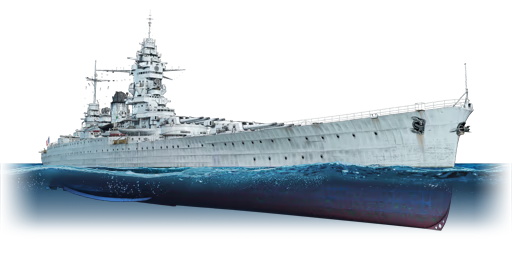
Dunkerque was laid down in December 1932 and launched in October 1935. Her trials began in April 1936 before the superstructures were fully complete, with her commissioning taking place in December 1936 after extensive sea trials. Trials continued into 1938, including gunnery training and an endurance cruise to the Caribbean and Senegal from January to March 1938. In September 1938, she became the flagship of the Atlantic Squadron. With the beginning of the Second World War, Dunkerque formed the core of France's Force de Raid, participating in missions such as convoy escorts and operations with British naval forces. Following France's armistice in 1940, Britain arrived at the French naval base at Mers-el-Kébir, demanding the surrender of the French fleet. When the ultimatum was declined, the British fleet opened fire, striking Dunkerque with four 15-inch shells, causing significant damage and casualties. A follow-up British aerial attack caused even more severe damage, with an explosion of the depth charges on a torpedo boat moored to the starboard. Despite severe damage, Dunkerque received temporary repairs and returned to Toulon in February 1942 for full restoration. In November 1942, as German forces advanced into Vichy France, the French Navy scuttled Dunkerque while she was in dry dock to prevent her capture. Post-war, she was deemed beyond repair, officially stricken from the naval register in September 1955, and sold for scrap in 1958.
The Dunkerque-class, Dunkerque, 1939 is an unusual battleship with two quad turrets, introduced in Update "Firebirds". She offers easy handling of the guns and can be extremely dangerous against vessels in her BR or lower, particularly against WW1-era battlecruisers and cruisers. Where she struggles the most is in fighting against vessels from the top tier, which can penetrate her directly into the magazines, while she is unable to provide an adequate response. She has relatively modern secondaries, limited only be the lack of AP and HE-VT shells, underwhelming anti-air armament, and in combat she can make use of her hydroplane for capturing points or setting smoke screens. Overall, she is an interesting but challenging vessel to play, with her combat performance being highly dependent on the enemies she encounters.
General info
Survivability and armour

Dunkerque is a relatively interesting design, as far as survivability goes. On paper, her armour scheme is very capable, with fascinating multi-layered design: First the external skin of 25 mm structural steel (which provides marginal protection) covers the armour of 225 mm at -11 to -13° construction angle (that inverse angle makes armor extra-effective against plunging fire, further increasing the impact angle). Then there's a second layer of internal armour, 40 mm at 27° construction angle, and behind that, an additional 40 mm at 0°. Inside the vessel, along most of the length of the hull, there's an additional fuel tank further separated with 25 mm structural steel from the magazines and engines. Decks are protected split in 3 sections: Aft deck has a single layer of 150 - 100 mm. Armour below the main superstructure is 22 - 20 mm top layer, then 115 mm main deck and 40 mm final layer. Main magazines are protected by 125 mm with 40 mm below it.
This complex protection, however, creates an illusion of safety.
In reality, an number of shells can damage magazines with shrapnel going through the bottom deck. Additionally, barbette of the front primary gun turret decreases to 50 mm, making any shell able to penetrate two plates of 220 mm and 50 mm capable of spraying front magazines with shrapnel. Plunging fire is also dangerous, while armor scheme makes it pretty much impossible for cruisers to penetrate it, the battleships armed with AP shells can have a lucky shell dive right into the magazines.
Finally, the front armour of just 210 mm is a very attractive target for multiple vessels, including some of the heavy cruisers, being able to penetrate it with the AP shells, under a favourable conditions, making it challenging to use Dunkerque in a pursuit role.
Mobility
For a battleship, Dunkerque is relatively mobile, having good speed in a straight line, acceptable turn rate and a well protected bridge and steering gear, making it more likely for her to maintain high mobility under enemy fire. That said, this mobility is limited by her large size, in effect, making it essential to plan two steps ahead especially when it comes to evading enemy torpedoes.
| Mobility Characteristics | |||
|---|---|---|---|
| Game Mode | Upgrade Status | Maximum Speed (km/h) | |
| Forward | Reverse | ||
| AB | |||
| Upgraded | |||
| RB/SB | |||
| Upgraded | |||
Modifications and economy
Armament
Primary armament

Dunkerque has one of the most unique primary armaments among battleships in the game, being armed with two turrets of 330 mm. The turrets are protected by 310 mm cemented armour over barbettes and a further 330 mm turret face at a 22° construction angle, making them unlikely to stop most of the battleship-grade AP shells, but they are relatively safe from SAP rounds or vessels armed with lower-calibre guns. The guns have an internal bulkhead modelled between each of the pairs of guns, but each Main Calibre Turret behaves as a single unit within the damage model, so even if only one pair of the Main Calibre Guns is damaged, all of them on the turret will be unable to fire.
The gun comes with two types of shells:
- SAPCBC - Despite being named "330 mm OPF", 330 mm Obus Perforant, or Armour Piercing, the shells are modelled as SAPCBC due to their unusually high percentage of explosive filler. This, in the calculation method used for War Thunder's naval mode, gives them 540 mm penetration at 0° at 1000 m, which in effect means that the guns are unfit to deal with the top-tier battleships Dunkerque will commonly encounter in battles. That said, the large explosive filler, high muzzle velocity, and average spread make them perfectly capable of dealing with lower BR battleships and heavy cruisers with ease.
- HE - With an impressive filler, equivalent to 66 kg, or over triple that of SAP, the high-explosive rounds are able to easily overwhelm any soft target, with even a single shell being capable of inflicting a crippling amount of damage. With an average of over 1 tonne of TNT fired every minute, Dunkerque's sustained TNT equivalent on target is comparable to IJN Mutsu or USS Tennessee, making her relatively efficient at stripping the crew off exposed positions and initiating fires.
| Penetration statistics | |||||||
|---|---|---|---|---|---|---|---|
| Ammunition | Type of warhead |
Penetration @ 0° Angle of Attack (mm) | |||||
| 1,000 m | 2,500 m | 5,000 m | 7,500 m | 10,000 m | 15,000 m | ||
| OEA Mle 1935 HE | HE | 74 | 74 | 74 | 74 | 74 | 74 |
| OPF Mle 1935 SAPCBC | SAPCBC | 540 | 512 | 470 | 433 | 400 | 348 |
| Shell details | ||||||||||||
|---|---|---|---|---|---|---|---|---|---|---|---|---|
| Ammunition | Type of warhead |
Velocity (m/s) |
Projectile mass (kg) |
Fuse delay (s) |
Fuse sensitivity (mm) |
Explosive mass (TNT equivalent) (kg) |
Ricochet | |||||
| 0% | 50% | 100% | ||||||||||
| OEA Mle 1935 HE | HE | 885 | 522 | 0 | 0.1 | 66 | 79° | 80° | 81° | |||
| OPF Mle 1935 SAPCBC | SAPCBC | 870 | 560 | 0.025 | 20 | 18.21 | 48° | 63° | 71° | |||
Secondary armament

Quite unusually, the secondary armament is split into two types of 130 mm turrets - an aft cluster of three quad-gun turrets and an additional set of twin-gun turrets on each side of the main superstructure. Sharing very good firing angles and an unusually high rate of fire for the secondaries on a battleship, these guns are effective counters to torpedo boats and destroyers alike. With the secondaries being able to easily fire five times for each full reload cycle of the main guns, it is possible to effectively use them in manual control, ensuring maximum accuracy and the ability to deal with multiple targets simultaneously.
| Penetration statistics | |||||||
|---|---|---|---|---|---|---|---|
| Ammunition | Type of warhead |
Penetration @ 0° Angle of Attack (mm) | |||||
| 1,000 m | 2,500 m | 5,000 m | 7,500 m | 10,000 m | 15,000 m | ||
| OEA Mle 1934 HE | HE | 36 | 36 | 36 | 36 | 36 | 36 |
| OPF Mle 1933 SAP | SAPBC | 71 | 62 | 50 | 41 | 34 | 26 |
| OEA Mle 1934 HE | HE-TF | 36 | 36 | 36 | 36 | 36 | 36 |
| Shell details | ||||||||||||
|---|---|---|---|---|---|---|---|---|---|---|---|---|
| Ammunition | Type of warhead |
Velocity (m/s) |
Projectile mass (kg) |
Fuse delay (s) |
Fuse sensitivity (mm) |
Explosive mass (TNT equivalent) (kg) |
Ricochet | |||||
| 0% | 50% | 100% | ||||||||||
| OEA Mle 1934 HE | HE | 840 | 29.5 | 0 | 0.1 | 3.52 | 79° | 80° | 81° | |||
| OPF Mle 1933 SAP | SAPBC | 800 | 32.1 | 0.035 | 5 | 1.76 | 48° | 63° | 71° | |||
| OEA Mle 1934 HE | HE-TF | 840 | 29.5 | 0 | 0.1 | 3.52 | 79° | 80° | 81° | |||
Anti-aircraft armament
An important part of the ship's armament responsible for air defence. Anti-aircraft armament is defined by the weapon chosen with the control Select anti-aircraft weapons. Talk about the ship's anti-air cannons and machine guns, the number of guns and their positions, their effective range, and about their overall effectiveness – including against surface targets. If there are no anti-aircraft armaments, remove this section.
Scout plane
Usage in battles
Describe the technique of using this ship, the characteristics of her use in a team and tips on strategy. Abstain from writing an entire guide – don't try to provide a single point of view, but give the reader food for thought. Talk about the most dangerous opponents for this vehicle and provide recommendations on fighting them. If necessary, note the specifics of playing with this vehicle in various modes (AB, RB, SB).
Pros and cons
Pros:
- Excellent firing angles for both primary and secondary weapons
- Very high sustained TNT equivalent per minute for the HE and SAP shells (if they manage to penetrate the target)
- Multiple redundant fire directors along with a well-protected bridge and steering gear
Cons:
- Main gun magazines are prone to exploding
- Penetrating a turret will cut down the firepower by half
- Inadequate penetration of the SAP shells and no dedicated AP rounds
- Lack of radar, HE-VT shells, along with very poor 37 mm autocannons and a small number of low-calibre guns, are resulting in relatively poor anti-air armament
- Very large vessel makes for an attractive target to surface vessels and bombers alike
History

Dunkerque's keel was laid down in 24 December 1932 at the Arsenal de Brest, with construction initially constrained to the Le Salou No. 4 dock. Upon her launch on 2 October 1935, she lacked the first 17 metres of her bow, which was later completed at the Laninon graving docks. Her initial sea trials began in April 1936, even before her superstructures were fully complete, and with some of her secondary and light anti-aircraft guns not yet installed. Dunkerque attained a speed of 29.43 knots during trials on 15 May. Fully commissioned in December 1936, her trials extended into 1938, marked by extensive machinery tests and gunnery evaluations, with minor modifications made throughout the testing period. In May 1937, she represented France at the Naval Review at Portsmouth, United Kingdom, for the coronation of King George VI, which was followed by a French naval review off the Île de Sein later that month. Throughout 1937 and into 1938, she conducted extensive gunnery trials and fleet exercises off the coast of Brittany and in the Morgat area. From 20 January 1938 until 6 March 1938, she embarked on an endurance cruise, visiting the Caribbean and Senegal. On 1 September 1938, Dunkerque officially became the flagship of the Atlantic Squadron and began exercises with the rest of the squadron, including operations with the aircraft carrier Béarn and gunnery exercises against the hulk of the Danton-class battleship Voltaire.
At the onset of the Second World War, Dunkerque, alongside her sister ship Strasbourg, formed the core of France's Force de Raid, an elite squadron tasked with hunting German surface raiders and protecting Allied shipping routes. Throughout 1939 and early 1940, she participated in several missions, including convoy escorts across the Atlantic and collaborative operations with British naval forces.
In June 1940, following France's armistice with Germany, concerns grew within the British government about the fate of the French fleet potentially falling into Axis hands. This led to Operation Catapult, aimed at neutralising the French naval assets. On 3 July 1940, British forces arrived at Mers-el-Kébir and issued an ultimatum to the French fleet, including Dunkerque. After negotiations failed, the British opened fire. Dunkerque was struck by four 15-inch shells: the first ricocheted off Turret II; the second penetrated an unarmoured section of the aft hull without detonating, causing only minor damage; and the final two penetrated through the main belt into the engine and boiler rooms, killing 180 crew members and causing flooding and significant internal damage, which forced her to be beached to prevent sinking. During the action, Dunkerque opened fire at the British vessels but failed to score any hits.

Three days later, on 6 July, the British launched a follow-up attack with Swordfish torpedo bombers. While the attack resulted in no direct hits to Dunkerque, a torpedo struck the motor torpedo boat Terre-Neuve, moored on Dunkerque’s starboard side near the superfiring main gun turret. Moments later, the depth charges stored on the MTB detonated in an enormous explosion equivalent to 1,400 kg of TNT. This caused far more damage than the earlier hits from the 15-inch guns, bending internal torpedo bulkheads, decks, and double-bottom plates, dislodging two of the main belt armour plates and two fire directors, tearing off external plating, and killing a further 30 sailors.
Despite the severe damage, magazines stayed intact and the efforts were made to repair Dunkerque. Temporary repairs allowed her to be refloated, and eventually, in February 1942, she returned to Toulon for full restoration.
In November 1942, as German forces advanced to occupy Vichy France, the French Navy decided to scuttle its fleet to prevent it from falling into German hands. Dunkerque was scuttled in dry dock by her crew. As German soldiers entered the docks in Toulon, the crew began flooding the dock, and explosive charges set inside the vessel were detonated. Germans soldiers stood, watching as seawater flooded the crippled vessel. When Italian forces, who were interested in acquiring French naval assets, inspected Dunkerque after the scuttling, they found the damage too extensive to justify salvage or repair efforts. She remained in the dockyard as a wreck for the remainder of the war.
Post-war, the remains of Dunkerque were assessed and deemed beyond repair. She was officially stricken from the naval register on 15 September 1955 and sold for scrap on 30 September 1958.
Media
Excellent additions to the article would be video guides, screenshots from the game, and photos.
See also
Links to articles on the War Thunder Wiki that you think will be useful for the reader, for example:
- reference to the series of the ship;
- links to approximate analogues of other nations and research trees.
External links
| Arsenal de Brest | |
|---|---|
| Avisos | |
| Arras-class | Arras |
| Light Cruisers | |
| Duguay-Trouin-class | Duguay-Trouin · Primauguet |
| Heavy Cruisers | |
| Suffren-class | Colbert · Dupleix |
| Battleships | |
| Bretagne-class | Bretagne |
| Dunkerque-class | Dunkerque |
| France battleships | |
|---|---|
| Courbet-class | Courbet · Paris |
| Bretagne-class | Bretagne · Lorraine |
| Dunkerque-class | Dunkerque |