Difference between pages "Kurnass" and "Geniere"
(Edits) |
m (typo) |
||
| Line 1: | Line 1: | ||
{{About | {{About | ||
| − | | about = | + | | about = premium Italian Fante-class destroyer '''{{PAGENAME}}''' |
| − | | usage = | + | | usage = the premium Italian Soldati-class destroyer |
| − | | link = | + | | link = RN Geniere |
}} | }} | ||
{{Specs-Card | {{Specs-Card | ||
| − | |code= | + | |code=it_destroyer_fletcher_geniere |
|images={{Specs-Card-Image|GarageImage_{{PAGENAME}}.jpg}} | |images={{Specs-Card-Image|GarageImage_{{PAGENAME}}.jpg}} | ||
}} | }} | ||
== Description == | == Description == | ||
| − | <!-- ''In the description, | + | <!-- ''In the first part of the description, cover the history of the ship's creation and military application. In the second part, tell the reader about using this ship in the game. Add a screenshot: if a beginner player has a hard time remembering vehicles by name, a picture will help them identify the ship in question.'' --> |
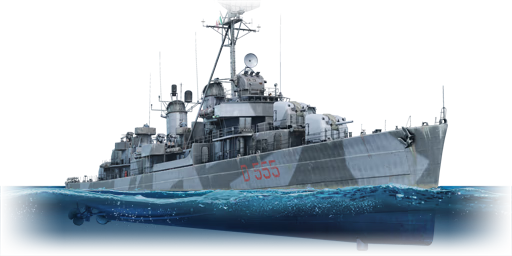
| − | + | After World War II, Italy's navy had been cut in half, and heavily restricted in terms of armaments. Only from the 1950s onward was it allowed to begin reconstruction, due to Italy's entry into NATO. Over the years, several ships were built, but at the same time tensions between NATO and the Warsaw Pact increased and so in the 1970s Italy asked the United States for destroyers to replace the old Benson-class destroyers. Three [[Fletcher (Family)|Fletcher-class]] ships were delivered, later renamed Fante (D 561), Geniere (D 555), and Lanciere (D 560). The Geniere (D 555) in Italian service participated in training missions, coastal control, and other minor missions, but never saw combat. After 5 years, the ship was replaced by more modern units and was eventually scrapped in 1975. | |
| − | + | Introduced in [[Update "Danger Zone"]], '''{{Specs|1=name}}''' is a fairly good premium ship thanks to its armament composed of four single 127 mm guns with good reload thanks to the autoloader. Thanks to the powerful SAP shells, you will be able to ammo rack enemy ships very easily, and their HE-VT shells are perfect to shoot down other targets, including aircraft. In conjunction with the three twin 76 mm emplacements, also able to be equipped with HE-VT shells, Geniere can quickly cause damage enemy aircraft and boats alike. The 6 anti-submarine torpedoes cause little damage to large ships, but they may disable important modules, allowing you to take the opportunity to finish them off with the main guns. The manoeuvrability and speed are quite good. This ship is perfect for those who want to have a different play style from the Italian WWII destroyers. | |
== General info == | == General info == | ||
| − | === | + | === Survivability and armour === |
| − | {{Specs- | + | {{Specs-Fleet-Armour}} |
| − | <!-- '' | + | <!-- ''Talk about the vehicle's armour. Note the most well-defended and most vulnerable zones, e.g. the ammo magazine. Evaluate the composition of components and assemblies responsible for movement and manoeuvrability. Evaluate the survivability of the primary and secondary armaments separately. Don't forget to mention the size of the crew, which plays an important role in fleet mechanics. Save tips on preserving survivability for the "Usage in battles" section. If necessary, use a graphical template to show the most well-protected or most vulnerable points in the armour.'' --> |
| + | Being a Fletcher-class ship, the Geniere's protection is generally the same as her sister ship [[USS Fletcher]] with some slight differences. The ship features the same anti-fragmentation armour as the Fletcher, with 19 mm at the belt and 13 mm at the deck respectively. Combined with the respectable crew count of 273, this allows the ship to take a considerable amount of punishment from the other destroyers she will usually face at her rank. | ||
| − | + | When it comes to differences, the Geniere's most noticeable change is the replacement of torpedo and anti-air armaments. The twin quintuple launchers were replaced with small triple anti-submarine torpedo launchers, and one of the turrets and other anti-air armaments were replaced with three sets of 76 mm autocannons. These optimized armaments helps the Geniere to retain her crew better than her sister, and significantly reduce the risk of torpedo detonation. | |
| − | |||
| − | |||
| − | |||
| − | |||
| − | |||
| − | |||
| − | |||
| − | |||
| − | |||
| − | |||
| − | |||
| − | |||
| − | |||
| − | |||
| − | |||
| − | |||
| − | + | However, the Geniere still retains the first stage ammo rack as her critical weakspot. Any HE shell that detonates close to it has a change to trigger it, causing significant damage to the ship. | |
| − | |||
| − | |||
| − | |||
| − | |||
| − | |||
| − | |||
| − | |||
| − | |||
| − | |||
| − | + | === Mobility === | |
| − | + | {{Specs-Fleet-Mobility}} | |
| − | + | <!-- ''Write about the ship's mobility. Evaluate its power and manoeuvrability, rudder rerouting speed, stopping speed at full tilt, with its maximum forward and reverse speed.'' --> | |
| − | + | Being a Fletcher-class, the Geniere features good overall mobility. The ship has a high top speed and good overall agility. This allows her to execute evasive manoeuvres against incoming shells or torpedoes alike. | |
| − | |||
| − | |||
| − | |||
| − | ! | ||
| − | |||
| − | |||
| − | |||
| − | |||
| − | |||
| − | |||
| − | { | + | {{NavalMobility}} |
| − | |||
| − | |||
| − | |||
| − | |||
| − | |||
| − | |||
| − | |||
| − | |||
| − | === | + | === Modifications and economy === |
| − | { | + | {{Specs-Economy}} |
| − | |||
| − | |||
| − | |||
| − | |||
| − | |||
| − | |||
| − | |||
| − | |||
| − | |||
| − | |||
| − | |||
| − | |||
| − | |||
| − | |||
| − | |||
| − | |||
| − | |||
| − | |||
| − | |||
| − | |||
| − | |||
| − | |||
| − | |||
| − | |||
| − | |||
| − | |||
| − | |||
| − | |||
| − | |||
| − | |||
| − | |||
| − | |||
| − | === | + | == Armament == |
| − | {{Specs- | + | {{Specs-Fleet-Armaments}} |
| − | <!-- '' | + | === Primary armament === |
| − | '' | + | {{Specs-Fleet-Primary}} |
| + | <!-- ''Provide information about the characteristics of the primary armament. Evaluate their efficacy in battle based on their reload speed, ballistics and the capacity of their shells. Add a link to the main article about the weapon: <code><nowiki>{{main|Weapon name (calibre)}}</nowiki></code>. Broadly describe the ammunition available for the primary armament, and provide recommendations on how to use it and which ammunition to choose.'' --> | ||
| + | {{main|127/38 Mk.12 (127 mm)}} | ||
| + | |||
| + | The Geniere features 4 x 5-inch (127 mm) Mk.12 cannons as the main armaments. The guns are mounted in a enclosed single turrets with two on the bow and stern each. The guns have an impressive fire rate of 22 rounds per minute (~2.7-second reload) with 25-round first stage ammo racks, and 15 rounds per minute (4-second reload) after depleting the ready racks. While one of the turrets was removed to make a room for anti-air system, these guns are more than capable of quickly eliminating opponents, and provide consistent firepower against early cruisers that she might have to face in uptiers. | ||
| + | |||
| + | Being standard-issued guns of the US Navy, the Geniere also has access to the standard US destroyer ammunition: a basic and potent HE shell with 3.2 kg of TNT equivalent filler, an HE-VT shell with the same characteristics as the HE shell but with a variable time fuse that will detonate within close proximity of any aircraft, a "common" SAP shell with respectable penetration and filler, and a "special" SAP shell which has improved penetration in exchange for somewhat reduced filler. As a premium ship, all of these shells are unlocked by default, so the HE-VT shell should be your "go-to" shell, as it is effective against both the surface and aerial targets, being able to deal the same external damage as the standard HE shell against enemy vessels while also being deadly against enemy aircraft. Due to having less penetration but slightly more filler, the "common" shell is somewhat more effective at dealing internal damage against destroyers compared to the "special" shell, but will lose its effectiveness against cruisers at mid-to-long range. Therefore, the "special" shell can be considered for versatility, especially in uptier matches. | ||
| + | |||
| + | As the ship is in the Cold War refit, the Geniere has access to a more modern fire control system with only 6 seconds of calculation time and 3 seconds of update time (compared to the 18-second calculation and 10-second update of the Fletcher). This allows the Geniere to accurately strike the enemy ship first at longer ranges for an advantage as well as making her capable of doing "snap shots" at multiple enemies at once. | ||
| + | |||
| + | {{:127/38 Mk.12 (127 mm)/Ammunition|5 inch AAC Mk.34, 5 inch Common Mk.32, 5 inch SP Common Mk.46, 5 inch AAVT Mk.31}} | ||
| + | |||
| + | === Secondary armament === | ||
| + | {{Specs-Fleet-Secondary}} | ||
| + | <!-- ''Some ships are fitted with weapons of various calibres. Secondary armaments are defined as weapons chosen with the control <code>Select secondary weapon</code>. Evaluate the secondary armaments and give advice on how to use them. Describe the ammunition available for the secondary armament. Provide recommendations on how to use them and which ammunition to choose. Remember that any anti-air armament, even heavy calibre weapons, belong in the next section. If there is no secondary armament, remove this section.'' --> | ||
| + | {{main|76/50 Mk.33 (76 mm)}} | ||
| − | + | The Geniere is armed with 6 x 76 mm Mk.33 semi-automatic cannons as the secondary armament, copies of the 3-inch Mk.33 cannons found on ships such as the [[USS Pittsburgh]] and the [[JDS Ayanami (DD-103)|JDS Ayanami]]. These guns replaced the X (third) turret of the Geniere, with two of the three twin mounts placed between the smokestacks and the third mount located on the former X turret placement; up to two of these mounts can be directed against surface target at the same time. These autocannons more than make up for the missing turret, however, thanks to their good rate of fire of 40 rounds per minute, the mount's wide coverage, and their accuracy at mid-to-close range (~7 km). They allow the Geniere to harass the enemy ship by disabling their main guns, and are more than capable of dealing with enemy aircraft. | |
| − | |||
| − | + | The gun has two shell options: a basic HE shell with respectable 500 g of TNT equivalent and an HE-VT shell with slightly lower filler at 352 g of TNT equivalent. Due to the filler size, the HE shell is slightly better at chipping away the enemy ship's crew and damaging their armaments, but lacks the versatility of the HE-VT shell. | |
| − | |||
| − | |||
| − | |||
| − | |||
| − | |||
| − | |||
| − | |||
| − | |||
| − | |||
| − | |||
| − | |||
| − | |||
| − | |||
| − | |||
| − | The | + | The gun is not without downsides, however. As switching between ammunition can take a considerable time of 8 seconds (with ace crew), this will leave you temporarily vulnerable against PT boats and aircraft. Situational awareness is important to switch the rounds at the right moment, especially since there are no other auxiliary weapons to deal with the incoming enemy, though the ship fortunately has access to a radar to detect inbound aircraft. In addition, the guns can also overheat relatively quickly, thus it is recommended to fire it in controlled bursts. |
| − | + | {{:76/50 Mk.33 (76 mm)/Ammunition|76 mm HC Mk.27, 76 mm HE-VT}} | |
| − | |||
| − | |||
| − | === | + | === Additional armament === |
| − | {{Specs- | + | {{Specs-Fleet-Additional}} |
| − | <!-- ''Describe the | + | <!-- ''Describe the available additional armaments of the ship: depth charges, mines, torpedoes. Talk about their positions, available ammunition and launch features such as dead zones of torpedoes. If there is no additional armament, remove this section.'' --> |
| − | {{main| | + | {{main|Mk.10 Hedgehog mortar|12.75 inch Mark 44 (324 mm)}} |
| − | |||
| − | |||
| − | |||
| − | + | As the Geniere was converted into an escort destroyer prior to her transfer to Italy, her torpedo suite was replaced with dedicated anti-submarine armaments consisting of 6 x Mark 44 torpedoes in two triple launchers located just behind the second funnel, and a fixed Hedgehog anti-submarine mortar located between the B (second) turret and the ship's bridge. | |
| − | + | Due to the absence of submarines in War Thunder, these armaments are less than ideal against surface combatants the Geniere has to face. The small Mark 44 torpedoes was designed to be used specifically against submarines, thus it only has just enough filler to critically damage them with ~54 kg of TNT warhead equivalent. The torpedo's relatively short range of ~5.5 km and mediocre speed of only 56 km/h further restricts is effectiveness. While very small, the torpedoes are not entirely useless, as it can be used to "spook" the enemy into making evasive manoeuvres and expose their vulnerable parts, as well as being useful against a preoccupied enemy to deal a surprise hit, potentially causing ammo rack explosion with well-placed hits. | |
| − | |||
| − | |||
| − | |||
| − | |||
| − | |||
| − | |||
| − | |||
| − | |||
| − | |||
| − | |||
| − | |||
| − | |||
| − | |||
| − | |||
| − | |||
| − | |||
| − | |||
| − | + | On the other hand, the Hedgehog mortar does not have any niche use like the Mark 44 torpedoes, primarily due to the awkward fixed firing angle and very long flight time. Thus it is not recommended to take it into the battle, lest it become an additional fire hazard. | |
| − | |||
| − | |||
| − | |||
| − | |||
| − | |||
| − | |||
| − | |||
| − | |||
| − | |||
| − | |||
| − | |||
| − | |||
| − | |||
| − | |||
| − | |||
| − | |||
| − | |||
| − | |||
| − | |||
| − | |||
| − | |||
| − | |||
| − | |||
| − | |||
| − | |||
| − | |||
| − | |||
| − | |||
| − | |||
| − | |||
| − | |||
| − | |||
| − | |||
| − | |||
| − | |||
| − | |||
| − | |||
| − | |||
| − | |||
| − | |||
| − | |||
| − | |||
| − | |||
| − | |||
| − | |||
| − | |||
| − | |||
| − | |||
| − | |||
| − | |||
| − | |||
| − | |||
| − | |||
| − | |||
| − | |||
| − | |||
| − | |||
| − | |||
== Usage in battles == | == Usage in battles == | ||
| − | <!-- ''Describe the | + | <!-- ''Describe the technique of using this ship, the characteristics of her use in a team and tips on strategy. Abstain from writing an entire guide – don't try to provide a single point of view, but give the reader food for thought. Talk about the most dangerous opponents for this vehicle and provide recommendations on fighting them. If necessary, note the specifics of playing with this vehicle in various modes (AB, RB, SB).'' --> |
| − | + | As with the other Fletcher-class destroyers, the Geniere primarily excels at taking down the opposition and suppressing them with her rapid-firing 127 mm cannons. Because of her conversion into a destroyer escort, however, the Geniere is more specialized at gunnery compared to her sister ships, primarily due to her improved fire control system, additional 76 mm semi-automatic cannons, and less effective torpedoes. These firepower improvements allow the Geniere to be played more aggressively, as she can quickly react to enemy ships and take the initiative by hitting them first while they are still calculating the distance, then quickly disable their critical modules to prevent them from fighting back. | |
| − | + | Other than pushing for capture zones, the Geniere also excels at hit-and-run and fire support. Thanks to her agility, the Geniere is capable of utilizing "cover hopping" and "peek-a-boom" tactics, which, when combined with the aforementioned fire control system, allows you to quickly hit an enemy before retreating to safety before they can hit you back. | |
| + | |||
| + | In exchange for improved firepower, the Geniere is equipped with a rather underwhelming set of anti-submarine torpedoes. However, you can still use these torpedoes as a bluff to force the enemy to dodge and expose their vulnerable sides, as well cause some damage to their hull when hit. Since the torpedoes are quite small, they have a rather slim chance of being hit and detonated, thus making it viable as a surprise weapon. | ||
| + | |||
| + | As the ship mostly relies on gunnery to deal damage, the Geniere will occasionally struggle when pitted against cruisers. In such situation, always make sure to have some cover or allies to fall back into when the enemy is too much for you to handle alone. | ||
=== Pros and cons === | === Pros and cons === | ||
| Line 239: | Line 89: | ||
'''Pros:''' | '''Pros:''' | ||
| − | * | + | * Great armaments |
| − | * | + | ** Four fast-firing and accurate 127 mm gun offers great damage output |
| − | * | + | ** Secondary 76 mm autocannons are effective against surface and aerial targets alike |
| − | * | + | * Fairly survivable for a destroyer due to armour and crew count |
| − | * | + | * High top speed and agility |
| − | * | + | * Access to an air search radar and modern fire control system |
'''Cons:''' | '''Cons:''' | ||
| − | * | + | * As with the other Fletcher-class destroyers, the first stage ammo racks is a vulnerable weak spot |
| − | * | + | * Secondary guns overheat quickly, restricting them to short-burst usage |
| − | * | + | * No auxiliary anti-air armaments, have to rely on radar to spot an inbound aircraft |
| − | + | * Very weak torpedoes, restricting its usage to a surprise weapon at best | |
| − | |||
== History == | == History == | ||
| − | <!-- ''Describe the history of the creation and combat usage of the | + | <!-- ''Describe the history of the creation and combat usage of the ship in more detail than in the introduction. If the historical reference turns out to be too long, take it to a separate article, taking a link to the article about the ship and adding a block "/History" (example: <nowiki>https://wiki.warthunder.com/(Ship-name)/History</nowiki>) and add a link to it here using the <code>main</code> template. Be sure to reference text and sources by using <code><nowiki><ref></ref></nowiki></code>, as well as adding them at the end of the article with <code><nowiki><references /></nowiki></code>. This section may also include the ship's dev blog entry (if applicable) and the in-game encyclopedia description (under <code><nowiki>=== In-game description ===</nowiki></code>, also if applicable).'' --> |
| − | + | [[File:Geniere3.jpg|300px|thumb|left|''Geniere'' (D 555) (ex-USS ''Prichett'') in 1971.]] | |
| + | USS ''Prichett'' (DD-561) was a ''Fletcher''-class destroyer, built for the United States Navy during World War II. The ship saw extensive action during the war in escort and bombardment roles, most notably during the Battle of Okinawa, during which she was struck by a bomb and a ''Kamikaze'' attack on two separate occasions. After the war, she served in the Korean War and the Vietnam War as a fire support ship, before being sold to the Italian navy with her sisters USS ''Taylor'' and USS ''Walker'' in 1970. She was renamed ''Geniere'' (D 555) by the Italians and served for five years before being scrapped in 1975. | ||
| + | |||
| + | === Construction and World War II services === | ||
| + | [[File:561prichett 01.jpg|300px|thumb|right|USS ''Prichett'' (DD-561) underway off the coast of Aiki Point, Washington, on February 4, 1944.]] | ||
| + | In 1942, ''Prichett'' was ordered from the Seattle-Tacoma Shipbuilding Company in Washington as one of 15 Fletcher-class destroyers for the US Navy. The ship was laid down on July 20, 1942, launched on July 31, 1943, and commissioned on January 15, 1944. | ||
| + | |||
| + | After testing and evaluation, on April 1, 1944, ''Prichett'' sailed to Majuro and then Manus where she joined the battleships of Task Force (TF) 58. On April 28, ''Prichett'' sortied as a part of Task Group (TG) 58.3 and joined together with the fast carriers of TG 58.1 for the Caroline islands. On April 29, ''Prichett'' served as an escort during the attack on the Japanese airfield. The next day, ''Prichett'' participated in the bombardment on Ponape before the task group retired to Majuro, whence ''Prichett'' returned to Pearl Harbor for a small refit to add fighter director equipment. | ||
| + | |||
| + | On May 30, 1944, ''Prichett'' sailed west to join TF 52 for the invasion of Saipan. After completing her transport escort objective, ''Prichett'' was then assigned to provide screening for the battleships as they bombarded the shore, then provided fire support for the landing troops on June 15. During the operation on June 18, she was involved in the rare rescue of a Japanese pilot who ditched his plane near the ship. | ||
| + | |||
| + | Between June 19-20, ''Prichett'' set sail for the attack on the Japanese-held Tinian island, before returning to the Marianas and remaining there until August. On August 17, ''Prichett'' joined TF 38 for the Philippines campaign. There, ''Prichett'' participated in raids on Japanese transports and convoys, fleet carrier escorts, and shore bombardment until January 1945, when the task force moved to the South China Sea to disrupt Japanese shipping lanes and strike the industrial complex on Taiwan, Yokohama, and Tokyo, and participated in the Iwo Jima campaign until March 9. | ||
| + | |||
| + | ==== Okinawa campaign ==== | ||
| + | By March 12, ''Prichett'' had returned to Ulithi island in preparation for the Okinawa campaign. Assigned to TF 54, ''Prichett'' arrived off the coast of the Okinawa Islands on March 25 to cover minesweeping operations. On April 1, she participated in the "feint" bombardment on southern Okinawa to deceive the Japanese intelligence, then steamed back to cover the actual landing at Hagushi. The next morning, ''Prichett'' narrowly avoided her demise when a Japanese bomber managed to fly unnoticed and drop a 500 lb bomb 20 yards off the port beam. Later that day, ''Prichett'' participated in the radar picket line to detect and screen the Japanese air raid. | ||
| + | |||
| + | Just after 1:00 on April 3, the task group detected a large group of Japanese aircraft. ''Prichett'' spotted four aircraft at 1:29, of which she shot one down and warded off another. The remaining two then pressed on, with one dropping a 500 lb bomb on the fantail. The bomb holed her under the waterline, causing flooding on her aft and a fire in the 20 mm magazine room. While the crew underwent damage control operations, the ship continued to ward off incoming attacks and managed to shoot down the other two aircraft. After being relieved by the USS ''Brush'' (DD-745) shortly before noon, ''Prichett'' retreated to Kerama Retto for emergency repairs. On April 7, she sailed back to Guam for a month of extensive repairs. | ||
| + | |||
| + | ''Prichett'' departed Guam on May 3 alongside the escort carrier USS ''Shipley Bay'' (CVE-85) and returned to Okinawa on May 7. She then resumed the radar picket duty and managed to avoid further damage for three months until late July. | ||
| + | |||
| + | Between midnight of July 28 and dawn of July 29, while on picket duty, two Yokosuka K5Y trainer aircraft modified for ''Kamikaze'' attack managed to slip past the radar. The first plane flew past the proximity shell fired from the USS ''Callaghan'' (DD-792) as the wood-and-fabric structure rendered the fuse ineffective, then struck ''Callaghan'' on the starboard sides at 0:40 of July 29, causing engine fires. Being close to ''Callaghan'', ''Prichett'' ran up to aid the crew of the former in firefighting and rescuing survivors in the water. In the fire-lit darkness, the ship proved an easy target and a second K5Y closed in for a ''Kamikaze'' attack. Despite retaliation, the plane bore in and crashed on the starboard side of the superstructure, killing two sailors. Despite the damage, ''Prichett'' remained in the area for two hours picking up survivors from ''Callaghan'' when the latter sank at 2:35. For this action, ''Prichett'' was later awarded a Navy Unit Commendation by the US Navy. | ||
| + | |||
| + | After Okinawa, ''Prichett'' sailed home on August 13 and arrived at the end of the war. She then underwent pre-inactivation overhaul at Puget Sound and was decommissioned and berthed for the Pacific Reserve Fleet, San Diego Group. | ||
| + | |||
| + | === Korean War === | ||
| + | ''Prichett'' was reactivated following the breakout of the Korean War on August 17, 1951. After test sailing off the coast of California, on January 13, 1952, ''Prichett'' sailed to the Atlantic, arriving in Norfolk on February 2. In April, she sailed to Boston for her modernization. The modernization, which included improved anti-air weaponry, fire control radar, sonar, and communications gear, was completed in November and she became the flagship of the 282nd Destroyer Division. After completing training in the Caribbean, ''Prichett'' departed Norfolk on January 4, 1953 and arrived in Sasebo, Japan on February 11. | ||
| + | |||
| + | Assigned to TF 77, ''Prichett'' provided air cover to friendly aircraft and bombarding ships, provided gunfire support at Wonsan Harbor and the Hungnam coast, as well as hospital ship services for the Marines fighting primarily around Wonsan. After her services between February and June, ''Prichett'' steamed back to Norfolk in a round-the-world goodwill visit trip between June 26 to August 22. After a major overhaul into a destroyer escort, she participated in numerous training and ASW exercises around the Sea of Japan and the Taiwan strait for almost 10 years before being sent to Vietnam in 1964. | ||
| + | |||
| + | === Vietnam War === | ||
| + | [[File:Usspritchett.jpg|300px|thumb|right|USS ''Prichett'' (DD-561) off the coast of San Diego, California in 1969. The ship is in the same configuration prior to her transfer to Italy as ''Geniere'' in 1970.]] | ||
| + | On August 30, 1964, ''Prichett'' joined TF 77 in the Tonkin Gulf and the South China Sea during the United States' entry into the Vietnam War. The ship then spent five years touring up and down the coast of Vietnam, conducting escort and shore bombardment operations. In mid-1967, the ship sailed back to the US for the final modernization to improve the ageing fire control system. | ||
| + | |||
| + | ''Prichett'' returned in November 1967 and was again assigned for the shore bombardment in December. During the Tet Offensive in February 1968, the ship provided crucial fire support during the battle of Phan Thiet, her accuracy and fire volume so remarkable that the captured Viet Cong fighters allegedly nicknamed her "the Mortar from the Sea". At the end of the operation, ''Prichett'' sailed home on May 6. | ||
| + | |||
| + | After spending almost a year in repair, ''Prichett'' sailed to Vietnam for one last time on June 4, 1969. While still underway however, the ship was scheduled for inspection, which was conducted upon her return on December 5. The ship was assessed to be in poor condition and recommended for disposal on December 17. She then sailed to San Diego and was decommissioned on January 10, 1970, and struck from the Navy List the same day. | ||
| + | |||
| + | At the end of her service with the US Navy, USS ''Prichett'' earned eight battle stars during World War II, two during the Korean War, and six during the Vietnam War. | ||
| − | + | === Post-Vietnam and Italian services === | |
| + | A week after her decommissioning, on January 17, 1970, the Italian Navy ordered the ''Prichett'' from the US Navy as the third ship of the ''Fante''-class destroyers, a ''Fletcher''-class destroyer that had been sold to Italy in 1969 as a replacement for the ''Artigliere''-class (ex-''Benson''-class) destroyer. | ||
| − | + | Originally, Italy ordered two ships from the US Navy; the USS ''Walker'' (DD-517), later the ''Fante'' (D 561), and the USS ''Taylor'' (DD-468), later the ''Lanciere'' (D 560). However, the ''Lanciere'' was found to be in very poor condition, which led to the purchase of the third ship - the ''Prichett'', as a replacement in 1970. The ship was sold in "as is" condition and transferred to the Italian Navy the same day, where she was renamed ''Geniere'' (D 555). Unlike the other two sister ships, the Geniere featured a different weapon suite, lacking the Mark 18 "Weapon Alfa" anti-submarine rocket launchers due to her undergoing different modernization plans. | |
| + | |||
| + | Due to the ship's worn-out condition, the Italian Navy only intended to operate the ''Fante''-class as a stopgap measure until the domestically-built ''Audace''-class guided missile destroyers were completed. As such, ''Fante'' and ''Geniere'' were operated and maintained using cannibalized parts from the ''Lanciere''. The ''Geniere'' served with the Italian Navy until 1975 when she was scrapped. | ||
== Media == | == Media == | ||
| Line 267: | Line 156: | ||
;Skins | ;Skins | ||
| − | * [https://live.warthunder.com/feed/camouflages/?vehicle= | + | * [https://live.warthunder.com/feed/camouflages/?vehicle=it_destroyer_fletcher_geniere Skins and camouflages for the {{PAGENAME}} from live.warthunder.com.] |
| + | |||
| + | ;Videos | ||
| + | |||
| + | {{Youtube-gallery|GLdachyN8Aw|'''RN Geniere - D555 Fante-class Destroyer''' - ''Cmdr. Tyrael''}} | ||
== See also == | == See also == | ||
| − | <!-- ''Links to | + | <!--''Links to articles on the War Thunder Wiki that you think will be useful for the reader, for example:'' |
| − | * ''reference to the series of the | + | * ''reference to the series of the ship;'' |
| − | * ''links to approximate analogues of other nations and research trees.'' --> | + | * ''links to approximate analogues of other nations and research trees.''--> |
| − | |||
| − | + | ;Related development | |
| − | * | + | |
| + | * [[Fletcher (Family)]] | ||
| + | |||
| + | ;Other vehicles of similar configuration and role | ||
| + | |||
| + | * [[USS Aylwin]] | ||
| + | * [[Harukaze|JDS Harukaze]] | ||
== External links == | == External links == | ||
| Line 283: | Line 181: | ||
* ''other literature.'' --> | * ''other literature.'' --> | ||
| − | * [https:// | + | * [https://www.history.navy.mil/research/histories/ship-histories/danfs/p/prichett.html Dictionary of American Naval Fighting Ships's entry of the USS Pritchett (DD-561)] |
| − | |||
| − | |||
| − | |||
| − | |||
| − | |||
| − | {{ | + | {{ShipManufacturer Seattle-Tacoma}} |
| − | {{ | + | {{Italy destroyers}} |
| + | {{Italy premium ships}} | ||
Latest revision as of 20:09, 18 November 2024
| This page is about the premium Italian Fante-class destroyer Geniere. For the premium Italian Soldati-class destroyer, see RN Geniere. |

Contents
Description
After World War II, Italy's navy had been cut in half, and heavily restricted in terms of armaments. Only from the 1950s onward was it allowed to begin reconstruction, due to Italy's entry into NATO. Over the years, several ships were built, but at the same time tensions between NATO and the Warsaw Pact increased and so in the 1970s Italy asked the United States for destroyers to replace the old Benson-class destroyers. Three Fletcher-class ships were delivered, later renamed Fante (D 561), Geniere (D 555), and Lanciere (D 560). The Geniere (D 555) in Italian service participated in training missions, coastal control, and other minor missions, but never saw combat. After 5 years, the ship was replaced by more modern units and was eventually scrapped in 1975.
Introduced in Update "Danger Zone", Fante-class, Geniere (D 555), 1972 is a fairly good premium ship thanks to its armament composed of four single 127 mm guns with good reload thanks to the autoloader. Thanks to the powerful SAP shells, you will be able to ammo rack enemy ships very easily, and their HE-VT shells are perfect to shoot down other targets, including aircraft. In conjunction with the three twin 76 mm emplacements, also able to be equipped with HE-VT shells, Geniere can quickly cause damage enemy aircraft and boats alike. The 6 anti-submarine torpedoes cause little damage to large ships, but they may disable important modules, allowing you to take the opportunity to finish them off with the main guns. The manoeuvrability and speed are quite good. This ship is perfect for those who want to have a different play style from the Italian WWII destroyers.
General info
Survivability and armour
Being a Fletcher-class ship, the Geniere's protection is generally the same as her sister ship USS Fletcher with some slight differences. The ship features the same anti-fragmentation armour as the Fletcher, with 19 mm at the belt and 13 mm at the deck respectively. Combined with the respectable crew count of 273, this allows the ship to take a considerable amount of punishment from the other destroyers she will usually face at her rank.
When it comes to differences, the Geniere's most noticeable change is the replacement of torpedo and anti-air armaments. The twin quintuple launchers were replaced with small triple anti-submarine torpedo launchers, and one of the turrets and other anti-air armaments were replaced with three sets of 76 mm autocannons. These optimized armaments helps the Geniere to retain her crew better than her sister, and significantly reduce the risk of torpedo detonation.
However, the Geniere still retains the first stage ammo rack as her critical weakspot. Any HE shell that detonates close to it has a change to trigger it, causing significant damage to the ship.
Mobility
Being a Fletcher-class, the Geniere features good overall mobility. The ship has a high top speed and good overall agility. This allows her to execute evasive manoeuvres against incoming shells or torpedoes alike.
| Mobility Characteristics | |||
|---|---|---|---|
| Game Mode | Upgrade Status | Maximum Speed (km/h) | |
| Forward | Reverse | ||
| AB | |||
| Upgraded | |||
| RB/SB | |||
| Upgraded | |||
Modifications and economy
Armament
Primary armament
The Geniere features 4 x 5-inch (127 mm) Mk.12 cannons as the main armaments. The guns are mounted in a enclosed single turrets with two on the bow and stern each. The guns have an impressive fire rate of 22 rounds per minute (~2.7-second reload) with 25-round first stage ammo racks, and 15 rounds per minute (4-second reload) after depleting the ready racks. While one of the turrets was removed to make a room for anti-air system, these guns are more than capable of quickly eliminating opponents, and provide consistent firepower against early cruisers that she might have to face in uptiers.
Being standard-issued guns of the US Navy, the Geniere also has access to the standard US destroyer ammunition: a basic and potent HE shell with 3.2 kg of TNT equivalent filler, an HE-VT shell with the same characteristics as the HE shell but with a variable time fuse that will detonate within close proximity of any aircraft, a "common" SAP shell with respectable penetration and filler, and a "special" SAP shell which has improved penetration in exchange for somewhat reduced filler. As a premium ship, all of these shells are unlocked by default, so the HE-VT shell should be your "go-to" shell, as it is effective against both the surface and aerial targets, being able to deal the same external damage as the standard HE shell against enemy vessels while also being deadly against enemy aircraft. Due to having less penetration but slightly more filler, the "common" shell is somewhat more effective at dealing internal damage against destroyers compared to the "special" shell, but will lose its effectiveness against cruisers at mid-to-long range. Therefore, the "special" shell can be considered for versatility, especially in uptier matches.
As the ship is in the Cold War refit, the Geniere has access to a more modern fire control system with only 6 seconds of calculation time and 3 seconds of update time (compared to the 18-second calculation and 10-second update of the Fletcher). This allows the Geniere to accurately strike the enemy ship first at longer ranges for an advantage as well as making her capable of doing "snap shots" at multiple enemies at once.
| Penetration statistics | |||||||
|---|---|---|---|---|---|---|---|
| Ammunition | Type of warhead |
Penetration @ 0° Angle of Attack (mm) | |||||
| 1,000 m | 2,500 m | 5,000 m | 7,500 m | 10,000 m | 15,000 m | ||
| AAC Mk.34 | HE | 36 | 36 | 36 | 36 | 36 | 36 |
| Common Mk.32 | Common | 124 | 103 | 77 | 58 | 46 | 37 |
| SP Common Mk.46 | SP Common | 150 | 125 | 93 | 71 | 56 | 45 |
| AAVT Mk.31 | HE-VT | 36 | 36 | 36 | 36 | 36 | 36 |
| Shell details | ||||||||||||
|---|---|---|---|---|---|---|---|---|---|---|---|---|
| Ammunition | Type of warhead |
Velocity (m/s) |
Projectile mass (kg) |
Fuse delay (s) |
Fuse sensitivity (mm) |
Explosive mass (TNT equivalent) (g) |
Ricochet | |||||
| 0% | 50% | 100% | ||||||||||
| AAC Mk.34 | HE | 792 | 25 | 0 | 0.1 | 3,220 | 79° | 80° | 81° | |||
| Common Mk.32 | Common | 792 | 24.49 | 0.01 | 6 | 1,150 | 47° | 60° | 65° | |||
| SP Common Mk.46 | SP Common | 792 | 25 | 0.01 | 6 | 906.5 | 48° | 63° | 71° | |||
| Proximity-fused shell details | ||||||||||||
|---|---|---|---|---|---|---|---|---|---|---|---|---|
| Ammunition | Type of warhead |
Velocity (m/s) |
Projectile mass (kg) |
Fuse delay (s) |
Fuse sensitivity (mm) |
Arming distance (m) |
Trigger radius (m) |
Explosive mass (TNT equivalent) (g) |
Ricochet | |||
| 0% | 50% | 100% | ||||||||||
| AAVT Mk.31 | HE-VT | 792 | 25 | 0 | 0.1 | 457 | 23 | 3,220 | 79° | 80° | 81° | |
Secondary armament
The Geniere is armed with 6 x 76 mm Mk.33 semi-automatic cannons as the secondary armament, copies of the 3-inch Mk.33 cannons found on ships such as the USS Pittsburgh and the JDS Ayanami. These guns replaced the X (third) turret of the Geniere, with two of the three twin mounts placed between the smokestacks and the third mount located on the former X turret placement; up to two of these mounts can be directed against surface target at the same time. These autocannons more than make up for the missing turret, however, thanks to their good rate of fire of 40 rounds per minute, the mount's wide coverage, and their accuracy at mid-to-close range (~7 km). They allow the Geniere to harass the enemy ship by disabling their main guns, and are more than capable of dealing with enemy aircraft.
The gun has two shell options: a basic HE shell with respectable 500 g of TNT equivalent and an HE-VT shell with slightly lower filler at 352 g of TNT equivalent. Due to the filler size, the HE shell is slightly better at chipping away the enemy ship's crew and damaging their armaments, but lacks the versatility of the HE-VT shell.
The gun is not without downsides, however. As switching between ammunition can take a considerable time of 8 seconds (with ace crew), this will leave you temporarily vulnerable against PT boats and aircraft. Situational awareness is important to switch the rounds at the right moment, especially since there are no other auxiliary weapons to deal with the incoming enemy, though the ship fortunately has access to a radar to detect inbound aircraft. In addition, the guns can also overheat relatively quickly, thus it is recommended to fire it in controlled bursts.
| Penetration statistics | |||||||
|---|---|---|---|---|---|---|---|
| Ammunition | Type of warhead |
Penetration @ 0° Angle of Attack (mm) | |||||
| 100 m | 1,000 m | 2,000 m | 3,000 m | 4,000 m | 5,000 m | ||
| HC Mk.27 | HE | 8 | 8 | 8 | 8 | 8 | 8 |
| Shell details | ||||||||||||
|---|---|---|---|---|---|---|---|---|---|---|---|---|
| Ammunition | Type of warhead |
Velocity (m/s) |
Projectile mass (kg) |
Fuse delay (s) |
Fuse sensitivity (mm) |
Explosive mass (TNT equivalent) (g) |
Ricochet | |||||
| 0% | 50% | 100% | ||||||||||
| HC Mk.27 | HE | 823 | 5.9 | 0 | 0.1 | 500 | 79° | 80° | 81° | |||
| Proximity-fused shell details | ||||||||||||
|---|---|---|---|---|---|---|---|---|---|---|---|---|
| Ammunition | Type of warhead |
Velocity (m/s) |
Projectile mass (kg) |
Fuse delay (m) |
Fuse sensitivity (mm) |
Arming distance (m) |
Trigger radius (m) |
Explosive mass (TNT equivalent) (g) |
Ricochet | |||
| 0% | 50% | 100% | ||||||||||
| AA Mk.31 | HE-VT | 823 | 5.85 | 0 | 0.1 | 548 | 15 | 352.8 | 79° | 80° | 81° | |
Additional armament
As the Geniere was converted into an escort destroyer prior to her transfer to Italy, her torpedo suite was replaced with dedicated anti-submarine armaments consisting of 6 x Mark 44 torpedoes in two triple launchers located just behind the second funnel, and a fixed Hedgehog anti-submarine mortar located between the B (second) turret and the ship's bridge.
Due to the absence of submarines in War Thunder, these armaments are less than ideal against surface combatants the Geniere has to face. The small Mark 44 torpedoes was designed to be used specifically against submarines, thus it only has just enough filler to critically damage them with ~54 kg of TNT warhead equivalent. The torpedo's relatively short range of ~5.5 km and mediocre speed of only 56 km/h further restricts is effectiveness. While very small, the torpedoes are not entirely useless, as it can be used to "spook" the enemy into making evasive manoeuvres and expose their vulnerable parts, as well as being useful against a preoccupied enemy to deal a surprise hit, potentially causing ammo rack explosion with well-placed hits.
On the other hand, the Hedgehog mortar does not have any niche use like the Mark 44 torpedoes, primarily due to the awkward fixed firing angle and very long flight time. Thus it is not recommended to take it into the battle, lest it become an additional fire hazard.
Usage in battles
As with the other Fletcher-class destroyers, the Geniere primarily excels at taking down the opposition and suppressing them with her rapid-firing 127 mm cannons. Because of her conversion into a destroyer escort, however, the Geniere is more specialized at gunnery compared to her sister ships, primarily due to her improved fire control system, additional 76 mm semi-automatic cannons, and less effective torpedoes. These firepower improvements allow the Geniere to be played more aggressively, as she can quickly react to enemy ships and take the initiative by hitting them first while they are still calculating the distance, then quickly disable their critical modules to prevent them from fighting back.
Other than pushing for capture zones, the Geniere also excels at hit-and-run and fire support. Thanks to her agility, the Geniere is capable of utilizing "cover hopping" and "peek-a-boom" tactics, which, when combined with the aforementioned fire control system, allows you to quickly hit an enemy before retreating to safety before they can hit you back.
In exchange for improved firepower, the Geniere is equipped with a rather underwhelming set of anti-submarine torpedoes. However, you can still use these torpedoes as a bluff to force the enemy to dodge and expose their vulnerable sides, as well cause some damage to their hull when hit. Since the torpedoes are quite small, they have a rather slim chance of being hit and detonated, thus making it viable as a surprise weapon.
As the ship mostly relies on gunnery to deal damage, the Geniere will occasionally struggle when pitted against cruisers. In such situation, always make sure to have some cover or allies to fall back into when the enemy is too much for you to handle alone.
Pros and cons
Pros:
- Great armaments
- Four fast-firing and accurate 127 mm gun offers great damage output
- Secondary 76 mm autocannons are effective against surface and aerial targets alike
- Fairly survivable for a destroyer due to armour and crew count
- High top speed and agility
- Access to an air search radar and modern fire control system
Cons:
- As with the other Fletcher-class destroyers, the first stage ammo racks is a vulnerable weak spot
- Secondary guns overheat quickly, restricting them to short-burst usage
- No auxiliary anti-air armaments, have to rely on radar to spot an inbound aircraft
- Very weak torpedoes, restricting its usage to a surprise weapon at best
History

USS Prichett (DD-561) was a Fletcher-class destroyer, built for the United States Navy during World War II. The ship saw extensive action during the war in escort and bombardment roles, most notably during the Battle of Okinawa, during which she was struck by a bomb and a Kamikaze attack on two separate occasions. After the war, she served in the Korean War and the Vietnam War as a fire support ship, before being sold to the Italian navy with her sisters USS Taylor and USS Walker in 1970. She was renamed Geniere (D 555) by the Italians and served for five years before being scrapped in 1975.
Construction and World War II services

In 1942, Prichett was ordered from the Seattle-Tacoma Shipbuilding Company in Washington as one of 15 Fletcher-class destroyers for the US Navy. The ship was laid down on July 20, 1942, launched on July 31, 1943, and commissioned on January 15, 1944.
After testing and evaluation, on April 1, 1944, Prichett sailed to Majuro and then Manus where she joined the battleships of Task Force (TF) 58. On April 28, Prichett sortied as a part of Task Group (TG) 58.3 and joined together with the fast carriers of TG 58.1 for the Caroline islands. On April 29, Prichett served as an escort during the attack on the Japanese airfield. The next day, Prichett participated in the bombardment on Ponape before the task group retired to Majuro, whence Prichett returned to Pearl Harbor for a small refit to add fighter director equipment.
On May 30, 1944, Prichett sailed west to join TF 52 for the invasion of Saipan. After completing her transport escort objective, Prichett was then assigned to provide screening for the battleships as they bombarded the shore, then provided fire support for the landing troops on June 15. During the operation on June 18, she was involved in the rare rescue of a Japanese pilot who ditched his plane near the ship.
Between June 19-20, Prichett set sail for the attack on the Japanese-held Tinian island, before returning to the Marianas and remaining there until August. On August 17, Prichett joined TF 38 for the Philippines campaign. There, Prichett participated in raids on Japanese transports and convoys, fleet carrier escorts, and shore bombardment until January 1945, when the task force moved to the South China Sea to disrupt Japanese shipping lanes and strike the industrial complex on Taiwan, Yokohama, and Tokyo, and participated in the Iwo Jima campaign until March 9.
Okinawa campaign
By March 12, Prichett had returned to Ulithi island in preparation for the Okinawa campaign. Assigned to TF 54, Prichett arrived off the coast of the Okinawa Islands on March 25 to cover minesweeping operations. On April 1, she participated in the "feint" bombardment on southern Okinawa to deceive the Japanese intelligence, then steamed back to cover the actual landing at Hagushi. The next morning, Prichett narrowly avoided her demise when a Japanese bomber managed to fly unnoticed and drop a 500 lb bomb 20 yards off the port beam. Later that day, Prichett participated in the radar picket line to detect and screen the Japanese air raid.
Just after 1:00 on April 3, the task group detected a large group of Japanese aircraft. Prichett spotted four aircraft at 1:29, of which she shot one down and warded off another. The remaining two then pressed on, with one dropping a 500 lb bomb on the fantail. The bomb holed her under the waterline, causing flooding on her aft and a fire in the 20 mm magazine room. While the crew underwent damage control operations, the ship continued to ward off incoming attacks and managed to shoot down the other two aircraft. After being relieved by the USS Brush (DD-745) shortly before noon, Prichett retreated to Kerama Retto for emergency repairs. On April 7, she sailed back to Guam for a month of extensive repairs.
Prichett departed Guam on May 3 alongside the escort carrier USS Shipley Bay (CVE-85) and returned to Okinawa on May 7. She then resumed the radar picket duty and managed to avoid further damage for three months until late July.
Between midnight of July 28 and dawn of July 29, while on picket duty, two Yokosuka K5Y trainer aircraft modified for Kamikaze attack managed to slip past the radar. The first plane flew past the proximity shell fired from the USS Callaghan (DD-792) as the wood-and-fabric structure rendered the fuse ineffective, then struck Callaghan on the starboard sides at 0:40 of July 29, causing engine fires. Being close to Callaghan, Prichett ran up to aid the crew of the former in firefighting and rescuing survivors in the water. In the fire-lit darkness, the ship proved an easy target and a second K5Y closed in for a Kamikaze attack. Despite retaliation, the plane bore in and crashed on the starboard side of the superstructure, killing two sailors. Despite the damage, Prichett remained in the area for two hours picking up survivors from Callaghan when the latter sank at 2:35. For this action, Prichett was later awarded a Navy Unit Commendation by the US Navy.
After Okinawa, Prichett sailed home on August 13 and arrived at the end of the war. She then underwent pre-inactivation overhaul at Puget Sound and was decommissioned and berthed for the Pacific Reserve Fleet, San Diego Group.
Korean War
Prichett was reactivated following the breakout of the Korean War on August 17, 1951. After test sailing off the coast of California, on January 13, 1952, Prichett sailed to the Atlantic, arriving in Norfolk on February 2. In April, she sailed to Boston for her modernization. The modernization, which included improved anti-air weaponry, fire control radar, sonar, and communications gear, was completed in November and she became the flagship of the 282nd Destroyer Division. After completing training in the Caribbean, Prichett departed Norfolk on January 4, 1953 and arrived in Sasebo, Japan on February 11.
Assigned to TF 77, Prichett provided air cover to friendly aircraft and bombarding ships, provided gunfire support at Wonsan Harbor and the Hungnam coast, as well as hospital ship services for the Marines fighting primarily around Wonsan. After her services between February and June, Prichett steamed back to Norfolk in a round-the-world goodwill visit trip between June 26 to August 22. After a major overhaul into a destroyer escort, she participated in numerous training and ASW exercises around the Sea of Japan and the Taiwan strait for almost 10 years before being sent to Vietnam in 1964.
Vietnam War

On August 30, 1964, Prichett joined TF 77 in the Tonkin Gulf and the South China Sea during the United States' entry into the Vietnam War. The ship then spent five years touring up and down the coast of Vietnam, conducting escort and shore bombardment operations. In mid-1967, the ship sailed back to the US for the final modernization to improve the ageing fire control system.
Prichett returned in November 1967 and was again assigned for the shore bombardment in December. During the Tet Offensive in February 1968, the ship provided crucial fire support during the battle of Phan Thiet, her accuracy and fire volume so remarkable that the captured Viet Cong fighters allegedly nicknamed her "the Mortar from the Sea". At the end of the operation, Prichett sailed home on May 6.
After spending almost a year in repair, Prichett sailed to Vietnam for one last time on June 4, 1969. While still underway however, the ship was scheduled for inspection, which was conducted upon her return on December 5. The ship was assessed to be in poor condition and recommended for disposal on December 17. She then sailed to San Diego and was decommissioned on January 10, 1970, and struck from the Navy List the same day.
At the end of her service with the US Navy, USS Prichett earned eight battle stars during World War II, two during the Korean War, and six during the Vietnam War.
Post-Vietnam and Italian services
A week after her decommissioning, on January 17, 1970, the Italian Navy ordered the Prichett from the US Navy as the third ship of the Fante-class destroyers, a Fletcher-class destroyer that had been sold to Italy in 1969 as a replacement for the Artigliere-class (ex-Benson-class) destroyer.
Originally, Italy ordered two ships from the US Navy; the USS Walker (DD-517), later the Fante (D 561), and the USS Taylor (DD-468), later the Lanciere (D 560). However, the Lanciere was found to be in very poor condition, which led to the purchase of the third ship - the Prichett, as a replacement in 1970. The ship was sold in "as is" condition and transferred to the Italian Navy the same day, where she was renamed Geniere (D 555). Unlike the other two sister ships, the Geniere featured a different weapon suite, lacking the Mark 18 "Weapon Alfa" anti-submarine rocket launchers due to her undergoing different modernization plans.
Due to the ship's worn-out condition, the Italian Navy only intended to operate the Fante-class as a stopgap measure until the domestically-built Audace-class guided missile destroyers were completed. As such, Fante and Geniere were operated and maintained using cannibalized parts from the Lanciere. The Geniere served with the Italian Navy until 1975 when she was scrapped.
Media
- Skins
- Videos
See also
- Related development
- Other vehicles of similar configuration and role
External links
| Seattle-Tacoma Shipbuilding Corporation | |
|---|---|
| Destroyers (DD) | |
| Fletcher-class | Geniere* |
| *USS Prichett in Italian service | |
| Italy destroyers | |
|---|---|
| Regia Marina | |
| Aquila-class | RN Aquila |
| Leone-class | RN Leone · RN Tigre |
| Turbine-class | RN Aquilone · RN Turbine |
| Navigatori-class | RN Da Verazzano |
| Dardo-class | RN Dardo |
| Soldati-class | RN Aviere · RN Corazziere · RN Geniere |
| Comandanti Medaglie d'Oro-class | RN Comandante Margottini |
| Marina Militare | |
| Fante-class* | Geniere |
| Indomito-class | Impetuoso |
| * Modified Fletcher-class destroyers | |
| Italy premium ships | |
|---|---|
| Motor torpedo boats | Freccia P-493 · MAS 569 · MS 444 · MC 485 |
| Motor gun boats | Sparviero |
| Sub-chasers | Folaga |
| Destroyers | RN Aquilone · RN Aviere · RN Geniere · RN Tigre · Geniere |
| Heavy cruisers | RN Pola |
| Battleships | RN Leonardo da Vinci |