Difference between pages "Vickers Mk.7" and "XM975"
(→Ammo racks) |
U154919320 (talk | contribs) m (made "top rank" "rank 7") (Tag: Visual edit) |
||
| Line 1: | Line 1: | ||
| − | |||
| − | |||
| − | |||
| − | |||
| − | |||
{{Specs-Card | {{Specs-Card | ||
| − | |code= | + | |code=us_xm_975_roland |
| − | |images={{Specs-Card-Image|GarageImage_{{PAGENAME}}.jpg}} | + | |images={{Specs-Card-Image|GarageImage_{{PAGENAME}}.jpg|ArtImage_{{PAGENAME}}.png}} |
}} | }} | ||
== Description == | == Description == | ||
<!-- ''In the description, the first part should be about the history of the creation and combat usage of the vehicle, as well as its key features. In the second part, tell the reader about the ground vehicle in the game. Insert a screenshot of the vehicle, so that if the novice player does not remember the vehicle by name, he will immediately understand what kind of vehicle the article is talking about.'' --> | <!-- ''In the description, the first part should be about the history of the creation and combat usage of the vehicle, as well as its key features. In the second part, tell the reader about the ground vehicle in the game. Insert a screenshot of the vehicle, so that if the novice player does not remember the vehicle by name, he will immediately understand what kind of vehicle the article is talking about.'' --> | ||
| − | The ''' | + | The '''Carrier Air Defense Missile System XM975''' is a U.S. self-propelled missile defence (SAM) system based on the French Roland ground-to-air missile that was constructed on the Tracked Carrier - XM975. The U.S. Army evaluated the Roland missile system in the 1970s and early 1980s. The [[Roland]] ground-to-air missile launcher was mounted on the Tracked Carrier - XM975 (a weapon-tracked carrier that was also utilized on the M109 self-propelled howitzer). Overall, this SAM system had limited service, with only one prototype manufactured and approximately 27 units produced in total. It served in the U.S. Army for about 5 to 10 years before being phased out. |
| − | + | Introduced in [[Update "Winged Lions"]], the XM975 is a rank VII U.S. Army ground forces SAM system, that clears the skies of potential enemy aircraft. This SAM system will be quite familiar to French Army ground personnel, as it uses the French Roland ground-to-air missile as its primary weapon. Unfortunately, it lacks additional armaments and only has two ready-to-fire missiles in the missile launcher, forcing the player to make every missile count. | |
| − | |||
| − | This | ||
| − | |||
| − | |||
== General info == | == General info == | ||
| Line 23: | Line 14: | ||
{{Specs-Tank-Armour}} | {{Specs-Tank-Armour}} | ||
<!-- ''Describe armour protection. Note the most well protected and key weak areas. Appreciate the layout of modules as well as the number and location of crew members. Is the level of armour protection sufficient, is the placement of modules helpful for survival in combat? If necessary use a visual template to indicate the most secure and weak zones of the armour.'' --> | <!-- ''Describe armour protection. Note the most well protected and key weak areas. Appreciate the layout of modules as well as the number and location of crew members. Is the level of armour protection sufficient, is the placement of modules helpful for survival in combat? If necessary use a visual template to indicate the most secure and weak zones of the armour.'' --> | ||
| + | |||
| + | The XM975 has similar protection to other SPAAs and SAMs of its rank, with enough protection to stop some splash damage from near misses of small rockets and bombs. The armour will also stop rifle-calibre rounds, but the American [[M2HB (12.7 mm)|M2HB Browning]], the Soviet [[NSVT (12.7 mm)|NSVT]], or other similar heavy machine guns will slice straight through the armour, along with of course any MBT round. Avoid direct confrontation with all enemy ground forces. | ||
| + | |||
| + | '''Armour type:''' | ||
| + | |||
| + | * Rolled homogeneous armour (turret, hull rear) | ||
| + | * Aluminium alloy 5083 (hull) | ||
{| class="wikitable" | {| class="wikitable" | ||
| Line 28: | Line 26: | ||
! Armour !! Front (Slope angle) !! Sides !! Rear !! Roof | ! Armour !! Front (Slope angle) !! Sides !! Rear !! Roof | ||
|- | |- | ||
| − | | Hull || | + | | Hull || 32 mm ''Top'' <br> 32 mm (30-75°) ''Upper glacis'' <br> 32 mm (0-59°) ''Lower glacis'' || 32 mm (24°) ''Top'' <br> 32 mm ''Bottom'' || 6.35 mm ''Top'' <br> 32 mm ''Bottom'' |
| − | | | + | | 32 mm |
| − | |||
|- | |- | ||
| − | | | + | | Turret || 15 mm || 15 mm || 15 mm || 10 mm |
|- | |- | ||
|} | |} | ||
| Line 38: | Line 35: | ||
'''Notes:''' | '''Notes:''' | ||
| − | * | + | * Tracks are 20 mm thick, suspension wheels are 15 mm thick |
| − | |||
| − | |||
| − | |||
| − | |||
| − | |||
| − | |||
| − | |||
| − | |||
| − | |||
| − | |||
| − | |||
| − | |||
| − | |||
| − | |||
| − | |||
| − | |||
| − | |||
=== Mobility === | === Mobility === | ||
| Line 61: | Line 41: | ||
<!-- ''Write about the mobility of the ground vehicle. Estimate the specific power and manoeuvrability, as well as the maximum speed forwards and backwards.'' --> | <!-- ''Write about the mobility of the ground vehicle. Estimate the specific power and manoeuvrability, as well as the maximum speed forwards and backwards.'' --> | ||
| − | {{tankMobility|abMinHp= | + | The top speed of 57 km/h (35.4 mph) is reasonably quick. The XM975 is capable of traversing the map relatively quickly, though it is recommended to travel in mostly straight lines if possible. The acceleration is mediocre and it will take time for the vehicle to regain speed again, so attempt to avoid many turns and take roads when able. |
| + | |||
| + | {{tankMobility|abMinHp=575|rbMinHp=358}} | ||
=== Modifications and economy === | === Modifications and economy === | ||
{{Specs-Economy}} | {{Specs-Economy}} | ||
| + | The modification order is fairly simple for the XM975. Parts and FPE should come first as usual, then the [[Roland 3]]. This will increase the engagement range of the XM975 from 6.3 km to 8 km and allow engagement of most enemy helicopters. Then horizontal drive, airstrike and elevation mechanism, to allow for better tracking of fast moving enemy aircraft and a reduction to the spawn cost of allied aircraft. After that, mobility modifications, crew replenishment and finally improved optics. | ||
== Armaments == | == Armaments == | ||
| Line 71: | Line 54: | ||
{{Specs-Tank-Weapon|1}} | {{Specs-Tank-Weapon|1}} | ||
<!-- ''Give the reader information about the characteristics of the main gun. Assess its effectiveness in a battle based on the reloading speed, ballistics and the power of shells. Do not forget about the flexibility of the fire, that is how quickly the cannon can be aimed at the target, open fire on it and aim at another enemy. Add a link to the main article on the gun: <code><nowiki>{{main|Name of the weapon}}</nowiki></code>. Describe in general terms the ammunition available for the main gun. Give advice on how to use them and how to fill the ammunition storage.'' --> | <!-- ''Give the reader information about the characteristics of the main gun. Assess its effectiveness in a battle based on the reloading speed, ballistics and the power of shells. Do not forget about the flexibility of the fire, that is how quickly the cannon can be aimed at the target, open fire on it and aim at another enemy. Add a link to the main article on the gun: <code><nowiki>{{main|Name of the weapon}}</nowiki></code>. Describe in general terms the ammunition available for the main gun. Give advice on how to use them and how to fill the ammunition storage.'' --> | ||
| − | {{main| | + | {{main|Roland}} |
| − | |||
| − | |||
{| class="wikitable" style="text-align:center" width="100%" | {| class="wikitable" style="text-align:center" width="100%" | ||
|- | |- | ||
| − | ! colspan="5" | [[ | + | ! colspan="5" | [[Roland]] missile || colspan="5" | Turret rotation speed (°/s) || Reloading rate (seconds) |
|- | |- | ||
| − | ! Mode !! Capacity !! Vertical !! Horizontal !! Stabilizer | + | ! Mode !! Capacity (Belt) !! Vertical !! Horizontal !! Stabilizer |
! Stock !! Upgraded !! Full !! Expert !! Aced | ! Stock !! Upgraded !! Full !! Expert !! Aced | ||
| − | ! | + | !Autoloader |
|- | |- | ||
! ''Arcade'' | ! ''Arcade'' | ||
| − | | rowspan="2" | | + | | rowspan="2" | 10 (2) || rowspan="2" | -10°/+80° || rowspan="2" | ±180° || rowspan="2" | N/A || 74.9 || 103.6 || 125.8 || 139.1 || 148.0 || rowspan="2" | 5.00 |
|- | |- | ||
! ''Realistic'' | ! ''Realistic'' | ||
| − | | | + | | 50.6 || 59.5 || 72.3 || 79.9 || 85.0 |
|- | |- | ||
|} | |} | ||
==== Ammunition ==== | ==== Ammunition ==== | ||
| − | { | + | {{:Roland/Ammunition|Roland 1, Roland 3}} |
| − | |||
| − | |||
| − | |||
| − | |||
| − | |||
| − | |||
| − | |||
| − | |||
| − | |||
| − | |||
| − | |||
| − | |||
| − | |||
| − | |||
| − | |||
| − | { | ||
| − | |||
| − | |||
| − | |||
| − | |||
| − | |||
| − | |||
| − | |||
| − | |||
| − | |||
| − | |||
| − | |||
| − | |||
| − | |||
| − | |||
| − | |||
| − | |||
| − | |||
| − | |||
| − | |||
| − | |||
| − | |||
| − | |||
| − | |||
| − | |||
| − | |||
| − | |||
| − | |||
| − | |||
| − | |||
| − | |||
| − | |||
| − | |||
| − | |||
| − | |||
==== [[Ammo racks]] ==== | ==== [[Ammo racks]] ==== | ||
[[File:Ammoracks_{{PAGENAME}}.png|right|thumb|x250px|[[Ammo racks]] of the {{PAGENAME}}]] | [[File:Ammoracks_{{PAGENAME}}.png|right|thumb|x250px|[[Ammo racks]] of the {{PAGENAME}}]] | ||
| − | <!-- '''Last updated: 2. | + | <!-- '''Last updated: 2.15.1.131''' --> |
{| class="wikitable" style="text-align:center" | {| class="wikitable" style="text-align:center" | ||
|- | |- | ||
! Full<br>ammo | ! Full<br>ammo | ||
| − | |||
! 1st<br>rack empty | ! 1st<br>rack empty | ||
! 2nd<br>rack empty | ! 2nd<br>rack empty | ||
! 3rd<br>rack empty | ! 3rd<br>rack empty | ||
! 4th<br>rack empty | ! 4th<br>rack empty | ||
| − | |||
! Visual<br>discrepancy | ! Visual<br>discrepancy | ||
|- | |- | ||
| − | | ''' | + | | '''5''' || 4 ''(+1)'' || 3 ''(+2)'' || 2 ''(+3)'' || 1 ''(+4)'' || No |
| − | |||
| − | |||
| − | |||
| − | |||
| − | |||
| − | |||
| − | |||
| − | |||
| − | |||
| − | |||
| − | |||
| − | |||
| − | |||
| − | |||
| − | |||
| − | |||
| − | |||
| − | |||
| − | |||
|- | |- | ||
|} | |} | ||
| Line 183: | Line 93: | ||
== Usage in battles == | == Usage in battles == | ||
<!-- ''Describe the tactics of playing in the vehicle, the features of using vehicles in the team and advice on tactics. Refrain from creating a "guide" - do not impose a single point of view but instead give the reader food for thought. Describe the most dangerous enemies and give recommendations on fighting them. If necessary, note the specifics of the game in different modes (AB, RB, SB).'' --> | <!-- ''Describe the tactics of playing in the vehicle, the features of using vehicles in the team and advice on tactics. Refrain from creating a "guide" - do not impose a single point of view but instead give the reader food for thought. Describe the most dangerous enemies and give recommendations on fighting them. If necessary, note the specifics of the game in different modes (AB, RB, SB).'' --> | ||
| − | + | When using the XM975, attempt to stay focused on the air threats. As a SAM platform, there are very few ground vehicles that can be knocked out by the Roland missile, so it is better to find a concealed position and avoid contact with enemy armour. The XM975 does have an advantage over quite a few other anti-air vehicles, thanks to the IRST (infrared search and track) mode. Commanders of the XM975 should be aware of this mode, as it prevents detection of lock-on by the enemy aircraft's RWR. The IRST mode also ignores enemy chaff, and is generally just a better mode to operate in as a whole. | |
| − | |||
| − | |||
| − | |||
| − | |||
| − | |||
| − | |||
| − | |||
| − | |||
| − | |||
| − | |||
| − | |||
| − | |||
| − | |||
| − | |||
| − | |||
| − | |||
| − | |||
| − | |||
| − | |||
| − | |||
| − | |||
| − | |||
| − | |||
| − | |||
| − | + | The Roland is a relatively slow missile, so it is not recommended to fire upon jets that are near the limit of the missile's range and/or fly at high speed. However, this is made up for by the high manoeuvrability of the missile, as the slower speed allows it to pull sharper turns than quicker SAM missiles. Helicopters are usually within range, as all helicopters armed with the [[AGM-114B Hellfire|AGM-114 Hellfire]] will be within engagement range, as the maximum range of the hellfire is 8 km, like the [[Roland 3]]. Some helicopters may outrange the Roland in uptiers, such as the [[Ka-50]] or [[Ka-52]] with the [[9K127 Vikhr|9K 127 Vikhr]] missiles. It is recommended to immediately take cover if outside engagement range, although it is possible to proximity fuse the Vikhr with the Roland if there is no other option available. | |
=== Pros and cons === | === Pros and cons === | ||
| Line 216: | Line 102: | ||
'''Pros:''' | '''Pros:''' | ||
| − | * | + | * Roland SAMs are quite manoeuvrable compared to other SAMs around the BR |
| − | + | * Can take down aircraft and choppers up to 8.0 km (4.97 mi) with the Roland 3 | |
| − | + | * SACLOS-guided SAMs are much harder to defeat compared to IR-guided SAMs | |
| − | * | ||
| − | |||
| − | * | ||
'''Cons:''' | '''Cons:''' | ||
| − | * | + | * Lacklustre armour and high profile makes the XM975 vulnerable to enemy fire |
| − | * | + | * Roland missiles are slower than later SAMs and fairly easy to spot |
| − | + | * No anti-aircraft cannons as backup once all missiles are expended or for use against close-range/ground targets | |
| − | |||
| − | |||
== History == | == History == | ||
<!-- ''Describe the history of the creation and combat usage of the vehicle in more detail than in the introduction. If the historical reference turns out to be too long, take it to a separate article, taking a link to the article about the vehicle and adding a block "/History" (example: <nowiki>https://wiki.warthunder.com/(Vehicle-name)/History</nowiki>) and add a link to it here using the <code>main</code> template. Be sure to reference text and sources by using <code><nowiki><ref></ref></nowiki></code>, as well as adding them at the end of the article with <code><nowiki><references /></nowiki></code>. This section may also include the vehicle's dev blog entry (if applicable) and the in-game encyclopedia description (under <code><nowiki>=== In-game description ===</nowiki></code>, also if applicable).'' --> | <!-- ''Describe the history of the creation and combat usage of the vehicle in more detail than in the introduction. If the historical reference turns out to be too long, take it to a separate article, taking a link to the article about the vehicle and adding a block "/History" (example: <nowiki>https://wiki.warthunder.com/(Vehicle-name)/History</nowiki>) and add a link to it here using the <code>main</code> template. Be sure to reference text and sources by using <code><nowiki><ref></ref></nowiki></code>, as well as adding them at the end of the article with <code><nowiki><references /></nowiki></code>. This section may also include the vehicle's dev blog entry (if applicable) and the in-game encyclopedia description (under <code><nowiki>=== In-game description ===</nowiki></code>, also if applicable).'' --> | ||
| − | + | The XM975 was selected by US Army as a forward air defence system in 1975. The first missiles were delivered in 1977 and fired in 1978. The XM975 was a modified M109 howitzer chassis equipped with a Roland 2 system with a longer range American-made search radar. Unfortunately problems with technology transfer and rising costs terminated the program after producing 27 launchers and 600 missiles, mounted on M812 flatbed trucks. | |
| − | |||
| − | The | ||
| − | |||
| − | |||
| − | |||
| − | |||
| − | |||
| − | |||
| − | |||
| − | |||
| − | |||
| − | |||
== Media == | == Media == | ||
| Line 252: | Line 121: | ||
;Skins | ;Skins | ||
| − | * [https://live.warthunder.com/feed/camouflages/?vehicle= | + | * [https://live.warthunder.com/feed/camouflages/?vehicle=us_xm_975_roland Skins and camouflages for the {{PAGENAME}} from live.warthunder.com.] |
| − | ; | + | ;Images |
| − | + | <gallery mode="packed-hover" heights="200"> | |
| + | File:XM975 Firing Roland 3.png|View of the XM975 firing its Roland 3 at an enemy air target, the vehicle's primary role. | ||
| + | </gallery> | ||
== See also == | == See also == | ||
| Line 261: | Line 132: | ||
* ''reference to the series of the vehicles;'' | * ''reference to the series of the vehicles;'' | ||
* ''links to approximate analogues of other nations and research trees.'' --> | * ''links to approximate analogues of other nations and research trees.'' --> | ||
| + | ''Links to the articles on the War Thunder Wiki that you think will be useful for the reader, for example:'' | ||
| − | ''' | + | * ''reference to the series of the vehicles;'' |
| − | + | * ''links to approximate analogues of other nations and research trees.'' | |
| − | |||
== External links == | == External links == | ||
| Line 271: | Line 142: | ||
* ''other literature.'' --> | * ''other literature.'' --> | ||
| − | * [[ | + | * [[wikipedia:Roland_(missile)|[Wikipedia] Roland (missile)]] |
| − | {{ | + | {{USA anti-aircraft vehicles}} |
| − | |||
Latest revision as of 01:30, 6 November 2024


Contents
Description
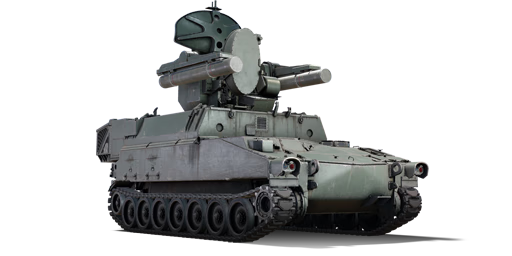
The Carrier Air Defense Missile System XM975 is a U.S. self-propelled missile defence (SAM) system based on the French Roland ground-to-air missile that was constructed on the Tracked Carrier - XM975. The U.S. Army evaluated the Roland missile system in the 1970s and early 1980s. The Roland ground-to-air missile launcher was mounted on the Tracked Carrier - XM975 (a weapon-tracked carrier that was also utilized on the M109 self-propelled howitzer). Overall, this SAM system had limited service, with only one prototype manufactured and approximately 27 units produced in total. It served in the U.S. Army for about 5 to 10 years before being phased out.
Introduced in Update "Winged Lions", the XM975 is a rank VII U.S. Army ground forces SAM system, that clears the skies of potential enemy aircraft. This SAM system will be quite familiar to French Army ground personnel, as it uses the French Roland ground-to-air missile as its primary weapon. Unfortunately, it lacks additional armaments and only has two ready-to-fire missiles in the missile launcher, forcing the player to make every missile count.
General info
Survivability and armour
The XM975 has similar protection to other SPAAs and SAMs of its rank, with enough protection to stop some splash damage from near misses of small rockets and bombs. The armour will also stop rifle-calibre rounds, but the American M2HB Browning, the Soviet NSVT, or other similar heavy machine guns will slice straight through the armour, along with of course any MBT round. Avoid direct confrontation with all enemy ground forces.
Armour type:
- Rolled homogeneous armour (turret, hull rear)
- Aluminium alloy 5083 (hull)
| Armour | Front (Slope angle) | Sides | Rear | Roof |
|---|---|---|---|---|
| Hull | 32 mm Top 32 mm (30-75°) Upper glacis 32 mm (0-59°) Lower glacis |
32 mm (24°) Top 32 mm Bottom |
6.35 mm Top 32 mm Bottom |
32 mm |
| Turret | 15 mm | 15 mm | 15 mm | 10 mm |
Notes:
- Tracks are 20 mm thick, suspension wheels are 15 mm thick
Mobility
The top speed of 57 km/h (35.4 mph) is reasonably quick. The XM975 is capable of traversing the map relatively quickly, though it is recommended to travel in mostly straight lines if possible. The acceleration is mediocre and it will take time for the vehicle to regain speed again, so attempt to avoid many turns and take roads when able.
| Game Mode | Max Speed (km/h) | Weight (tons) | Engine power (horsepower) | Power-to-weight ratio (hp/ton) | |||
|---|---|---|---|---|---|---|---|
| Forward | Reverse | Stock | Upgraded | Stock | Upgraded | ||
| Arcade | Expression error: Unexpected * operator. | 575 | Expression error: Unexpected round operator. | __.__ | |||
| Realistic | 358 | Expression error: Unexpected round operator. | __.__ | ||||
Modifications and economy
The modification order is fairly simple for the XM975. Parts and FPE should come first as usual, then the Roland 3. This will increase the engagement range of the XM975 from 6.3 km to 8 km and allow engagement of most enemy helicopters. Then horizontal drive, airstrike and elevation mechanism, to allow for better tracking of fast moving enemy aircraft and a reduction to the spawn cost of allied aircraft. After that, mobility modifications, crew replenishment and finally improved optics.
Armaments
Main armament
| Roland missile | Turret rotation speed (°/s) | Reloading rate (seconds) | ||||||||
|---|---|---|---|---|---|---|---|---|---|---|
| Mode | Capacity (Belt) | Vertical | Horizontal | Stabilizer | Stock | Upgraded | Full | Expert | Aced | Autoloader |
| Arcade | 10 (2) | -10°/+80° | ±180° | N/A | 74.9 | 103.6 | 125.8 | 139.1 | 148.0 | 5.00 |
| Realistic | 50.6 | 59.5 | 72.3 | 79.9 | 85.0 | |||||
Ammunition
| Penetration statistics | |||||||
|---|---|---|---|---|---|---|---|
| Ammunition | Type of warhead |
Penetration @ 0° Angle of Attack (mm) | |||||
| 10 m | 100 m | 500 m | 1,000 m | 1,500 m | 2,000 m | ||
| Roland 1 | SAM | 39 | 39 | 39 | 39 | 39 | 39 |
| Roland 3 | SAM | 54 | 54 | 54 | 54 | 54 | 54 |
| Missile details | ||||||||||||
|---|---|---|---|---|---|---|---|---|---|---|---|---|
| Ammunition | Type of warhead |
Velocity (m/s) |
Range (m) |
Projectile mass (kg) |
Fuse delay (m) |
Fuse sensitivity (mm) |
Arming distance (m) |
Trigger radius (m) |
Explosive mass (TNT equivalent) (kg) |
Ricochet | ||
| 0% | 50% | 100% | ||||||||||
| Roland 1 | SAM | 500 | 6,300 | 65 | 1 | 0.1 | 300 | 6 | 4.59 | 79° | 80° | 81° |
| Roland 3 | SAM | 570 | 8,000 | 77 | 1 | 0.1 | 300 | 6 | 6.81 | 79° | 80° | 81° |
Ammo racks

| Full ammo |
1st rack empty |
2nd rack empty |
3rd rack empty |
4th rack empty |
Visual discrepancy |
|---|---|---|---|---|---|
| 5 | 4 (+1) | 3 (+2) | 2 (+3) | 1 (+4) | No |
Usage in battles
When using the XM975, attempt to stay focused on the air threats. As a SAM platform, there are very few ground vehicles that can be knocked out by the Roland missile, so it is better to find a concealed position and avoid contact with enemy armour. The XM975 does have an advantage over quite a few other anti-air vehicles, thanks to the IRST (infrared search and track) mode. Commanders of the XM975 should be aware of this mode, as it prevents detection of lock-on by the enemy aircraft's RWR. The IRST mode also ignores enemy chaff, and is generally just a better mode to operate in as a whole.
The Roland is a relatively slow missile, so it is not recommended to fire upon jets that are near the limit of the missile's range and/or fly at high speed. However, this is made up for by the high manoeuvrability of the missile, as the slower speed allows it to pull sharper turns than quicker SAM missiles. Helicopters are usually within range, as all helicopters armed with the AGM-114 Hellfire will be within engagement range, as the maximum range of the hellfire is 8 km, like the Roland 3. Some helicopters may outrange the Roland in uptiers, such as the Ka-50 or Ka-52 with the 9K 127 Vikhr missiles. It is recommended to immediately take cover if outside engagement range, although it is possible to proximity fuse the Vikhr with the Roland if there is no other option available.
Pros and cons
Pros:
- Roland SAMs are quite manoeuvrable compared to other SAMs around the BR
- Can take down aircraft and choppers up to 8.0 km (4.97 mi) with the Roland 3
- SACLOS-guided SAMs are much harder to defeat compared to IR-guided SAMs
Cons:
- Lacklustre armour and high profile makes the XM975 vulnerable to enemy fire
- Roland missiles are slower than later SAMs and fairly easy to spot
- No anti-aircraft cannons as backup once all missiles are expended or for use against close-range/ground targets
History
The XM975 was selected by US Army as a forward air defence system in 1975. The first missiles were delivered in 1977 and fired in 1978. The XM975 was a modified M109 howitzer chassis equipped with a Roland 2 system with a longer range American-made search radar. Unfortunately problems with technology transfer and rising costs terminated the program after producing 27 launchers and 600 missiles, mounted on M812 flatbed trucks.
Media
- Skins
- Images
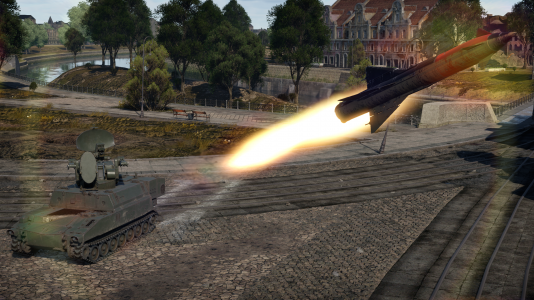
View of the XM975 firing its Roland 3 at an enemy air target, the vehicle's primary role.

See also
Links to the articles on the War Thunder Wiki that you think will be useful for the reader, for example:
- reference to the series of the vehicles;
- links to approximate analogues of other nations and research trees.
External links
| USA anti-aircraft vehicles | |
|---|---|
| M3 Half-track derivatives | M13 MGMC · M15 CGMC · M16 MGMC |
| M24 derivative | M19A1 |
| M41 derivative | M42 |
| Radar SPAAG | M163 · M247 |
| Missile SPAA | ADATS · Imp.Chaparral · LAV-AD · XM975 |