Difference between pages "Ho-Ni III" and "AH-64DJP"
(→History: Placeholder Dev Blog Entry) |
U148469566 (talk | contribs) m (→Usage in battles: deleting the this sentence because the AH-64DJP does not have MAW.) (Tag: Visual edit) |
||
| Line 1: | Line 1: | ||
| − | |||
{{About | {{About | ||
| − | |about= | + | | about = Japanese attack helicopter '''{{PAGENAME}}''' |
| − | |usage= | + | | usage = other versions |
| − | |link= | + | | link = AH-64 (Family) |
| + | }} | ||
| + | {{Specs-Card | ||
| + | |code=ah_64d_japan | ||
| + | |images={{Specs-Card-Image|GarageImage_{{PAGENAME}}.jpg|ArtImage_{{PAGENAME}}.png}} | ||
}} | }} | ||
== Description == | == Description == | ||
| − | <!--''In the description, the first part | + | <!-- ''In the description, the first part should be about the history of and the creation and combat usage of the helicopter, as well as its key features. In the second part, tell the reader about the helicopter in the game. Insert a screenshot of the vehicle, so that if the novice player does not remember the vehicle by name, he will immediately understand what kind of vehicle the article is talking about.'' --> |
| − | + | The '''{{Specs|name}}''' is a license-built version of the [[AH-64D]] by Fuji Heavy Industries to improve the Japanese anti-tank helicopter capabilities, and a cost-efficient alternative over a domestic attack helicopter development program. With a promised future for 62 Japanese Apaches, the slow and long-term purchase of 2 helicopters a year raised the price and the order was later cut down to a total of 12 AH-64DJPs. The remaining Japanese Apaches later received upgrade kits to serve them longer in service but with the MoD deciding in 2022 that the future isn't for helicopters, the AH-64D's together with the [[AH-1S]] and OH-1 will soon be replaced by unmanned drones instead. | |
| − | + | ||
| − | The '''{{Specs|name}}''' is a | + | It was introduced in [[Update "Starfighters"]]. It is similar to the American version, but it does not have AMASE or APKWS missiles. The main advantage of the Apache is its AGM-114K Hellfire II, which can destroy tanks from a long distance. The best way to use the missiles is to scan the ground with radar and thermal vision and launch missiles every five seconds or more once targets are acquired. This way, it can hit multiple targets or make sure they are destroyed and compensate for the long flight time. The AH-64DJP is equipped with four ATAS missiles for self-defense, which can shoot down enemy aircraft. It also has a 30 mm cannon with a computerized system that can automatically track and lead targets in the air or on the ground, and fire at them with precision. |
== General info == | == General info == | ||
| − | === | + | === Flight performance === |
| − | <!--''Describe | + | {{Specs-Heli-Flight}} |
| − | + | <!-- ''Describe how the helicopter behaves in the air. Speed, manoeuvrability, acceleration and allowable loads - these are the most important characteristics of the vehicle.'' --> | |
| + | The AH-64DJP sports great manoeuvrability, incredible acceleration, and overall provides great speed of up to 320 km/h in arcade and 295 km/h in realistic and simulator game modes. As fast as the [[AH-64D|United States Army, AH-64D Longbow]] and slower than the [[AH_Mk.1|British Army, AH Mk.1]] variants of the Apache, the AH-64DJP is still able to perform manoeuvres other helicopters can only dream about, from barrel rolls, flips to loops which allow it to evade enemy missiles with ease. | ||
| − | + | {| class="wikitable" style="text-align:center" | |
| + | |- | ||
| + | ! rowspan="2" | Characteristics | ||
| + | ! colspan="2" | Max Speed<br>(km/h at 1,000 m) | ||
| + | ! rowspan="2" | Max altitude<br>(metres) | ||
| + | |- | ||
| + | ! AB !! RB | ||
| + | |- | ||
| + | ! Stock | ||
| + | | 269 || 249 || rowspan="2" | {{Specs|ceiling}} | ||
| + | |- | ||
| + | ! Upgraded | ||
| + | | 320 || 295 | ||
| + | |- | ||
| + | |} | ||
| − | + | === Survivability and armour === | |
| + | {{Specs-Heli-Armour}} | ||
| + | <!-- ''Examine the survivability of the helicopter. Note how vulnerable the structure is and how secure the pilot is, whether the fuel tanks are armoured, etc. Describe the armour, if there is any, and also mention the vulnerability of other critical systems.'' --> | ||
| + | The AH-64D Apache longbow, has only limited armour protection installed with bullet proof glass only being installed on the pilot windscreen. The helicopter uses Kevlar boron carbide, composite martial which is limited only to instrument, floor and side panels around the cockpit. It does not provide the same level of protection as seen on other helicopters such as the [[Mi-28N]]. | ||
| − | + | * Bullet proof glass installed only for the pilot - 22 mm thick. | |
| + | * Installation of Kevlar boron carbide, composite martial only on the: Seats, cockpit side panels, Gunner floor panels and pilot instrument panel - 20 mm thick. | ||
| − | + | === Modifications and economy === | |
| + | {{Specs-Economy}} | ||
| − | {| class="wikitable" | + | == Armaments == |
| + | {{Specs-Heli-Armaments}} | ||
| + | {| class="wikitable" style="text-align:center" | ||
|- | |- | ||
| − | ! | + | ! colspan="3" | [[Ballistic Computer]] |
|- | |- | ||
| − | + | ! CCIP (Guns) !! CCIP (Rockets) !! CCIP (Bombs) | |
|- | |- | ||
| − | | | + | | {{Tick}} || {{Tick}} || {{Cross}} |
|- | |- | ||
|} | |} | ||
| − | '' | + | === Offensive armament === |
| + | {{Specs-Heli-Offensive}} | ||
| + | <!-- ''Describe the offensive armament of the helicopter, if any. Describe how effective the cannons and machine guns are in battle, also what ammunition belts or drums are better to use. If there is no offensive weaponry, delete this subsection.'' --> | ||
| + | {{main|M230E-1 (30 mm)}} | ||
| − | + | The '''''{{PAGENAME}}''''' is armed with: | |
| − | |||
| − | |||
| − | + | * 1 x 30 mm M230E-1 cannon, chin turret (1,200 rpg) | |
| − | + | * 30 x countermeasures | |
| − | {{ | + | === Suspended armament === |
| + | {{Specs-Heli-Suspended}} | ||
| + | <!-- ''Describe the helicopter's suspended armament: additional cannons under the winglets, any bombs, and rockets. Since any helicopter is essentially only a platform for suspended weaponry, this section is significant and deserves your special attention. If there is no suspended weaponry remove this subsection.'' --> | ||
| − | The | + | The '''''{{PAGENAME}}''''' can be outfitted with the following ordnance: |
| − | |||
| − | |||
| − | |||
| − | |||
| − | |||
| − | |||
| − | |||
{| class="wikitable" style="text-align:center" width="100%" | {| class="wikitable" style="text-align:center" width="100%" | ||
|- | |- | ||
| − | ! | + | ! !! width="7%" | 1 !! width="7%" | 2 !! width="7%" | 3 !! width="7%" | 4 !! width="7%" | 5 !! width="7%" | 6 |
| + | | rowspan="4" width="20%" | <div class="ttx-image">[[File:Hardpoints_AH-64A_(Israel).png]]</div> | ||
|- | |- | ||
| − | ! | + | ! [[Hydra-70 M247]] rockets |
| − | + | | || 19 || 19 || 19 || 19 || | |
| − | |||
|- | |- | ||
| − | ! | + | ! [[AGM-114K Hellfire II]] missiles |
| − | | | + | | || 2, 4 || 2, 4 || 2, 4 || 2, 4 || |
|- | |- | ||
| − | ! | + | ! [[ATAS (AIM-92)]] missiles |
| − | | | + | | 2 || || || || || 2 |
|- | |- | ||
|} | |} | ||
| − | + | {{Navigation-Start|Default weapon presets}} | |
| − | { | + | {{Navigation-First-Simple-Line}} |
| − | + | ||
| − | + | * Without load | |
| − | + | * 4 x ATAS (AIM-92) missiles | |
| − | + | * 76 x Hydra-70 M247 rockets | |
| − | + | * 4 x AGM-114K Hellfire II missiles | |
| − | + | * 8 x AGM-114K Hellfire II missiles | |
| − | + | * 16 x AGM-114K Hellfire II missiles | |
| − | + | {{Navigation-End}} | |
| − | + | ||
| − | + | === Defensive systems === | |
| − | + | <!--''Defensive armament with turret machine guns or cannons, crewed by gunners. Examine the number of gunners and what belts or drums are better to use. If defensive weaponry is not available, remove this subsection.''--> | |
| − | + | The '''''{{PAGENAME}}''''' only has the following Defensive systems installed: | |
| − | + | ||
| − | { | + | * '''Flares/Chaff''' - Up to 30 countermeasures can be installed. |
| − | + | * '''AIM-92 Stinger''' - AIM-92 Stingers and Infrared Counter Measures. | |
| − | + | ||
| − | + | When unlocked, countermeasures are not installed - this requires the Flares/Chaff module (tier I) to be researched and installed, this provides up to 30 countermeasures. The last module called AIM-92 (tier III) allows for the installation of a maximum of four AIM-92 Stinger missiles, which two are mounted on each wing tip, 30 countermeasures & IRCM module. Flares launch in a back left pattern, keep that in mind when flaring missiles or turning away from the combat area whilst pre-flaring. | |
| − | |||
| − | |||
| − | |||
| − | |||
| − | |||
| − | ! | ||
| − | |||
| − | |||
| − | |||
| − | |||
| − | |||
| − | |||
| − | |||
| − | |||
| − | |||
| − | |||
| − | |||
| − | |||
| − | |||
| − | |||
| − | |||
| − | |||
| − | |||
| − | |||
| − | |||
| − | |||
| − | |||
| − | |||
| − | |||
| − | + | Important note: unlike the American and British brothers, the AH-64DJP lacks a MAW (missile approach warning) system. This means that the AH-64JDP player should keep an extra eye on SPAAs and incoming SAMs by himself, as without MAW missiles must be spotted and countermeasures deployed manually. | |
| − | |||
| − | |||
| − | |||
| − | |||
| − | |||
| − | |||
| − | |||
| − | |||
| − | |||
| − | |||
| − | |||
| − | |||
| − | |||
| − | |||
| − | + | The AH-64DJP, like most of its siblings, has a fully digital RWR covering the full radar band spectrum. This means it will be able to see any (turned on) radar in the lobby with corresponding abbreviation. | |
== Usage in battles == | == Usage in battles == | ||
| − | <!--''Describe the tactics of playing in | + | <!-- ''Describe the tactics of playing in a helicopter, the features of using the helicopter in a team and advice on tactics. Refrain from creating a "guide" - do not impose a single point of view, but instead, give the reader food for thought. Examine the most dangerous enemies and give recommendations on fighting them. If necessary, note the specifics of the game in different modes (AB, RB, SB).'' --> |
| + | |||
| + | '''Overview:''' | ||
| + | |||
| + | The AH-64DJP is very similar to the AH-64D Apache. The only difference is the lack of an ability to carry an advanced MAW (a system that alerts the pilot to incoming missiles, Missile Alert Warning). The Apache is an excellent helicopter for attacking ground targets, and can also hold its own against many enemy aircraft. Through adequate use of cover, teamwork, and game sense, the Apache can easily dismantle enemy teams. An Apache pilot must understand all of the tools at their disposal. | ||
| − | The | + | The Apache has an arsenal of weapons. The most effective anti-tank weapon in the Apache's arsenal is the AGM-114 Hellfire, which uses a top attack trajectory to destroy ground vehicles. There is functionally very little difference between the AGM-114B and K variants, used on early and late Apaches respectively. |
| − | The | + | '''Staying Alive:''' |
| + | |||
| + | Flying the Apache effectively can be more difficult than most players would imagine, processing information from optical sights, radar displays, and the radar warning receiver all at once can lead to information overload. If distracted by irrelevant information, a pilot can quickly lose situational awareness. Being successful in the Apache requires situational awareness above all else. Due to the fragility of the helicopter, any blindspot can lead to a quick and sudden death. Additionally, the mobility of the Apache is adequate but not impressive, so evasive manoeuvres are not always effective. | ||
| + | |||
| + | Using cover is a very important part of staying alive in the Apache. Always stay behind a hill or building in ground battles. When exposing yourself in order to fire on the enemy, be mindful to not gain too much altitude. | ||
| + | |||
| + | The biggest improvement of the later Apache variants is the ability to mount the Longbow radar system. This system, if used properly, will help maintain situational awareness. | ||
| + | |||
| + | Additionally, it is important to know when to use flares. Flares are extremely effective against heat-seeking missiles, but useless against any other missiles. It is the responsibility of the Apache pilot to recognize the threat and decide whether to use flares or not. For Apaches with MAW (missile approach warning), there is an option for flares to be dispensed automatically. | ||
| + | |||
| + | '''Using the Longbow Radar:''' | ||
| + | |||
| + | The radar of the Apache should be used as a secondary tool when engaging ground targets. The radar is not effective in obtaining target lock for ground vehicles. The AGM-114L radar guided Hellfire is not in the game, so guidance of Hellfires should be done by using the FLIR thermal imaging camera to lase targets. However, the radar is still useful in detecting enemy aircraft. By using the multi-function menu to switch radar mode, the radar will begin to search for air rather than ground targets. Keeping track of enemy aircraft is vital to survival in the Apache, as any plane can make quick work of the Apache if the helicopter is unprepared. | ||
| + | |||
| + | '''Air-to-Air (Stinger and Gun):''' | ||
| + | |||
| + | The Apache is surprisingly potent in air-to-air combat. Engagements should be conducted primarily through the use of the Stinger missile. The Stinger is a simple but effective air-to-air missile. It has an excellent seeker head and can obtain all aspect lock on almost any air target within 3-5 km (even propeller aircraft with a low heat signature). However, the Stinger can be easily fooled by flares or outmanoeuvred by a fast enemy aircraft. The best way to use the Stinger against enemy aircraft is when they are heading directly towards you. If fired at the right second, most enemies will struggle to dodge a Stinger. | ||
| + | |||
| + | If the enemy gets close, the 30 mm autocannon can be extremely effective. The gun will automatically aim with optical lock, so Apache pilots can aim accurately while taking evasive manoeuvres. | ||
| + | |||
| + | '''Close Range Air-to-Ground (Gun and Rockets):''' | ||
| + | |||
| + | At close range, the Apache has excellent offensive capability. The 30 mm autocannon is incredibly accurate even at surprisingly far distances. This cannon uses a High Explosive Dual Purpose round that can engage lightly armoured targets. Rocket pods can also be used, with the CCIP computer helping maintain accuracy even at further distances. Be careful when trying to use the Hellfire missile at close range. It can do a direct attack at closer ranges (rather than its usual top attack) but if fired at an odd angle, it may not have time to manoeuvre onto the target if fired at closer ranges. | ||
| + | |||
| + | The problem with trying to engage at close range is that doing so will put the Apache in huge amounts of danger. Enemy tanks will be able to quickly destroy the Apache with their main guns or anti-aircraft machine guns. | ||
| + | |||
| + | [[File:HellfireTrajectory.png|thumb]] | ||
| + | '''Long Range Air-to-Ground (Hellfire): ''' | ||
| + | |||
| + | At longer ranges, the Hellfire missile can be used to full effect. The Hellfire will guide on its target as shown in the attached diagram. This is known as top attack. Being that it takes this path to the enemy target, the Hellfire can take upward of 30 seconds to reach its target at longer ranges. Do not fire at enemies that are about to move to cover, and make sure to fire multiple missiles at once in order to deal maximum damage. Because the Hellfire is laser guided, multiple missiles can be fired at once. They should be fired at intervals of 5-10 seconds, where between missiles the Apache can switch to a new ground target. This will allow for the quick destruction of multiple enemies. This tactic can be incredibly effective. Although the time to target for the most recently fired Hellfire is available on the HUD, pilots will have to keep track of all the missiles they have fired by memory and quick calculations. | ||
| + | [[File:HellfireSequenceDemonstration.mp4|left]] | ||
| + | |||
| + | Combatting enemy anti-aircraft vehicles can be a challenge. Always remain in cover and move unpredictably in combat. Use the radar warning receiver to obtain the general direction of enemy AA, and then attack with a Hellfire. An effective strategy is to fire a Hellfire, break optical lock to gain cover and avoid counterfire, and then pop back up and get lock again several seconds before the Hellfire hits. This strategy if applied correctly will result in a hit, as the Hellfire is smart enough to begin following the laser designator again once the Apache re-obtains its lock. | ||
| + | {{Clear}} | ||
| − | |||
| − | |||
| − | |||
| − | |||
| − | |||
| − | |||
| − | |||
| − | |||
| − | |||
| − | |||
| − | |||
| − | |||
| − | |||
| − | |||
| − | |||
| − | |||
| − | |||
| − | |||
| − | |||
| − | |||
| − | |||
| − | |||
| − | |||
| − | |||
| − | |||
| − | |||
| − | |||
| − | |||
| − | |||
=== Pros and cons === | === Pros and cons === | ||
| − | <!--'' | + | <!-- ''Summarise and briefly evaluate the vehicle in terms of its characteristics and combat effectiveness. Mark its pros and cons in the bulleted list. Try not to use more than 6 points for each of the characteristics. Avoid using categorical definitions such as "bad", "good" and the like - use substitutions with softer forms such as "inadequate" and "effective".'' --> |
'''Pros:''' | '''Pros:''' | ||
| − | * | + | * Attack capabilities: |
| − | * | + | ** Rockets |
| − | * | + | ** Long-range Hellfire II ATGMs |
| − | * | + | *** Timer to show you when they will hit the target, giving you the exact time to return to cover |
| − | * | + | *** Range of approximately 9 km |
| − | * | + | *** Can launch and guide several ATGMs at the same time |
| − | + | ** Flexible 30 mm cannon | |
| + | *** Has 51 mm pen to penetrate roof-top armour and light vehicles in a mono-type belt | ||
| + | *** Devastating against any air target hit | ||
| + | * Anti-air capabilities: | ||
| + | ** 4 AIM-92 Stinger AAMs | ||
| + | ** Flexible 30 mm cannon | ||
| + | *** Rounds in mono-type belt are {{Annotation|HEDP|High Explosive Dual Purpose}} | ||
| + | * Spotting capabilities: | ||
| + | ** Longbow radar, both air and ground units | ||
| + | ** Thermal sights | ||
| + | * Amazing speed, acceleration, climb and roll - very manoeuvrable helicopter | ||
| + | * Very survivable (Compared to other helis) with 2 crew members, and a beefy air frame | ||
'''Cons:''' | '''Cons:''' | ||
| − | * | + | * Long-range Hellfire II ATGMs |
| − | * | + | ** Slow, utilizing their long range is hard due to very long flight times |
| − | * | + | ** While they can in theory hit air targets, they're too slow to reliably hit air targets |
| − | * | + | * Lacks {{Annotation|MAW|Missile Approach Warning}} which is a very important system for top helicopters |
| + | * Has only 30 flares | ||
| + | * 30 mm cannon has high dispersion at longer range, making it inaccurate beyond 500 m | ||
| + | * AIM-92 is inconsistent at hitting side/front aspect against manoeuvrable craft | ||
== History == | == History == | ||
| − | <!--''Describe the history of the creation and combat usage of the | + | <!-- ''Describe the history of the creation and combat usage of the helicopter in more detail than in the introduction. If the historical reference turns out to be too long, take it to a separate article, taking a link to the article about the vehicle and adding a block "/History" (example: <nowiki>https://wiki.warthunder.com/(Vehicle-name)/History</nowiki>) and add a link to it here using the <code>main</code> template. Be sure to reference text and sources by using <code><nowiki><ref></ref></nowiki></code>, as well as adding them at the end of the article with <code><nowiki><references /></nowiki></code>. This section may also include the vehicle's dev blog entry (if applicable) and the in-game encyclopedia description (under <code><nowiki>=== In-game description ===</nowiki></code>, also if applicable).'' --> |
| − | The | + | |
| + | The AH-64D was selected by the Japanese Ground Self-Defense Force (JGSDF) in 2001, with a requirement for about 50 helicopters. 50 were ordered, and they were built by the Japanese Fuji Heavy Industries as the '''AH-64DJP''' (JP standing for Japan). The first AH-64DJP was delivered in 2006, but the order was cancelled after the delivery of only 13 helicopters. The AH-64DJP has the possibility of equipping AIM-92 Stinger air-to-air missiles (AAMs). | ||
| + | |||
| + | In 2017, it was announced that the AH-64DJP helicopters were to have their targeting systems upgraded by the American Lockheed Martin defense firm. According to a press briefing from April 26 of 2017, the upgrade was to the Modernized Target Acquisition Designation Sight/Pilot Night Vision Sensor (M‑TADS/PNVS). The M-TADS is the laser designator that allows the targeting of the AGM-114 Hellfire missiles, while the PNVS assists with safe flight in day, night, and adverse weather missions. The contract was for the delivery of 14 Modernized Day Sensor Assembly (M-DSA) laser designator kits. The M-DSA increases the reliability of the laser designator and also increases the precision of the system. Additionally, Lockheed Martin's Apache sustainment team was to provide performance-based logistics support to the JGSDF under a separate three-year contract. Japan was the first Apache operator to receive the M-DSA upgrade. | ||
| − | + | The JGSDF operated one squadron of ten AH-64DJP helicopters, with the other three acting as training helicopters. One AH-64DJP was destroyed in a crash in February 2018, resulting in the deaths of both crew members; this left a total of 12 AH-64DJP helicopters. | |
| − | + | In late 2022, the Japanese Ministry of Defence in its plans of "Elimination of obsolete equipment" decided to largely replace its fleet of attack and observation helicopters with drone craft and loitering munitions. Part of this list includes the AH-64D. Officially resulting in its end of service by 2027. | |
== Media == | == Media == | ||
| − | <!--''Excellent additions to the article would be video guides, screenshots from the game, and photos.''--> | + | <!-- ''Excellent additions to the article would be video guides, screenshots from the game, and photos.'' --> |
| − | * [https://live.warthunder.com/feed/camouflages/? | + | |
| + | ;Skins | ||
| + | |||
| + | * [https://live.warthunder.com/feed/camouflages/?vehicle=ah_64d_japan Skins and camouflages for the {{PAGENAME}} from live.warthunder.com.] | ||
| + | {{Skin-gallery |market|ugcitem_1000607|AH-64DJP JG-4557.png|Camo "AH-64DJP, Bicolor winter"}} | ||
| + | |||
| + | |||
| + | |||
| + | ;Videos | ||
| + | {{Youtube-gallery|irF2YOn8zOs|'''AH-64 Apache Ultimate Review''' - ''Bob Dickinson''}} | ||
== See also == | == See also == | ||
| − | ''Links to the articles on the War Thunder Wiki that you think will be useful for the reader, for example:'' | + | <!-- ''Links to the articles on the War Thunder Wiki that you think will be useful for the reader, for example:'' |
| + | * ''reference to the series of the helicopter;'' | ||
| + | * ''links to approximate analogues of other nations and research trees.'' --> | ||
| + | |||
| + | ;[[AH-64 (Family)|Related development]] | ||
| + | {{columns|4| | ||
| + | * [[File:USA flag.png|30px|link=]] [[AH-64D]] | ||
| + | * [[File:Britain flag.png|30px|link=]] [[AH Mk.1]] | ||
| + | * [[File:Sweden flag.png|30px|link=]] [[AHS]] | ||
| + | * [[File:Israel flag.png|30px|link=]] [[Saraph]] | ||
| + | }} | ||
| − | * | + | ;Rotorcraft of comparable role, configuration and era |
| − | * | + | {{columns|4| |
| + | * [[File:FRG flag.png|30px|link=]] [[File:France flag.png|30px|link=]] [[Tiger Eurocopter (Family)]] | ||
| + | * [[File:Italy flag.png|30px|link=]] [[A129 (Family)]] | ||
| + | * [[File:South Africa flag.png|30px|link=]] [[Rooivalk Mk1F CSH]] | ||
| + | * [[File:China flag.png|30px|link=]] [[Z-10]] | ||
| + | }} | ||
== External links == | == External links == | ||
| − | <!--''Paste links to sources and external resources, such as:'' | + | <!-- ''Paste links to sources and external resources, such as:'' |
* ''topic on the official game forum;'' | * ''topic on the official game forum;'' | ||
| − | + | * ''other literature.'' --> | |
| − | * ''other literature.''--> | ||
| − | * [https:// | + | * [[wikipedia:Boeing_AH-64_Apache|[Wikipedia] Boeing AH-64]] |
| − | * [ | + | * [https://www.helis.com/database/model/AH-64DJP-Apache/ <nowiki>[Helis.com]</nowiki> Fuji AH-64DJP Apache] |
| + | * [https://www.milavia.net/news/2006/first-ah-64djp-delivered-to-the-jgsdf.html <nowiki>[MILAVIA]</nowiki> First AH-64DJP Delivered to the JGSDF] | ||
| + | * [https://www.mod.go.jp/j/approach/agenda/guideline/plan/pdf/plan_outline.pdf Japanese Ministry of Defence development plan December 2022] | ||
| − | {{Japan | + | {{AirManufacturer Fuji}} |
| + | {{Japan helicopters}} | ||
Latest revision as of 13:42, 5 November 2024
| This page is about the Japanese attack helicopter AH-64DJP. For other versions, see AH-64 (Family). |


Contents
Description
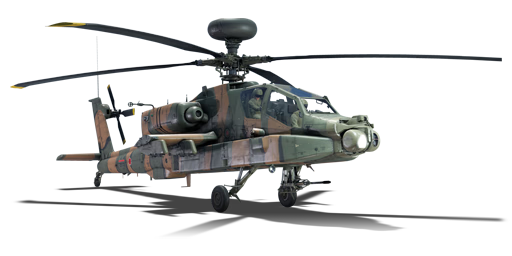
The AH-64DJP is a license-built version of the AH-64D by Fuji Heavy Industries to improve the Japanese anti-tank helicopter capabilities, and a cost-efficient alternative over a domestic attack helicopter development program. With a promised future for 62 Japanese Apaches, the slow and long-term purchase of 2 helicopters a year raised the price and the order was later cut down to a total of 12 AH-64DJPs. The remaining Japanese Apaches later received upgrade kits to serve them longer in service but with the MoD deciding in 2022 that the future isn't for helicopters, the AH-64D's together with the AH-1S and OH-1 will soon be replaced by unmanned drones instead.
It was introduced in Update "Starfighters". It is similar to the American version, but it does not have AMASE or APKWS missiles. The main advantage of the Apache is its AGM-114K Hellfire II, which can destroy tanks from a long distance. The best way to use the missiles is to scan the ground with radar and thermal vision and launch missiles every five seconds or more once targets are acquired. This way, it can hit multiple targets or make sure they are destroyed and compensate for the long flight time. The AH-64DJP is equipped with four ATAS missiles for self-defense, which can shoot down enemy aircraft. It also has a 30 mm cannon with a computerized system that can automatically track and lead targets in the air or on the ground, and fire at them with precision.
General info
Flight performance
The AH-64DJP sports great manoeuvrability, incredible acceleration, and overall provides great speed of up to 320 km/h in arcade and 295 km/h in realistic and simulator game modes. As fast as the United States Army, AH-64D Longbow and slower than the British Army, AH Mk.1 variants of the Apache, the AH-64DJP is still able to perform manoeuvres other helicopters can only dream about, from barrel rolls, flips to loops which allow it to evade enemy missiles with ease.
| Characteristics | Max Speed (km/h at 1,000 m) |
Max altitude (metres) | |
|---|---|---|---|
| AB | RB | ||
| Stock | 269 | 249 | |
| Upgraded | 320 | 295 | |
Survivability and armour
The AH-64D Apache longbow, has only limited armour protection installed with bullet proof glass only being installed on the pilot windscreen. The helicopter uses Kevlar boron carbide, composite martial which is limited only to instrument, floor and side panels around the cockpit. It does not provide the same level of protection as seen on other helicopters such as the Mi-28N.
- Bullet proof glass installed only for the pilot - 22 mm thick.
- Installation of Kevlar boron carbide, composite martial only on the: Seats, cockpit side panels, Gunner floor panels and pilot instrument panel - 20 mm thick.
Modifications and economy
Armaments
| Ballistic Computer | ||
|---|---|---|
| CCIP (Guns) | CCIP (Rockets) | CCIP (Bombs) |
 |
|

|
Offensive armament
The AH-64DJP is armed with:
- 1 x 30 mm M230E-1 cannon, chin turret (1,200 rpg)
- 30 x countermeasures
Suspended armament
The AH-64DJP can be outfitted with the following ordnance:
| 1 | 2 | 3 | 4 | 5 | 6 |  | |
|---|---|---|---|---|---|---|---|
| Hydra-70 M247 rockets | 19 | 19 | 19 | 19 | |||
| AGM-114K Hellfire II missiles | 2, 4 | 2, 4 | 2, 4 | 2, 4 | |||
| ATAS (AIM-92) missiles | 2 | 2 |
| Default weapon presets | |
|---|---|
| |
Defensive systems
The AH-64DJP only has the following Defensive systems installed:
- Flares/Chaff - Up to 30 countermeasures can be installed.
- AIM-92 Stinger - AIM-92 Stingers and Infrared Counter Measures.
When unlocked, countermeasures are not installed - this requires the Flares/Chaff module (tier I) to be researched and installed, this provides up to 30 countermeasures. The last module called AIM-92 (tier III) allows for the installation of a maximum of four AIM-92 Stinger missiles, which two are mounted on each wing tip, 30 countermeasures & IRCM module. Flares launch in a back left pattern, keep that in mind when flaring missiles or turning away from the combat area whilst pre-flaring.
Important note: unlike the American and British brothers, the AH-64DJP lacks a MAW (missile approach warning) system. This means that the AH-64JDP player should keep an extra eye on SPAAs and incoming SAMs by himself, as without MAW missiles must be spotted and countermeasures deployed manually.
The AH-64DJP, like most of its siblings, has a fully digital RWR covering the full radar band spectrum. This means it will be able to see any (turned on) radar in the lobby with corresponding abbreviation.
Usage in battles
Overview:
The AH-64DJP is very similar to the AH-64D Apache. The only difference is the lack of an ability to carry an advanced MAW (a system that alerts the pilot to incoming missiles, Missile Alert Warning). The Apache is an excellent helicopter for attacking ground targets, and can also hold its own against many enemy aircraft. Through adequate use of cover, teamwork, and game sense, the Apache can easily dismantle enemy teams. An Apache pilot must understand all of the tools at their disposal.
The Apache has an arsenal of weapons. The most effective anti-tank weapon in the Apache's arsenal is the AGM-114 Hellfire, which uses a top attack trajectory to destroy ground vehicles. There is functionally very little difference between the AGM-114B and K variants, used on early and late Apaches respectively.
Staying Alive:
Flying the Apache effectively can be more difficult than most players would imagine, processing information from optical sights, radar displays, and the radar warning receiver all at once can lead to information overload. If distracted by irrelevant information, a pilot can quickly lose situational awareness. Being successful in the Apache requires situational awareness above all else. Due to the fragility of the helicopter, any blindspot can lead to a quick and sudden death. Additionally, the mobility of the Apache is adequate but not impressive, so evasive manoeuvres are not always effective.
Using cover is a very important part of staying alive in the Apache. Always stay behind a hill or building in ground battles. When exposing yourself in order to fire on the enemy, be mindful to not gain too much altitude.
The biggest improvement of the later Apache variants is the ability to mount the Longbow radar system. This system, if used properly, will help maintain situational awareness.
Additionally, it is important to know when to use flares. Flares are extremely effective against heat-seeking missiles, but useless against any other missiles. It is the responsibility of the Apache pilot to recognize the threat and decide whether to use flares or not. For Apaches with MAW (missile approach warning), there is an option for flares to be dispensed automatically.
Using the Longbow Radar:
The radar of the Apache should be used as a secondary tool when engaging ground targets. The radar is not effective in obtaining target lock for ground vehicles. The AGM-114L radar guided Hellfire is not in the game, so guidance of Hellfires should be done by using the FLIR thermal imaging camera to lase targets. However, the radar is still useful in detecting enemy aircraft. By using the multi-function menu to switch radar mode, the radar will begin to search for air rather than ground targets. Keeping track of enemy aircraft is vital to survival in the Apache, as any plane can make quick work of the Apache if the helicopter is unprepared.
Air-to-Air (Stinger and Gun):
The Apache is surprisingly potent in air-to-air combat. Engagements should be conducted primarily through the use of the Stinger missile. The Stinger is a simple but effective air-to-air missile. It has an excellent seeker head and can obtain all aspect lock on almost any air target within 3-5 km (even propeller aircraft with a low heat signature). However, the Stinger can be easily fooled by flares or outmanoeuvred by a fast enemy aircraft. The best way to use the Stinger against enemy aircraft is when they are heading directly towards you. If fired at the right second, most enemies will struggle to dodge a Stinger.
If the enemy gets close, the 30 mm autocannon can be extremely effective. The gun will automatically aim with optical lock, so Apache pilots can aim accurately while taking evasive manoeuvres.
Close Range Air-to-Ground (Gun and Rockets):
At close range, the Apache has excellent offensive capability. The 30 mm autocannon is incredibly accurate even at surprisingly far distances. This cannon uses a High Explosive Dual Purpose round that can engage lightly armoured targets. Rocket pods can also be used, with the CCIP computer helping maintain accuracy even at further distances. Be careful when trying to use the Hellfire missile at close range. It can do a direct attack at closer ranges (rather than its usual top attack) but if fired at an odd angle, it may not have time to manoeuvre onto the target if fired at closer ranges.
The problem with trying to engage at close range is that doing so will put the Apache in huge amounts of danger. Enemy tanks will be able to quickly destroy the Apache with their main guns or anti-aircraft machine guns.

Long Range Air-to-Ground (Hellfire):
At longer ranges, the Hellfire missile can be used to full effect. The Hellfire will guide on its target as shown in the attached diagram. This is known as top attack. Being that it takes this path to the enemy target, the Hellfire can take upward of 30 seconds to reach its target at longer ranges. Do not fire at enemies that are about to move to cover, and make sure to fire multiple missiles at once in order to deal maximum damage. Because the Hellfire is laser guided, multiple missiles can be fired at once. They should be fired at intervals of 5-10 seconds, where between missiles the Apache can switch to a new ground target. This will allow for the quick destruction of multiple enemies. This tactic can be incredibly effective. Although the time to target for the most recently fired Hellfire is available on the HUD, pilots will have to keep track of all the missiles they have fired by memory and quick calculations.
Combatting enemy anti-aircraft vehicles can be a challenge. Always remain in cover and move unpredictably in combat. Use the radar warning receiver to obtain the general direction of enemy AA, and then attack with a Hellfire. An effective strategy is to fire a Hellfire, break optical lock to gain cover and avoid counterfire, and then pop back up and get lock again several seconds before the Hellfire hits. This strategy if applied correctly will result in a hit, as the Hellfire is smart enough to begin following the laser designator again once the Apache re-obtains its lock.
Pros and cons
Pros:
- Attack capabilities:
- Rockets
- Long-range Hellfire II ATGMs
- Timer to show you when they will hit the target, giving you the exact time to return to cover
- Range of approximately 9 km
- Can launch and guide several ATGMs at the same time
- Flexible 30 mm cannon
- Has 51 mm pen to penetrate roof-top armour and light vehicles in a mono-type belt
- Devastating against any air target hit
- Anti-air capabilities:
- 4 AIM-92 Stinger AAMs
- Flexible 30 mm cannon
- Rounds in mono-type belt are HEDP
- Spotting capabilities:
- Longbow radar, both air and ground units
- Thermal sights
- Amazing speed, acceleration, climb and roll - very manoeuvrable helicopter
- Very survivable (Compared to other helis) with 2 crew members, and a beefy air frame
Cons:
- Long-range Hellfire II ATGMs
- Slow, utilizing their long range is hard due to very long flight times
- While they can in theory hit air targets, they're too slow to reliably hit air targets
- Lacks MAW which is a very important system for top helicopters
- Has only 30 flares
- 30 mm cannon has high dispersion at longer range, making it inaccurate beyond 500 m
- AIM-92 is inconsistent at hitting side/front aspect against manoeuvrable craft
History
The AH-64D was selected by the Japanese Ground Self-Defense Force (JGSDF) in 2001, with a requirement for about 50 helicopters. 50 were ordered, and they were built by the Japanese Fuji Heavy Industries as the AH-64DJP (JP standing for Japan). The first AH-64DJP was delivered in 2006, but the order was cancelled after the delivery of only 13 helicopters. The AH-64DJP has the possibility of equipping AIM-92 Stinger air-to-air missiles (AAMs).
In 2017, it was announced that the AH-64DJP helicopters were to have their targeting systems upgraded by the American Lockheed Martin defense firm. According to a press briefing from April 26 of 2017, the upgrade was to the Modernized Target Acquisition Designation Sight/Pilot Night Vision Sensor (M‑TADS/PNVS). The M-TADS is the laser designator that allows the targeting of the AGM-114 Hellfire missiles, while the PNVS assists with safe flight in day, night, and adverse weather missions. The contract was for the delivery of 14 Modernized Day Sensor Assembly (M-DSA) laser designator kits. The M-DSA increases the reliability of the laser designator and also increases the precision of the system. Additionally, Lockheed Martin's Apache sustainment team was to provide performance-based logistics support to the JGSDF under a separate three-year contract. Japan was the first Apache operator to receive the M-DSA upgrade.
The JGSDF operated one squadron of ten AH-64DJP helicopters, with the other three acting as training helicopters. One AH-64DJP was destroyed in a crash in February 2018, resulting in the deaths of both crew members; this left a total of 12 AH-64DJP helicopters.
In late 2022, the Japanese Ministry of Defence in its plans of "Elimination of obsolete equipment" decided to largely replace its fleet of attack and observation helicopters with drone craft and loitering munitions. Part of this list includes the AH-64D. Officially resulting in its end of service by 2027.
Media
- Skins
 Market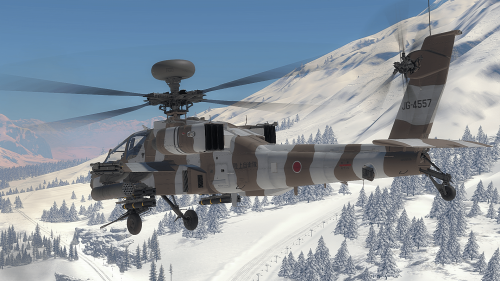
- Videos
See also


- Rotorcraft of comparable role, configuration and era


External links
- [Wikipedia] Boeing AH-64
- [Helis.com] Fuji AH-64DJP Apache
- [MILAVIA] First AH-64DJP Delivered to the JGSDF
- Japanese Ministry of Defence development plan December 2022
| Fuji Heavy Industries, Ltd. (富士重工業株式会社) | |
|---|---|
| Utility | UH-1B Hiyodori* |
| Attack | ▅AH-1E* · AH-1S* · AH-1S Kisarazu* |
| AH-64DJP* | |
| *Licensed | |
| Fuji Heavy Industries traces its roots to the Nakajima Aircraft Company. At the end of World War II, Nakajima was broken up by the Allied Occupation government, and by 1957 part of the separated company was already known as Fuji Heavy Industries.
Fuji Heavy Industries was renamed to Subaru Corporation from 2017 onward. | |
| See also | Nakajima Aircraft Company (1918-1945) · Bell Aircraft Corporation · Boeing Aircraft |
| Japan helicopters | |
|---|---|
| Utility | ▅UH-1B |
| Attack | ▅AH-1E · AH-1S · AH-1S Kisarazu |
| AH-64DJP | |