Difference between pages "Type K-8 No.13 late" and "Type K-3 No.1"
(→Description: New Description Project) |
m (Fixed the parts regarding the HE-TF belt) |
||
| Line 1: | Line 1: | ||
| − | |||
| − | |||
| − | |||
| − | |||
| − | |||
{{Specs-Card | {{Specs-Card | ||
| − | |code= | + | |code=jp_no1_ch2 |
| − | |images={{Specs-Card-Image| | + | |images={{Specs-Card-Image|GarageImage {{PAGENAME}}.jpg|GarageImage {{PAGENAME}} (2).jpg}} |
}} | }} | ||
== Description == | == Description == | ||
| − | <!-- | + | <!--In the first part of the description, cover the history of the ship's creation and military application. In the second part, tell the reader about using this ship in the game. Add a screenshot; if a beginner player has a hard time remembering vehicles by name, a picture will help them identify the ship in question.--> |
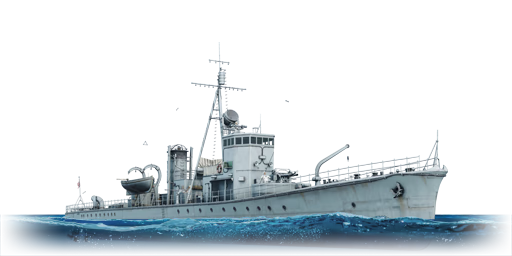
| − | The Japanese Project | + | The Japanese Project K3, No.1-class Submarine Chaser No.1 was completed in March 1934 as a part of the Maru 1 Programme. It was the first class of the dedicated Anti-Submarine Warfare vessels in the Imperial Japanese Navy. The major advantage of the vessel was its high speed, while the key issue was a problem with the strength of the hull, which was later addressed in refits, modification of the No.3 subclass before it was built and finally, fully resolved in the [[Type K-7 No.4|No.4-class]]. She spent most of her service in the southern seas, survived the war without any notable successes, and finally was scuttled by the Royal Navy off Singapore. |
| − | The '''{{Specs|name}}''' | + | The '''{{Specs|name}}''' was introduced in [[Update 1.89 "Imperial Navy"]]. The ship has a powerful and varied combination of weapons, as well as good survivability compared to the other vessels in her BR. Her main disadvantages come from being such a large vessel - she has a low manoeuvrability and is easy to hit with nearly anything, from bombs and rockets to artillery strikes. |
== General info == | == General info == | ||
=== Survivability and armour === | === Survivability and armour === | ||
{{Specs-Fleet-Armour}} | {{Specs-Fleet-Armour}} | ||
| − | <!-- | + | <!--Talk about the vehicle's armour. Note the most well-defended and most vulnerable zones, e.g. the ammo magazine. Evaluate the composition of components and assemblies responsible for movement and manoeuvrability. Evaluate the survivability of the primary and secondary armaments separately. Don't forget to mention the size of the crew, which plays an important role in fleet mechanics. Save tips on preserving survivability for the "Usage in battles" section. If necessary, use a graphical template to show the most well-protected or most vulnerable points in the armour.--> |
| − | + | Relatively well-armoured, large ship with high survivability for its rank. Its major weakness is in being prone to fires. Major strength in a high crew count of 65, one of the largest in its battle rating class (after [[HMCS Brantford]]). Weapons are relatively well distributed, making them a difficult targets to take down separately. While the ship itself is large in size, its frontal cross-section is relatively small, making it a tricky target in a hands of a more experienced player. Secondary anti-aircraft armament, while powerful, is centred around sides, making ship most prone to the attacks from a rear. Another potential weak-point are ammunition racks exposed over the water line, however those can be minimized by reducing the ammunition count by half. | |
| − | |||
| − | |||
| − | |||
=== Mobility === | === Mobility === | ||
{{Specs-Fleet-Mobility}} | {{Specs-Fleet-Mobility}} | ||
| − | <!-- | + | <!--Write about the ship's mobility. Evaluate its power and manoeuvrability, rudder rerouting speed, stopping speed at full tilt, with its maximum forward and reverse speed.--> |
| − | + | [[File:Type K-3 dodge torpedoes.png|thumb|right|Type K-3 taking evasive action to avoid incoming torpedoes]] | |
| + | |||
| + | While the ship is relatively large it's still characterized with a comparatively high manoeuvrability. While the base speed is 44 km/h, a fully-upgraded setup can reach an impressive maximum speed of 59 km/h. Combined with a Rudder Replacement K-3 can choose engagements even with a number of torpedo boats. | ||
{{NavalMobility}} | {{NavalMobility}} | ||
| Line 38: | Line 32: | ||
=== Primary armament === | === Primary armament === | ||
{{Specs-Fleet-Primary}} | {{Specs-Fleet-Primary}} | ||
| + | [[File:40 mm 62 Vickers on Type K-3.png|thumb|Manned by two gunners 40 mm Vickers has a horizontal guidance of 180° and vertical -10°/+75°, making it an excellent dual-purpose gun.]] | ||
<!-- ''Provide information about the characteristics of the primary armament. Evaluate their efficacy in battle based on their reload speed, ballistics and the capacity of their shells. Add a link to the main article about the weapon: <code><nowiki>{{main|Weapon name (calibre)}}</nowiki></code>. Broadly describe the ammunition available for the primary armament, and provide recommendations on how to use it and which ammunition to choose.'' --> | <!-- ''Provide information about the characteristics of the primary armament. Evaluate their efficacy in battle based on their reload speed, ballistics and the capacity of their shells. Add a link to the main article about the weapon: <code><nowiki>{{main|Weapon name (calibre)}}</nowiki></code>. Broadly describe the ammunition available for the primary armament, and provide recommendations on how to use it and which ammunition to choose.'' --> | ||
| − | + | {{main|40 mm/62 Vickers (40 mm)}} | |
| − | {{main| | ||
| − | + | Primary weapon is a relatively low-shell-speed, high-arcing, high rate of fire dual-barrel 40 mm Vickers autocannon. It's an excellent weapon for relatively quickly dispatching targets within 1.5 km range, where its high rate of fire can be used to correct lead and land number of shots before the need to reload. It's extremely useful against small fast vessels, such as hydrofoil torpedo boats. At range however, the flight time becomes a near-impossible for tracking anything smaller than a sub-chaser. There is, however, one advantage to the gun at >1,500 m range: due to its low shell speed gun will fire at a very high arc, allowing K-3 to be one of a very few ships within its rank capable of reaching enemies hidden behind near-vertical obstacles, making it an excellent weapon to use against various opponents trying to hide behind the islands or other terrain obstacles. | |
| − | + | * '''Universal:''' {{Annotation|HEF|High-explosive fragmentation}}{{-}}{{Annotation|APHE|Armour-piercing high-explosive}}{{-}}{{Annotation|HEF|High-explosive fragmentation}}{{-}}{{Annotation|APHE|Armour-piercing high-explosive}} | |
| − | {{ | + | * '''40 mm HE clips:''' {{Annotation|HEF|High-explosive fragmentation}}{{-}}{{Annotation|HEF|High-explosive fragmentation}}{{-}}{{Annotation|HEF|High-explosive fragmentation}}{{-}}{{Annotation|APHE|Armour-piercing high-explosive}} |
| − | + | * '''40 mm AP clips:''' {{Annotation|APHE|Armour-piercing high-explosive}}{{-}}{{Annotation|APHE|Armour-piercing high-explosive}}{{-}}{{Annotation|APHE|Armour-piercing high-explosive}}{{-}}{{Annotation|HEF|High-explosive fragmentation}}- Armour piercing shells, good at damaging interior modules and armoured ships | |
| − | {{ | + | * '''40 mm HE-TF clips:''' {{Annotation|HE-TF|High-explosive time fuse}}{{-}}{{Annotation|HE-TF|High-explosive time fuse}}{{-}}{{Annotation|HE-TF|High-explosive time fuse}}{{-}}{{Annotation|HE-TF|High-explosive time fuse}}- Time fuse HE shells, effective against both: boats and aircraft, generally superior to the HE clip, unless trying to engage boats at a very long range. |
| + | {{:40 mm/62 Vickers (40 mm)/Ammunition|APHE, HEF, HE-TF}} | ||
=== Secondary armament === | === Secondary armament === | ||
{{Specs-Fleet-Secondary}} | {{Specs-Fleet-Secondary}} | ||
<!-- ''Some ships are fitted with weapons of various calibres. Secondary armaments are defined as weapons chosen with the control <code>Select secondary weapon</code>. Evaluate the secondary armaments and give advice on how to use them. Describe the ammunition available for the secondary armament. Provide recommendations on how to use them and which ammunition to choose. Remember that any anti-air armament, even heavy calibre weapons, belong in the next section. If there is no secondary armament, remove this section.'' --> | <!-- ''Some ships are fitted with weapons of various calibres. Secondary armaments are defined as weapons chosen with the control <code>Select secondary weapon</code>. Evaluate the secondary armaments and give advice on how to use them. Describe the ammunition available for the secondary armament. Provide recommendations on how to use them and which ammunition to choose. Remember that any anti-air armament, even heavy calibre weapons, belong in the next section. If there is no secondary armament, remove this section.'' --> | ||
| − | [[File:Type | + | [[File:25 mm 60 Type 96.png|thumb|Rapid firing, single-barrel 25 mm/60 Type 96 is effective against both: naval and airborne targets.]] |
| − | {{main| | + | {{main|Type 96 (25 mm)}} |
| − | |||
| − | |||
| − | |||
| − | |||
| − | + | The {{PAGENAME}} possesses some of the best anti-air armament among Japanese rank 1 ships, making it extremely useful in fending-off enemy ships, even armoured gun boats, and relatively useful against air targets. The only disadvantage is in the guns layout, where at most 2 guns can be firing at a target, due to the fact that two guns amid-ship are pointing in the opposite directions, without any overlapping field of fire. | |
| − | * '''Universal:''' {{Annotation|HEF-T*|High-explosive fragmentation tracer (self-destroying)}}{{-}}{{Annotation|HEF|High-explosive fragmentation}}{{-}}{{Annotation|AP-T|Armour-piercing tracer}}{{-}}{{Annotation|HEI|High-explosive incendiary}} | + | * '''Universal:''' {{Annotation|HEF-T*|High-explosive fragmentation tracer (self-destroying)}}{{-}}{{Annotation|HEF|High-explosive fragmentation}}{{-}}{{Annotation|AP-T|Armour-piercing tracer}}{{-}}{{Annotation|HEI|High-explosive incendiary}} |
| − | * '''APT:''' {{Annotation|AP-T|Armour-piercing tracer}}{{-}}{{Annotation|AP-T|Armour-piercing tracer}}{{-}}{{Annotation|AP-T|Armour-piercing tracer}}{{-}}{{Annotation|HEF|High-explosive fragmentation}} | + | * '''25 mm APT belt:''' {{Annotation|AP-T|Armour-piercing tracer}}{{-}}{{Annotation|AP-T|Armour-piercing tracer}}{{-}}{{Annotation|AP-T|Armour-piercing tracer}}{{-}}{{Annotation|HEF|High-explosive fragmentation}} |
| − | * '''HEIT:''' {{Annotation|HEF-T*|High-explosive fragmentation tracer (self-destroying)}}{{-}}{{Annotation|HEI|High-explosive incendiary}}{{-}}{{Annotation|HEI|High-explosive incendiary}}{{-}}{{Annotation|HEI|High-explosive incendiary}} | + | * '''25 mm HEIT belts:''' {{Annotation|HEF-T*|High-explosive fragmentation tracer (self-destroying)}}{{-}}{{Annotation|HEI|High-explosive incendiary}}{{-}}{{Annotation|HEI|High-explosive incendiary}}{{-}}{{Annotation|HEI|High-explosive incendiary}} |
{{:25 mm/60 Type 96 (25 mm)/Ammunition|HEF-T*, HEI, HEF, AP-T}} | {{:25 mm/60 Type 96 (25 mm)/Ammunition|HEF-T*, HEI, HEF, AP-T}} | ||
| − | |||
| − | |||
| − | |||
| − | |||
| − | |||
| − | |||
| − | |||
| − | |||
| − | |||
=== Additional armament === | === Additional armament === | ||
| Line 86: | Line 68: | ||
<!-- ''Describe the technique of using this ship, the characteristics of her use in a team and tips on strategy. Abstain from writing an entire guide – don't try to provide a single point of view, but give the reader food for thought. Talk about the most dangerous opponents for this vehicle and provide recommendations on fighting them. If necessary, note the specifics of playing with this vehicle in various modes (AB, RB, SB).'' --> | <!-- ''Describe the technique of using this ship, the characteristics of her use in a team and tips on strategy. Abstain from writing an entire guide – don't try to provide a single point of view, but give the reader food for thought. Talk about the most dangerous opponents for this vehicle and provide recommendations on fighting them. If necessary, note the specifics of playing with this vehicle in various modes (AB, RB, SB).'' --> | ||
| − | The | + | The K-3 is largely a support ship that excels in one-on-one fights in similar or lower battle ratings, while still being useful in higher-BR battles. It's ill-advised to rush capture points in this ship due to its large size that makes for an attractive target to the enemy team. It's a particularly difficult vessel to play until unlocking fire protection system, as it's extremely easy to ignite and fires will quickly take it down - for that reason when fighting against Type K-3 it's highly recommended to use HE shells on every occasion. |
| + | |||
| + | The sub-chaser's primary advantage is in a very narrow hull and an outstanding 40 mm gun. The ship is so narrow in fact that it's near-impossible to hit for a motor torpedo boats when facing bow (front) or stern (rear). On the other hand, its length is one of, if not the longest in BR, being a serious issue when faced with torpedoes or high-rank ships, therefore care should the taken to pre-emptively position oneself when engaging opponents. | ||
| + | |||
| + | The ship is best taken equipped with less than a half of a total ammunition capacity, as it's more than sufficient for a vast majority of battles, while significantly lowers the cross-section of the unarmoured ammunition racks that are prone to explosions. Also ignoring depth charges is recommended due to their extremely limited usefulness while adding mass and risk of explosion to the ship. | ||
| + | |||
| + | It's generally good to have at least some HE-TF ammunition onboard, as with a rapid fire of the 40 mm Vickers it can dispatch a field of flak fire very effectively destroying enemy bombers and fighters, or at least scaring them off. Within Rank 1 battles 40 mm HE clips are a better choice than the Universal or SAP, as none of the targets will have enough armour to resist them even at 2,000 m, while additional explosive power increases the speed in which enemies can be destroyed. Primary gun is positioned at the front of the vessel, making it possible to peek from cover and shoot, without exposing much of a vessel. High firing arc makes it possible to shoot from behind cover of a small islands and to attack enemies inaccessible to the ships with higher shell speed. | ||
| + | |||
| + | Both K-3 and K-7 have a relatively undefended rear arc, where at most only one 20 mm anti-aircraft gun can shoot back. | ||
=== Pros and cons === | === Pros and cons === | ||
| Line 92: | Line 82: | ||
'''Pros:''' | '''Pros:''' | ||
| − | * | + | |
| − | * | + | * Effective 40 mm twin cannon with high firing arc and rapid fire |
| − | * | + | * Secondary armament is very powerful against small ships and unsuspecting bombers |
| − | + | * Decent anti-aircraft artillery for its battle rating | |
| − | * | + | * Decent speed |
| + | * Possesses one of the highest crew count in its rank | ||
| + | * HE-TF rounds are very useful against enemy vessels in close quarter battles | ||
'''Cons:''' | '''Cons:''' | ||
| − | * | + | * Low manoeuvrability |
* Large target | * Large target | ||
| + | * Primary armament is not very effective against larger, well-armoured ships | ||
| + | * Low shell speed makes for a challenging gameplay when up-tiered | ||
== History == | == History == | ||
<!-- ''Describe the history of the creation and combat usage of the ship in more detail than in the introduction. If the historical reference turns out to be too long, take it to a separate article, taking a link to the article about the ship and adding a block "/History" (example: <nowiki>https://wiki.warthunder.com/(Ship-name)/History</nowiki>) and add a link to it here using the <code>main</code> template. Be sure to reference text and sources by using <code><nowiki><ref></ref></nowiki></code>, as well as adding them at the end of the article with <code><nowiki><references /></nowiki></code>. This section may also include the ship's dev blog entry (if applicable) and the in-game encyclopedia description (under <code><nowiki>=== In-game description ===</nowiki></code>, also if applicable).'' --> | <!-- ''Describe the history of the creation and combat usage of the ship in more detail than in the introduction. If the historical reference turns out to be too long, take it to a separate article, taking a link to the article about the ship and adding a block "/History" (example: <nowiki>https://wiki.warthunder.com/(Ship-name)/History</nowiki>) and add a link to it here using the <code>main</code> template. Be sure to reference text and sources by using <code><nowiki><ref></ref></nowiki></code>, as well as adding them at the end of the article with <code><nowiki><references /></nowiki></code>. This section may also include the ship's dev blog entry (if applicable) and the in-game encyclopedia description (under <code><nowiki>=== In-game description ===</nowiki></code>, also if applicable).'' --> | ||
| + | The No.1-class submarine chasers (第一号型駆潜艇, Dai 1 Gō-gata Kusentei) were built under Maru 1 Keikaku programme, totalling 2 ships built in 1933. Vessels suffered from stability and hull strength issues that were resolved in a later redesign that became the [[Type K-7 No.4|No.4]]. The ship is a flush deck design with a relatively high freeboard for its size and an unproportionally large bridge. Ship's waterline length was 64 m, width 5.6 m for a total displacement of 383 tonnes. Crew consisted of 53 sailors, with up to 65 capacity. | ||
| − | + | Designers considered one of two primary guns against surfaced submarines: Either 8 cm/40 3rd Year Type naval gun or Type Bi-4 cm autocannon, which they've eventually picked for the final design. Both proposed guns were built domestically in Japan on a license. Additionally armament featured two imported Lewis light machine guns with the third one added during the war. Ships were equipped with 36 depth charges released overboard (projectors were added in the No.4). Additional equipment included Type 91 sonar, Type MV hydrophone, 6m motor boat and a 6m cutter, 60 mm search and signal light and an additional 30 mm search light. | |
| − | |||
| − | |||
| − | |||
| − | |||
| − | |||
| − | |||
| − | |||
| − | |||
| − | |||
| − | |||
| − | |||
| − | |||
| − | |||
| − | |||
| − | |||
| − | |||
| − | |||
| − | |||
| − | |||
| − | |||
| − | |||
| − | |||
| − | |||
| − | |||
| − | |||
| − | |||
| − | |||
| − | |||
| − | |||
| − | |||
| − | |||
| − | |||
| − | |||
| − | |||
| − | |||
| − | |||
| − | |||
| − | |||
| − | |||
| − | |||
| − | |||
| − | |||
| − | |||
| − | |||
| − | |||
| − | |||
| − | |||
| − | |||
| − | |||
| − | |||
| − | |||
| − | |||
| − | |||
| − | |||
| − | |||
| − | |||
| − | |||
| − | |||
| − | |||
| − | |||
| − | |||
| − | |||
| − | |||
| − | |||
| − | |||
| − | |||
| − | |||
| − | |||
| − | |||
| − | |||
| − | |||
| − | |||
| − | |||
| − | |||
| − | |||
| − | |||
| − | |||
| − | |||
| − | |||
| − | |||
| − | |||
| − | |||
| − | |||
| − | |||
| − | |||
| − | |||
| − | |||
| − | |||
| − | |||
| − | |||
| − | |||
| − | |||
| − | |||
| − | |||
| − | |||
| − | |||
| − | |||
| − | |||
| − | |||
| − | |||
| − | |||
| − | |||
| − | |||
| − | |||
| − | |||
| − | |||
| − | |||
| − | |||
| − | |||
| − | |||
| − | |||
| − | |||
| − | |||
| − | |||
| − | |||
| − | |||
| − | |||
| − | |||
| − | |||
| − | |||
| − | |||
| − | |||
| − | |||
| − | + | The first ship was commissioned on 23 December 1933, numbered No.2 by the Tōkyō Ishikawajima Shipyard, followed 3 days later by No.1 from the Uraga Dock Company. Both ships participated in the events following the Marco Polo Bridge Incident in the 1938. In 1941 ships participated in the Operation M, and for the remaining of the Pacific War they've took part in convoy escorts around the region. | |
| − | + | On 27 June 1945 No.2 was struck by a 533 mm torpedo from the Balao-class submarine USS Blueback. No.1 survived the war meeting end of it in a city of Surabaya on a Philippines island of Java. It eventually was scuttled in the Singapore by the Royal Navy. | |
| − | |||
| − | |||
| − | |||
| − | |||
| − | |||
| − | |||
| − | |||
| − | |||
== Media == | == Media == | ||
| Line 246: | Line 110: | ||
;Skins | ;Skins | ||
| − | * [https://live.warthunder.com/feed/camouflages/?vehicle= | + | * [https://live.warthunder.com/feed/camouflages/?vehicle=jp_no1_ch2 Skins and camouflages for the {{PAGENAME}} from live.warthunder.com.] |
== See also == | == See also == | ||
| Line 252: | Line 116: | ||
* ''reference to the series of the ship;'' | * ''reference to the series of the ship;'' | ||
* ''links to approximate analogues of other nations and research trees.'' --> | * ''links to approximate analogues of other nations and research trees.'' --> | ||
| − | |||
| − | * [[ | + | ;Ships of comparable role, configuration and era |
| − | * [[ | + | * [[SC-497]] |
| + | * [[R-301]] | ||
| + | * [[MPK pr.122A]] | ||
| + | * [[HMCS Brantford]] | ||
| + | * [[Type K-7 No.4]] | ||
== External links == | == External links == | ||
| Line 261: | Line 128: | ||
* ''topic on the official game forum;'' | * ''topic on the official game forum;'' | ||
* ''other literature.'' --> | * ''other literature.'' --> | ||
| + | * [[wikipedia:No.1-class submarine chaser|[Wikipedia] No.1-class submarine chaser]] | ||
| + | * [http://www.combinedfleet.com/CH-1_t.htm <nowiki>[Imperial Japanese Navy Page]</nowiki> IJN Subchaser CH-1: Tabular Record of Movement] | ||
| + | * Ships of the World - Escort Vessels of the Imperial Japanese Navy (Special Issue Vol. 45) (世界の艦船 - 日本海軍護衛詳艇史 (増刊第45集條 1996.No.507)) page 66. | ||
| − | + | {{ShipManufacturer Uraga Dock Company}} | |
| − | |||
| − | |||
| − | |||
| − | {{ShipManufacturer | ||
{{Japan sub-chasers}} | {{Japan sub-chasers}} | ||
Latest revision as of 18:07, 4 November 2024

.jpg)
Contents
Description
The Japanese Project K3, No.1-class Submarine Chaser No.1 was completed in March 1934 as a part of the Maru 1 Programme. It was the first class of the dedicated Anti-Submarine Warfare vessels in the Imperial Japanese Navy. The major advantage of the vessel was its high speed, while the key issue was a problem with the strength of the hull, which was later addressed in refits, modification of the No.3 subclass before it was built and finally, fully resolved in the No.4-class. She spent most of her service in the southern seas, survived the war without any notable successes, and finally was scuttled by the Royal Navy off Singapore.
The Type K-3 No.1, Kusentei was introduced in Update 1.89 "Imperial Navy". The ship has a powerful and varied combination of weapons, as well as good survivability compared to the other vessels in her BR. Her main disadvantages come from being such a large vessel - she has a low manoeuvrability and is easy to hit with nearly anything, from bombs and rockets to artillery strikes.
General info
Survivability and armour
Relatively well-armoured, large ship with high survivability for its rank. Its major weakness is in being prone to fires. Major strength in a high crew count of 65, one of the largest in its battle rating class (after HMCS Brantford). Weapons are relatively well distributed, making them a difficult targets to take down separately. While the ship itself is large in size, its frontal cross-section is relatively small, making it a tricky target in a hands of a more experienced player. Secondary anti-aircraft armament, while powerful, is centred around sides, making ship most prone to the attacks from a rear. Another potential weak-point are ammunition racks exposed over the water line, however those can be minimized by reducing the ammunition count by half.
Mobility

While the ship is relatively large it's still characterized with a comparatively high manoeuvrability. While the base speed is 44 km/h, a fully-upgraded setup can reach an impressive maximum speed of 59 km/h. Combined with a Rudder Replacement K-3 can choose engagements even with a number of torpedo boats.
| Mobility Characteristics | |||
|---|---|---|---|
| Game Mode | Upgrade Status | Maximum Speed (km/h) | |
| Forward | Reverse | ||
| AB | |||
| Upgraded | |||
| RB/SB | |||
| Upgraded | |||
Modifications and economy
Armament
Primary armament

Primary weapon is a relatively low-shell-speed, high-arcing, high rate of fire dual-barrel 40 mm Vickers autocannon. It's an excellent weapon for relatively quickly dispatching targets within 1.5 km range, where its high rate of fire can be used to correct lead and land number of shots before the need to reload. It's extremely useful against small fast vessels, such as hydrofoil torpedo boats. At range however, the flight time becomes a near-impossible for tracking anything smaller than a sub-chaser. There is, however, one advantage to the gun at >1,500 m range: due to its low shell speed gun will fire at a very high arc, allowing K-3 to be one of a very few ships within its rank capable of reaching enemies hidden behind near-vertical obstacles, making it an excellent weapon to use against various opponents trying to hide behind the islands or other terrain obstacles.
- Universal: HEF · APHE · HEF · APHE
- 40 mm HE clips: HEF · HEF · HEF · APHE
- 40 mm AP clips: APHE · APHE · APHE · HEF- Armour piercing shells, good at damaging interior modules and armoured ships
- 40 mm HE-TF clips: HE-TF · HE-TF · HE-TF · HE-TF- Time fuse HE shells, effective against both: boats and aircraft, generally superior to the HE clip, unless trying to engage boats at a very long range.
| Penetration statistics | |||||||
|---|---|---|---|---|---|---|---|
| Ammunition | Penetration @ 0° Angle of Attack (mm) | ||||||
| 10 m | 100 m | 500 m | 1,000 m | 1,500 m | 2,000 m | ||
| APHE | 36 | 35 | 29 | 22 | 18 | 14 | |
| HEF | 3 | 3 | 3 | 3 | 3 | 3 | |
| HE-TF | 3 | 3 | 3 | 3 | 3 | 3 | |
| Shell details | ||||||||||||
|---|---|---|---|---|---|---|---|---|---|---|---|---|
| Ammunition | Velocity (m/s) |
Projectile mass (kg) |
Fuse delay (m) |
Fuse sensitivity (mm) |
Explosive mass (TNT equivalent) (g) |
Ricochet | ||||||
| 0% | 50% | 100% | ||||||||||
| APHE | 600 | 0.78 | 1 | 3 | 23 | 47° | 60° | 65° | ||||
| HEF | 600 | 0.79 | 0 | 0.1 | 70 | 79° | 80° | 81° | ||||
| HE-TF | 600 | 0.79 | 0 | 0.1 | 70 | 79° | 80° | 81° | ||||
Secondary armament

The Type K-3 No.1 possesses some of the best anti-air armament among Japanese rank 1 ships, making it extremely useful in fending-off enemy ships, even armoured gun boats, and relatively useful against air targets. The only disadvantage is in the guns layout, where at most 2 guns can be firing at a target, due to the fact that two guns amid-ship are pointing in the opposite directions, without any overlapping field of fire.
- Universal: HEF-T* · HEF · AP-T · HEI
- 25 mm APT belt: AP-T · AP-T · AP-T · HEF
- 25 mm HEIT belts: HEF-T* · HEI · HEI · HEI
| Penetration statistics | |||||||
|---|---|---|---|---|---|---|---|
| Ammunition | Penetration @ 0° Angle of Attack (mm) | ||||||
| 10 m | 100 m | 500 m | 1,000 m | 1,500 m | 2,000 m | ||
| HEF-T* | 2 | 2 | 2 | 2 | 2 | 2 | |
| HEI | 2 | 2 | 2 | 2 | 2 | 2 | |
| HEF | 2 | 2 | 2 | 2 | 2 | 2 | |
| AP-T | 55 | 53 | 43 | 33 | 25 | 19 | |
| Shell details | ||||||||||||
|---|---|---|---|---|---|---|---|---|---|---|---|---|
| Ammunition | Velocity (m/s) |
Projectile mass (kg) |
Fuse delay (m) |
Fuse sensitivity (mm) |
Explosive mass (TNT equivalent) (g) |
Ricochet | ||||||
| 0% | 50% | 100% | ||||||||||
| HEF-T* | 900 | 0.24 | 0 | 0.1 | 8.5 | 79° | 80° | 81° | ||||
| HEI | 900 | 0.26 | 0 | 0.1 | 5.52 | 79° | 80° | 81° | ||||
| HEF | 900 | 0.25 | 0 | 0.1 | 23.93 | 79° | 80° | 81° | ||||
| AP-T | 900 | 0.28 | - | - | - | 47° | 60° | 65° | ||||
Additional armament
Describe the available additional armaments of the ship: depth charges, mines, torpedoes. Talk about their positions, available ammunition and launch features such as dead zones of torpedoes. If there is no additional armament, remove this section.
Usage in battles
The K-3 is largely a support ship that excels in one-on-one fights in similar or lower battle ratings, while still being useful in higher-BR battles. It's ill-advised to rush capture points in this ship due to its large size that makes for an attractive target to the enemy team. It's a particularly difficult vessel to play until unlocking fire protection system, as it's extremely easy to ignite and fires will quickly take it down - for that reason when fighting against Type K-3 it's highly recommended to use HE shells on every occasion.
The sub-chaser's primary advantage is in a very narrow hull and an outstanding 40 mm gun. The ship is so narrow in fact that it's near-impossible to hit for a motor torpedo boats when facing bow (front) or stern (rear). On the other hand, its length is one of, if not the longest in BR, being a serious issue when faced with torpedoes or high-rank ships, therefore care should the taken to pre-emptively position oneself when engaging opponents.
The ship is best taken equipped with less than a half of a total ammunition capacity, as it's more than sufficient for a vast majority of battles, while significantly lowers the cross-section of the unarmoured ammunition racks that are prone to explosions. Also ignoring depth charges is recommended due to their extremely limited usefulness while adding mass and risk of explosion to the ship.
It's generally good to have at least some HE-TF ammunition onboard, as with a rapid fire of the 40 mm Vickers it can dispatch a field of flak fire very effectively destroying enemy bombers and fighters, or at least scaring them off. Within Rank 1 battles 40 mm HE clips are a better choice than the Universal or SAP, as none of the targets will have enough armour to resist them even at 2,000 m, while additional explosive power increases the speed in which enemies can be destroyed. Primary gun is positioned at the front of the vessel, making it possible to peek from cover and shoot, without exposing much of a vessel. High firing arc makes it possible to shoot from behind cover of a small islands and to attack enemies inaccessible to the ships with higher shell speed.
Both K-3 and K-7 have a relatively undefended rear arc, where at most only one 20 mm anti-aircraft gun can shoot back.
Pros and cons
Pros:
- Effective 40 mm twin cannon with high firing arc and rapid fire
- Secondary armament is very powerful against small ships and unsuspecting bombers
- Decent anti-aircraft artillery for its battle rating
- Decent speed
- Possesses one of the highest crew count in its rank
- HE-TF rounds are very useful against enemy vessels in close quarter battles
Cons:
- Low manoeuvrability
- Large target
- Primary armament is not very effective against larger, well-armoured ships
- Low shell speed makes for a challenging gameplay when up-tiered
History
The No.1-class submarine chasers (第一号型駆潜艇, Dai 1 Gō-gata Kusentei) were built under Maru 1 Keikaku programme, totalling 2 ships built in 1933. Vessels suffered from stability and hull strength issues that were resolved in a later redesign that became the No.4. The ship is a flush deck design with a relatively high freeboard for its size and an unproportionally large bridge. Ship's waterline length was 64 m, width 5.6 m for a total displacement of 383 tonnes. Crew consisted of 53 sailors, with up to 65 capacity.
Designers considered one of two primary guns against surfaced submarines: Either 8 cm/40 3rd Year Type naval gun or Type Bi-4 cm autocannon, which they've eventually picked for the final design. Both proposed guns were built domestically in Japan on a license. Additionally armament featured two imported Lewis light machine guns with the third one added during the war. Ships were equipped with 36 depth charges released overboard (projectors were added in the No.4). Additional equipment included Type 91 sonar, Type MV hydrophone, 6m motor boat and a 6m cutter, 60 mm search and signal light and an additional 30 mm search light.
The first ship was commissioned on 23 December 1933, numbered No.2 by the Tōkyō Ishikawajima Shipyard, followed 3 days later by No.1 from the Uraga Dock Company. Both ships participated in the events following the Marco Polo Bridge Incident in the 1938. In 1941 ships participated in the Operation M, and for the remaining of the Pacific War they've took part in convoy escorts around the region.
On 27 June 1945 No.2 was struck by a 533 mm torpedo from the Balao-class submarine USS Blueback. No.1 survived the war meeting end of it in a city of Surabaya on a Philippines island of Java. It eventually was scuttled in the Singapore by the Royal Navy.
Media
- Skins
See also
- Ships of comparable role, configuration and era
External links
- [Wikipedia] No.1-class submarine chaser
- [Imperial Japanese Navy Page] IJN Subchaser CH-1: Tabular Record of Movement
- Ships of the World - Escort Vessels of the Imperial Japanese Navy (Special Issue Vol. 45) (世界の艦船 - 日本海軍護衛詳艇史 (増刊第45集條 1996.No.507)) page 66.
| Uraga Dock Company (浦賀船渠株式会社) | |
|---|---|
| Sub Chasers (駆潜艇) | |
| No.1 Type | Type K-3 No.1 |
| Destroyers (DD) | |
| Hatsuharu-class | IJN Nenohi |
| Yugumo-class | IJN Kiyoshimo |
| Light Cruisers (CL) | |
| Nagara-class | IJN Isuzu |
| Japan sub-chasers | |
|---|---|