Difference between pages "MiG-21bis (Sweden)" and "MiG-21MF (Italy)"
U145340863 (talk | contribs) m (Undo revision 193562 by U145340863 (talk)) |
|||
| Line 5: | Line 5: | ||
}} | }} | ||
{{Specs-Card | {{Specs-Card | ||
| − | |code= | + | |code=mig-21_mf_hungary |
|images={{Specs-Card-Image|GarageImage_{{PAGENAME}}.jpg}} | |images={{Specs-Card-Image|GarageImage_{{PAGENAME}}.jpg}} | ||
}} | }} | ||
| Line 11: | Line 11: | ||
== Description == | == Description == | ||
<!-- ''In the description, the first part should be about the history of and the creation and combat usage of the aircraft, as well as its key features. In the second part, tell the reader about the aircraft in the game. Insert a screenshot of the vehicle, so that if the novice player does not remember the vehicle by name, he will immediately understand what kind of vehicle the article is talking about.'' --> | <!-- ''In the description, the first part should be about the history of and the creation and combat usage of the aircraft, as well as its key features. In the second part, tell the reader about the aircraft in the game. Insert a screenshot of the vehicle, so that if the novice player does not remember the vehicle by name, he will immediately understand what kind of vehicle the article is talking about.'' --> | ||
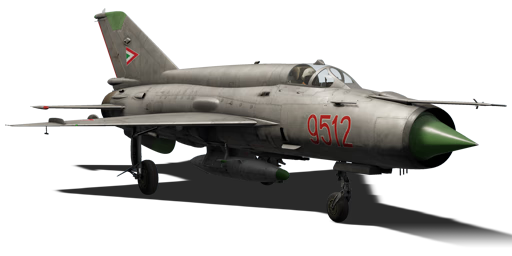
| − | + | Similar to the stories of the "[[F-104G (Germany)|Widowmaker]]" in the West due to its high accident rate, the Eastern Bloc had its own equivalent. The MiG-21 in Hungarian service was one of the most deadly aircraft to its own pilots ever in Hungarian history. Hungary received hundreds of MiG-21s throughout the years, which ended up in 72 total airframe losses and 32 pilot fatalities due to accidents resulting from various problems. Faulty engines in Hungarian MiG-21 batches, improper training, and lack of maintenance on the older models, all resulted in the infamous reputation of the MiG-21 as a widowmaker in the Hungarian Air Force. One of these widowmakers was the MiG-21MF variant, of which Hungary acquired 50 between 1971 and 1974 before being supplemented by the more advanced [[MiG-21bis-SAU (Italy)|MiG-21bis]] just three years later. The MiG-21s saw very long service with Hungary even after the fall of the USSR, with the last MiG-21MFs being retired in 1996. | |
| − | The '''{{Specs|name}}''' (NATO Code: Fishbed- | + | The '''{{Specs|name}}''' (NATO Code: Fishbed-J) was introduced in [[Update "Alpha Strike"]] in the Hungarian sub-tree of the Italian tech tree. Like the other third-generation MiG-21 airframes, this one features a built-in [[GSh-23-2 (23 mm)|GSh-23]] cannon under the fuselage instead of an external Gsh-23L gunpod, meaning it does not have to sacrifice the cannon to take the SPS-141 countermeasures pod. In addition to that improvement, the MiG-21MF has a potent arsenal of weaponry for its battle rating, namely the [[R-60]] air-to-air missile. Combined with its incredible high speed manoeuvrability and overall gameplay loop, the MiG-21MF is a very potent fighter aircraft for its tier. Do be wary, however, that while the MiG-21MF is indeed lighter than its Soviet counterpart, the [[MiG-21SMT]], the SMT has a far better engine, which allows it to win longer dogfights easier assuming both planes start on equal footing. All in all, the MiG-21MF provides acceptable air support and welcomed choice variety to the pilots of the Italian tech tree around this battle rating. |
== General info == | == General info == | ||
| Line 19: | Line 19: | ||
{{Specs-Avia-Flight}} | {{Specs-Avia-Flight}} | ||
<!-- ''Describe how the aircraft behaves in the air. Speed, manoeuvrability, acceleration and allowable loads - these are the most important characteristics of the vehicle.'' --> | <!-- ''Describe how the aircraft behaves in the air. Speed, manoeuvrability, acceleration and allowable loads - these are the most important characteristics of the vehicle.'' --> | ||
| − | + | ''Describe how the aircraft behaves in the air. Speed, manoeuvrability, acceleration and allowable loads - these are the most important characteristics of the vehicle.'' | |
| − | |||
| − | |||
{| class="wikitable" style="text-align:center" width="70%" | {| class="wikitable" style="text-align:center" width="70%" | ||
! rowspan="2" | Characteristics | ! rowspan="2" | Characteristics | ||
| − | ! colspan="2" | Max | + | ! colspan="2" | Max speed<br>(km/h at _,___ m) |
! rowspan="2" | Max altitude<br>(metres) | ! rowspan="2" | Max altitude<br>(metres) | ||
! colspan="2" | Turn time<br>(seconds) | ! colspan="2" | Turn time<br>(seconds) | ||
| Line 34: | Line 32: | ||
|- | |- | ||
! Stock | ! Stock | ||
| − | | | + | | ___ || ___ || rowspan="2" | {{Specs|ceiling}} || __._ || __._ || __._ || __._ || rowspan="2" | ___ |
|- | |- | ||
! Upgraded | ! Upgraded | ||
| − | | | + | | ___ || ___ || __._ || __._ || __._ || __._ |
|- | |- | ||
|} | |} | ||
| Line 48: | Line 46: | ||
! Combat flaps !! Take-off flaps !! Landing flaps !! Air brakes !! Arrestor gear !! Drogue chute | ! Combat flaps !! Take-off flaps !! Landing flaps !! Air brakes !! Arrestor gear !! Drogue chute | ||
|- | |- | ||
| − | | | + | | _ || _ || _ || _ || _ || _ <!-- ✓ --> |
|- | |- | ||
|} | |} | ||
| Line 63: | Line 61: | ||
! Combat !! Take-off !! Landing !! + !! - | ! Combat !! Take-off !! Landing !! + !! - | ||
|- | |- | ||
| − | | {{Specs|destruction|body}} || {{Specs|destruction|gear}} || | + | | {{Specs|destruction|body}} || {{Specs|destruction|gear}} || ___ || ___ || ___ || ~__ || ~__ |
|- | |- | ||
|} | |} | ||
| Line 73: | Line 71: | ||
! Ailerons !! Rudder !! Elevators !! Radiator | ! Ailerons !! Rudder !! Elevators !! Radiator | ||
|- | |- | ||
| − | | < | + | | < ___ || < ___ || < ___ || - |
|- | |- | ||
|} | |} | ||
| Line 81: | Line 79: | ||
|- | |- | ||
! colspan="3" | Engine | ! colspan="3" | Engine | ||
| − | ! colspan=" | + | ! colspan="4" | Aircraft mass |
|- | |- | ||
! colspan="2" | Engine name || Number | ! colspan="2" | Engine name || Number | ||
| − | ! colspan="2" | {{Annotation|Basic mass|Mass of the aircraft with pilot and engine oil, but no fuel or weapons load}} || colspan=" | + | ! colspan="2" | {{Annotation|Basic mass|Mass of the aircraft with pilot and engine oil, but no fuel or weapons load}} || colspan="2" | Wing loading (full fuel) |
|- | |- | ||
| − | | colspan="2" | | + | | colspan="2" | _____ || _ |
| − | | colspan="2" | | + | | colspan="2" | _,___ kg || colspan="2" | ___ kg/m<sup>2</sup> |
|- | |- | ||
! colspan="3" | Engine characteristics | ! colspan="3" | Engine characteristics | ||
| − | ! colspan=" | + | ! colspan="3" | Mass with fuel (no weapons load) || rowspan="2" | {{Annotation|Max Gross<br>Weight|Mass of the fully equipped aircraft with heaviest weapons load}} |
|- | |- | ||
! Weight (each) || colspan="2" | Type | ! Weight (each) || colspan="2" | Type | ||
| − | ! | + | ! _m fuel || __m fuel || __m fuel |
|- | |- | ||
| − | | | + | | ___ kg || colspan="2" | ___ |
| − | | | + | | _,___ kg || _,___ kg || _,___ kg || _,___ kg |
|- | |- | ||
! colspan="3" | {{Annotation|Maximum engine thrust @ 0 m (RB/SB)|The maximum thrust produced by each engine, while mounted in the aircraft. NOTE: Thrust varies significantly depending on speed & altitude.}} | ! colspan="3" | {{Annotation|Maximum engine thrust @ 0 m (RB/SB)|The maximum thrust produced by each engine, while mounted in the aircraft. NOTE: Thrust varies significantly depending on speed & altitude.}} | ||
| − | ! colspan=" | + | ! colspan="4" | Thrust to weight ratio @ 0 m (___%/WEP) |
|- | |- | ||
| − | ! Condition || 100% || WEP | + | ! Condition || 100% || ___%/WEP |
| − | ! | + | ! _m fuel || __m fuel || __m fuel || MGW |
|- | |- | ||
| − | | ''Stationary'' || | + | | ''Stationary'' || ___ kgf || ___ kgf |
| − | | | + | | _.__ || _.__ || _.__ || _.__ |
|- | |- | ||
| − | | ''Optimal'' || | + | | ''Optimal'' || ___ kgf<br>(_ km/h) || ___ kgf<br>(_ km/h) |
| − | | | + | | _.__ || _.__ || _.__ || _.__ |
|- | |- | ||
|} | |} | ||
| Line 115: | Line 113: | ||
{{Specs-Avia-Armour}} | {{Specs-Avia-Armour}} | ||
<!-- ''Examine the survivability of the aircraft. Note how vulnerable the structure is and how secure the pilot is, whether the fuel tanks are armoured, etc. Describe the armour, if there is any, and also mention the vulnerability of other critical aircraft systems.'' --> | <!-- ''Examine the survivability of the aircraft. Note how vulnerable the structure is and how secure the pilot is, whether the fuel tanks are armoured, etc. Describe the armour, if there is any, and also mention the vulnerability of other critical aircraft systems.'' --> | ||
| − | + | ''Examine the survivability of the aircraft. Note how vulnerable the structure is and how secure the pilot is, whether the fuel tanks are armoured, etc. Describe the armour, if there is any, and also mention the vulnerability of other critical aircraft systems.'' | |
| − | |||
| − | |||
| − | |||
=== Modifications and economy === | === Modifications and economy === | ||
| Line 127: | Line 122: | ||
{| class="wikitable" style="text-align:center" | {| class="wikitable" style="text-align:center" | ||
|- | |- | ||
| − | ! colspan=" | + | ! colspan="5" | [[Ballistic Computer]] |
|- | |- | ||
| − | ! CCIP (Guns) !! CCIP (Rockets) !! CCIP (Bombs) !! CCRP (Bombs) | + | ! CCIP (Guns) !! CCIP (Rockets) !! CCIP (Bombs) !! CCRP (Bombs) !! EEGS |
|- | |- | ||
| − | | {{Tick}} || {{Tick}} || {{Cross}} || {{Cross}} | + | | {{Tick}} || {{Tick}} || {{Cross}} || {{Cross}} || {{Cross}} |
|- | |- | ||
|} | |} | ||
| Line 141: | Line 136: | ||
The '''''{{PAGENAME}}''''' is armed with: | The '''''{{PAGENAME}}''''' is armed with: | ||
| − | * 1 x 23 mm GSh-23L cannon, belly-mounted ( | + | * 1 x 23 mm GSh-23L cannon, belly-mounted (200 rpg) |
| − | |||
=== Suspended armament === | === Suspended armament === | ||
| Line 153: | Line 147: | ||
|- | |- | ||
! !! width="9%" | 1 !! width="9%" | 2 !! width="9%" | 3 !! width="9%" | 4 !! width="9%" | 5 | ! !! width="9%" | 1 !! width="9%" | 2 !! width="9%" | 3 !! width="9%" | 4 !! width="9%" | 5 | ||
| − | | rowspan=" | + | | rowspan="9" width="30%" | <div class="ttx-image">[[File:Hardpoints_MiG-21bis.png]]</div> |
| + | |- | ||
| + | ! [[OFAB-250sv (250 kg)|250 kg OFAB-250sv]] bombs | ||
| + | | 1 || 1 || || 1 || 1 | ||
|- | |- | ||
! [[S-5K]] rockets | ! [[S-5K]] rockets | ||
| 16 || 16, 32 || || 16, 32 || 16 | | 16 || 16, 32 || || 16, 32 || 16 | ||
| + | |- | ||
| + | ! [[S-24]] rockets | ||
| + | | 1 || 1 || || 1 || 1 | ||
|- | |- | ||
! [[R-3R]] missiles | ! [[R-3R]] missiles | ||
| Line 164: | Line 164: | ||
| 1 || 1 || || 1 || 1 | | 1 || 1 || || 1 || 1 | ||
|- | |- | ||
| − | ! [[R- | + | ! [[R-60]] missiles |
| 1 || 1 || || 1 || 1 | | 1 || 1 || || 1 || 1 | ||
|- | |- | ||
| − | ! | + | ! Countermeasures |
| − | | | + | | || || 64 || || |
|- | |- | ||
| − | ! | + | ! 490 l drop tanks |
| − | | || || 1 || || | + | | 1 || || 1 || || 1 |
|- | |- | ||
|} | |} | ||
| Line 177: | Line 177: | ||
{{Navigation-Start|Default weapon presets}} | {{Navigation-Start|Default weapon presets}} | ||
{{Navigation-First-Simple-Line}} | {{Navigation-First-Simple-Line}} | ||
| − | * | + | |
| − | * | + | * 3 x 490 l drop tanks |
| − | * | + | * 2 x 490 l drop tanks + 64 x countermeasures + 2 x R-3S missiles |
| + | * 2 x 490 l drop tanks + 64 x countermeasures + 2 x R-3R missiles | ||
| + | * 4 x R-3S missiles | ||
* 4 x R-3R missiles | * 4 x R-3R missiles | ||
| − | * 4 x R- | + | * 4 x R-60 missiles |
| − | * 4 x | + | * 4 x S-24 rockets |
| − | * | + | * 64 x S-5K rockets |
| − | * 64 x S-5K rockets | + | * 64 x S-5K rockets |
| − | * 64 x | + | * 4 x 250 kg OFAB-250sv bombs (1,000 kg total) |
| + | * 64 x countermeasures | ||
{{Navigation-End}} | {{Navigation-End}} | ||
== Usage in battles == | == Usage in battles == | ||
<!-- ''Describe the tactics of playing in the aircraft, the features of using aircraft in a team and advice on tactics. Refrain from creating a "guide" - do not impose a single point of view, but instead, give the reader food for thought. Examine the most dangerous enemies and give recommendations on fighting them. If necessary, note the specifics of the game in different modes (AB, RB, SB).'' --> | <!-- ''Describe the tactics of playing in the aircraft, the features of using aircraft in a team and advice on tactics. Refrain from creating a "guide" - do not impose a single point of view, but instead, give the reader food for thought. Examine the most dangerous enemies and give recommendations on fighting them. If necessary, note the specifics of the game in different modes (AB, RB, SB).'' --> | ||
| − | + | ''Describe the tactics of playing in the aircraft, the features of using aircraft in a team and advice on tactics. Refrain from creating a "guide" - do not impose a single point of view, but instead, give the reader food for thought. Examine the most dangerous enemies and give recommendations on fighting them. If necessary, note the specifics of the game in different modes (AB, RB, SB).'' | |
| − | |||
| − | |||
| − | |||
| − | |||
| − | |||
| − | |||
| − | |||
| − | |||
| − | |||
| − | |||
| − | |||
| − | |||
| − | |||
| − | |||
| − | |||
=== Pros and cons === | === Pros and cons === | ||
| Line 212: | Line 200: | ||
'''Pros:''' | '''Pros:''' | ||
| − | * | + | * Great acceleration and top speed |
| − | * | + | * Extremely manoeuvrable |
| − | * | + | * 4 x R-60 missiles are extremely effective at this BR, 30G max overload and adequate IR tracking |
| − | |||
| − | |||
'''Cons:''' | '''Cons:''' | ||
| − | * | + | * Low ammo count for the 23 mm cannon |
| − | * | + | * R-60 missiles are prone to chasing flares |
| − | |||
| − | |||
== History == | == History == | ||
<!-- ''Describe the history of the creation and combat usage of the aircraft in more detail than in the introduction. If the historical reference turns out to be too long, take it to a separate article, taking a link to the article about the vehicle and adding a block "/History" (example: <nowiki>https://wiki.warthunder.com/(Vehicle-name)/History</nowiki>) and add a link to it here using the <code>main</code> template. Be sure to reference text and sources by using <code><nowiki><ref></ref></nowiki></code>, as well as adding them at the end of the article with <code><nowiki><references /></nowiki></code>. This section may also include the vehicle's dev blog entry (if applicable) and the in-game encyclopedia description (under <code><nowiki>=== In-game description ===</nowiki></code>, also if applicable).'' --> | <!-- ''Describe the history of the creation and combat usage of the aircraft in more detail than in the introduction. If the historical reference turns out to be too long, take it to a separate article, taking a link to the article about the vehicle and adding a block "/History" (example: <nowiki>https://wiki.warthunder.com/(Vehicle-name)/History</nowiki>) and add a link to it here using the <code>main</code> template. Be sure to reference text and sources by using <code><nowiki><ref></ref></nowiki></code>, as well as adding them at the end of the article with <code><nowiki><references /></nowiki></code>. This section may also include the vehicle's dev blog entry (if applicable) and the in-game encyclopedia description (under <code><nowiki>=== In-game description ===</nowiki></code>, also if applicable).'' --> | ||
| − | + | ''Describe the history of the creation and combat usage of the aircraft in more detail than in the introduction. If the historical reference turns out to be too long, take it to a separate article, taking a link to the article about the vehicle and adding a block "/History" (example: <nowiki>https://wiki.warthunder.com/(Vehicle-name)/History</nowiki>) and add a link to it here using the <code>main</code> template. Be sure to reference text and sources by using <code><nowiki><ref></ref></nowiki></code>, as well as adding them at the end of the article with <code><nowiki><references /></nowiki></code>. This section may also include the vehicle's dev blog entry (if applicable) and the in-game encyclopedia description (under <code><nowiki>=== In-game description ===</nowiki></code>, also if applicable).'' | |
| − | |||
| − | |||
| − | |||
| − | |||
| − | |||
| − | |||
== Media == | == Media == | ||
| Line 240: | Line 218: | ||
;Skins | ;Skins | ||
| − | * [https://live.warthunder.com/feed/camouflages/?vehicle= | + | * [https://live.warthunder.com/feed/camouflages/?vehicle=mig-21_mf_hungary Skins and camouflages for the {{PAGENAME}} from live.warthunder.com.] |
== See also == | == See also == | ||
| Line 246: | Line 224: | ||
* ''reference to the series of the aircraft;'' | * ''reference to the series of the aircraft;'' | ||
* ''links to approximate analogues of other nations and research trees.'' --> | * ''links to approximate analogues of other nations and research trees.'' --> | ||
| − | |||
| − | + | ;Related development | |
| − | * | + | |
| + | * [[MiG-21 (Family)]] | ||
== External links == | == External links == | ||
| Line 255: | Line 233: | ||
* ''topic on the official game forum;'' | * ''topic on the official game forum;'' | ||
* ''other literature.'' --> | * ''other literature.'' --> | ||
| − | |||
| − | * | + | * [[wt:en/news/8767-development-the-hungarian-aircraft-line-is-coming-to-the-italian-tree-en|[Devblog] The Hungarian Aircraft Line is Coming to the Italian Tree!]] |
| − | |||
{{AirManufacturer MiG}} | {{AirManufacturer MiG}} | ||
| − | {{ | + | {{Italy jet aircraft}} |
Revision as of 00:36, 15 October 2024
| This page is about the jet fighter MiG-21MF (Italy). For other versions, see MiG-21 (Family). |
.jpg)
Contents
Description
Similar to the stories of the "Widowmaker" in the West due to its high accident rate, the Eastern Bloc had its own equivalent. The MiG-21 in Hungarian service was one of the most deadly aircraft to its own pilots ever in Hungarian history. Hungary received hundreds of MiG-21s throughout the years, which ended up in 72 total airframe losses and 32 pilot fatalities due to accidents resulting from various problems. Faulty engines in Hungarian MiG-21 batches, improper training, and lack of maintenance on the older models, all resulted in the infamous reputation of the MiG-21 as a widowmaker in the Hungarian Air Force. One of these widowmakers was the MiG-21MF variant, of which Hungary acquired 50 between 1971 and 1974 before being supplemented by the more advanced MiG-21bis just three years later. The MiG-21s saw very long service with Hungary even after the fall of the USSR, with the last MiG-21MFs being retired in 1996.
The ◔MiG-21MF (NATO Code: Fishbed-J) was introduced in Update "Alpha Strike" in the Hungarian sub-tree of the Italian tech tree. Like the other third-generation MiG-21 airframes, this one features a built-in GSh-23 cannon under the fuselage instead of an external Gsh-23L gunpod, meaning it does not have to sacrifice the cannon to take the SPS-141 countermeasures pod. In addition to that improvement, the MiG-21MF has a potent arsenal of weaponry for its battle rating, namely the R-60 air-to-air missile. Combined with its incredible high speed manoeuvrability and overall gameplay loop, the MiG-21MF is a very potent fighter aircraft for its tier. Do be wary, however, that while the MiG-21MF is indeed lighter than its Soviet counterpart, the MiG-21SMT, the SMT has a far better engine, which allows it to win longer dogfights easier assuming both planes start on equal footing. All in all, the MiG-21MF provides acceptable air support and welcomed choice variety to the pilots of the Italian tech tree around this battle rating.
General info
Flight performance
Describe how the aircraft behaves in the air. Speed, manoeuvrability, acceleration and allowable loads - these are the most important characteristics of the vehicle.
| Characteristics | Max speed (km/h at _,___ m) |
Max altitude (metres) |
Turn time (seconds) |
Rate of climb (metres/second) |
Take-off run (metres) | |||
|---|---|---|---|---|---|---|---|---|
| AB | RB | AB | RB | AB | RB | |||
| Stock | ___ | ___ | __._ | __._ | __._ | __._ | ___ | |
| Upgraded | ___ | ___ | __._ | __._ | __._ | __._ | ||
Details
| Features | |||||
|---|---|---|---|---|---|
| Combat flaps | Take-off flaps | Landing flaps | Air brakes | Arrestor gear | Drogue chute |
| _ | _ | _ | _ | _ | _ |
| Limits | ||||||
|---|---|---|---|---|---|---|
| Wings (km/h) | Gear (km/h) | Flaps (km/h) | Max Static G | |||
| Combat | Take-off | Landing | + | - | ||
| ___ | ___ | ___ | ~__ | ~__ | ||
| Optimal velocities (km/h) | |||
|---|---|---|---|
| Ailerons | Rudder | Elevators | Radiator |
| < ___ | < ___ | < ___ | - |
Engine performance
| Engine | Aircraft mass | |||||
|---|---|---|---|---|---|---|
| Engine name | Number | Basic mass | Wing loading (full fuel) | |||
| _____ | _ | _,___ kg | ___ kg/m2 | |||
| Engine characteristics | Mass with fuel (no weapons load) | Max Gross Weight | ||||
| Weight (each) | Type | _m fuel | __m fuel | __m fuel | ||
| ___ kg | ___ | _,___ kg | _,___ kg | _,___ kg | _,___ kg | |
| Maximum engine thrust @ 0 m (RB/SB) | Thrust to weight ratio @ 0 m (___%/WEP) | |||||
| Condition | 100% | ___%/WEP | _m fuel | __m fuel | __m fuel | MGW |
| Stationary | ___ kgf | ___ kgf | _.__ | _.__ | _.__ | _.__ |
| Optimal | ___ kgf (_ km/h) |
___ kgf (_ km/h) |
_.__ | _.__ | _.__ | _.__ |
Survivability and armour
Examine the survivability of the aircraft. Note how vulnerable the structure is and how secure the pilot is, whether the fuel tanks are armoured, etc. Describe the armour, if there is any, and also mention the vulnerability of other critical aircraft systems.
Modifications and economy
Armaments
| Ballistic Computer | ||||
|---|---|---|---|---|
| CCIP (Guns) | CCIP (Rockets) | CCIP (Bombs) | CCRP (Bombs) | EEGS |
 |
|
 |
|
|
Offensive armament
The MiG-21MF (Italy) is armed with:
- 1 x 23 mm GSh-23L cannon, belly-mounted (200 rpg)
Suspended armament
The MiG-21MF (Italy) can be outfitted with the following ordnance:
| 1 | 2 | 3 | 4 | 5 |  | |
|---|---|---|---|---|---|---|
| 250 kg OFAB-250sv bombs | 1 | 1 | 1 | 1 | ||
| S-5K rockets | 16 | 16, 32 | 16, 32 | 16 | ||
| S-24 rockets | 1 | 1 | 1 | 1 | ||
| R-3R missiles | 1 | 1 | 1 | 1 | ||
| R-3S missiles | 1 | 1 | 1 | 1 | ||
| R-60 missiles | 1 | 1 | 1 | 1 | ||
| Countermeasures | 64 | |||||
| 490 l drop tanks | 1 | 1 | 1 |
| Default weapon presets | |
|---|---|
| |
Usage in battles
Describe the tactics of playing in the aircraft, the features of using aircraft in a team and advice on tactics. Refrain from creating a "guide" - do not impose a single point of view, but instead, give the reader food for thought. Examine the most dangerous enemies and give recommendations on fighting them. If necessary, note the specifics of the game in different modes (AB, RB, SB).
Pros and cons
Pros:
- Great acceleration and top speed
- Extremely manoeuvrable
- 4 x R-60 missiles are extremely effective at this BR, 30G max overload and adequate IR tracking
Cons:
- Low ammo count for the 23 mm cannon
- R-60 missiles are prone to chasing flares
History
Describe the history of the creation and combat usage of the aircraft in more detail than in the introduction. If the historical reference turns out to be too long, take it to a separate article, taking a link to the article about the vehicle and adding a block "/History" (example: https://wiki.warthunder.com/(Vehicle-name)/History) and add a link to it here using the main template. Be sure to reference text and sources by using <ref></ref>, as well as adding them at the end of the article with <references />. This section may also include the vehicle's dev blog entry (if applicable) and the in-game encyclopedia description (under === In-game description ===, also if applicable).
Media
- Skins
See also
- Related development
External links
| Mikoyan-Gurevich Design Bureau (Микоя́н и Гуре́вич Опытное конструкторское бюро) | |
|---|---|
| Fighters | MiG-3-15 · MiG-3-15 (BK) · MiG-3-34 |
| I-225 | |
| Jet fighters | MiG-9 · MiG-9 (l) |
| MiG-15 · MiG-15bis · MiG-15bis ISh | |
| MiG-17 | |
| MiG-19PT | |
| MiG-21F-13 · MiG-21PFM · MiG-21S (R-13-300) · MiG-21SMT · MiG-21bis | |
| MiG-23M · MiG-23ML · MiG-23MLD | |
| MiG-27M · MiG-27K | |
| MiG-29 · MiG-29SMT | |
| Export/Licensed | ␗MiG-9 · ␗MiG-9 (l) |
| ◊MiG-15bis · ◔MiG-15bis · J-2* | |
| MiG-17AS · ◔MiG-17PF · J-4* · Shenyang F-5* | |
| ◊MiG-19S · J-6A* | |
| ◄MiG-21 SPS-K · ◊MiG-21MF · ◔MiG-21MF · ▄MiG-21bis · ◔MiG-21bis-SAU · ◊MiG-21bis-SAU · ◊MiG-21 "Lazur-M" · ▄MiG-21 Bison · J-7II** | |
| ◊MiG-23BN · ◊MiG-23MF · ◔MiG-23MF · ◊MiG-23MLA | |
| ◔MiG-29 · ◊MiG-29 · ◄MiG-29G | |
| *Licensed and domesticated with Chinese designations. | |
| **Unlicensed, reverse-engineered and domesticated with Chinese designations. | |
| See Also | Shenyang · Chengdu |
| Italy jet aircraft | |
|---|---|
| Aerfer | Sagittario 2 · Ariete |
| Fiat | G.91 pre-serie · G.91 R/1 · G.91 R/4 (Portugal) · G.91 Y · G.91 YS |
| AMX International | AMX · AMX A-1A (Brazil) |
| Panavia | Tornado ADV · ▄Tornado IDS · ▄Tornado IDS (1995) |
| Foreign: | |
| Vampire | Vampire FB 52A |
| F-84 | ▄F-84F · ▄F-84G-21-RE |
| F-86 | CL-13 Mk.4 · ▄F-86K |
| F-104 | ▄F-104G · F-104S · ▄F-104S TAF (Turkey) · F-104S.ASA |
| F-16 | ▄F-16A ADF |
| AV-8 | ▄AV-8B Plus |
| Hungary | |
| Mikoyan-Gurevich | ◔MiG-15bis · ◔MiG-17PF · ◔MiG-21MF · ◔MiG-21bis-SAU · ◔MiG-23MF · ◔MiG-29 |
| Ilyushin | ◔IL-28 |
| Sukhoi | ◔Su-22M3 |
| Saab | ◔JAS39EBS HU C |