Difference between pages "A-4E Early" and "Spitfire F Mk XVI"
U138686716 (talk | contribs) m (→Pros and cons) (Tag: Visual edit) |
U178117757 (talk | contribs) m (→Flight performance: RB stock speed) (Tag: Visual edit) |
||
| Line 1: | Line 1: | ||
{{About | {{About | ||
| − | | about = | + | | about = British fighter '''{{PAGENAME}}''' |
| usage = other versions | | usage = other versions | ||
| − | | link = | + | | link = Spitfire (Family) |
}} | }} | ||
{{Specs-Card | {{Specs-Card | ||
| − | |code= | + | |code=spitfire_xvi |
| − | |images={{Specs-Card-Image|GarageImage_{{PAGENAME}}.jpg|ArtImage_{{PAGENAME}}. | + | |images={{Specs-Card-Image|GarageImage_{{PAGENAME}}.jpg|ArtImage_{{PAGENAME}}.png}} |
}} | }} | ||
== Description == | == Description == | ||
<!-- ''In the description, the first part should be about the history of and the creation and combat usage of the aircraft, as well as its key features. In the second part, tell the reader about the aircraft in the game. Insert a screenshot of the vehicle, so that if the novice player does not remember the vehicle by name, he will immediately understand what kind of vehicle the article is talking about.'' --> | <!-- ''In the description, the first part should be about the history of and the creation and combat usage of the aircraft, as well as its key features. In the second part, tell the reader about the aircraft in the game. Insert a screenshot of the vehicle, so that if the novice player does not remember the vehicle by name, he will immediately understand what kind of vehicle the article is talking about.'' --> | ||
| + | The final Merlin-powered variant of the Spitfire, the Spitfire F Mk XVI was a [[Spitfire LF Mk IX]] equipped with the Packard Merlin 266 engine, a Rolls-Royce Merlin 66 licence-built by the American Packard Motor Company. Notably, the model represented in-game features the new "E-type" wings, which allowed either an all-cannon arrangement like the C-type or installation of M2 Browning heavy machine guns. These could also be "clipped", removing the wingtips to improve low-altitude characteristics at the cost of high-altitude manoeuvrability. | ||
| − | + | In the game since the start of the Open Beta Test, the Spitfire F Mk XVI is a very unique plane with an awkwardly unique role and design. Virtually identical to the [[Spitfire LF Mk IX]], aside from the clipped wings and bubble cockpit, the Mk XVI combines the low-altitude capabilities of the aforementioned fighter with the fantastic roll, dive, and speed capabilities of the German [[Fw 190 (Family)|Focke-Wulfe 190 series]]. The clipped wings give the Mk XVI a great roll rate and amazing dive and level speed and acceleration. However, compared to similar Merlin Spitfires, the turn rate is far worse, higher-altitude performance is abysmal, and climb performance is worse, though marginally. In terms of armament, the two M2 Brownings also provide a significant increase in firepower compared to the previous quad .303 Browning setup. | |
| − | |||
| − | |||
| − | |||
== General info == | == General info == | ||
| Line 21: | Line 19: | ||
{{Specs-Avia-Flight}} | {{Specs-Avia-Flight}} | ||
<!-- ''Describe how the aircraft behaves in the air. Speed, manoeuvrability, acceleration and allowable loads - these are the most important characteristics of the vehicle.'' --> | <!-- ''Describe how the aircraft behaves in the air. Speed, manoeuvrability, acceleration and allowable loads - these are the most important characteristics of the vehicle.'' --> | ||
| − | |||
{| class="wikitable" style="text-align:center" width="70%" | {| class="wikitable" style="text-align:center" width="70%" | ||
! rowspan="2" | Characteristics | ! rowspan="2" | Characteristics | ||
| − | ! colspan="2" | Max Speed<br>(km/h at | + | ! colspan="2" | Max Speed<br>(km/h at 6,098 m) |
! rowspan="2" | Max altitude<br>(metres) | ! rowspan="2" | Max altitude<br>(metres) | ||
! colspan="2" | Turn time<br>(seconds) | ! colspan="2" | Turn time<br>(seconds) | ||
| Line 34: | Line 31: | ||
|- | |- | ||
! Stock | ! Stock | ||
| − | | | + | | 624 || 604 || rowspan="2" | {{Specs|ceiling}} || 21.0 || 21.8 || 17.5 || 17.5 || rowspan="2" | 390 |
|- | |- | ||
! Upgraded | ! Upgraded | ||
| − | | | + | | 683 || 651 || 18.7 || 19.8 || 29.2 || 22.3 |
|- | |- | ||
|} | |} | ||
| Line 44: | Line 41: | ||
{| class="wikitable" style="text-align:center" width="50%" | {| class="wikitable" style="text-align:center" width="50%" | ||
|- | |- | ||
| − | ! colspan=" | + | ! colspan="5" | Features |
|- | |- | ||
| − | ! Combat flaps !! Take-off flaps !! Landing flaps !! Air brakes !! Arrestor gear | + | ! Combat flaps !! Take-off flaps !! Landing flaps !! Air brakes !! Arrestor gear |
|- | |- | ||
| − | | | + | | X || X || ✓ || X || X <!-- ✓ --> |
|- | |- | ||
|} | |} | ||
| Line 63: | Line 60: | ||
! Combat !! Take-off !! Landing !! + !! - | ! Combat !! Take-off !! Landing !! + !! - | ||
|- | |- | ||
| − | | {{Specs|destruction|body}} || {{Specs|destruction|gear}} || | + | | {{Specs|destruction|body}} || {{Specs|destruction|gear}} || N/A || N/A || 260 || ~9 || ~5 |
|- | |- | ||
|} | |} | ||
| − | |||
{| class="wikitable" style="text-align:center" | {| class="wikitable" style="text-align:center" | ||
| Line 74: | Line 70: | ||
! Ailerons !! Rudder !! Elevators !! Radiator | ! Ailerons !! Rudder !! Elevators !! Radiator | ||
|- | |- | ||
| − | | < | + | | < 321 || < 400 || < 350 || > 500 |
|- | |- | ||
|} | |} | ||
| − | |||
{| class="wikitable" style="text-align:center" | {| class="wikitable" style="text-align:center" | ||
|- | |- | ||
| − | ! colspan="3" | | + | ! colspan="3" | Compressor (RB/SB) |
| − | |||
| − | |||
| − | |||
| − | |||
|- | |- | ||
| − | + | ! colspan="3" | Setting 1 | |
| − | |||
|- | |- | ||
| − | ! | + | ! Optimal altitude |
| − | ! | + | ! 100% Engine power |
| + | ! WEP Engine power | ||
|- | |- | ||
| − | + | | 3,400 m || 1,380 hp || 1,766 hp | |
| − | |||
|- | |- | ||
| − | + | ! colspan="3" | Setting 2 | |
| − | |||
|- | |- | ||
| − | ! | + | ! Optimal altitude |
| − | ! | + | ! 100% Engine power |
| + | ! WEP Engine power | ||
|- | |- | ||
| − | + | | 7,200 m || 1,190 hp || 1,523 hp | |
| − | |||
| − | |||
| − | |||
| − | |||
| − | | | ||
| − | | | ||
| − | |||
|- | |- | ||
|} | |} | ||
| Line 117: | Line 100: | ||
<!-- ''Examine the survivability of the aircraft. Note how vulnerable the structure is and how secure the pilot is, whether the fuel tanks are armoured, etc. Describe the armour, if there is any, and also mention the vulnerability of other critical aircraft systems.'' --> | <!-- ''Examine the survivability of the aircraft. Note how vulnerable the structure is and how secure the pilot is, whether the fuel tanks are armoured, etc. Describe the armour, if there is any, and also mention the vulnerability of other critical aircraft systems.'' --> | ||
| − | * | + | * 38 mm Bulletproof glass - Armoured windscreen |
| − | * | + | * 4 mm Steel plate in pilot's seat |
| − | + | * 3-7 mm Steel plate behind the pilot | |
| − | + | * 6 mm Steel plate in front of liquid cooling system | |
| − | + | * 1 mm Steel plate in front of fuel tanks | |
| − | + | * 3 mm Steel boxes around wing ammunition | |
=== Modifications and economy === | === Modifications and economy === | ||
| Line 129: | Line 112: | ||
== Armaments == | == Armaments == | ||
{{Specs-Avia-Armaments}} | {{Specs-Avia-Armaments}} | ||
| − | |||
| − | |||
| − | |||
| − | |||
| − | |||
| − | |||
| − | |||
| − | |||
| − | |||
=== Offensive armament === | === Offensive armament === | ||
{{Specs-Avia-Offensive}} | {{Specs-Avia-Offensive}} | ||
<!-- ''Describe the offensive armament of the aircraft, if any. Describe how effective the cannons and machine guns are in a battle, and also what belts or drums are better to use. If there is no offensive weaponry, delete this subsection.'' --> | <!-- ''Describe the offensive armament of the aircraft, if any. Describe how effective the cannons and machine guns are in a battle, and also what belts or drums are better to use. If there is no offensive weaponry, delete this subsection.'' --> | ||
| − | {{main|Browning | + | {{main|Hispano Mk.II (20 mm)|M2 Browning (12.7 mm)}} |
The '''''{{PAGENAME}}''''' is armed with: | The '''''{{PAGENAME}}''''' is armed with: | ||
| − | + | * 2 x 20 mm Hispano Mk.II cannons, wing-mounted (135 rpg = 270 total) | |
| − | + | * 2 x 12.7 mm M2 Browning machine guns, wing-mounted (260 rpg = 520 total) | |
| − | |||
=== Suspended armament === | === Suspended armament === | ||
{{Specs-Avia-Suspended}} | {{Specs-Avia-Suspended}} | ||
<!-- ''Describe the aircraft's suspended armament: additional cannons under the wings, bombs, rockets and torpedoes. This section is especially important for bombers and attackers. If there is no suspended weaponry remove this subsection.'' --> | <!-- ''Describe the aircraft's suspended armament: additional cannons under the wings, bombs, rockets and torpedoes. This section is especially important for bombers and attackers. If there is no suspended weaponry remove this subsection.'' --> | ||
| − | {{main| | + | {{main|G.P. Mk.IV (250 lb)}} |
| − | |||
| − | |||
| − | |||
| − | The '''''{{PAGENAME}}''''' can be outfitted with the following ordnance | + | The '''''{{PAGENAME}}''''' can be outfitted with the following ordnance: |
* Without load | * Without load | ||
| − | * 2 | + | * 2 x 250 lb G.P. Mk.IV bombs (500 lb total) |
| − | |||
| − | |||
| − | |||
| − | |||
| − | |||
| − | |||
| − | |||
| − | |||
| − | |||
| − | |||
| − | |||
| − | |||
| − | |||
| − | |||
| − | |||
| − | |||
| − | |||
| − | |||
| − | |||
| − | |||
| − | |||
| − | |||
| − | |||
| − | |||
| − | |||
| − | |||
| − | |||
| − | |||
| − | |||
| − | |||
| − | |||
| − | |||
| − | |||
| − | |||
| − | |||
| − | |||
| − | |||
| − | |||
| − | |||
| − | |||
| − | |||
| − | |||
| − | |||
| − | |||
| − | |||
| − | |||
| − | |||
| − | |||
| − | |||
| − | |||
| − | |||
| − | |||
| − | |||
| − | |||
| − | |||
| − | |||
| − | |||
| − | |||
| − | |||
| − | |||
| − | |||
| − | |||
| − | |||
| − | |||
| − | |||
| − | |||
| − | |||
== Usage in battles == | == Usage in battles == | ||
<!-- ''Describe the tactics of playing in the aircraft, the features of using aircraft in a team and advice on tactics. Refrain from creating a "guide" - do not impose a single point of view, but instead, give the reader food for thought. Examine the most dangerous enemies and give recommendations on fighting them. If necessary, note the specifics of the game in different modes (AB, RB, SB).'' --> | <!-- ''Describe the tactics of playing in the aircraft, the features of using aircraft in a team and advice on tactics. Refrain from creating a "guide" - do not impose a single point of view, but instead, give the reader food for thought. Examine the most dangerous enemies and give recommendations on fighting them. If necessary, note the specifics of the game in different modes (AB, RB, SB).'' --> | ||
| − | + | [[File:Spitfire F Mk XVI tailing.jpg|thumb|400px|A concerned [[Fw 190 (Family)|Fw 190]] pilot watching the {{PAGENAME}} tailing him.]] | |
| − | + | The Spitfire F Mk XVI is quite unique with its clipped wings. These give this version of the Spitfire a distinct advantage in roll rate, dive performance, and level top speed. However, they reduce the plane's ability to turn, and unlike other Merlin Spitfires this one is only average in its turning ability. Thankfully, it retains a good climb rate, even if it is not as high as that of the unclipped Spitfire variants. In addition, the clipped wings reduce lift at high altitudes, so performance is best when closer to sea level. | |
| − | + | Thanks to a great roll rate, this Spitfire is very capable in defensive manoeuvres, and although turn rate is decreased, the boost in roll speed make this a great dogfighter as well. | |
| − | + | This vehicle maximizes its performance at low altitudes. Below 1500 m, it has an incredible climb rate, very good top speed and acceleration, great dive performance, and generally outmatches its opponents. Still, there are some American and German planes that can outspeed and outdive this plane (especially since it locks up and may rip at high speeds), and the unclipped Merlin Spitfires outclimb this one. | |
| − | + | This plane is equipped with 2 x 20 mm cannons and 2 x 12.7 mm machine guns. These are effective against fighters but may struggle against large planes such as heavy bombers. They can't destroy well-armoured ground targets, but can destroy lightly armoured ground targets and open-topped vehicles. Since all of these guns are wing-mounted, convergence should be kept in mind. A good convergence setting is usually between 300 and 500 m. Since cannon ammunition is somewhat limited, firing the 12.7 mm machine guns alone can be a good way to visualize the lead required to shoot enemies at longer ranges. | |
| − | + | The Spitfire can also mount 2 x 250 lb bombs for destroying ground targets. These are quite small and must be aimed precisely to destroy the target. While this plane can be used in Ground Realistic battles, the fact that it can only carry 2 small bombs reduces its anti-ground capabilities. Instead, this plane can work as an air-superiority fighter in mixed battles. | |
| − | + | The Spitfire F Mk XVI can rightly be considered a jack of all trades. It has some limited ground-attack capacity, decent guns, and flight characteristics that don't stand out in any one aspect. With a great roll rate; good dive and climb performance; and good energy retention, speed, and acceleration; this vehicle is a great low-altitude fighter as long as its weaknesses are understood. | |
| + | |||
| + | === Manual Engine Control === | ||
| + | {| class="wikitable" style="text-align:center" | ||
| + | |- | ||
| + | ! colspan="7" | MEC elements | ||
| + | |- | ||
| + | ! rowspan="2" | Mixer | ||
| + | ! rowspan="2" | Pitch | ||
| + | ! colspan="3" | Radiator | ||
| + | ! rowspan="2" | Supercharger | ||
| + | ! rowspan="2" | Turbocharger | ||
| + | |- | ||
| + | ! Oil !! Water !! Type | ||
| + | |- | ||
| + | | Controllable || Controllable<br>Auto control available || Not controllable<br>Not auto controlled || Controllable<br>Auto control available || Combined || Controllable<br>2 gears || Not controllable | ||
| + | |- | ||
| + | |} | ||
=== Pros and cons === | === Pros and cons === | ||
| Line 250: | Line 170: | ||
'''Pros:''' | '''Pros:''' | ||
| − | * | + | * Good climb rate, albeit lower than non-clipped wing variants |
| − | * | + | * Great roll rate |
| − | * | + | * Great dive acceleration |
| − | * | + | * Better dive speed than other Merlin Spitfires |
| − | ** | + | * Better turning ability that most of its German and American counterparts |
| − | * | + | * New M2 HMGs are far more effective than the Browning .303s |
| − | ** | + | * Good 20 mm cannons |
| − | + | * Ability to mount bombs for a ground attack option | |
| − | + | * Slightly better simulator visibility due to its bubble cockpit | |
| − | + | * Stock parts are not as bad as some other rank IV or V planes, such as the P-51D-5, Ki-84 and Late Bf 109s | |
| − | |||
'''Cons:''' | '''Cons:''' | ||
| − | * | + | * Worse turning ability than all other Merlin Spitfires |
| − | * | + | * Worse dive speed than its German and American counterparts |
| − | + | * Poor performance at high altitude | |
| − | * | + | * Relatively low rip speed (650 km/h) |
| − | * | + | * Low wing lift efficiency when at high altitudes or speeds under 320 km/h (200 mph) |
| − | + | * Goes through fuel very quickly on WEP for a prop plane, you might have to return for fuel with sustained WEP usage. | |
| − | * | ||
| − | * | ||
== History == | == History == | ||
<!-- ''Describe the history of the creation and combat usage of the aircraft in more detail than in the introduction. If the historical reference turns out to be too long, take it to a separate article, taking a link to the article about the vehicle and adding a block "/History" (example: <nowiki>https://wiki.warthunder.com/(Vehicle-name)/History</nowiki>) and add a link to it here using the <code>main</code> template. Be sure to reference text and sources by using <code><nowiki><ref></ref></nowiki></code>, as well as adding them at the end of the article with <code><nowiki><references /></nowiki></code>. This section may also include the vehicle's dev blog entry (if applicable) and the in-game encyclopedia description (under <code><nowiki>=== In-game description ===</nowiki></code>, also if applicable).'' --> | <!-- ''Describe the history of the creation and combat usage of the aircraft in more detail than in the introduction. If the historical reference turns out to be too long, take it to a separate article, taking a link to the article about the vehicle and adding a block "/History" (example: <nowiki>https://wiki.warthunder.com/(Vehicle-name)/History</nowiki>) and add a link to it here using the <code>main</code> template. Be sure to reference text and sources by using <code><nowiki><ref></ref></nowiki></code>, as well as adding them at the end of the article with <code><nowiki><references /></nowiki></code>. This section may also include the vehicle's dev blog entry (if applicable) and the in-game encyclopedia description (under <code><nowiki>=== In-game description ===</nowiki></code>, also if applicable).'' --> | ||
| − | |||
| − | |||
| − | |||
| − | |||
| − | |||
| − | |||
| − | |||
| − | + | {{break}} | |
| + | {{Navigation-Start|{{Annotation|Archive of the in-game description|An archive of the historical description of the vehicle that was presented in-game prior to Update 1.55 'Royal Armour'}}|expand=true}} | ||
| + | {{Navigation-First-Simple-Line}} | ||
| + | The Supermarine Spitfire was a British single-engine, all-metal, low-wing monoplane fighter. Various modifications served as fighters, interceptors, high-altitude fighters, fighter-bombers and reconnaissance aircraft. | ||
| − | + | The Mk XVI variant was very similar to the Mk IX; however, it was powered by a US-manufactured Packard Merlin 266 engine. A total of 1,054 Spitfires of this variant were produced. All production variants had the distinguishing feature of low-altitude clipped wings and a cut down rear fuselage and bubble canopy for increased visibility. The clipped wings increased the roll rate and top speed due to a reduction in drag, but sacrificed some of the fighter's climb rate. This, coupled with an engine optimised for efficiency in denser air made the Mk XVI ideally suited to combat at lower altitudes. | |
| − | + | {{Navigation-End}} | |
| − | |||
| − | |||
| − | |||
| − | |||
| − | |||
| − | |||
| − | |||
| − | |||
== Media == | == Media == | ||
| Line 301: | Line 206: | ||
;Skins | ;Skins | ||
| − | * [https://live.warthunder.com/feed/camouflages/?vehicle= | + | * [https://live.warthunder.com/feed/camouflages/?vehicle=spitfire_xvi Skins and camouflages for the {{PAGENAME}} from live.warthunder.com.] |
| − | |||
| − | |||
| − | |||
| − | |||
| − | |||
| − | |||
| − | |||
| − | |||
| − | |||
| − | |||
;Videos | ;Videos | ||
| − | {{Youtube-gallery| | + | {{Youtube-gallery|MNacjyimuCQ|'''The Shooting Range #95''' - ''Metal Beasts'' section at 00:57 discusses the Spitfire F Mk XVI.}} |
== See also == | == See also == | ||
| − | + | ''Links to the articles on the War Thunder Wiki that you think will be useful for the reader, for example:'' | |
| + | |||
* ''reference to the series of the aircraft;'' | * ''reference to the series of the aircraft;'' | ||
| − | * ''links to approximate analogues of other nations and research trees.'' | + | * ''links to approximate analogues of other nations and research trees.'' |
| − | |||
| − | |||
| − | |||
| − | |||
| − | |||
| − | |||
| − | |||
== External links == | == External links == | ||
| − | <!-- ''Paste links to sources and external resources, such as:'' | + | <!--''Paste links to sources and external resources, such as:'' |
* ''topic on the official game forum;'' | * ''topic on the official game forum;'' | ||
| − | * ''other literature.'' --> | + | * ''other literature.''--> |
| − | |||
| − | |||
| − | |||
| − | |||
| − | |||
| − | |||
| − | |||
| − | |||
| − | * | + | * [https://forum.warthunder.com/index.php?/topic/341986-supermarine-spitfire-lfmkxvie/ Official data sheet - more details about the performance] |
| − | |||
| − | |||
| − | {{AirManufacturer | + | {{AirManufacturer Supermarine}} |
| − | {{ | + | {{Britain fighters}} |
| − | |||
Latest revision as of 02:33, 1 September 2024
| This page is about the British fighter Spitfire F Mk XVI. For other versions, see Spitfire (Family). |


Contents
Description
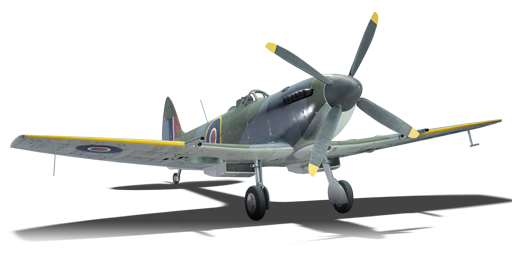
The final Merlin-powered variant of the Spitfire, the Spitfire F Mk XVI was a Spitfire LF Mk IX equipped with the Packard Merlin 266 engine, a Rolls-Royce Merlin 66 licence-built by the American Packard Motor Company. Notably, the model represented in-game features the new "E-type" wings, which allowed either an all-cannon arrangement like the C-type or installation of M2 Browning heavy machine guns. These could also be "clipped", removing the wingtips to improve low-altitude characteristics at the cost of high-altitude manoeuvrability.
In the game since the start of the Open Beta Test, the Spitfire F Mk XVI is a very unique plane with an awkwardly unique role and design. Virtually identical to the Spitfire LF Mk IX, aside from the clipped wings and bubble cockpit, the Mk XVI combines the low-altitude capabilities of the aforementioned fighter with the fantastic roll, dive, and speed capabilities of the German Focke-Wulfe 190 series. The clipped wings give the Mk XVI a great roll rate and amazing dive and level speed and acceleration. However, compared to similar Merlin Spitfires, the turn rate is far worse, higher-altitude performance is abysmal, and climb performance is worse, though marginally. In terms of armament, the two M2 Brownings also provide a significant increase in firepower compared to the previous quad .303 Browning setup.
General info
Flight performance
| Characteristics | Max Speed (km/h at 6,098 m) |
Max altitude (metres) |
Turn time (seconds) |
Rate of climb (metres/second) |
Take-off run (metres) | |||
|---|---|---|---|---|---|---|---|---|
| AB | RB | AB | RB | AB | RB | |||
| Stock | 624 | 604 | 21.0 | 21.8 | 17.5 | 17.5 | 390 | |
| Upgraded | 683 | 651 | 18.7 | 19.8 | 29.2 | 22.3 | ||
Details
| Features | ||||
|---|---|---|---|---|
| Combat flaps | Take-off flaps | Landing flaps | Air brakes | Arrestor gear |
| X | X | ✓ | X | X |
| Limits | ||||||
|---|---|---|---|---|---|---|
| Wings (km/h) | Gear (km/h) | Flaps (km/h) | Max Static G | |||
| Combat | Take-off | Landing | + | - | ||
| N/A | N/A | 260 | ~9 | ~5 | ||
| Optimal velocities (km/h) | |||
|---|---|---|---|
| Ailerons | Rudder | Elevators | Radiator |
| < 321 | < 400 | < 350 | > 500 |
| Compressor (RB/SB) | ||
|---|---|---|
| Setting 1 | ||
| Optimal altitude | 100% Engine power | WEP Engine power |
| 3,400 m | 1,380 hp | 1,766 hp |
| Setting 2 | ||
| Optimal altitude | 100% Engine power | WEP Engine power |
| 7,200 m | 1,190 hp | 1,523 hp |
Survivability and armour
- 38 mm Bulletproof glass - Armoured windscreen
- 4 mm Steel plate in pilot's seat
- 3-7 mm Steel plate behind the pilot
- 6 mm Steel plate in front of liquid cooling system
- 1 mm Steel plate in front of fuel tanks
- 3 mm Steel boxes around wing ammunition
Modifications and economy
Armaments
Offensive armament
The Spitfire F Mk XVI is armed with:
- 2 x 20 mm Hispano Mk.II cannons, wing-mounted (135 rpg = 270 total)
- 2 x 12.7 mm M2 Browning machine guns, wing-mounted (260 rpg = 520 total)
Suspended armament
The Spitfire F Mk XVI can be outfitted with the following ordnance:
- Without load
- 2 x 250 lb G.P. Mk.IV bombs (500 lb total)
Usage in battles

The Spitfire F Mk XVI is quite unique with its clipped wings. These give this version of the Spitfire a distinct advantage in roll rate, dive performance, and level top speed. However, they reduce the plane's ability to turn, and unlike other Merlin Spitfires this one is only average in its turning ability. Thankfully, it retains a good climb rate, even if it is not as high as that of the unclipped Spitfire variants. In addition, the clipped wings reduce lift at high altitudes, so performance is best when closer to sea level.
Thanks to a great roll rate, this Spitfire is very capable in defensive manoeuvres, and although turn rate is decreased, the boost in roll speed make this a great dogfighter as well.
This vehicle maximizes its performance at low altitudes. Below 1500 m, it has an incredible climb rate, very good top speed and acceleration, great dive performance, and generally outmatches its opponents. Still, there are some American and German planes that can outspeed and outdive this plane (especially since it locks up and may rip at high speeds), and the unclipped Merlin Spitfires outclimb this one.
This plane is equipped with 2 x 20 mm cannons and 2 x 12.7 mm machine guns. These are effective against fighters but may struggle against large planes such as heavy bombers. They can't destroy well-armoured ground targets, but can destroy lightly armoured ground targets and open-topped vehicles. Since all of these guns are wing-mounted, convergence should be kept in mind. A good convergence setting is usually between 300 and 500 m. Since cannon ammunition is somewhat limited, firing the 12.7 mm machine guns alone can be a good way to visualize the lead required to shoot enemies at longer ranges.
The Spitfire can also mount 2 x 250 lb bombs for destroying ground targets. These are quite small and must be aimed precisely to destroy the target. While this plane can be used in Ground Realistic battles, the fact that it can only carry 2 small bombs reduces its anti-ground capabilities. Instead, this plane can work as an air-superiority fighter in mixed battles.
The Spitfire F Mk XVI can rightly be considered a jack of all trades. It has some limited ground-attack capacity, decent guns, and flight characteristics that don't stand out in any one aspect. With a great roll rate; good dive and climb performance; and good energy retention, speed, and acceleration; this vehicle is a great low-altitude fighter as long as its weaknesses are understood.
Manual Engine Control
| MEC elements | ||||||
|---|---|---|---|---|---|---|
| Mixer | Pitch | Radiator | Supercharger | Turbocharger | ||
| Oil | Water | Type | ||||
| Controllable | Controllable Auto control available |
Not controllable Not auto controlled |
Controllable Auto control available |
Combined | Controllable 2 gears |
Not controllable |
Pros and cons
Pros:
- Good climb rate, albeit lower than non-clipped wing variants
- Great roll rate
- Great dive acceleration
- Better dive speed than other Merlin Spitfires
- Better turning ability that most of its German and American counterparts
- New M2 HMGs are far more effective than the Browning .303s
- Good 20 mm cannons
- Ability to mount bombs for a ground attack option
- Slightly better simulator visibility due to its bubble cockpit
- Stock parts are not as bad as some other rank IV or V planes, such as the P-51D-5, Ki-84 and Late Bf 109s
Cons:
- Worse turning ability than all other Merlin Spitfires
- Worse dive speed than its German and American counterparts
- Poor performance at high altitude
- Relatively low rip speed (650 km/h)
- Low wing lift efficiency when at high altitudes or speeds under 320 km/h (200 mph)
- Goes through fuel very quickly on WEP for a prop plane, you might have to return for fuel with sustained WEP usage.
History
| Archive of the in-game description | |
|---|---|
|
The Supermarine Spitfire was a British single-engine, all-metal, low-wing monoplane fighter. Various modifications served as fighters, interceptors, high-altitude fighters, fighter-bombers and reconnaissance aircraft. The Mk XVI variant was very similar to the Mk IX; however, it was powered by a US-manufactured Packard Merlin 266 engine. A total of 1,054 Spitfires of this variant were produced. All production variants had the distinguishing feature of low-altitude clipped wings and a cut down rear fuselage and bubble canopy for increased visibility. The clipped wings increased the roll rate and top speed due to a reduction in drag, but sacrificed some of the fighter's climb rate. This, coupled with an engine optimised for efficiency in denser air made the Mk XVI ideally suited to combat at lower altitudes. | |
Media
- Skins
- Videos
See also
Links to the articles on the War Thunder Wiki that you think will be useful for the reader, for example:
- reference to the series of the aircraft;
- links to approximate analogues of other nations and research trees.
External links
| Supermarine | |
|---|---|
| Spitfires | |
| Merlin engine | Spitfire Mk Ia · Spitfire Mk IIa · Spitfire Mk.IIa Venture I · Spitfire Mk IIb |
| Spitfire Mk Vb · Spitfire Mk Vb/trop · Spitfire Mk Vc · Spitfire Mk Vc/trop | |
| Spitfire F Mk IX · Spitfire F Mk IXc · Spitfire F Mk XVI | |
| Spitfire LF Mk IX · Plagis' Spitfire LF Mk IXc | |
| Griffon engine | Spitfire F Mk XIVc · Spitfire F Mk XIVe · Prendergast's Spitfire FR Mk XIVe · Spitfire F Mk XVIIIe · Spitfire F Mk 22 · Spitfire F Mk 24 |
| Export | ▄Spitfire Mk Vb/trop · ▃Spitfire LF Mk IXc · ▂Spitfire Mk IXc · Spitfire Mk IXc · Spitfire Mk.IX (CW) · Weizman's Spitfire LF Mk.IXe · ▄Spitfire FR Mk XIVe |
| Seafires | Seafire LF Mk.III · Seafire F Mk XVII · Seafire FR 47 |
| Export | ▄Seafire LF Mk.III |
| Jet fighters | Attacker FB 1 · Attacker FB.2 · Scimitar F Mk.1 · Swift F.1 · Swift F.7 |
| Hydroplanes | Walrus Mk.I |