Difference between pages "AMX (Family)" and "Tornade"
(→Description) |
|||
| Line 1: | Line 1: | ||
| + | {{About | ||
| + | | about = French Destroyer '''{{PAGENAME}}''' | ||
| + | | usage = other versions | ||
| + | | link = Bourrasque (Family) | ||
| + | }} | ||
| + | {{Specs-Card | ||
| + | |code=fr_destroyer_bourrasque_class_tornade | ||
| + | |images={{Specs-Card-Image|GarageImage_{{PAGENAME}}.jpg|GarageImage_{{PAGENAME}} (2).jpg}} | ||
| + | }} | ||
== Description == | == Description == | ||
| − | + | <!-- ''In the first part of the description, cover the history of the ship's creation and military application. In the second part, tell the reader about using this ship in the game. Add a screenshot: if a beginner player has a hard time remembering vehicles by name, a picture will help them identify the ship in question.'' --> | |
| − | + | The '''Tornade''' was a French ''torpilleur'' of the [[Bourrasque (Family)|Bourrasque class]], the ninth vessel of her type, launched in February 1925. Details about her military service remain scarce, but it is believed that her primary duties before the outbreak of World War II involved patrol and escort operations. Following the French surrender in 1940, the Tornade came under the control of Vichy France. During Operation Torch in November 1942, she was stationed at Oran, a strategic location targeted by the Allied Center Task Force. At the onset of the battle, the Tornade attempted to reach open sea; however, dense smoke obscured her path, causing her to run aground on a reef. As the crew worked to repair the hull and navigate the ship out, she was struck multiple times by the British light cruiser HMS Aurora, which destroyed her stern and one of her engine rooms. The Tornade capsized to starboard shortly thereafter, on 8 November 1942. | |
| − | + | Introduced as a premium destroyer in [[Update "Seek & Destroy"]], the '''{{Specs|name}}''' suffers from a very slow turret rotation speed and a low rate of fire, but this is at least partially compensated by the large explosive filler in both HE and SAP shells. The magazines and shell rooms are located deep below the waterline, providing good protection against detonation. Her torpedoes are excellent for the battle rating, featuring long range, high speed, and a large warhead. Compared to her researchable equivalent, she is equipped with an additional pair of 13.2 mm machine guns on either side of the superstructure at deck level for anti-air defense. | |
| − | + | == General info == | |
| − | + | === Survivability and armour === | |
| + | {{Specs-Fleet-Armour}} | ||
| + | <!-- ''Talk about the vehicle's armour. Note the most well-defended and most vulnerable zones, e.g. the ammo magazine. Evaluate the composition of components and assemblies responsible for movement and manoeuvrability. Evaluate the survivability of the primary and secondary armaments separately. Don't forget to mention the size of the crew, which plays an important role in fleet mechanics. Save tips on preserving survivability for the "Usage in battles" section. If necessary, use a graphical template to show the most well-protected or most vulnerable points in the armour.'' --> | ||
| + | The Tornade, like other Bourrasque-class destroyers, features minimal armour, instead relying on its mobility and small size to avoid being hit. The only armour that can be found on the ship are the gun shields, reaching 10 mm thick. The ship is quite compact, meaning most shots that hit the vessel will damage or destroy a component, and the small number of crew means that prolonged combat will eventually lead to its destruction. | ||
| − | == | + | === Mobility === |
| − | + | {{Specs-Fleet-Mobility}} | |
| − | {{ | + | <!-- ''Write about the ship's mobility. Evaluate its power and manoeuvrability, rudder rerouting speed, stopping speed at full tilt, with its maximum forward and reverse speed.'' --> |
| + | |||
| + | {{NavalMobility}} | ||
| + | |||
| + | === Modifications and economy === | ||
| + | {{Specs-Economy}} | ||
| + | |||
| + | == Armament == | ||
| + | {{Specs-Fleet-Armaments}} | ||
| + | === Primary armament === | ||
| + | {{Specs-Fleet-Primary}} | ||
| + | <!-- ''Provide information about the characteristics of the primary armament. Evaluate their efficacy in battle based on their reload speed, ballistics and the capacity of their shells. Add a link to the main article about the weapon: <code><nowiki>{{main|Weapon name (calibre)}}</nowiki></code>. Broadly describe the ammunition available for the primary armament, and provide recommendations on how to use it and which ammunition to choose.'' --> | ||
| + | {{main|130 mm/40 model 1919 (130 mm)}} | ||
| + | ''Provide information about the characteristics of the primary armament. Evaluate their efficacy in battle based on their reload speed, ballistics and the capacity of their shells. Add a link to the main article about the weapon: <code><nowiki>{{main|Weapon name (calibre)}}</nowiki></code>. Broadly describe the ammunition available for the primary armament, and provide recommendations on how to use it and which ammunition to choose.'' | ||
| + | |||
| + | {{:130 mm/40 model 1919 (130 mm)/Ammunition|130 mm OEA Mle 1932, 130 mm OPFA Mle 1923}} | ||
| + | |||
| + | === Secondary armament === | ||
| + | {{Specs-Fleet-Secondary}} | ||
| + | <!-- ''Some ships are fitted with weapons of various calibres. Secondary armaments are defined as weapons chosen with the control <code>Select secondary weapon</code>. Evaluate the secondary armaments and give advice on how to use them. Describe the ammunition available for the secondary armament. Provide recommendations on how to use them and which ammunition to choose. Remember that any anti-air armament, even heavy calibre weapons, belong in the next section. If there is no secondary armament, remove this section.'' --> | ||
| + | {{main|37 mm/50 model 1933 (37 mm)}} | ||
| + | ''Some ships are fitted with weapons of various calibres. Secondary armaments are defined as weapons chosen with the control <code>Select secondary weapon</code>. Evaluate the secondary armaments and give advice on how to use them. Describe the ammunition available for the secondary armament. Provide recommendations on how to use them and which ammunition to choose. Remember that any anti-air armament, even heavy calibre weapons, belong in the next section. If there is no secondary armament, remove this section.'' | ||
| + | |||
| + | {{:37 mm/50 model 1933 (37 mm)/Ammunition|37 mm OEA Mle 1925}} | ||
| + | |||
| + | === Anti-aircraft armament === | ||
| + | {{Specs-Fleet-AA}} | ||
| + | <!-- ''An important part of the ship's armament responsible for air defence. Anti-aircraft armament is defined by the weapon chosen with the control <code>Select anti-aircraft weapons</code>. Talk about the ship's anti-air cannons and machine guns, the number of guns and their positions, their effective range, and about their overall effectiveness – including against surface targets. If there are no anti-aircraft armaments, remove this section.'' --> | ||
| + | {{main|Model 1929 Hotchkiss (13.2 mm)}} | ||
| + | ''An important part of the ship's armament responsible for air defence. Anti-aircraft armament is defined by the weapon chosen with the control <code>Select anti-aircraft weapons</code>. Talk about the ship's anti-air cannons and machine guns, the number of guns and their positions, their effective range, and about their overall effectiveness – including against surface targets. If there are no anti-aircraft armaments, remove this section.'' | ||
| + | |||
| + | === Additional armament === | ||
| + | {{Specs-Fleet-Additional}} | ||
| + | <!-- ''Describe the available additional armaments of the ship: depth charges, mines, torpedoes. Talk about their positions, available ammunition and launch features such as dead zones of torpedoes. If there is no additional armament, remove this section.'' --> | ||
| + | {{main|Model 1923DT (550 mm)}} | ||
| + | ''Describe the available additional armaments of the ship: depth charges, mines, torpedoes. Talk about their positions, available ammunition and launch features such as dead zones of torpedoes. If there is no additional armament, remove this section.'' | ||
| + | |||
| + | == Usage in battles == | ||
| + | <!-- ''Describe the technique of using this ship, the characteristics of her use in a team and tips on strategy. Abstain from writing an entire guide – don't try to provide a single point of view, but give the reader food for thought. Talk about the most dangerous opponents for this vehicle and provide recommendations on fighting them. If necessary, note the specifics of playing with this vehicle in various modes (AB, RB, SB).'' --> | ||
| + | ''Describe the technique of using this ship, the characteristics of her use in a team and tips on strategy. Abstain from writing an entire guide – don't try to provide a single point of view, but give the reader food for thought. Talk about the most dangerous opponents for this vehicle and provide recommendations on fighting them. If necessary, note the specifics of playing with this vehicle in various modes (AB, RB, SB).'' | ||
| + | |||
| + | === Pros and cons === | ||
| + | <!-- ''Summarise and briefly evaluate the vehicle in terms of its characteristics and combat effectiveness. Mark its pros and cons in the bulleted list. Try not to use more than 6 points for each of the characteristics. Avoid using categorical definitions such as "bad", "good" and the like - use substitutions with softer forms such as "inadequate" and "effective".'' --> | ||
| + | ''Summarise and briefly evaluate the vehicle in terms of its characteristics and combat effectiveness. Mark its pros and cons in the bulleted list. Try not to use more than 6 points for each of the characteristics. Avoid using categorical definitions such as "bad", "good" and the like - use substitutions with softer forms such as "inadequate" and "effective".'' | ||
| − | + | '''Pros:''' | |
| − | |||
| − | + | * | |
| − | + | '''Cons:''' | |
| − | + | * | |
| − | + | == History == | |
| + | <!-- ''Describe the history of the creation and combat usage of the ship in more detail than in the introduction. If the historical reference turns out to be too long, take it to a separate article, taking a link to the article about the ship and adding a block "/History" (example: <nowiki>https://wiki.warthunder.com/(Ship-name)/History</nowiki>) and add a link to it here using the <code>main</code> template. Be sure to reference text and sources by using <code><nowiki><ref></ref></nowiki></code>, as well as adding them at the end of the article with <code><nowiki><references /></nowiki></code>. This section may also include the ship's dev blog entry (if applicable) and the in-game encyclopedia description (under <code><nowiki>=== In-game description ===</nowiki></code>, also if applicable).'' --> | ||
| + | ''Describe the history of the creation and combat usage of the ship in more detail than in the introduction. If the historical reference turns out to be too long, take it to a separate article, taking a link to the article about the ship and adding a block "/History" (example: <nowiki>https://wiki.warthunder.com/(Ship-name)/History</nowiki>) and add a link to it here using the <code>main</code> template. Be sure to reference text and sources by using <code><nowiki><ref></ref></nowiki></code>, as well as adding them at the end of the article with <code><nowiki><references /></nowiki></code>. This section may also include the ship's dev blog entry (if applicable) and the in-game encyclopedia description (under <code><nowiki>=== In-game description ===</nowiki></code>, also if applicable).'' | ||
| − | + | == Media == | |
| + | <!-- ''Excellent additions to the article would be video guides, screenshots from the game, and photos.'' --> | ||
| + | ''Excellent additions to the article would be video guides, screenshots from the game, and photos.'' | ||
| + | |||
| + | == See also == | ||
| + | <!-- ''Links to articles on the War Thunder Wiki that you think will be useful for the reader, for example:'' | ||
| + | * ''reference to the series of the ship;'' | ||
| + | * ''links to approximate analogues of other nations and research trees.'' --> | ||
| + | ''Links to articles on the War Thunder Wiki that you think will be useful for the reader, for example:'' | ||
| + | |||
| + | * ''reference to the series of the ship;'' | ||
| + | * ''links to approximate analogues of other nations and research trees.'' | ||
== External links == | == External links == | ||
| Line 30: | Line 97: | ||
* ''topic on the official game forum;'' | * ''topic on the official game forum;'' | ||
* ''other literature.'' --> | * ''other literature.'' --> | ||
| − | + | ''Paste links to sources and external resources, such as:'' | |
| − | + | ||
| + | * ''topic on the official game forum;'' | ||
| + | * ''other literature.'' | ||
| + | |||
| + | {{ShipManufacturer Dyle et Bacalan}} | ||
| + | {{France destroyers}} | ||
| + | {{France premium ships}} | ||
Latest revision as of 08:06, 25 August 2024
| This page is about the French Destroyer Tornade. For other versions, see Bourrasque (Family). |

.jpg)
Contents
Description
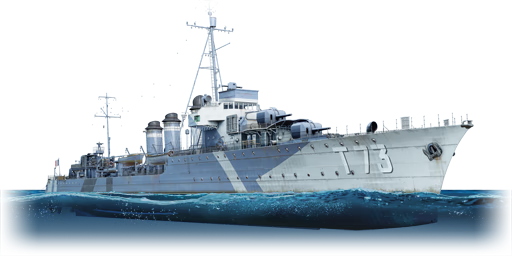
The Tornade was a French torpilleur of the Bourrasque class, the ninth vessel of her type, launched in February 1925. Details about her military service remain scarce, but it is believed that her primary duties before the outbreak of World War II involved patrol and escort operations. Following the French surrender in 1940, the Tornade came under the control of Vichy France. During Operation Torch in November 1942, she was stationed at Oran, a strategic location targeted by the Allied Center Task Force. At the onset of the battle, the Tornade attempted to reach open sea; however, dense smoke obscured her path, causing her to run aground on a reef. As the crew worked to repair the hull and navigate the ship out, she was struck multiple times by the British light cruiser HMS Aurora, which destroyed her stern and one of her engine rooms. The Tornade capsized to starboard shortly thereafter, on 8 November 1942.
Introduced as a premium destroyer in Update "Seek & Destroy", the Bourrasque-class, Tornade, 1939 suffers from a very slow turret rotation speed and a low rate of fire, but this is at least partially compensated by the large explosive filler in both HE and SAP shells. The magazines and shell rooms are located deep below the waterline, providing good protection against detonation. Her torpedoes are excellent for the battle rating, featuring long range, high speed, and a large warhead. Compared to her researchable equivalent, she is equipped with an additional pair of 13.2 mm machine guns on either side of the superstructure at deck level for anti-air defense.
General info
Survivability and armour
The Tornade, like other Bourrasque-class destroyers, features minimal armour, instead relying on its mobility and small size to avoid being hit. The only armour that can be found on the ship are the gun shields, reaching 10 mm thick. The ship is quite compact, meaning most shots that hit the vessel will damage or destroy a component, and the small number of crew means that prolonged combat will eventually lead to its destruction.
Mobility
| Mobility Characteristics | |||
|---|---|---|---|
| Game Mode | Upgrade Status | Maximum Speed (km/h) | |
| Forward | Reverse | ||
| AB | |||
| Upgraded | |||
| RB/SB | |||
| Upgraded | |||
Modifications and economy
Armament
Primary armament
Provide information about the characteristics of the primary armament. Evaluate their efficacy in battle based on their reload speed, ballistics and the capacity of their shells. Add a link to the main article about the weapon: {{main|Weapon name (calibre)}}. Broadly describe the ammunition available for the primary armament, and provide recommendations on how to use it and which ammunition to choose.
| Penetration statistics | |||||||
|---|---|---|---|---|---|---|---|
| Ammunition | Type of warhead |
Penetration @ 0° Angle of Attack (mm) | |||||
| 1,000 m | 2,500 m | 5,000 m | 7,500 m | 10,000 m | 15,000 m | ||
| OEA Mle 1932 | HE | 37 | 37 | 37 | 37 | 37 | 37 |
| OPFA Mle 1923 | SAPBC | 61 | 54 | 43 | 34 | 27 | 25 |
| Shell details | ||||||||||||
|---|---|---|---|---|---|---|---|---|---|---|---|---|
| Ammunition | Type of warhead |
Velocity (m/s) |
Projectile mass (kg) |
Fuse delay (s) |
Fuse sensitivity (mm) |
Explosive mass (TNT equivalent) (kg) |
Ricochet | |||||
| 0% | 50% | 100% | ||||||||||
| OEA Mle 1932 | HE | 725 | 34.83 | 0 | 0.1 | 3.96 | 79° | 80° | 81° | |||
| OPFA Mle 1923 | SAPBC | 725 | 32.05 | 0.035 | 5 | 1.98 | 48° | 63° | 71° | |||
Secondary armament
Some ships are fitted with weapons of various calibres. Secondary armaments are defined as weapons chosen with the control Select secondary weapon. Evaluate the secondary armaments and give advice on how to use them. Describe the ammunition available for the secondary armament. Provide recommendations on how to use them and which ammunition to choose. Remember that any anti-air armament, even heavy calibre weapons, belong in the next section. If there is no secondary armament, remove this section.
| Penetration statistics | |||||||
|---|---|---|---|---|---|---|---|
| Ammunition | Type of warhead |
Penetration @ 0° Angle of Attack (mm) | |||||
| 10 m | 100 m | 500 m | 1,000 m | 1,500 m | 2,000 m | ||
| OEA Mle 1925 | HE | 3 | 3 | 3 | 3 | 3 | 3 |
| Shell details | ||||||||||||
|---|---|---|---|---|---|---|---|---|---|---|---|---|
| Ammunition | Type of warhead |
Velocity (m/s) |
Projectile mass (kg) |
Fuse delay (m) |
Fuse sensitivity (mm) |
Explosive mass (TNT equivalent) (g) |
Ricochet | |||||
| 0% | 50% | 100% | ||||||||||
| OEA Mle 1925 | HE | 810 | 0.73 | 0 | 0.1 | 50 | 79° | 80° | 81° | |||
Anti-aircraft armament
An important part of the ship's armament responsible for air defence. Anti-aircraft armament is defined by the weapon chosen with the control Select anti-aircraft weapons. Talk about the ship's anti-air cannons and machine guns, the number of guns and their positions, their effective range, and about their overall effectiveness – including against surface targets. If there are no anti-aircraft armaments, remove this section.
Additional armament
Describe the available additional armaments of the ship: depth charges, mines, torpedoes. Talk about their positions, available ammunition and launch features such as dead zones of torpedoes. If there is no additional armament, remove this section.
Usage in battles
Describe the technique of using this ship, the characteristics of her use in a team and tips on strategy. Abstain from writing an entire guide – don't try to provide a single point of view, but give the reader food for thought. Talk about the most dangerous opponents for this vehicle and provide recommendations on fighting them. If necessary, note the specifics of playing with this vehicle in various modes (AB, RB, SB).
Pros and cons
Summarise and briefly evaluate the vehicle in terms of its characteristics and combat effectiveness. Mark its pros and cons in the bulleted list. Try not to use more than 6 points for each of the characteristics. Avoid using categorical definitions such as "bad", "good" and the like - use substitutions with softer forms such as "inadequate" and "effective".
Pros:
Cons:
History
Describe the history of the creation and combat usage of the ship in more detail than in the introduction. If the historical reference turns out to be too long, take it to a separate article, taking a link to the article about the ship and adding a block "/History" (example: https://wiki.warthunder.com/(Ship-name)/History) and add a link to it here using the main template. Be sure to reference text and sources by using <ref></ref>, as well as adding them at the end of the article with <references />. This section may also include the ship's dev blog entry (if applicable) and the in-game encyclopedia description (under === In-game description ===, also if applicable).
Media
Excellent additions to the article would be video guides, screenshots from the game, and photos.
See also
Links to articles on the War Thunder Wiki that you think will be useful for the reader, for example:
- reference to the series of the ship;
- links to approximate analogues of other nations and research trees.
External links
Paste links to sources and external resources, such as:
- topic on the official game forum;
- other literature.
| Société Anonyme de Travaux Dyle et Bacalan | |
|---|---|
| Destroyers | |
| Bourrasque-class | Tornade |
| France destroyers | |
|---|---|
| Bourrasque-class | Bourrasque · Tornade |
| Chacal-class | Chacal · Leopard · Panthere |
| Aigle-class | Aigle · Vautour · Milan |
| Vauquelin-class | Vauquelin |
| Le Fantasque-class | Le Malin · Le Triomphant |
| Mogador-class | Mogador |
| Hunt-class | La Combattante |
| Trophies | Germany |
| Desaix-class¹ | Kleber |
| Type 1936 | Marceau |
| Italy | |
| Chateaurenault-class² | Guichen |
| Modified: ¹Type 1934A-class destroyers · ²Capitani Romani-class cruisers | |
| France premium ships | |
|---|---|
| Motor torpedo boats | VTB-9 · VLT-2 |
| Destroyers | Panthere · Tornade · Aigle · Le Triomphant |
| Light cruisers | Duguay-Trouin |
| Heavy cruisers | Dupleix |
| Battleships | Courbet |