Difference between pages "P-36G" and "P-38G-1"
(→In-game description: Reformatted) |
m (Reverted edits by U178117757 (talk) to last revision by U128870270) |
||
| Line 1: | Line 1: | ||
{{About | {{About | ||
| − | | about = American fighter '''{{PAGENAME}}''' | + | | about = American twin-engine fighter '''{{PAGENAME}}''' |
| − | | usage = other | + | | usage = other variants |
| − | | link = P- | + | | link = P-38 (Family) |
}} | }} | ||
{{Specs-Card | {{Specs-Card | ||
| − | |code=p- | + | |code=p-38g |
|images={{Specs-Card-Image|GarageImage_{{PAGENAME}}.jpg}} | |images={{Specs-Card-Image|GarageImage_{{PAGENAME}}.jpg}} | ||
| − | |cockpit=cockpit_p- | + | |cockpit=cockpit_p-38g.jpg |
}} | }} | ||
== Description == | == Description == | ||
<!-- ''In the description, the first part should be about the history of and the creation and combat usage of the aircraft, as well as its key features. In the second part, tell the reader about the aircraft in the game. Insert a screenshot of the vehicle, so that if the novice player does not remember the vehicle by name, he will immediately understand what kind of vehicle the article is talking about.'' --> | <!-- ''In the description, the first part should be about the history of and the creation and combat usage of the aircraft, as well as its key features. In the second part, tell the reader about the aircraft in the game. Insert a screenshot of the vehicle, so that if the novice player does not remember the vehicle by name, he will immediately understand what kind of vehicle the article is talking about.'' --> | ||
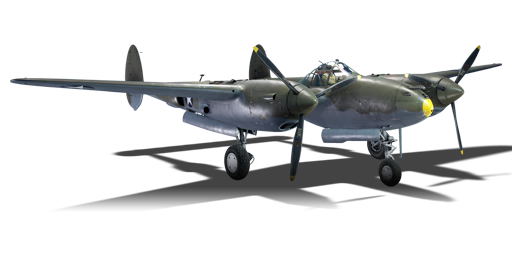
| − | The | + | The P-38G was a minor evolution of the P-38 and was also widely produced with over 1,000 aircraft built. The P-38G was largely the same aircraft as the P-38F except the G ran at higher boost settings as well as having improved radio equipment. The Allison V-1710-51 in the P-38G (F10R) runs at a slightly higher manifold pressure (47.5) compared to the engine in the P-38F (47.0). Unfortunately, due to cooling issues with the engines at higher altitudes, the power was significantly limited. A decent portion of P-38G’s were actually F-5A Lightnings that were unarmed and fitted with five cameras for reconnaissance duties. These received the same improvements found in the P-38G and were built along the same production lines. |
| − | + | The '''{{Specs|name}}''' was present at the beginning of the Open Beta Test prior to Update 1.27. It’s a significant improvement over the previous P-38. It features better engines, a lighter airframe, and the ability to use rockets. The P-38G is a fairly strong plane due to its low BR and excellent climb performance. Furthermore, all of the guns are mounted in the nose which greatly helps with quickly downing enemy aircraft. Unfortunately, the P-38G is still an early version of the P-38 family and lacks the dive brakes which help against compressibility. However, players should still be satisfied with the P-38G’s performance. | |
| − | |||
| − | |||
| − | |||
| − | |||
| − | |||
== General info == | == General info == | ||
| Line 26: | Line 21: | ||
{{Specs-Avia-Flight}} | {{Specs-Avia-Flight}} | ||
<!-- ''Describe how the aircraft behaves in the air. Speed, manoeuvrability, acceleration and allowable loads - these are the most important characteristics of the vehicle.'' --> | <!-- ''Describe how the aircraft behaves in the air. Speed, manoeuvrability, acceleration and allowable loads - these are the most important characteristics of the vehicle.'' --> | ||
| − | |||
| − | + | Despite being a heavy twin engine fighter the P-38G has good overall performance. Its level speed is comparable to many single engined fighters and faster than some of them. It can reach 550 km/h at the sea level and thanks to its superchargers the plane's maximum is speed is close to 660 km/h at 5,000 m altitude. The cruising speed remains constant up to 11,000 m altitude. That makes it a good medium and high altitude fighter and in most cases outperforms the opposition. | |
| + | |||
| + | Acceleration in level flight is decent and when it starts diving it gets very good. However, it is required to keep an eye on the speed due to the low structural speed limit. Of course due to the plane's configuration it suffers a lot from high speed compression, which starts close to 0.70 Mach. | ||
| + | |||
| + | Climb rate is comparable to other American fighters. The plane is able to reach 5,000 m in 4 minutes and 40 seconds which is quite mediocre. Its climb rate at 1,000 m is close to 18 m/s but, again thanks to the supercharger, it will not suffer so much at high altitude. When climbing from 5,000 m alt to 9,000 m alt it will outperform most of other fighters. | ||
| + | |||
| + | The P-38G's turn rate is quite good but depends a lot on its Fowler flaps. They do increase the lift significantly but at the cost of a proportional increase in drag too. Sustained turn rate is quite good, better than in almost every other heavy twin engined fighter but in most cases only comparable or worse to other single engined fighters. On the other hand the instantaneous turn rate especially with deployed flaps is very good and can help a lot with getting the guns on the target and high deflection shooting. | ||
| + | |||
| + | The other issue is its roll rate, at best it reaches 70 degrees per second at 400 km/h. | ||
| + | |||
| + | The way the Lighting's engines are mirrored in turn direction makes it so the pilot does not need to worry about the propeller torque effect as the propellers on one side negate the effect of the other. Furthermore, the plane doesn't require any trimming except for some elevator adjustments to fly in a straight line. | ||
{| class="wikitable" style="text-align:center" width="70%" | {| class="wikitable" style="text-align:center" width="70%" | ||
! rowspan="2" | Characteristics | ! rowspan="2" | Characteristics | ||
| − | ! colspan="2" | Max Speed<br>(km/h at | + | ! colspan="2" | Max Speed<br>(km/h at 8,229 m) |
! rowspan="2" | Max altitude<br>(metres) | ! rowspan="2" | Max altitude<br>(metres) | ||
! colspan="2" | Turn time<br>(seconds) | ! colspan="2" | Turn time<br>(seconds) | ||
| Line 41: | Line 45: | ||
|- | |- | ||
! Stock | ! Stock | ||
| − | | | + | | 634 || 616 || rowspan="2" | {{Specs|ceiling}} || 23.1 || 24.0 || 14.6 || 14.6 || rowspan="2" | 380 |
|- | |- | ||
! Upgraded | ! Upgraded | ||
| − | | | + | | 687 || 660 || 20.9 || 22.0 || 22.4 || 18.0 |
|- | |- | ||
|} | |} | ||
| Line 70: | Line 74: | ||
! Combat !! Take-off !! Landing !! + !! - | ! Combat !! Take-off !! Landing !! + !! - | ||
|- | |- | ||
| − | | {{Specs|destruction|body}} || {{Specs|destruction|gear}} || | + | | {{Specs|destruction|body}} || {{Specs|destruction|gear}} || 565 || 495 || 250 || ~9 || ~5 |
|- | |- | ||
|} | |} | ||
| Line 80: | Line 84: | ||
! Ailerons !! Rudder !! Elevators !! Radiator | ! Ailerons !! Rudder !! Elevators !! Radiator | ||
|- | |- | ||
| − | | < | + | | < 380 || < 460 || < 500 || > 420 |
|- | |- | ||
|} | |} | ||
| Line 94: | Line 98: | ||
! WEP Engine power | ! WEP Engine power | ||
|- | |- | ||
| − | | 2, | + | | 5,800 m || 2,620 hp || 3,010 hp |
| + | |- | ||
| + | |} | ||
| + | |||
| + | ====Engine performance==== | ||
| + | {| class="wikitable" style="text-align:center" | ||
| + | |- | ||
| + | ! colspan="4" | Engine | ||
| + | |- | ||
| + | ! colspan="3" | Engine Name | ||
| + | ! colspan="3" | Number present | ||
| + | |- | ||
| + | | colspan="3" | Allison V-1710-51 12-cylinder || colspan="1" | 2 | ||
| + | |- | ||
| + | ! colspan="4" | Engine characteristics | ||
| + | |- | ||
| + | ! colspan="2" | Weight (each) | ||
| + | ! colspan="1" | Type | ||
| + | ! colspan="1" | Cooling | ||
| + | |- | ||
| + | | colspan="2" | 610 kg || Inline || Water | ||
| + | |- | ||
| + | ! colspan="4" | Engine power (Stock) | ||
| + | |- | ||
| + | ! colspan="1" | Mode | ||
| + | ! colspan="2" | Max | ||
| + | ! colspan="2" | Take-off | ||
| + | |- | ||
| + | | ''Arcade'' || colspan="2" | 1,084 hp || colspan="2" | 1,350 hp | ||
| + | |- | ||
| + | | ''Realistic/Simulator'' || colspan="2" | 1,072 hp || colspan="2" | 1,200 hp | ||
| + | |- | ||
| + | ! colspan="4" | Engine power (Upgraded) | ||
|- | |- | ||
| − | ! colspan=" | + | ! Mode |
| + | ! colspan="2" | Max | ||
| + | ! colspan="2" | Take-off | ||
|- | |- | ||
| − | ! | + | | ''Arcade'' || colspan="2" | 1,264 hp || colspan="2" | 1,531 hp |
| − | ! | + | |- |
| − | ! | + | | ''Realistic/Simulator'' || colspan="2" | 1,252 hp || colspan="2" | 1,380 hp |
| + | |- | ||
| + | |} | ||
| + | |||
| + | {| class="wikitable" style="text-align:center" | ||
| + | |- | ||
| + | ! colspan="4" | WEP Duration | ||
| + | |- | ||
| + | ! colspan="2" | Arcade | ||
| + | ! colspan="2" | Realistic/Simulator | ||
|- | |- | ||
| − | | | + | | colspan="2" | 25 seconds || colspan="2" | Infinite |
|- | |- | ||
|} | |} | ||
| Line 110: | Line 157: | ||
<!-- ''Examine the survivability of the aircraft. Note how vulnerable the structure is and how secure the pilot is, whether the fuel tanks are armoured, etc. Describe the armour, if there is any, and also mention the vulnerability of other critical aircraft systems.'' --> | <!-- ''Examine the survivability of the aircraft. Note how vulnerable the structure is and how secure the pilot is, whether the fuel tanks are armoured, etc. Describe the armour, if there is any, and also mention the vulnerability of other critical aircraft systems.'' --> | ||
| − | * | + | * 38 mm Bulletproof glass in cockpit top front. |
| − | * | + | * 6.5 mm Steel plates in the nose. |
| − | + | * 6.5 mm Steel plates in pilot's seat. | |
| − | + | * 9.5 mm Steel plate in pilot's headrest. | |
=== Modifications and economy === | === Modifications and economy === | ||
| Line 123: | Line 170: | ||
{{Specs-Avia-Offensive}} | {{Specs-Avia-Offensive}} | ||
<!-- ''Describe the offensive armament of the aircraft, if any. Describe how effective the cannons and machine guns are in a battle, and also what belts or drums are better to use. If there is no offensive weaponry, delete this subsection.'' --> | <!-- ''Describe the offensive armament of the aircraft, if any. Describe how effective the cannons and machine guns are in a battle, and also what belts or drums are better to use. If there is no offensive weaponry, delete this subsection.'' --> | ||
| − | {{main|M2 | + | {{main|AN/M2 (20 mm)|M2 Browning (12.7 mm)}} |
The '''''{{PAGENAME}}''''' is armed with: | The '''''{{PAGENAME}}''''' is armed with: | ||
| − | * | + | * 1 x 20 mm AN/M2 cannon, nose-mounted (150 rpg) |
| − | * 4 x 7 | + | * 4 x 12.7 mm M2 Browning machine guns, nose-mounted (500 rpg = 2,000 total) |
| − | + | === Suspended armament === | |
| + | {{Specs-Avia-Suspended}} | ||
| + | <!-- ''Describe the aircraft's suspended armament: additional cannons under the wings, bombs, rockets and torpedoes. This section is especially important for bombers and attackers. If there is no suspended weaponry remove this subsection.'' --> | ||
| + | {{main|M8}} | ||
| − | + | The '''''{{PAGENAME}}''''' can be outfitted with the following ordnance: | |
| − | * | + | * Without load |
| − | + | * 6 x M8 rockets | |
| − | * | ||
| − | == | + | == Usage in battles == |
| − | + | <!-- ''Describe the tactics of playing in the aircraft, the features of using aircraft in a team and advice on tactics. Refrain from creating a "guide" - do not impose a single point of view, but instead, give the reader food for thought. Examine the most dangerous enemies and give recommendations on fighting them. If necessary, note the specifics of the game in different modes (AB, RB, SB).'' --> | |
| − | + | The P-38G-1 is a medium- and high-altitude fighter which excels in anti-bomber roles and when working with teammates to destroy enemy fighters. Its manoeuvrability is unsurprisingly worse than that of single-engine fighters, but is quite good compared to that of other heavy fighters. The plane excels in a boom and zoom roll, where its powerful armament and good energy retention are brought into the spotlight. | |
| − | |||
| − | |||
| − | |||
| − | + | In a turning engagement, the P-38 fares better than most other heavy fighters. When engaging its flaps, it can turn surprisingly well; however, these flaps bleed a considerable amount of airspeed, and sustained turning is unadvisable in most scenarios. Most single-engine fighters will be able to outturn the P-38. All of this means that engaging in furballs is unwise. It is usually better to boom and zoom, going in and out of the dogfight while evading enemy fire. | |
| − | |||
| − | |||
| − | |||
| − | |||
| − | + | If there is an enemy on the P-38's tail it is best to dive away, utilising the plane's great acceleration; or to fly towards teammates. The P-38's lack of manoeuvrability compared to single-engine fighters means that attempting a rolling scissors or other type of reversal is often very difficult. Indeed, the plane suffers especially from a poor roll rate, which although excellent for a plane of this size, is not comparable to that of planes such as the Fw 190. | |
| − | |||
| − | |||
| − | + | With a 20 mm cannon and four machine guns located in its nose, the P-38G-1 has formidable firepower. This can be used to destroy enemy bombers to great effect (the P-38 finds much success in a bomber-hunting role), and to easily destroy lightly armoured ground targets. Smaller enemy planes such as single-engine fighters are especially easy to take down. | |
| − | + | In ground realistic battles, this plane can be used reasonably well to destroy ground targets and ensure air superiority. With 6 rockets and nose-mounted guns, the P-38 can destroy lightly-armoured and open-top vehicles easily, and also engage some more heavily-defended targets. | |
=== Manual Engine Control === | === Manual Engine Control === | ||
| Line 172: | Line 212: | ||
! Oil !! Water !! Type | ! Oil !! Water !! Type | ||
|- | |- | ||
| − | | | + | | Controllable || Controllable<br>Auto control available || Controllable<br>Not auto controlled || Controllable<br>Not auto controlled || Separate || Not controllable<br>1 gear || Not controllable |
|- | |- | ||
|} | |} | ||
| Line 181: | Line 221: | ||
'''Pros:''' | '''Pros:''' | ||
| − | * | + | * Good top speed |
| − | * | + | * Good dive acceleration |
| − | * | + | * Nose-mounted weaponry is powerful, accurate and good in head-ons |
| − | * | + | * Excellent roll rate |
| − | * | + | * Great climb rate |
| + | * Extremely stable in terms of torque | ||
| + | * Turns well at high speeds | ||
| + | * Has a great ammunition reserve for its machine guns | ||
| + | * Cannon has a respectable ammunition reserve of 150 rounds | ||
'''Cons:''' | '''Cons:''' | ||
| − | * | + | * Large aircraft and thus an easy target |
| − | * | + | * Prone to elevator damage |
| − | * | + | * Low dive speed limit |
| − | * | + | * Controls will stiffen around 560 km/h (350 mph) |
| − | * | + | * Cannon inaccurate without "New 20 mm cannon" upgrade |
| + | * Susceptible to catching fire | ||
== History == | == History == | ||
<!-- ''Describe the history of the creation and combat usage of the aircraft in more detail than in the introduction. If the historical reference turns out to be too long, take it to a separate article, taking a link to the article about the vehicle and adding a block "/History" (example: <nowiki>https://wiki.warthunder.com/(Vehicle-name)/History</nowiki>) and add a link to it here using the <code>main</code> template. Be sure to reference text and sources by using <code><nowiki><ref></ref></nowiki></code>, as well as adding them at the end of the article with <code><nowiki><references /></nowiki></code>. This section may also include the vehicle's dev blog entry (if applicable) and the in-game encyclopedia description (under <code><nowiki>=== In-game description ===</nowiki></code>, also if applicable).'' --> | <!-- ''Describe the history of the creation and combat usage of the aircraft in more detail than in the introduction. If the historical reference turns out to be too long, take it to a separate article, taking a link to the article about the vehicle and adding a block "/History" (example: <nowiki>https://wiki.warthunder.com/(Vehicle-name)/History</nowiki>) and add a link to it here using the <code>main</code> template. Be sure to reference text and sources by using <code><nowiki><ref></ref></nowiki></code>, as well as adding them at the end of the article with <code><nowiki><references /></nowiki></code>. This section may also include the vehicle's dev blog entry (if applicable) and the in-game encyclopedia description (under <code><nowiki>=== In-game description ===</nowiki></code>, also if applicable).'' --> | ||
| − | The P- | + | The P-38 was an all-metal, three-wheeled, single-seater, twin-engined monoplane fighter with an aerodynamic design rarely seen in World War II. |
| + | |||
| + | An experimental XP-38 (Model 22) was first flown on January 27, 1938. Production began in June of 1941. | ||
| + | |||
| + | The G variant was created at the end of 1942 and was based on the E and F variants. The G had a more powerful turbocharged Allison V-1710-51/55 engine and benefited from more automated engine management. The G model had lighter weight and handling characteristics compared to the later J and L models, and was therefore favoured by some of the more experienced pilots despite accumulated age and wear in theatre. | ||
| + | |||
| + | The armament suite was formidable and consisted of a 20 mm Hispano AN/M2 cannon with 150 rounds and four 12.7 mm Colt-Browning M2 machine guns with 500 rounds apiece. The fuselage of the F and G models was reinforced, and the operating manual allows for the carry of two extra 300-gallon (1,136-litre) fuel tanks, or up to 1,100 lbs of external ordnance. However, in-theatre operational requirements often dictated the need for heavier ordnance, and it was not uncommon for 2 x 1,000 bombs to be hung on the racks. Field modifications allowed additional external ordnance to be loaded, including 2 x M10 triple-tube rocket launchers, or installation of outer wing pylons allowing 4 x 500 lb bombs to be carried outboard of the engines (two bombs per pylon) - thereby allowing long-range drop tanks to be carried simultaneously on the standard inner-wing racks. | ||
| − | + | One of the P-38's unique characteristics was its incredibly long range, especially for a fighter - a trait which made it ideally suited to bomber escort, intruder patrols, and long-range strikes, such as the famous "shuttle missions" over Germany to Ukraine. Perhaps the most exceptional display of the P-38G's capabilities was Operation Vengeance - a war-changing mission to kill the Imperial Japanese Navy's brilliant naval strategist and mastermind of the Pearl Harbor attack, Admiral Isokoru Yamamoto. The highly-secret 18 April 1943 interception successfully brought down two G4M1 bombers - one transporting Adm. Yamamoto, the other carrying his chief of staff. Despite the mission's success, the U.S. kept the operation a state-secret for some 35 years in order to protect the intelligence sources and methods used to plan the operation. | |
| − | + | The P-38 was widely used by the Army Air Force (USAAF) in all theatres and was the plane used by the United States' top aces: Richard Ira Bong (40 kills) and Thomas McGuire (38 kills). Other noteworthy aces of early P-38s include Jack Ilfrey and Dixie Sloan of the Mediterranean Theater; Robin Olds and John Lowell of the European Theater; Charles McDonald, Gerald Johnson and numerous others in the Pacific Theater. George Welch, famed for his exploits in a P-40 during the Japanese attack on Pearl Harbor also became a P-38 ace of 12 kills. In addition, the famed 'Lone Eagle', Charles Lindbergh, splashed a Ki-46 at the controls of a P-38 while on a visit with the 475 FG in the South Pacific. | |
| + | |||
| + | From 1942 to 1943, Lockheed built 1,462 P-38Gs. Whether out of preference, or sheer necessity, some F and G models served in theatre as late as 1945. They were finally decommissioned in 1949. | ||
{{break}} | {{break}} | ||
{{Navigation-Start|{{Annotation|Archive of the in-game description|An archive of the historical description of the vehicle that was presented in-game prior to Update 1.55 'Royal Armour'}}}} | {{Navigation-Start|{{Annotation|Archive of the in-game description|An archive of the historical description of the vehicle that was presented in-game prior to Update 1.55 'Royal Armour'}}}} | ||
{{Navigation-First-Simple-Line}} | {{Navigation-First-Simple-Line}} | ||
| − | + | The P-38 was an all-metal, three-wheeled, single-seater, twin-engined monoplane fighter with an aerodynamic design rarely seen in World War II. | |
| − | + | An experimental XP-38 (Model 22) was first flown on January 27, 1938. Production began in June of 1941. | |
| − | The | + | The G variant was created at the end of 1942 and was based on the E and F variants. The G had a more powerful turbocharged Allison V-1710-51/55 engine. Engine management was significantly more automated than before. |
| − | + | The plane carried a formidable armament consisting of 20 mm Hispano AN/M2 cannons with 150 rounds and four 12.7 mm Colt-Browning M2 .50 cal machine guns with 300 rounds apiece. The P-38G had a reinforced fuselage and could carry two extra 300 gallons (1136 litres) fuel tanks. The G was not equipped to carry rockets and bombs, but was often modified on the field to carry 250 lb or even 500 lb bombs as well as unguided rockets. | |
| − | The | + | The P-38G was widely used by the Army Air Force (USAAF) in all theaters of the war. They were often used for shuttle missions over Germany from the airfields of Ukraine. The best known operation in which the P-38G participated was Operation Lightning, which changed the war in the Pacific. The mission, which was flown on April 18, 1943, intercepted and shot down a Japanese G4M1 bomber with Japanese Admiral Isoroku Yamamoto on board. In addition, the P-38 was the plane of choice of the two most successful American aces: Richard Ira Bong (40 kills) and Thomas McGuire (38 kills). |
| − | + | From 1942 to 1943, Lockheed built 1,462 P-38Gs. They were decommissioned in 1949. | |
| − | |||
| − | |||
| − | |||
| − | |||
{{Navigation-End}} | {{Navigation-End}} | ||
| Line 227: | Line 276: | ||
;Skins | ;Skins | ||
| − | * [https://live.warthunder.com/feed/camouflages/?vehicle=p- | + | |
| + | * [https://live.warthunder.com/feed/camouflages/?vehicle=p-38g Skins and camouflages for the {{PAGENAME}} from live.warthunder.com.] | ||
;Videos | ;Videos | ||
| − | {{Youtube-gallery| | + | {{Youtube-gallery|cHakCK96pjA|'''The Shooting Range #155''' - ''Pages of History'' section at 04:53 discusses the P-38 Lightning.}} |
== See also == | == See also == | ||
| − | <!-- ''Links to the articles on the War Thunder Wiki that you think will be useful for the reader, for example:'' | + | <!--''Links to the articles on the War Thunder Wiki that you think will be useful for the reader, for example:'' |
* ''reference to the series of the aircraft;'' | * ''reference to the series of the aircraft;'' | ||
| − | * ''links to approximate analogues of other nations and research trees.'' --> | + | * ''links to approximate analogues of other nations and research trees.''--> |
| − | ; | + | ;Aircraft of comparable role, configuration and era |
| − | |||
| − | + | * Northrop [[P-61C-1|P-61]] Black Widow | |
| − | + | * Savoia-Marchetti [[SM.92]] | |
| − | * | ||
| − | |||
| − | * | ||
== External links == | == External links == | ||
| − | <!-- ''Paste links to sources and external resources, such as:'' | + | <!--''Paste links to sources and external resources, such as:'' |
* ''topic on the official game forum;'' | * ''topic on the official game forum;'' | ||
| − | * ''other literature.'' -- | + | * ''other literature.''--> |
| − | |||
| − | |||
| − | |||
| − | |||
| − | |||
| − | |||
| − | |||
| − | |||
| − | |||
| − | |||
| − | |||
| − | + | * [https://forum.warthunder.com/index.php?/topic/56587-lockheed-p-38g-1/ Official data sheet - more details about the performance] | |
| − | * | + | * [https://archive.org/details/PilotTrainingManualP38/page/n1/mode/2up/ AAF Manual 51-127-1 - Pilot Training Manual for the Lightning P-38] |
| − | * | ||
| − | |||
| − | {{AirManufacturer | + | {{AirManufacturer Lockheed}} |
| − | {{USA fighters}} | + | {{USA twin-engine fighters}} |
Latest revision as of 18:52, 24 August 2024
| This page is about the American twin-engine fighter P-38G-1. For other variants, see P-38 (Family). |

Contents
Description
The P-38G was a minor evolution of the P-38 and was also widely produced with over 1,000 aircraft built. The P-38G was largely the same aircraft as the P-38F except the G ran at higher boost settings as well as having improved radio equipment. The Allison V-1710-51 in the P-38G (F10R) runs at a slightly higher manifold pressure (47.5) compared to the engine in the P-38F (47.0). Unfortunately, due to cooling issues with the engines at higher altitudes, the power was significantly limited. A decent portion of P-38G’s were actually F-5A Lightnings that were unarmed and fitted with five cameras for reconnaissance duties. These received the same improvements found in the P-38G and were built along the same production lines.
The P-38G-1 Lightning was present at the beginning of the Open Beta Test prior to Update 1.27. It’s a significant improvement over the previous P-38. It features better engines, a lighter airframe, and the ability to use rockets. The P-38G is a fairly strong plane due to its low BR and excellent climb performance. Furthermore, all of the guns are mounted in the nose which greatly helps with quickly downing enemy aircraft. Unfortunately, the P-38G is still an early version of the P-38 family and lacks the dive brakes which help against compressibility. However, players should still be satisfied with the P-38G’s performance.
General info
Flight performance
Despite being a heavy twin engine fighter the P-38G has good overall performance. Its level speed is comparable to many single engined fighters and faster than some of them. It can reach 550 km/h at the sea level and thanks to its superchargers the plane's maximum is speed is close to 660 km/h at 5,000 m altitude. The cruising speed remains constant up to 11,000 m altitude. That makes it a good medium and high altitude fighter and in most cases outperforms the opposition.
Acceleration in level flight is decent and when it starts diving it gets very good. However, it is required to keep an eye on the speed due to the low structural speed limit. Of course due to the plane's configuration it suffers a lot from high speed compression, which starts close to 0.70 Mach.
Climb rate is comparable to other American fighters. The plane is able to reach 5,000 m in 4 minutes and 40 seconds which is quite mediocre. Its climb rate at 1,000 m is close to 18 m/s but, again thanks to the supercharger, it will not suffer so much at high altitude. When climbing from 5,000 m alt to 9,000 m alt it will outperform most of other fighters.
The P-38G's turn rate is quite good but depends a lot on its Fowler flaps. They do increase the lift significantly but at the cost of a proportional increase in drag too. Sustained turn rate is quite good, better than in almost every other heavy twin engined fighter but in most cases only comparable or worse to other single engined fighters. On the other hand the instantaneous turn rate especially with deployed flaps is very good and can help a lot with getting the guns on the target and high deflection shooting.
The other issue is its roll rate, at best it reaches 70 degrees per second at 400 km/h.
The way the Lighting's engines are mirrored in turn direction makes it so the pilot does not need to worry about the propeller torque effect as the propellers on one side negate the effect of the other. Furthermore, the plane doesn't require any trimming except for some elevator adjustments to fly in a straight line.
| Characteristics | Max Speed (km/h at 8,229 m) |
Max altitude (metres) |
Turn time (seconds) |
Rate of climb (metres/second) |
Take-off run (metres) | |||
|---|---|---|---|---|---|---|---|---|
| AB | RB | AB | RB | AB | RB | |||
| Stock | 634 | 616 | 23.1 | 24.0 | 14.6 | 14.6 | 380 | |
| Upgraded | 687 | 660 | 20.9 | 22.0 | 22.4 | 18.0 | ||
Details
| Features | ||||
|---|---|---|---|---|
| Combat flaps | Take-off flaps | Landing flaps | Air brakes | Arrestor gear |
| ✓ | ✓ | ✓ | X | X |
| Limits | ||||||
|---|---|---|---|---|---|---|
| Wings (km/h) | Gear (km/h) | Flaps (km/h) | Max Static G | |||
| Combat | Take-off | Landing | + | - | ||
| 565 | 495 | 250 | ~9 | ~5 | ||
| Optimal velocities (km/h) | |||
|---|---|---|---|
| Ailerons | Rudder | Elevators | Radiator |
| < 380 | < 460 | < 500 | > 420 |
| Compressor (RB/SB) | ||
|---|---|---|
| Setting 1 | ||
| Optimal altitude | 100% Engine power | WEP Engine power |
| 5,800 m | 2,620 hp | 3,010 hp |
Engine performance
| Engine | |||||
|---|---|---|---|---|---|
| Engine Name | Number present | ||||
| Allison V-1710-51 12-cylinder | 2 | ||||
| Engine characteristics | |||||
| Weight (each) | Type | Cooling | |||
| 610 kg | Inline | Water | |||
| Engine power (Stock) | |||||
| Mode | Max | Take-off | |||
| Arcade | 1,084 hp | 1,350 hp | |||
| Realistic/Simulator | 1,072 hp | 1,200 hp | |||
| Engine power (Upgraded) | |||||
| Mode | Max | Take-off | |||
| Arcade | 1,264 hp | 1,531 hp | |||
| Realistic/Simulator | 1,252 hp | 1,380 hp | |||
| WEP Duration | |||
|---|---|---|---|
| Arcade | Realistic/Simulator | ||
| 25 seconds | Infinite | ||
Survivability and armour
- 38 mm Bulletproof glass in cockpit top front.
- 6.5 mm Steel plates in the nose.
- 6.5 mm Steel plates in pilot's seat.
- 9.5 mm Steel plate in pilot's headrest.
Modifications and economy
Armaments
Offensive armament
The P-38G-1 is armed with:
- 1 x 20 mm AN/M2 cannon, nose-mounted (150 rpg)
- 4 x 12.7 mm M2 Browning machine guns, nose-mounted (500 rpg = 2,000 total)
Suspended armament
The P-38G-1 can be outfitted with the following ordnance:
- Without load
- 6 x M8 rockets
Usage in battles
The P-38G-1 is a medium- and high-altitude fighter which excels in anti-bomber roles and when working with teammates to destroy enemy fighters. Its manoeuvrability is unsurprisingly worse than that of single-engine fighters, but is quite good compared to that of other heavy fighters. The plane excels in a boom and zoom roll, where its powerful armament and good energy retention are brought into the spotlight.
In a turning engagement, the P-38 fares better than most other heavy fighters. When engaging its flaps, it can turn surprisingly well; however, these flaps bleed a considerable amount of airspeed, and sustained turning is unadvisable in most scenarios. Most single-engine fighters will be able to outturn the P-38. All of this means that engaging in furballs is unwise. It is usually better to boom and zoom, going in and out of the dogfight while evading enemy fire.
If there is an enemy on the P-38's tail it is best to dive away, utilising the plane's great acceleration; or to fly towards teammates. The P-38's lack of manoeuvrability compared to single-engine fighters means that attempting a rolling scissors or other type of reversal is often very difficult. Indeed, the plane suffers especially from a poor roll rate, which although excellent for a plane of this size, is not comparable to that of planes such as the Fw 190.
With a 20 mm cannon and four machine guns located in its nose, the P-38G-1 has formidable firepower. This can be used to destroy enemy bombers to great effect (the P-38 finds much success in a bomber-hunting role), and to easily destroy lightly armoured ground targets. Smaller enemy planes such as single-engine fighters are especially easy to take down.
In ground realistic battles, this plane can be used reasonably well to destroy ground targets and ensure air superiority. With 6 rockets and nose-mounted guns, the P-38 can destroy lightly-armoured and open-top vehicles easily, and also engage some more heavily-defended targets.
Manual Engine Control
| MEC elements | ||||||
|---|---|---|---|---|---|---|
| Mixer | Pitch | Radiator | Supercharger | Turbocharger | ||
| Oil | Water | Type | ||||
| Controllable | Controllable Auto control available |
Controllable Not auto controlled |
Controllable Not auto controlled |
Separate | Not controllable 1 gear |
Not controllable |
Pros and cons
Pros:
- Good top speed
- Good dive acceleration
- Nose-mounted weaponry is powerful, accurate and good in head-ons
- Excellent roll rate
- Great climb rate
- Extremely stable in terms of torque
- Turns well at high speeds
- Has a great ammunition reserve for its machine guns
- Cannon has a respectable ammunition reserve of 150 rounds
Cons:
- Large aircraft and thus an easy target
- Prone to elevator damage
- Low dive speed limit
- Controls will stiffen around 560 km/h (350 mph)
- Cannon inaccurate without "New 20 mm cannon" upgrade
- Susceptible to catching fire
History
The P-38 was an all-metal, three-wheeled, single-seater, twin-engined monoplane fighter with an aerodynamic design rarely seen in World War II.
An experimental XP-38 (Model 22) was first flown on January 27, 1938. Production began in June of 1941.
The G variant was created at the end of 1942 and was based on the E and F variants. The G had a more powerful turbocharged Allison V-1710-51/55 engine and benefited from more automated engine management. The G model had lighter weight and handling characteristics compared to the later J and L models, and was therefore favoured by some of the more experienced pilots despite accumulated age and wear in theatre.
The armament suite was formidable and consisted of a 20 mm Hispano AN/M2 cannon with 150 rounds and four 12.7 mm Colt-Browning M2 machine guns with 500 rounds apiece. The fuselage of the F and G models was reinforced, and the operating manual allows for the carry of two extra 300-gallon (1,136-litre) fuel tanks, or up to 1,100 lbs of external ordnance. However, in-theatre operational requirements often dictated the need for heavier ordnance, and it was not uncommon for 2 x 1,000 bombs to be hung on the racks. Field modifications allowed additional external ordnance to be loaded, including 2 x M10 triple-tube rocket launchers, or installation of outer wing pylons allowing 4 x 500 lb bombs to be carried outboard of the engines (two bombs per pylon) - thereby allowing long-range drop tanks to be carried simultaneously on the standard inner-wing racks.
One of the P-38's unique characteristics was its incredibly long range, especially for a fighter - a trait which made it ideally suited to bomber escort, intruder patrols, and long-range strikes, such as the famous "shuttle missions" over Germany to Ukraine. Perhaps the most exceptional display of the P-38G's capabilities was Operation Vengeance - a war-changing mission to kill the Imperial Japanese Navy's brilliant naval strategist and mastermind of the Pearl Harbor attack, Admiral Isokoru Yamamoto. The highly-secret 18 April 1943 interception successfully brought down two G4M1 bombers - one transporting Adm. Yamamoto, the other carrying his chief of staff. Despite the mission's success, the U.S. kept the operation a state-secret for some 35 years in order to protect the intelligence sources and methods used to plan the operation.
The P-38 was widely used by the Army Air Force (USAAF) in all theatres and was the plane used by the United States' top aces: Richard Ira Bong (40 kills) and Thomas McGuire (38 kills). Other noteworthy aces of early P-38s include Jack Ilfrey and Dixie Sloan of the Mediterranean Theater; Robin Olds and John Lowell of the European Theater; Charles McDonald, Gerald Johnson and numerous others in the Pacific Theater. George Welch, famed for his exploits in a P-40 during the Japanese attack on Pearl Harbor also became a P-38 ace of 12 kills. In addition, the famed 'Lone Eagle', Charles Lindbergh, splashed a Ki-46 at the controls of a P-38 while on a visit with the 475 FG in the South Pacific.
From 1942 to 1943, Lockheed built 1,462 P-38Gs. Whether out of preference, or sheer necessity, some F and G models served in theatre as late as 1945. They were finally decommissioned in 1949.
| Archive of the in-game description | |
|---|---|
|
The P-38 was an all-metal, three-wheeled, single-seater, twin-engined monoplane fighter with an aerodynamic design rarely seen in World War II. An experimental XP-38 (Model 22) was first flown on January 27, 1938. Production began in June of 1941. The G variant was created at the end of 1942 and was based on the E and F variants. The G had a more powerful turbocharged Allison V-1710-51/55 engine. Engine management was significantly more automated than before. The plane carried a formidable armament consisting of 20 mm Hispano AN/M2 cannons with 150 rounds and four 12.7 mm Colt-Browning M2 .50 cal machine guns with 300 rounds apiece. The P-38G had a reinforced fuselage and could carry two extra 300 gallons (1136 litres) fuel tanks. The G was not equipped to carry rockets and bombs, but was often modified on the field to carry 250 lb or even 500 lb bombs as well as unguided rockets. The P-38G was widely used by the Army Air Force (USAAF) in all theaters of the war. They were often used for shuttle missions over Germany from the airfields of Ukraine. The best known operation in which the P-38G participated was Operation Lightning, which changed the war in the Pacific. The mission, which was flown on April 18, 1943, intercepted and shot down a Japanese G4M1 bomber with Japanese Admiral Isoroku Yamamoto on board. In addition, the P-38 was the plane of choice of the two most successful American aces: Richard Ira Bong (40 kills) and Thomas McGuire (38 kills). From 1942 to 1943, Lockheed built 1,462 P-38Gs. They were decommissioned in 1949. | |
Media
- Skins
- Videos
See also
- Aircraft of comparable role, configuration and era
External links
- Official data sheet - more details about the performance
- AAF Manual 51-127-1 - Pilot Training Manual for the Lightning P-38
| Lockheed Corporation | |
|---|---|
| Fighters | XP-38G · P-38E · P-38G-1 · P-38J-15 · Bong's P-38J-15 · P-38K · P-38L-5-LO · YP-38 |
| Bombers | B-34 · PV-2D |
| Jet Fighters | F-80A-5 · F-80C-10 |
| F-104A · F-104C | |
| Strike Aircraft | F-117 |
| Export / License | A-29 · ▄Hudson Mk V |
| ␗P-38L-1 | |
| ␗F-104A · ▀F-104G · ␗F-104G · ▄F-104G · ▅F-104J · ▄F-104S | |
| The Lockheed Corporation merged with Martin Marietta Corporation in 1995 to form Lockheed Martin Corporation. | |
| See Also | SABCA · Mitsubishi Heavy Industries · Fiat Aviation |
| USA twin-engine fighters | |
|---|---|
| P-38 | XP-38G · P-38E · P-38G-1 · P-38J-15 · Bong's P-38J-15 · P-38L-5-LO · P-38K · YP-38 |
| P-61 | P-61A-11 · P-61C-1 |
| F7F | F7F-1 · F7F-3 |
| Other | XF5F · XP-50 · F-82E |