Difference between revisions of "RN Andrea Doria"
m (fuze -> fuse) |
(→Description) (Tag: Visual edit) |
||
| Line 8: | Line 8: | ||
The '''RN Andrea Doria''' was the lead ship of the Andrea Doria-class battleships, also referred to as the Duilio-class in Italian sources. The class consisted of the two ships Andrea Doria and [[RN Duilio|Duilio]], also referred to as Caio Duilio. The two ships were improved Conte di Cavour-class battleships and just like them, they shared the same main armament of thirteen 305 mm/46 Model 1909 guns. Secondary armament consisted of sixteen Ansaldo 152 mm/45 Model 1911 cannons and nineteen 76 mm QF-14 pdr Mk.I cannons together with three 450 mm torpedo tubes. Andrea Doria was named after 16th century Genoese admiral. She was launched on 30th March 1913 and completed on 13th March 1916. She saw little action during World War I. During the 1920s, she helped suppress rebels in Fiume and took part in the 1923 Corfu incident. Between 1937 and 1940, Andrea Doria underwent a refit just like her sister Duilio, changing her armament to two triple and two twin OTO 320 mm Model 1934 guns, four triple 135 mm/45 OTO 1937 cannons, ten 90 mm/53 Ansaldo anti-aircraft guns, six twin and three single 37 mm/54 Breda autocannons, and eight twin 20 mm Breda Model 35 autocannons, together with her torpedo tubes being removed. After the refit, Andrea Doria took part in the First Battle of Sirte during which she damaged the British K-class destroyer HMS Kipling with near misses. After the armistice was signed, on 9th September 1943, she sailed to internment at Malta where she remained until 8th June 1944, after which she returned to Taranto on 14th March 1945. After the war, she served as the flagship of the Italian Navy together with her sister Duilio. She was paid off on 16th September 1956 after serving for more than 40 years and broken up for scrap in La Spezia. | The '''RN Andrea Doria''' was the lead ship of the Andrea Doria-class battleships, also referred to as the Duilio-class in Italian sources. The class consisted of the two ships Andrea Doria and [[RN Duilio|Duilio]], also referred to as Caio Duilio. The two ships were improved Conte di Cavour-class battleships and just like them, they shared the same main armament of thirteen 305 mm/46 Model 1909 guns. Secondary armament consisted of sixteen Ansaldo 152 mm/45 Model 1911 cannons and nineteen 76 mm QF-14 pdr Mk.I cannons together with three 450 mm torpedo tubes. Andrea Doria was named after 16th century Genoese admiral. She was launched on 30th March 1913 and completed on 13th March 1916. She saw little action during World War I. During the 1920s, she helped suppress rebels in Fiume and took part in the 1923 Corfu incident. Between 1937 and 1940, Andrea Doria underwent a refit just like her sister Duilio, changing her armament to two triple and two twin OTO 320 mm Model 1934 guns, four triple 135 mm/45 OTO 1937 cannons, ten 90 mm/53 Ansaldo anti-aircraft guns, six twin and three single 37 mm/54 Breda autocannons, and eight twin 20 mm Breda Model 35 autocannons, together with her torpedo tubes being removed. After the refit, Andrea Doria took part in the First Battle of Sirte during which she damaged the British K-class destroyer HMS Kipling with near misses. After the armistice was signed, on 9th September 1943, she sailed to internment at Malta where she remained until 8th June 1944, after which she returned to Taranto on 14th March 1945. After the war, she served as the flagship of the Italian Navy together with her sister Duilio. She was paid off on 16th September 1956 after serving for more than 40 years and broken up for scrap in La Spezia. | ||
| − | The '''{{Specs|1=name}}''' was introduced in [[Update "Drone Age"]] as the second dreadnought of the Regia Marina after RN Dante Alighieri. She is in her pre-refit configuration, featuring her original thirteen 305 mm gun configuration without the enhanced anti-air suite. Her armour is also quite weak compared to other battleships she faces. Unlike other ships, she does not possess HE shells in her arsenal. Her SAP shells have issues overpenetrating destroyers and some light cruisers as they require 17 mm of armour to | + | The '''{{Specs|1=name}}''' was introduced in [[Update "Drone Age"]] as the second dreadnought of the Regia Marina after RN Dante Alighieri. She is in her pre-refit configuration, featuring her original thirteen 305 mm gun configuration without the enhanced anti-air suite. Her armour is also quite weak compared to other battleships she faces. Unlike other ships, she does not possess HE shells in her arsenal. Her SAP shells have issues overpenetrating destroyers and some light cruisers as they require 17 mm of armour to fuze. The same fuze sensitivity is required for her APCBC shell, which also carries only 5.66 kg TNT as opposed to heavier payload of her contemporaries. |
== General info == | == General info == | ||
Revision as of 21:10, 25 June 2024

Contents
Description
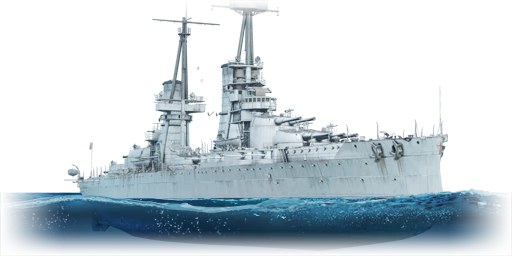
The RN Andrea Doria was the lead ship of the Andrea Doria-class battleships, also referred to as the Duilio-class in Italian sources. The class consisted of the two ships Andrea Doria and Duilio, also referred to as Caio Duilio. The two ships were improved Conte di Cavour-class battleships and just like them, they shared the same main armament of thirteen 305 mm/46 Model 1909 guns. Secondary armament consisted of sixteen Ansaldo 152 mm/45 Model 1911 cannons and nineteen 76 mm QF-14 pdr Mk.I cannons together with three 450 mm torpedo tubes. Andrea Doria was named after 16th century Genoese admiral. She was launched on 30th March 1913 and completed on 13th March 1916. She saw little action during World War I. During the 1920s, she helped suppress rebels in Fiume and took part in the 1923 Corfu incident. Between 1937 and 1940, Andrea Doria underwent a refit just like her sister Duilio, changing her armament to two triple and two twin OTO 320 mm Model 1934 guns, four triple 135 mm/45 OTO 1937 cannons, ten 90 mm/53 Ansaldo anti-aircraft guns, six twin and three single 37 mm/54 Breda autocannons, and eight twin 20 mm Breda Model 35 autocannons, together with her torpedo tubes being removed. After the refit, Andrea Doria took part in the First Battle of Sirte during which she damaged the British K-class destroyer HMS Kipling with near misses. After the armistice was signed, on 9th September 1943, she sailed to internment at Malta where she remained until 8th June 1944, after which she returned to Taranto on 14th March 1945. After the war, she served as the flagship of the Italian Navy together with her sister Duilio. She was paid off on 16th September 1956 after serving for more than 40 years and broken up for scrap in La Spezia.
The Duilio-class, RN Andrea Doria, 1930 was introduced in Update "Drone Age" as the second dreadnought of the Regia Marina after RN Dante Alighieri. She is in her pre-refit configuration, featuring her original thirteen 305 mm gun configuration without the enhanced anti-air suite. Her armour is also quite weak compared to other battleships she faces. Unlike other ships, she does not possess HE shells in her arsenal. Her SAP shells have issues overpenetrating destroyers and some light cruisers as they require 17 mm of armour to fuze. The same fuze sensitivity is required for her APCBC shell, which also carries only 5.66 kg TNT as opposed to heavier payload of her contemporaries.
General info
Survivability and armour

All battleships in this BR range have a relatively comparable armor. Differences rarely if every exceed 20%, and typically are below 10%. That said, Andrea Doria features below-average armor, while having one of the largest crew compliments.
Similarly to other battleships from World War 1, it has a number of crewmen exposed on an external gun mounts, making it easy for any ship armed with HE shells to kill a number of crewmen. Repairing these mounts will crew them back again, making it easy to lose the ship when under a constant HE fire. In order to prevent this, avoid repairing the ship until any of the vital components are damaged.
Shell rooms and auxiliary ammunition storage are protected deep below the waterline and/or multiple components, making it very difficult to destroy, even with a diving shells.
Ship lacks dedicated torpedo defence, but the coal bunkers along with heavy armor will reduce the impact of the hits from the torpedoes with smaller warheads (in particular: aerial torpedoes). Still, a care should be taken to avoid the hits if possible.
Mobility
Write about the ship's mobility. Evaluate its power and manoeuvrability, rudder rerouting speed, stopping speed at full tilt, with its maximum forward and reverse speed.
| Mobility Characteristics | |||
|---|---|---|---|
| Game Mode | Upgrade Status | Maximum Speed (km/h) | |
| Forward | Reverse | ||
| AB | |||
| Upgraded | |||
| RB/SB | |||
| Upgraded | |||
Modifications and economy
Armament
Primary armament
Provide information about the characteristics of the primary armament. Evaluate their efficacy in battle based on their reload speed, ballistics and the capacity of their shells. Add a link to the main article about the weapon: {{main|Weapon name (calibre)}}. Broadly describe the ammunition available for the primary armament, and provide recommendations on how to use it and which ammunition to choose.
| Penetration statistics | |||||||
|---|---|---|---|---|---|---|---|
| Ammunition | Type of warhead |
Penetration @ 0° Angle of Attack (mm) | |||||
| 1,000 m | 2,500 m | 5,000 m | 7,500 m | 10,000 m | 15,000 m | ||
| 305 mm SAP | SAP | 418 | 375 | 314 | 264 | 224 | 172 |
| 305 mm APCBC | APCBC | 673 | 611 | 521 | 447 | 387 | 303 |
| Shell details | ||||||||||||
|---|---|---|---|---|---|---|---|---|---|---|---|---|
| Ammunition | Type of warhead |
Velocity (m/s) |
Projectile mass (kg) |
Fuse delay (s) |
Fuse sensitivity (mm) |
Explosive mass (TNT equivalent) (kg) |
Ricochet | |||||
| 0% | 50% | 100% | ||||||||||
| 305 mm SAP | SAP | 861 | 401.2 | 0.03 | 17 | 31 | 47° | 60° | 65° | |||
| 305 mm APCBC | APCBC | 861 | 452.37 | 0.035 | 17 | 5.66 | 48° | 63° | 71° | |||
Secondary armament
Some ships are fitted with weapons of various calibres. Secondary armaments are defined as weapons chosen with the control Select secondary weapon. Evaluate the secondary armaments and give advice on how to use them. Describe the ammunition available for the secondary armament. Provide recommendations on how to use them and which ammunition to choose. Remember that any anti-air armament, even heavy calibre weapons, belong in the next section. If there is no secondary armament, remove this section.
| Penetration statistics | |||||||
|---|---|---|---|---|---|---|---|
| Ammunition | Type of warhead |
Penetration @ 0° Angle of Attack (mm) | |||||
| 1,000 m | 2,500 m | 5,000 m | 7,500 m | 10,000 m | 15,000 m | ||
| HE Dirompente | HE | 44 | 44 | 44 | 44 | 44 | 44 |
| APHE Perforante | APHE | 199 | 164 | 120 | 90 | 70 | 55 |
| APHE Perforante da 152/45-50 | APHE | 198 | 164 | 120 | 90 | 69 | 55 |
| Shell details | ||||||||||||
|---|---|---|---|---|---|---|---|---|---|---|---|---|
| Ammunition | Type of warhead |
Velocity (m/s) |
Projectile mass (kg) |
Fuse delay (s) |
Fuse sensitivity (mm) |
Explosive mass (TNT equivalent) (kg) |
Ricochet | |||||
| 0% | 50% | 100% | ||||||||||
| HE Dirompente | HE | 830 | 46.3 | 0 | 0.1 | 5.4 | 79° | 80° | 81° | |||
| APHE Perforante | APHE | 830 | 47.1 | 0.03 | 7 | 2.62 | 47° | 60° | 65° | |||
| APHE Perforante da 152/45-50 | APHE | 830 | 47 | 0.03 | 7 | 3.1 | 47° | 60° | 65° | |||
Anti-aircraft armament
An important part of the ship's armament responsible for air defence. Anti-aircraft armament is defined by the weapon chosen with the control Select anti-aircraft weapons. Talk about the ship's anti-air cannons and machine guns, the number of guns and their positions, their effective range, and about their overall effectiveness – including against surface targets. If there are no anti-aircraft armaments, remove this section.
Additional armament
Describe the available additional armaments of the ship: depth charges, mines, torpedoes. Talk about their positions, available ammunition and launch features such as dead zones of torpedoes. If there is no additional armament, remove this section.
Usage in battles
Describe the technique of using this ship, the characteristics of her use in a team and tips on strategy. Abstain from writing an entire guide – don't try to provide a single point of view, but give the reader food for thought. Talk about the most dangerous opponents for this vehicle and provide recommendations on fighting them. If necessary, note the specifics of playing with this vehicle in various modes (AB, RB, SB).
Pros and cons
Pros:
- Effective secondary armament for light targets
- Effective Main armament for most naval targets
- The 76mm present on top of Main guns has a rapid reload
- Average Speed and manoeuvrability
Cons:
- Very weak AAs
- Very easily destroyed by other BB and Battlecruisers
History
Devblog
While Italy was ramping up its construction of dreadnought battleships in the early 1910s, the decision was made to construct another two battleships in order to meet its naval rearmament goals. As ships of the Conte di Cavour class were already under construction at the time, shipbuilders decided to base the new class off the design of the former, while only applying some minor changes. This design was completed within six months and construction was ordered in September 1911.
Andrea Doria was laid down in March of 1912 in the Spezia dockyards and was subsequently launched the following year. However, it wouldn't be until 1916 before the warship was considered complete. This was due to numerous delays in the fitting out period, primarily due to difficulties in the supply of the ship's primary battery guns which caused significant delays. Nonetheless, the ship did see completion and officially joined the ranks of the Regia Marina in August 1916.
Despite entering service in the middle of WWI, Andrea Doria didn't see much combat action as the primary adversary - the Austro-Hungarian navy - operated in the Adriatic. However, as the Italian navy deemed the danger of submarines and minelayers for capital ships to be too great in the narrow waters of the Adriatic, most ended up not being deployed for extensive combat operations in that particular theater.
As a result, Andrea Doria survived The Great War without great incident and continued its service into the postwar period. In this time, it helped suppress a rebellion in Fiume and undertook several diplomatic missions to a number of ports in the Mediterranean and Black Sea. In August 1932 however, Andrea Doria was withdrawn from active service and placed in reserve. Starting in 1937 and going into 1940, Andrea Doria underwent a full reconstruction, which drastically changed the warship's visual appearance and combat capabilities.
Media
- Skins
See also
External links
| Arsenale militare marittimo della Spezia | |
|---|---|
| Battleships | |
| Conte di Cavour-class | RN Conte di Cavour |
| Duilio-class | RN Andrea Doria |
| Italy battleships | |
|---|---|
| RN Dante Alighieri* | |
| Conte di Cavour-class | RN Conte di Cavour · RN Leonardo da Vinci |
| Duilio-class | RN Duilio · RN Andrea Doria |
| Francesco Caracciolo-class | RN Francesco Caracciolo |
| * = Unique ship | |