Difference between pages "PB4Y-2 (China)" and "PBY-5A Catalina (USSR)"
| Line 1: | Line 1: | ||
| − | |||
{{About | {{About | ||
| − | |about= | + | | about = bomber '''{{PAGENAME}}''' |
| − | |usage=other | + | | usage = other versions |
| − | |link= | + | | link = PBY-5 (Family) |
}} | }} | ||
| + | {{Specs-Card | ||
| + | |code=pby-5a_ussr | ||
| + | |images={{Specs-Card-Image|GarageImage_{{PAGENAME}}.jpg}} | ||
| + | }} | ||
| + | |||
== Description == | == Description == | ||
<!-- ''In the description, the first part should be about the history of and the creation and combat usage of the aircraft, as well as its key features. In the second part, tell the reader about the aircraft in the game. Insert a screenshot of the vehicle, so that if the novice player does not remember the vehicle by name, he will immediately understand what kind of vehicle the article is talking about.'' --> | <!-- ''In the description, the first part should be about the history of and the creation and combat usage of the aircraft, as well as its key features. In the second part, tell the reader about the aircraft in the game. Insert a screenshot of the vehicle, so that if the novice player does not remember the vehicle by name, he will immediately understand what kind of vehicle the article is talking about.'' --> | ||
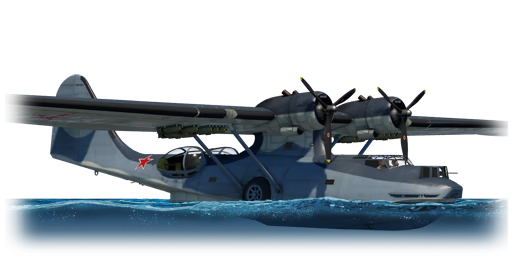
| − | + | The Catalina was the Soviet Union's main naval reconnaissance aircraft and naval bomber during and after the Second World War. It was so popular in fact that bombers meant to replace it, like the Be-6, never fully managed to fulfil its role. The Soviet Union received a total of 185 Catalinas of the two main variants in the Lend-Lease program. The Catalinas received by the Soviet Union were both the amphibious variants and those with tricycle landing gear. The Catalinas arrived to the Soviet Union in 1944 and gained good reputation in Soviet naval aviation, serving for many years as naval bombers and rescue aircraft, until they were finally fully retired from military service between 1954 and 1957. | |
| − | + | ||
| − | + | It has been in the game since the start of the Open Beta Test prior to Update 1.27. Although technically a medium bomber, the PBY-5's strategies are much like that of heavy bombers in higher tiers such as the Pe-8. It is best to fly high, and for fending off enemy fighters, it is better to use the rudder to direct one of the side gunners towards the attacking plane. It is also smart to use the guns manually in this situation, as the AI is often very inaccurate and will refuse to fire beyond a certain distance. The PBY-5A Catalina is slow and clunky, but it offers a heavy payload that is sure to be a game changer if used properly. It also has a very good defensive armament for its tier, which can occasionally be a saviour against an enemy fighter. The plane is quite unmanoeuvrable, and its wings are very weak, being able to snap just by turning just a little too tight at higher speeds in a realistic battle. This version has landing gear, facilitating the task of landing and enabling it to capture bases in Airfield Domination mode in Arcade Battles. | |
== General info == | == General info == | ||
=== Flight performance === | === Flight performance === | ||
| − | ''Describe how the aircraft behaves in the air. Speed, manoeuvrability, acceleration and allowable loads - these are the most important characteristics of the vehicle.'' | + | {{Specs-Avia-Flight}} |
| − | + | <!-- ''Describe how the aircraft behaves in the air. Speed, manoeuvrability, acceleration and allowable loads - these are the most important characteristics of the vehicle.'' --> | |
| − | {| class="wikitable" style="text-align:center" | + | {| class="wikitable" style="text-align:center" width="70%" |
| − | + | ! rowspan="2" | Characteristics | |
| − | + | ! colspan="2" | Max Speed<br>(km/h at 2,135 m) | |
| − | + | ! rowspan="2" | Max altitude<br>(metres) | |
| − | ! | ||
| − | |||
| − | ! colspan="2" | Max Speed<br>(km/h at | ||
| − | ! rowspan="2" | Max altitude<br>( | ||
! colspan="2" | Turn time<br>(seconds) | ! colspan="2" | Turn time<br>(seconds) | ||
| − | ! colspan="2" | Rate of climb<br>( | + | ! colspan="2" | Rate of climb<br>(metres/second) |
| − | ! rowspan="2" | Take-off run<br>( | + | ! rowspan="2" | Take-off run<br>(metres) |
|- | |- | ||
! AB !! RB !! AB !! RB !! AB !! RB | ! AB !! RB !! AB !! RB !! AB !! RB | ||
|- | |- | ||
| − | | | + | ! Stock |
| − | | | + | | 259 || 249 || rowspan="2" | {{Specs|ceiling}} || 31.0 || 31.9 || 2.6 || 2.6 || rowspan="2" | 364 |
| − | |||
| − | |||
| − | |||
| − | |||
| − | |||
| − | |||
| − | |||
| − | |||
| − | |||
|- | |- | ||
| − | | | + | ! Upgraded |
| + | | 310 || 282 || 29.1 || 30.0 || 8.7 || 5.1 | ||
|- | |- | ||
|} | |} | ||
==== Details ==== | ==== Details ==== | ||
| − | {| class="wikitable" style="text-align:center" | + | {| class="wikitable" style="text-align:center" width="50%" |
|- | |- | ||
! colspan="5" | Features | ! colspan="5" | Features | ||
| Line 52: | Line 44: | ||
! Combat flaps !! Take-off flaps !! Landing flaps !! Air brakes !! Arrestor gear | ! Combat flaps !! Take-off flaps !! Landing flaps !! Air brakes !! Arrestor gear | ||
|- | |- | ||
| − | | X || | + | | X || X || X || X || X <!-- ✓ --> |
|- | |- | ||
|} | |} | ||
| − | {| class="wikitable" style="text-align:center" | + | {| class="wikitable" style="text-align:center" width="50%" |
|- | |- | ||
| − | ! colspan=" | + | ! colspan="7" | Limits |
|- | |- | ||
| − | ! rowspan="2" | | + | ! rowspan="2" | Wings (km/h) |
| − | ! rowspan="2" | Gear | + | ! rowspan="2" | Gear (km/h) |
| − | ! | + | ! colspan="3" | Flaps (km/h) |
! colspan="2" | Max Static G | ! colspan="2" | Max Static G | ||
|- | |- | ||
| − | ! + !! - | + | ! Combat !! Take-off !! Landing !! + !! - |
|- | |- | ||
| − | | {{Specs|destruction| | + | | {{Specs|destruction|body}} || {{Specs|destruction|gear}} || N/A || N/A || N/A || ~3 || ~3 |
|- | |- | ||
|} | |} | ||
| Line 73: | Line 65: | ||
{| class="wikitable" style="text-align:center" | {| class="wikitable" style="text-align:center" | ||
|- | |- | ||
| − | ! colspan="4" | Optimal velocities | + | ! colspan="4" | Optimal velocities (km/h) |
|- | |- | ||
| − | ! Ailerons | + | ! Ailerons !! Rudder !! Elevators !! Radiator |
| − | ! Rudder | ||
| − | ! Elevators | ||
| − | ! Radiator | ||
|- | |- | ||
| − | | < | + | | < 220 || < 220 || < 230 || > 200 |
|- | |- | ||
|} | |} | ||
| − | |||
| − | + | === Survivability and armour === | |
| − | + | {{Specs-Avia-Armour}} | |
| − | + | <!-- ''Examine the survivability of the aircraft. Note how vulnerable the structure is and how secure the pilot is, whether the fuel tanks are armoured, etc. Describe the armour, if there is any, and also mention the vulnerability of other critical aircraft systems.'' --> | |
| − | |||
| − | |||
| − | |||
| − | |||
| − | |||
| − | |||
| − | |||
| − | |||
| − | |||
| − | ! | ||
| − | |||
| − | |||
| − | |||
| − | |||
| − | |||
| − | |||
| − | |||
| − | |||
| − | + | * 9.5 mm Steel - Plates behind pilot and co-pilot seats | |
| − | + | * 4.7 mm Steel - Plates between fuel tanks | |
| + | * 6.3 mm Steel - Plates behind fuel tanks | ||
| + | * 6.35 mm Steel - Ventral gunner hatch/door | ||
| + | * No armour glazing | ||
| + | * Critical components located in front of aircraft (fuel, pilot, engine, controls) | ||
| + | * More fuel tanks located in wings near fuselage | ||
| − | + | === Modifications and economy === | |
| + | {{Specs-Economy}} | ||
== Armaments == | == Armaments == | ||
| + | {{Specs-Avia-Armaments}} | ||
=== Suspended armament === | === Suspended armament === | ||
| − | <!--Describe the aircraft's suspended armament: additional cannons under the wings, bombs, rockets and torpedoes. This section is especially important for bombers and attackers. If there is no suspended weaponry remove this subsection.--> | + | {{Specs-Avia-Suspended}} |
| − | + | <!-- ''Describe the aircraft's suspended armament: additional cannons under the wings, bombs, rockets and torpedoes. This section is especially important for bombers and attackers. If there is no suspended weaponry remove this subsection.'' --> | |
| − | The '''''{{PAGENAME}}''''' can be outfitted with the following | + | The '''''{{PAGENAME}}''''' can be outfitted with the following ordnance: |
| − | + | {| class="wikitable" style="text-align:center" width="100%" | |
| − | + | |- | |
| − | * | + | ! !! width="7%" | 1 !! width="7%" | 2 !! width="7%" | 3 !! width="7%" | 4 !! width="7%" | 5 !! width="7%" | 6 |
| − | + | | rowspan="8" width="30%" | <div class="ttx-image">[[File:Hardpoints_PBY-5_Catalina.png]]</div> | |
| − | + | |- | |
| − | + | ! [[AN-M30A1 (100 lb)|100 lb AN-M30A1]] bombs | |
| − | + | | 1 || 1 || 6* || 6* || 1 || 1 | |
| − | + | |- | |
| − | + | ! [[AN-M64A1 (500 lb)|500 lb AN-M64A1]] bombs | |
| − | + | | 1 || 1* || || || 1* || 1 | |
| − | |||
| − | |||
| − | |||
|- | |- | ||
| − | ! | + | ! [[AN-M65A1 (1,000 lb)|1,000 lb AN-M65A1]] bombs |
| + | | 1 || 1* || || || 1* || 1 | ||
|- | |- | ||
| − | ! | + | ! [[Mk.13-6 Case (2,216 lb)|2,216 lb Mk.13-6 Case]] torpedoes |
| − | + | | || || 1 || 1 || || | |
| − | |||
| − | |||
| − | |||
|- | |- | ||
| − | | | + | ! [[Mk.13-6 (2,216 lb)|2,216 lb Mk.13-6]] torpedoes |
| + | | || || 1 || 1 || || | ||
|- | |- | ||
| − | | | + | ! [[Type A Mark I mine|Type A Mark I]] mines |
| + | | 1 || 1* || || || 1* || 1 | ||
|- | |- | ||
| − | | | + | | colspan="7" | Maximum permissible loadout weight: 2,200 kg<br>Maximum permissible wing load: 1,100 kg<br>Maximum permissible weight imbalance: 800 kg |
|- | |- | ||
| − | | | + | | colspan="8" | * Marked ordnance on hardpoints 2/5 cannot be equipped in conjunction with 100 lb bombs on hardpoints 3/4 respectively |
|- | |- | ||
|} | |} | ||
| − | == | + | {{Navigation-Start|Default weapon presets}} |
| − | <!-- | + | {{Navigation-First-Simple-Line}} |
| − | + | ||
| + | * 16 x 100 lb AN-M30A1 bombs (1,600 lb total) | ||
| + | * 4 x 500 lb AN-M64A1 bombs (2,000 lb total) | ||
| + | * 4 x 1,000 lb AN-M65A1 bombs (4,000 lb total) | ||
| + | * 4 x Type A Mark I mines | ||
| + | * 2 x 2,216 lb Mk.13-6 torpedoes | ||
| + | * 2 x 2,216 lb Mk.13-6 Case torpedoes | ||
| + | {{Navigation-End}} | ||
| + | |||
| + | === Defensive armament === | ||
| + | {{Specs-Avia-Defensive}} | ||
| + | <!-- ''Defensive armament with turret machine guns or cannons, crewed by gunners. Examine the number of gunners and what belts or drums are better to use. If defensive weaponry is not available, remove this subsection.'' --> | ||
| + | {{main|M2 Browning (12.7 mm)|Browning (7.62 mm)}} | ||
| − | + | The '''''{{PAGENAME}}''''' is defended by: | |
| − | |||
| − | + | * 1 x 12.7 mm M2 Browning machine gun, 2 x beam turrets (478 rpg) | |
| − | + | * 2 x 7.62 mm Browning machine guns, nose turret (1,050 rpg = 2,100 total) | |
| + | * 1 x 7.62 mm Browning machine gun, ventral turret (500 rpg) | ||
| − | + | == Usage in battles == | |
| + | <!-- ''Describe the tactics of playing in the aircraft, the features of using aircraft in a team and advice on tactics. Refrain from creating a "guide" - do not impose a single point of view, but instead, give the reader food for thought. Examine the most dangerous enemies and give recommendations on fighting them. If necessary, note the specifics of the game in different modes (AB, RB, SB).'' --> | ||
| + | Climb off to the side immediately and attempt to avoid all contact with enemy aircraft for as long as possible. The large bomb load will allow you to take care of bases easily, but the fact that this is a flying boat will prevent you from defending yourself in all directions. Never forget this aspect of the Catalina: It's defenceless against attacks from below. | ||
| − | + | ====Specific enemies worth noting==== | |
| + | <!--Some concerning vehicles to worry about if playing this plane. (i.e. Japanese fighters will out turn you)--> | ||
| + | Any vehicle with a 12.7 mm guns or higher or anything with a majority tracer filled belt. The .50 cals can easily disable your very much exposed engines and control surfaces, and tracer belts quickly ignite the exposed fuel tanks. | ||
| − | + | ====Counter-tactics==== | |
| + | <!--What to expect, if it would be in command of the enemy and how to counter it. (i.e. They will most likely BnZ, etc.)--> | ||
| + | Many enemies, due to your low rate of climb and slow speed, will engage you from above and in front. As the Catalina only has a weak gunner on the front, it is vital to engage them early if they approach from this direction. Scaring off enemies should be your main tactic if they approach you in any other direction, though using the rudder to twist your plane will allow you to use the rear gunners effectively against enemies behind you. | ||
=== Manual Engine Control === | === Manual Engine Control === | ||
| Line 172: | Line 164: | ||
! colspan="7" | MEC elements | ! colspan="7" | MEC elements | ||
|- | |- | ||
| − | ! rowspan="2" | Mixer | + | ! rowspan="2" |Mixer |
| − | ! rowspan="2" | Pitch | + | ! rowspan="2" |Pitch |
| − | ! colspan="3" | Radiator | + | ! colspan="3" |Radiator |
| − | ! rowspan="2" | Supercharger | + | ! rowspan="2" |Supercharger |
| − | ! rowspan="2" | Turbocharger | + | ! rowspan="2" |Turbocharger |
|- | |- | ||
| − | ! Oil | + | ! Oil |
| + | ! Water | ||
| + | ! Type | ||
|- | |- | ||
| − | | | + | | Not controllable || Controllable<br>Auto control available || Not controllable<br>Not auto controlled || Controllable<br>Not auto controlled || Combined || Not controllable<br>1 gear || Not controllable |
|- | |- | ||
|} | |} | ||
=== Pros and cons === | === Pros and cons === | ||
| − | <!--Summarise and briefly evaluate the vehicle in terms of its characteristics and combat effectiveness. Mark its pros and cons in the bulleted list. Try not to use more than 6 points for each of the characteristics. Avoid using categorical definitions such as "bad", "good" and the like - use substitutions with softer forms such as "inadequate" and "effective".--> | + | <!-- ''Summarise and briefly evaluate the vehicle in terms of its characteristics and combat effectiveness. Mark its pros and cons in the bulleted list. Try not to use more than 6 points for each of the characteristics. Avoid using categorical definitions such as "bad", "good" and the like - use substitutions with softer forms such as "inadequate" and "effective".'' --> |
'''Pros:''' | '''Pros:''' | ||
| − | * | + | * Multiple turrets allow for good coverage of the bomber in all directions but directly above and below |
| − | * | + | * Massive bomb load for Tier I |
| − | * | + | * Can carry torpedoes unlike most bombers in the Soviet Tree |
| + | * Landing gear | ||
'''Cons:''' | '''Cons:''' | ||
| − | * | + | * Terrible roll rate |
| − | * | + | * Slow |
| − | * | + | * Cannot defend itself from attacks directed at it from above or below |
| + | * Wings are extremely fragile | ||
== History == | == History == | ||
| − | ''Describe the history of the creation and combat usage of the aircraft in more detail than in the introduction. If the historical reference turns out to be too long, take it to a separate article, taking a link to the article about the vehicle and adding a block "/History" (example: <nowiki>https://wiki.warthunder.com/(Vehicle-name)/History</nowiki>) and add a link to it here using the <code>main</code> template. Be sure to reference text and sources by using <code><nowiki><ref></ref></nowiki></code>, as well as adding them at the end of the article with <code><nowiki><references /></nowiki></code>. This section may also include the vehicle's dev blog entry (if applicable) and the in-game encyclopedia description (under <code><nowiki>=== In-game description ===</nowiki></code>, also if applicable).'' | + | <!-- ''Describe the history of the creation and combat usage of the aircraft in more detail than in the introduction. If the historical reference turns out to be too long, take it to a separate article, taking a link to the article about the vehicle and adding a block "/History" (example: <nowiki>https://wiki.warthunder.com/(Vehicle-name)/History</nowiki>) and add a link to it here using the <code>main</code> template. Be sure to reference text and sources by using <code><nowiki><ref></ref></nowiki></code>, as well as adding them at the end of the article with <code><nowiki><references /></nowiki></code>. This section may also include the vehicle's dev blog entry (if applicable) and the in-game encyclopedia description (under <code><nowiki>=== In-game description ===</nowiki></code>, also if applicable).'' --> |
| + | The PBY-5 flying boat and the PBY-5A amphibious aircraft, all-metal parasol monoplanes, were developed in the Consolidated Aircraft Corporation's design bureau under the direction of Isaac Laddon under the designation of Model 28. A prototype XP3Y-1 flying boat made its first flight on March 21, 1935. Full-scale production began in September 1936. | ||
| + | |||
| + | Full-scale production of the PBY-5В version began in 1939. This variant of the flying boat had a new tail assembly with a more angular rudder and 1,200 hp Pratt & Whitney R-1830-92 Twin Wasp fourteen-cylinder, air-cooled engines. The plane's defensive armament was reinforced: The 7.62 mm Browning M2.3 machine guns in the aircraft's gun placements were replaced with large-calibre 12.7 mm Colt-Browning M2.5 machine guns with 800 rounds each. Transparent drop-shaped blisters were installed on each side of the boat instead of sliding hatches. The aircraft's equipment was also upgraded. | ||
| + | |||
| + | At the same time as the PBY-5, Consolidated Aircraft designers developed an amphibious variant with retractable tricycle landing gear. The main wheels were hydraulically raised and stored in open bays between struts connected to the wing. The XPBY-5A prototype made its first flight on November 22, 1939. | ||
| + | The amphibious variant proved heavier than the PBY-5 flying boat, losing speed, ceiling height, and flight range, but these disadvantages were fully compensated for by the aircraft's increased combat capabilities. | ||
| + | |||
| + | Catalinas of various versions were in service with the USA and countries of the Anti-Hitler Coalition, including the USSR, where they were delivered as part of the Lend-Lease program. | ||
| + | |||
| + | The Soviets' naval aviation suffered a heavy crisis in the second half of the war. The enormous losses from the first years of the war went practically unremedied by any deliveries of new seaplanes from the aircraft industry. What the Soviet naval aviation industry could offer did not meet the standards of the time, either. Unable to provide their troops with domestically produced planes, the Soviet leaders had to ask for help from the Allies. | ||
| + | |||
| + | Catalinas were delivered to the USSR beginning in 1944. As part of the Soviet Naval Aviation force, these flying boats ran anti-submarine defence and long-distance reconnaissance missions and participated in rescue and landing operations. A total of 185 Catalinas of the PBN-1 and PBY-6A versions were delivered from the USA to the USSR. In addition, several PBY-5A amphibians were delivered to the Soviet Union: these aircraft were handed over to Soviet crews in 1944 at the Vancouver Island base. | ||
| + | |||
| + | The Catalinas that served with the Soviet Naval Aviation force were discarded from 1954 to 1957. | ||
| + | |||
| + | {{break}} | ||
| + | {{Navigation-Start|{{Annotation|Archive of the in-game description|An archive of the historical description of the vehicle that was presented in-game prior to Update 1.55 'Royal Armour'}}}} | ||
| + | {{Navigation-First-Simple-Line}} | ||
| + | Consolidated PBY-5A Catalina twin-engine, long-distance naval scout aircraft | ||
| + | |||
| + | The PBY-5 flying boat and the PBY-5A amphibious aircraft, all-metal parasol monoplanes, were developed in the Consolidated Aircraft Corporation's design bureau under the direction of Isaac Laddon under the designation of Model 28. A prototype XP3Y-1 flying boat made its first flight on March 21, 1935. Full-scale production began in September 1936. | ||
| + | |||
| + | Full-scale production of the PBY-5В version began in 1939. This variant of the flying boat had a new tail assembly with a more angular rudder and 1,200 hp Pratt & Whitney R-1830-92 Twin Wasp fourteen-cylinder, air-cooled engines. The plane's defensive armament was reinforced: The 7.62 mm Browning M2.3 machine guns in the aircraft's gun placements were replaced with large-calibre 12.7 mm Colt-Browning M2.5 machine guns with 800 rounds each. Transparent drop-shaped blisters were installed on each side of the boat instead of sliding hatches. The aircraft's equipment was also upgraded. | ||
| + | |||
| + | At the same time as the PBY-5, Consolidated Aircraft designers developed an amphibious variant with retractable tricycle landing gear. The main wheels were hydraulically raised and stored in open bays between struts connected to the wing. The XPBY-5A prototype made its first flight on November 22, 1939. | ||
| + | |||
| + | The amphibious variant proved heavier than the PBY-5 flying boat, losing speed, ceiling height, and flight range, but these disadvantages were fully compensated for by the aircraft's increased combat capabilities. | ||
| + | |||
| + | Catalinas of various versions were in service with the USA and countries of the Anti-Hitler Coalition, including the USSR, where they were delivered as part of the Lend-Lease programme. | ||
| + | |||
| + | The Soviets' naval aviation suffered a heavy crisis in the second half of the war. The enormous losses from the first years of the war went practically unremedied by any deliveries of new seaplanes from the aircraft industry. What the Soviet naval aviation industry could offer did not meet the standards of the time, either. Unable to provide their troops with domestically produced planes, the Soviet leaders had to ask for help from the Allies. | ||
| + | |||
| + | Catalinas were delivered to the USSR beginning in 1944. As part of the Soviet Naval Aviation force, these flying boats ran anti-submarine defence and long-distance reconnaissance missions and participated in rescue and landing operations. | ||
| + | |||
| + | A total of 185 Catalinas of the PBN-1 and PBY-6A versions were delivered from the USA to the USSR. In addition, several PBY-5A amphibians were delivered to the Soviet Union: these aircraft were handed over to Soviet crews in 1944 at the Vancouver Island base. | ||
| + | |||
| + | The Catalinas that served with the Soviet Naval Aviation force were discarded from 1954 to 1957. | ||
| + | {{Navigation-End}} | ||
== Media == | == Media == | ||
| − | ''Excellent additions to the article would be video guides, screenshots from the game, and photos.'' | + | <!-- ''Excellent additions to the article would be video guides, screenshots from the game, and photos.'' --> |
| + | |||
| + | ;Skins | ||
| + | |||
| + | * [https://live.warthunder.com/feed/camouflages/?vehicle=pby-5a_ussr Skins and camouflages for the {{PAGENAME}} from live.warthunder.com.] | ||
| + | |||
| + | ;Videos | ||
| + | {{Youtube-gallery|HjD-qAz3EOE|'''Premium Review. Russian PBY-5A Catalina. Infused with Soviet Might!''' - ''Joseph 2000''}} | ||
== See also == | == See also == | ||
| Line 212: | Line 253: | ||
== External links == | == External links == | ||
| − | ''Paste links to sources and external resources, such as:'' | + | <!-- ''Paste links to sources and external resources, such as:'' |
| + | * ''topic on the official game forum;'' | ||
| + | * ''other literature.'' --> | ||
| − | * | + | * [http://forum.warthunder.com/index.php?/topic/18963-pby-5a-catalina-official-thread/ <nowiki>[Forum]</nowiki> PBY-5A Catalina Official Thread] |
| − | |||
| − | |||
{{AirManufacturer Consolidated}} | {{AirManufacturer Consolidated}} | ||
| − | {{ | + | {{USSR bombers}} |
| + | {{USSR premium aircraft}} | ||
Latest revision as of 07:42, 24 June 2024
| This page is about the bomber PBY-5A Catalina (USSR). For other versions, see PBY-5 (Family). |
.jpg)
Contents
Description
The Catalina was the Soviet Union's main naval reconnaissance aircraft and naval bomber during and after the Second World War. It was so popular in fact that bombers meant to replace it, like the Be-6, never fully managed to fulfil its role. The Soviet Union received a total of 185 Catalinas of the two main variants in the Lend-Lease program. The Catalinas received by the Soviet Union were both the amphibious variants and those with tricycle landing gear. The Catalinas arrived to the Soviet Union in 1944 and gained good reputation in Soviet naval aviation, serving for many years as naval bombers and rescue aircraft, until they were finally fully retired from military service between 1954 and 1957.
It has been in the game since the start of the Open Beta Test prior to Update 1.27. Although technically a medium bomber, the PBY-5's strategies are much like that of heavy bombers in higher tiers such as the Pe-8. It is best to fly high, and for fending off enemy fighters, it is better to use the rudder to direct one of the side gunners towards the attacking plane. It is also smart to use the guns manually in this situation, as the AI is often very inaccurate and will refuse to fire beyond a certain distance. The PBY-5A Catalina is slow and clunky, but it offers a heavy payload that is sure to be a game changer if used properly. It also has a very good defensive armament for its tier, which can occasionally be a saviour against an enemy fighter. The plane is quite unmanoeuvrable, and its wings are very weak, being able to snap just by turning just a little too tight at higher speeds in a realistic battle. This version has landing gear, facilitating the task of landing and enabling it to capture bases in Airfield Domination mode in Arcade Battles.
General info
Flight performance
| Characteristics | Max Speed (km/h at 2,135 m) |
Max altitude (metres) |
Turn time (seconds) |
Rate of climb (metres/second) |
Take-off run (metres) | |||
|---|---|---|---|---|---|---|---|---|
| AB | RB | AB | RB | AB | RB | |||
| Stock | 259 | 249 | 31.0 | 31.9 | 2.6 | 2.6 | 364 | |
| Upgraded | 310 | 282 | 29.1 | 30.0 | 8.7 | 5.1 | ||
Details
| Features | ||||
|---|---|---|---|---|
| Combat flaps | Take-off flaps | Landing flaps | Air brakes | Arrestor gear |
| X | X | X | X | X |
| Limits | ||||||
|---|---|---|---|---|---|---|
| Wings (km/h) | Gear (km/h) | Flaps (km/h) | Max Static G | |||
| Combat | Take-off | Landing | + | - | ||
| N/A | N/A | N/A | ~3 | ~3 | ||
| Optimal velocities (km/h) | |||
|---|---|---|---|
| Ailerons | Rudder | Elevators | Radiator |
| < 220 | < 220 | < 230 | > 200 |
Survivability and armour
- 9.5 mm Steel - Plates behind pilot and co-pilot seats
- 4.7 mm Steel - Plates between fuel tanks
- 6.3 mm Steel - Plates behind fuel tanks
- 6.35 mm Steel - Ventral gunner hatch/door
- No armour glazing
- Critical components located in front of aircraft (fuel, pilot, engine, controls)
- More fuel tanks located in wings near fuselage
Modifications and economy
Armaments
Suspended armament
The PBY-5A Catalina (USSR) can be outfitted with the following ordnance:
| 1 | 2 | 3 | 4 | 5 | 6 |  | |
|---|---|---|---|---|---|---|---|
| 100 lb AN-M30A1 bombs | 1 | 1 | 6* | 6* | 1 | 1 | |
| 500 lb AN-M64A1 bombs | 1 | 1* | 1* | 1 | |||
| 1,000 lb AN-M65A1 bombs | 1 | 1* | 1* | 1 | |||
| 2,216 lb Mk.13-6 Case torpedoes | 1 | 1 | |||||
| 2,216 lb Mk.13-6 torpedoes | 1 | 1 | |||||
| Type A Mark I mines | 1 | 1* | 1* | 1 | |||
| Maximum permissible loadout weight: 2,200 kg Maximum permissible wing load: 1,100 kg Maximum permissible weight imbalance: 800 kg | |||||||
| * Marked ordnance on hardpoints 2/5 cannot be equipped in conjunction with 100 lb bombs on hardpoints 3/4 respectively | |||||||
| Default weapon presets | |
|---|---|
| |
Defensive armament
The PBY-5A Catalina (USSR) is defended by:
- 1 x 12.7 mm M2 Browning machine gun, 2 x beam turrets (478 rpg)
- 2 x 7.62 mm Browning machine guns, nose turret (1,050 rpg = 2,100 total)
- 1 x 7.62 mm Browning machine gun, ventral turret (500 rpg)
Usage in battles
Climb off to the side immediately and attempt to avoid all contact with enemy aircraft for as long as possible. The large bomb load will allow you to take care of bases easily, but the fact that this is a flying boat will prevent you from defending yourself in all directions. Never forget this aspect of the Catalina: It's defenceless against attacks from below.
Specific enemies worth noting
Any vehicle with a 12.7 mm guns or higher or anything with a majority tracer filled belt. The .50 cals can easily disable your very much exposed engines and control surfaces, and tracer belts quickly ignite the exposed fuel tanks.
Counter-tactics
Many enemies, due to your low rate of climb and slow speed, will engage you from above and in front. As the Catalina only has a weak gunner on the front, it is vital to engage them early if they approach from this direction. Scaring off enemies should be your main tactic if they approach you in any other direction, though using the rudder to twist your plane will allow you to use the rear gunners effectively against enemies behind you.
Manual Engine Control
| MEC elements | ||||||
|---|---|---|---|---|---|---|
| Mixer | Pitch | Radiator | Supercharger | Turbocharger | ||
| Oil | Water | Type | ||||
| Not controllable | Controllable Auto control available |
Not controllable Not auto controlled |
Controllable Not auto controlled |
Combined | Not controllable 1 gear |
Not controllable |
Pros and cons
Pros:
- Multiple turrets allow for good coverage of the bomber in all directions but directly above and below
- Massive bomb load for Tier I
- Can carry torpedoes unlike most bombers in the Soviet Tree
- Landing gear
Cons:
- Terrible roll rate
- Slow
- Cannot defend itself from attacks directed at it from above or below
- Wings are extremely fragile
History
The PBY-5 flying boat and the PBY-5A amphibious aircraft, all-metal parasol monoplanes, were developed in the Consolidated Aircraft Corporation's design bureau under the direction of Isaac Laddon under the designation of Model 28. A prototype XP3Y-1 flying boat made its first flight on March 21, 1935. Full-scale production began in September 1936.
Full-scale production of the PBY-5В version began in 1939. This variant of the flying boat had a new tail assembly with a more angular rudder and 1,200 hp Pratt & Whitney R-1830-92 Twin Wasp fourteen-cylinder, air-cooled engines. The plane's defensive armament was reinforced: The 7.62 mm Browning M2.3 machine guns in the aircraft's gun placements were replaced with large-calibre 12.7 mm Colt-Browning M2.5 machine guns with 800 rounds each. Transparent drop-shaped blisters were installed on each side of the boat instead of sliding hatches. The aircraft's equipment was also upgraded.
At the same time as the PBY-5, Consolidated Aircraft designers developed an amphibious variant with retractable tricycle landing gear. The main wheels were hydraulically raised and stored in open bays between struts connected to the wing. The XPBY-5A prototype made its first flight on November 22, 1939. The amphibious variant proved heavier than the PBY-5 flying boat, losing speed, ceiling height, and flight range, but these disadvantages were fully compensated for by the aircraft's increased combat capabilities.
Catalinas of various versions were in service with the USA and countries of the Anti-Hitler Coalition, including the USSR, where they were delivered as part of the Lend-Lease program.
The Soviets' naval aviation suffered a heavy crisis in the second half of the war. The enormous losses from the first years of the war went practically unremedied by any deliveries of new seaplanes from the aircraft industry. What the Soviet naval aviation industry could offer did not meet the standards of the time, either. Unable to provide their troops with domestically produced planes, the Soviet leaders had to ask for help from the Allies.
Catalinas were delivered to the USSR beginning in 1944. As part of the Soviet Naval Aviation force, these flying boats ran anti-submarine defence and long-distance reconnaissance missions and participated in rescue and landing operations. A total of 185 Catalinas of the PBN-1 and PBY-6A versions were delivered from the USA to the USSR. In addition, several PBY-5A amphibians were delivered to the Soviet Union: these aircraft were handed over to Soviet crews in 1944 at the Vancouver Island base.
The Catalinas that served with the Soviet Naval Aviation force were discarded from 1954 to 1957.
| Archive of the in-game description | |
|---|---|
|
Consolidated PBY-5A Catalina twin-engine, long-distance naval scout aircraft The PBY-5 flying boat and the PBY-5A amphibious aircraft, all-metal parasol monoplanes, were developed in the Consolidated Aircraft Corporation's design bureau under the direction of Isaac Laddon under the designation of Model 28. A prototype XP3Y-1 flying boat made its first flight on March 21, 1935. Full-scale production began in September 1936. Full-scale production of the PBY-5В version began in 1939. This variant of the flying boat had a new tail assembly with a more angular rudder and 1,200 hp Pratt & Whitney R-1830-92 Twin Wasp fourteen-cylinder, air-cooled engines. The plane's defensive armament was reinforced: The 7.62 mm Browning M2.3 machine guns in the aircraft's gun placements were replaced with large-calibre 12.7 mm Colt-Browning M2.5 machine guns with 800 rounds each. Transparent drop-shaped blisters were installed on each side of the boat instead of sliding hatches. The aircraft's equipment was also upgraded. At the same time as the PBY-5, Consolidated Aircraft designers developed an amphibious variant with retractable tricycle landing gear. The main wheels were hydraulically raised and stored in open bays between struts connected to the wing. The XPBY-5A prototype made its first flight on November 22, 1939. The amphibious variant proved heavier than the PBY-5 flying boat, losing speed, ceiling height, and flight range, but these disadvantages were fully compensated for by the aircraft's increased combat capabilities. Catalinas of various versions were in service with the USA and countries of the Anti-Hitler Coalition, including the USSR, where they were delivered as part of the Lend-Lease programme. The Soviets' naval aviation suffered a heavy crisis in the second half of the war. The enormous losses from the first years of the war went practically unremedied by any deliveries of new seaplanes from the aircraft industry. What the Soviet naval aviation industry could offer did not meet the standards of the time, either. Unable to provide their troops with domestically produced planes, the Soviet leaders had to ask for help from the Allies. Catalinas were delivered to the USSR beginning in 1944. As part of the Soviet Naval Aviation force, these flying boats ran anti-submarine defence and long-distance reconnaissance missions and participated in rescue and landing operations. A total of 185 Catalinas of the PBN-1 and PBY-6A versions were delivered from the USA to the USSR. In addition, several PBY-5A amphibians were delivered to the Soviet Union: these aircraft were handed over to Soviet crews in 1944 at the Vancouver Island base. The Catalinas that served with the Soviet Naval Aviation force were discarded from 1954 to 1957. | |
Media
- Skins
- Videos
See also
Links to the articles on the War Thunder Wiki that you think will be useful for the reader, for example:
- reference to the series of the aircraft;
- links to approximate analogues of other nations and research trees.
External links
| Consolidated Aircraft Corporation | |
|---|---|
| Bombers | PBY-5 Catalina · PBY-5A Catalina |
| PB4Y-2 | |
| B-24D-25-CO | |
| Export | ▄Catalina Mk IIIa · ▂PBY-5A Catalina · ▄PBY-5A Late · ␗PB4Y-2 · ▄PB4Y-2 |
| USSR bombers | |
|---|---|
| SB and Ar | SB 2M-100 · SB 2M-103 · SB 2M-103 MV-3 · SB 2M-103U · SB 2M-103U MV-3 · SB 2M-105 · Ar-2 |
| Yer-2 (petrol) | Yer-2 (M-105) · Yer-2 (M-105) TAT · Yer-2 (M-105R) TAT · Yer-2 (M-105R) LU |
| Yer-2 (diesel) | Yer-2 (ACh-30B) (e) · Yer-2 (ACh-30B) (l) |
| Tu | Tu-2 · Tu-2S · Tu-2S-44 · Tu-2S-59 · Tu-4 |
| Pe | Pe-2-1 · Pe-2-31 · Pe-2-83 · Pe-2-110 · Pe-2-205 · Pe-2-359 · Pe-8 |
| IL | DB-3B · IL-4 |
| Po | Po-2 · Po-2M |
| Other | MBR-2-M-34 · TB-3M-17-32 · Yak-4 · Be-6 |
| Lend-Lease | ▂PBY-5A Catalina · ▂Hampden TB Mk I · ▂A-20G-30 · ▂B-25J-30 |
| USSR premium aircraft | |
|---|---|
| Fighters | Krasnolutsky's I-15bis · I-16 type 28 · Zhukovsky's I-153-M62 · I-153P · I-180S · I-301 · ITP (M-1) |
| LaGG-3-4 · LaGG-3-23 · LaGG-3-34 · Dolgushin's La-7 · La-11 | |
| Eremin's Yak-3(e) · Yak-3 (VK-107) · Yak-3T · Golovachev's Yak-9M | |
| ▂P-39K-1 · ▂Pokryshkin's P-39N-0 · ▂P-39Q-15 · ▂P-40E-1 · ▂P-47D-27 · ▂P-63A-5 · ▂P-63A-10 · ▂P-63C-5 | |
| ▂Hurricane Mk IIB · ▂Spitfire Mk IXc · ▂Fw 190 D-9 | |
| Twin-engine fighters | I-29 |
| Jet fighters | Su-11 · MiG-15bis ISh · MiG-17AS · MiG-21S (R-13-300) · MiG-23ML |
| Strike aircraft | IL-2M "Avenger" · IL-2 M-82 · IL-8 (1944) · Su-6 · Tandem MAI · TIS MA · Su-8 · Tu-1 |
| Yak-38 · Su-7BMK · Su-25K · Su-39 | |
| Bombers | Po-2M · Be-6 · MBR-2-M-34 · Pe-2-205 · TB-3M-17-32 |
| ▂PBY-5A Catalina · ▂Hampden TB Mk I · ▂A-20G-30 · ▂B-25J-30 | |