Difference between pages "Meteor F Mk.8 Reaper" and "Meteor F Mk 4 G.41F"
(→Offensive armament: Updated) |
|||
| Line 1: | Line 1: | ||
| + | {{About | ||
| + | | about = British jet fighter '''{{PAGENAME}}''' | ||
| + | | usage = other versions | ||
| + | | link = Meteor (Family) | ||
| + | }} | ||
{{Specs-Card | {{Specs-Card | ||
| − | |code= | + | |code=meteor_fmk4_lw |
| − | + | |images={{Specs-Card-Image|GarageImage_{{PAGENAME}}.jpg}} | |
| − | {{ | ||
| − | | | ||
| − | |||
| − | |||
| − | |||
| − | |||
| − | |||
}} | }} | ||
== Description == | == Description == | ||
<!-- ''In the description, the first part should be about the history of and the creation and combat usage of the aircraft, as well as its key features. In the second part, tell the reader about the aircraft in the game. Insert a screenshot of the vehicle, so that if the novice player does not remember the vehicle by name, he will immediately understand what kind of vehicle the article is talking about.'' --> | <!-- ''In the description, the first part should be about the history of and the creation and combat usage of the aircraft, as well as its key features. In the second part, tell the reader about the aircraft in the game. Insert a screenshot of the vehicle, so that if the novice player does not remember the vehicle by name, he will immediately understand what kind of vehicle the article is talking about.'' --> | ||
| − | + | The '''{{Specs|name}}''' is a rank {{Specs|rank}} British jet fighter {{Battle-rating}}. It has been in the game since the start of the Open Beta Test prior to Update 1.27. | |
| − | |||
| − | The '''{{Specs|name}}''' is a | ||
| − | |||
| − | |||
== General info == | == General info == | ||
=== Flight performance === | === Flight performance === | ||
| − | ''Describe how the aircraft behaves in the air. Speed, manoeuvrability, acceleration and allowable loads - these are the most important characteristics of the vehicle.'' | + | {{Specs-Avia-Flight}} |
| + | <!-- ''Describe how the aircraft behaves in the air. Speed, manoeuvrability, acceleration and allowable loads - these are the most important characteristics of the vehicle.'' --> | ||
| + | The Meteor F Mk 4 G.41F performs far better than the [[Meteor F Mk 3]]; it is very similar to the [[Sea Meteor F Mk 3]], but better optimised for high speed flight. When compared to the [[Sea Meteor F Mk 3]], at first glance the Meteor F Mk 4 G.41F may seem somewhat unappealing; it has the same mass and thrust, seemingly a very similar airframe, but a higher BR. However on closer inspection the Meteor F Mk 4 G.41F improves upon many of the annoyances of the Sea Meteor. The wing ripping speed has been increased by ~150 km/h and the wings have been strengthened reducing the risk of wing ripping in turns; the high speed handling has been improved (via increased in the control surface effective speeds), and drag reduced. These changes allow the Meteor F Mk 4 G.41F to achieve higher speeds than the Sea Meteor, and mean you will no longer exceed your wing ripping speed in level flight; and make the aircraft more enjoyable to fly at high speeds. | ||
| − | {| class="wikitable" style="text-align:center" | + | {| class="wikitable" style="text-align:center" width="70%" |
| − | + | ! rowspan="2" | Characteristics | |
| − | + | ! colspan="2" | Max Speed<br>(km/h at 600 m) | |
| − | + | ! rowspan="2" | Max altitude<br>(metres) | |
| − | ! | ||
| − | |||
| − | ! colspan="2" | Max Speed<br>(km/h at | ||
| − | ! rowspan="2" | Max altitude<br>( | ||
! colspan="2" | Turn time<br>(seconds) | ! colspan="2" | Turn time<br>(seconds) | ||
| − | ! colspan="2" | Rate of climb<br>( | + | ! colspan="2" | Rate of climb<br>(metres/second) |
| − | ! rowspan="2" | Take-off run<br>( | + | ! rowspan="2" | Take-off run<br>(metres) |
|- | |- | ||
! AB !! RB !! AB !! RB !! AB !! RB | ! AB !! RB !! AB !! RB !! AB !! RB | ||
|- | |- | ||
| − | | | + | ! Stock |
| − | + | | 904 || 877 || rowspan="2" | {{Specs|ceiling}} || 20.2 || 21.4 || 30.8 || 29.2 || rowspan="2" | 325 | |
| − | |||
| − | |||
| − | |||
| − | |||
| − | |||
| − | |||
| − | |||
| − | |||
| − | |||
|- | |- | ||
| − | | 976 || | + | ! Upgraded |
| + | | 976 || 945 || 19.8 || 20.0 || 43.7 || 37.0 | ||
|- | |- | ||
|} | |} | ||
==== Details ==== | ==== Details ==== | ||
| − | {| class="wikitable" style="text-align:center" | + | {| class="wikitable" style="text-align:center" width="50%" |
|- | |- | ||
| − | ! colspan=" | + | ! colspan="6" | Features |
|- | |- | ||
| − | ! Combat flaps !! Take-off flaps !! Landing flaps !! Air brakes !! Arrestor gear | + | ! Combat flaps !! Take-off flaps !! Landing flaps !! Air brakes !! Arrestor gear !! Drogue chute |
|- | |- | ||
| − | | ✓ || ✓ || ✓ || ✓ || X <!-- ✓ --> | + | | ✓ || ✓ || ✓ || ✓ || X || X <!-- ✓ --> |
|- | |- | ||
|} | |} | ||
| − | {| class="wikitable" style="text-align:center" | + | {| class="wikitable" style="text-align:center" width="50%" |
|- | |- | ||
| − | ! colspan=" | + | ! colspan="7" | Limits |
|- | |- | ||
| − | ! rowspan="2" | | + | ! rowspan="2" | Wings (km/h) |
| − | ! rowspan="2" | Gear | + | ! rowspan="2" | Gear (km/h) |
| − | ! | + | ! colspan="3" | Flaps (km/h) |
! colspan="2" | Max Static G | ! colspan="2" | Max Static G | ||
|- | |- | ||
| − | ! + !! - | + | ! Combat !! Take-off !! Landing !! + !! - |
|- | |- | ||
| − | | {{Specs|destruction| | + | | 999 <!-- {{Specs|destruction|body}} --> || {{Specs|destruction|gear}} || 495 || 462 || 290 || ~8 || ~4 |
|- | |- | ||
|} | |} | ||
| Line 81: | Line 65: | ||
{| class="wikitable" style="text-align:center" | {| class="wikitable" style="text-align:center" | ||
|- | |- | ||
| − | ! colspan="4" | Optimal velocities | + | ! colspan="4" | Optimal velocities (km/h) |
|- | |- | ||
| − | ! Ailerons | + | ! Ailerons !! Rudder !! Elevators !! Radiator |
| − | ! Rudder | ||
| − | ! Elevators | ||
| − | ! Radiator | ||
|- | |- | ||
| − | | < | + | | < 500 || < 600 || < 590 || N/A |
|- | |- | ||
|} | |} | ||
| + | ==== Engine performance ==== | ||
{| class="wikitable" style="text-align:center" | {| class="wikitable" style="text-align:center" | ||
|- | |- | ||
| − | ! colspan="3" | | + | ! colspan="3" | Engine |
| + | ! colspan="3" | Aircraft mass | ||
|- | |- | ||
| − | ! colspan=" | + | ! colspan="2" | Engine name || Number |
| + | ! colspan="1" | {{Annotation|Basic mass|Mass of the aircraft with pilot and engine oil, but no fuel or weapons load}} || colspan="2" | Wing loading (full fuel) | ||
|- | |- | ||
| − | + | | colspan="2" | Rolls-Royce Derwent 5 || 2 | |
| − | + | | colspan="1" | 5,629 kg || colspan="2" | 197 kg/m<sup>2</sup> | |
| − | |||
|- | |- | ||
| − | | 0 m || 1, | + | ! colspan="3" | Engine characteristics |
| + | ! colspan="2" | Mass with fuel (no weapons load) || rowspan="2" | Max Takeoff<br>Weight | ||
| + | |- | ||
| + | ! Weight (each) || colspan="2" | Type | ||
| + | ! 5m fuel || 19m fuel | ||
| + | |- | ||
| + | | 443 kg || colspan="2" | Centrifugal-flow turbojet | ||
| + | | 5,989 kg || 6,829 kg || 6,940 kg | ||
| + | |- | ||
| + | ! colspan="3" | {{Annotation|Maximum engine thrust @ 0 m (RB/SB)|The maximum thrust produced by each engine, while mounted in the aircraft. NOTE: Thrust varies significantly depending on speed & altitude.}} | ||
| + | ! colspan="3" | Thrust to weight ratio @ 0 m (100%) | ||
| + | |- | ||
| + | ! Condition || 100% || WEP | ||
| + | ! 5m fuel || 19m fuel || MTOW | ||
| + | |- | ||
| + | | ''Stationary'' || 1,587 kgf || N/A | ||
| + | | 0.53 || 0.46 || 0.46 | ||
| + | |- | ||
| + | | ''Optimal'' || 1,587 kgf<br>(0 km/h) || N/A | ||
| + | | 0.53 || 0.46 || 0.46 | ||
|- | |- | ||
|} | |} | ||
=== Survivability and armour === | === Survivability and armour === | ||
| − | ''Examine the survivability of the aircraft. Note how vulnerable the structure is and how secure the pilot is, whether the fuel tanks are armoured, etc. Describe the armour, if there is any, and also mention the vulnerability of other critical aircraft systems.'' | + | {{Specs-Avia-Armour}} |
| + | <!-- ''Examine the survivability of the aircraft. Note how vulnerable the structure is and how secure the pilot is, whether the fuel tanks are armoured, etc. Describe the armour, if there is any, and also mention the vulnerability of other critical aircraft systems.'' --> | ||
| + | [[File:Meteor F Mk 4.png|thumb|Armour Layout for the Meteor F Mk 4 G.41F]] | ||
| + | |||
| + | ;Armour | ||
| + | * 38 mm Bulletproof glass in cockpit front. | ||
| + | * 12.7 mm Steel plate behind the pilot. | ||
| + | * 12.7 mm Steel plate in the nose. | ||
| + | |||
| + | ;Modules | ||
| + | * Critical components are located at the front of the aircraft (fuel, pilot, engine, controls). | ||
| + | |||
| + | === Modifications and economy === | ||
| + | {{Specs-Economy}} | ||
== Armaments == | == Armaments == | ||
| + | {{Specs-Avia-Armaments}} | ||
=== Offensive armament === | === Offensive armament === | ||
| + | {{Specs-Avia-Offensive}} | ||
<!-- ''Describe the offensive armament of the aircraft, if any. Describe how effective the cannons and machine guns are in a battle, and also what belts or drums are better to use. If there is no offensive weaponry, delete this subsection.'' --> | <!-- ''Describe the offensive armament of the aircraft, if any. Describe how effective the cannons and machine guns are in a battle, and also what belts or drums are better to use. If there is no offensive weaponry, delete this subsection.'' --> | ||
| − | {{main|Hispano Mk. | + | {{main|Hispano Mk.II (20 mm)}} |
The '''''{{PAGENAME}}''''' is armed with: | The '''''{{PAGENAME}}''''' is armed with: | ||
| − | * 4 x 20 mm Hispano Mk. | + | |
| + | * 4 x 20 mm Hispano Mk.II cannons, nose-mounted (180 rpg = 720 total) | ||
=== Suspended armament === | === Suspended armament === | ||
| + | {{Specs-Avia-Suspended}} | ||
<!-- ''Describe the aircraft's suspended armament: additional cannons under the wings, bombs, rockets and torpedoes. This section is especially important for bombers and attackers. If there is no suspended weaponry remove this subsection.'' --> | <!-- ''Describe the aircraft's suspended armament: additional cannons under the wings, bombs, rockets and torpedoes. This section is especially important for bombers and attackers. If there is no suspended weaponry remove this subsection.'' --> | ||
| − | {{main| | + | {{main|H.E. M.C. Mk.13 (1,000 lb)}} |
The '''''{{PAGENAME}}''''' can be outfitted with the following ordnance: | The '''''{{PAGENAME}}''''' can be outfitted with the following ordnance: | ||
| + | |||
* Without load | * Without load | ||
| − | + | * 2 x 1,000 lb H.E. M.C. Mk.13 bombs (2,000 lb total) | |
| − | |||
| − | |||
| − | |||
| − | |||
| − | * 2 x 1,000 lb | ||
| − | |||
== Usage in battles == | == Usage in battles == | ||
| − | ''Describe the tactics of playing in the aircraft, the features of using aircraft in a team and advice on tactics. Refrain from creating a "guide" - do not impose a single point of view, but instead, give the reader food for thought. Examine the most dangerous enemies and give recommendations on fighting them. If necessary, note the specifics of the game in different modes (AB, RB, SB).'' | + | <!-- ''Describe the tactics of playing in the aircraft, the features of using aircraft in a team and advice on tactics. Refrain from creating a "guide" - do not impose a single point of view, but instead, give the reader food for thought. Examine the most dangerous enemies and give recommendations on fighting them. If necessary, note the specifics of the game in different modes (AB, RB, SB).'' --> |
| + | The Meteor F Mk 4 G.41F flies very similarly to the [[Sea Meteor F Mk 3]], maintaining the Sea Meteor's good acceleration, speed and climb rate. Flying the Meteor F Mk 4 G.41F feels a lot like flying the Sea Meteor and two should be played in the much the same way. Where the Meteor F Mk 4 G.41F excels over the sea meteor is in high speed flight , the wing ripping speed has been substantially improved, a high speed handling is better. The wings are also stronger, so while you do still have to be careful at higher speeds you can feel more confident in your manoeuvres than in the Sea Meteor. | ||
| − | + | In general boom and zoom attacks work well in the Meteor F Mk 4 G.41F, you can dive on enemy aircraft and use your good acceleration and climb rate to get away quickly. If you need to slow yourself down when diving on enemy aircraft the airbrakes should be your first port of call, by keeping the engines spooled up you allow yourself to rapidly accelerate away from your target after an attack. While turn fighting is not generally recommended in jets the Meteor F Mk 4 G.41F (like all meteors) does have very good manoeuvrability, which can be used to your advantage in low latitude dog fights. The Meteor F Mk 4 G.41F can also be used as a bomber hunter, being fast enough to deal with early jet bombers, and having the climb rate to be able to intercept high altitude piston engine bombers (like the [[Tu-4]]); however the cannons can leave something to be desired when trying to deal with tougher bombers (particularly if you have the stock ammo belts). | |
| − | |||
| − | |||
| − | |||
| − | |||
| − | |||
| − | |||
| − | |||
| − | |||
| − | |||
| − | |||
| − | |||
| − | |||
| − | |||
| − | |||
| − | |||
| − | |||
| − | |||
| − | |||
| − | |||
| − | |||
| − | |||
| − | |||
| − | |||
| − | |||
| − | |||
| − | |||
| − | |||
| − | |||
| − | |||
| − | |||
| − | |||
| − | |||
| − | |||
| − | |||
| − | |||
=== Pros and cons === | === Pros and cons === | ||
| − | ''Summarise and briefly evaluate the vehicle in terms of its characteristics and combat effectiveness. Mark its pros and cons in the bulleted list. Try not to use more than 6 points for each of the characteristics. Avoid using categorical definitions such as "bad", "good" and the like - use substitutions with softer forms such as "inadequate" and "effective".'' | + | <!-- ''Summarise and briefly evaluate the vehicle in terms of its characteristics and combat effectiveness. Mark its pros and cons in the bulleted list. Try not to use more than 6 points for each of the characteristics. Avoid using categorical definitions such as "bad", "good" and the like - use substitutions with softer forms such as "inadequate" and "effective".'' --> |
'''Pros:''' | '''Pros:''' | ||
| − | * | + | |
| + | * Good acceleration | ||
| + | * High top speed | ||
| + | * Good energy retention | ||
| + | * Good at turning below 650 km/h | ||
| + | * Good climb rate | ||
| + | * Excellent ammo capacity for cannons (190 RPG for two of the cannons, 200 RPG for the other two) | ||
| + | * Easy to fly missing half a wing | ||
| + | * Will not rip wings in level flight, unlike the [[Sea Meteor F Mk 3]] | ||
'''Cons:''' | '''Cons:''' | ||
| − | * | + | |
| + | * Compression | ||
| + | * Loses manoeuvrability over 700 km/h significantly | ||
| + | * Rips easily if pulled hard at high speeds | ||
| + | * Limited visibility out of the rear of the cockpit | ||
| + | * Lacklustre roll rate | ||
== History == | == History == | ||
<!-- ''Describe the history of the creation and combat usage of the aircraft in more detail than in the introduction. If the historical reference turns out to be too long, take it to a separate article, taking a link to the article about the vehicle and adding a block "/History" (example: <nowiki>https://wiki.warthunder.com/(Vehicle-name)/History</nowiki>) and add a link to it here using the <code>main</code> template. Be sure to reference text and sources by using <code><nowiki><ref></ref></nowiki></code>, as well as adding them at the end of the article with <code><nowiki><references /></nowiki></code>. This section may also include the vehicle's dev blog entry (if applicable) and the in-game encyclopedia description (under <code><nowiki>=== In-game description ===</nowiki></code>, also if applicable).'' --> | <!-- ''Describe the history of the creation and combat usage of the aircraft in more detail than in the introduction. If the historical reference turns out to be too long, take it to a separate article, taking a link to the article about the vehicle and adding a block "/History" (example: <nowiki>https://wiki.warthunder.com/(Vehicle-name)/History</nowiki>) and add a link to it here using the <code>main</code> template. Be sure to reference text and sources by using <code><nowiki><ref></ref></nowiki></code>, as well as adding them at the end of the article with <code><nowiki><references /></nowiki></code>. This section may also include the vehicle's dev blog entry (if applicable) and the in-game encyclopedia description (under <code><nowiki>=== In-game description ===</nowiki></code>, also if applicable).'' --> | ||
| − | |||
| − | + | {{break}} | |
| + | {{Navigation-Start|{{Annotation|Archive of the in-game description|An archive of the historical description of the vehicle that was presented in-game prior to Update 1.55 'Royal Armour'}}|expand=true}} | ||
| + | {{Navigation-First-Simple-Line}} | ||
| + | In 1946 the Gloster Meteor F.Mk.4 was introduced; a variant intended to replace the F.Mk.3. The prototype F.Mk.4 flew for the first time on May 17th 1945; the new variant was powered by Rolls-Royce Derwent Mk.5 turbojet engines, producing 1,590 kg of thrust (more than twice as much as the Derwent Mk.1). The engines were fitted in new extended nacelles, which reduced drag, and a strengthened airframe design was incorporated to harness the increased power. Fitted with the new engines, the Meteor F.Mk.4 would go on to set two world air speed records in November 1945 and then again in September 1946. | ||
| + | |||
| + | Further modifications to the Meteor F.Mk.4 included its ailerons and adjustments to its rudder trim tab to reduce snaking. The cockpit was now fully pressurized and ventilated; previous versions of the Meteor had had a non-pressurized cockpit. | ||
| − | + | Trials of the prototype Gloster Meteor F.Mk.4 fighter showed that its maximum speed was increased by 180 km/h, but that this additional speed produced excessive stress on the wings. The wing panels, therefore, were made shorter from the ninth production aircraft onwards. This reduced the stress and improved horizontal manoeuvrability but reduced the rate of climb and the service ceiling. Type G.41F became the designation for the long-wing aircraft, and Type G.41G for the short-wing variant. | |
| − | + | The Gloster Meteor F.Mk.4 represented a significant leap in terms of performance and was produced in large numbers, including as an export fighter. Based on the F.Mk.4, the two-seat T.Mk.7 trainer was developed. | |
| − | + | By 1948 the F.Mk.4 had completely replaced the F.Mk.3 in the RAF and In May 1947, an export version was purchased by Argentina, followed by orders from Denmark, Egypt, Belgium and the Netherlands. | |
| − | + | 535 Gloster Meteor F.Mk.4 were produced for the RAF, with a further 168 aircraft being exported. | |
| + | {{Navigation-End}} | ||
| − | + | == Media == | |
| + | <!-- ''Excellent additions to the article would be video guides, screenshots from the game, and photos.'' --> | ||
| − | + | ;Skins | |
| − | = | + | * [https://live.warthunder.com/feed/camouflages/?vehicle=meteor_fmk4_lw Skins and camouflages for the {{PAGENAME}} from live.warthunder.com.] |
| − | |||
== See also == | == See also == | ||
| − | ''Links to the articles on the War Thunder Wiki that you think will be useful for the reader, for example:'' | + | <!-- ''Links to the articles on the War Thunder Wiki that you think will be useful for the reader, for example:'' |
* ''reference to the series of the aircraft;'' | * ''reference to the series of the aircraft;'' | ||
| − | * ''links to approximate analogues of other nations and research trees.'' | + | * ''links to approximate analogues of other nations and research trees.'' --> |
| + | |||
| + | ;Related development | ||
| + | |||
| + | * [[Meteor (Family)]] | ||
== External links == | == External links == | ||
| − | ''Paste links to sources and external resources, such as:'' | + | <!-- ''Paste links to sources and external resources, such as:'' |
* ''topic on the official game forum;'' | * ''topic on the official game forum;'' | ||
| − | * '' | + | * ''other literature.'' --> |
| − | * | + | |
| + | * [https://forum.warthunder.com/index.php?/topic/264951-gloster-meteor-f-mk4-g41f/ Official data sheet - more details about the performance] | ||
| + | * [[wikipedia:Gloster_Meteor|[Wikipedia] Gloster Meteor]] | ||
| + | * [http://www.airvectors.net/avmeteor.html <nowiki>[Air Vectors]</nowiki> The Gloster Meteor] | ||
{{AirManufacturer Gloster}} | {{AirManufacturer Gloster}} | ||
{{Britain jet aircraft}} | {{Britain jet aircraft}} | ||
| − | |||
Latest revision as of 15:23, 22 June 2024
| This page is about the British jet fighter Meteor F Mk 4 G.41F. For other versions, see Meteor (Family). |

Contents
Description
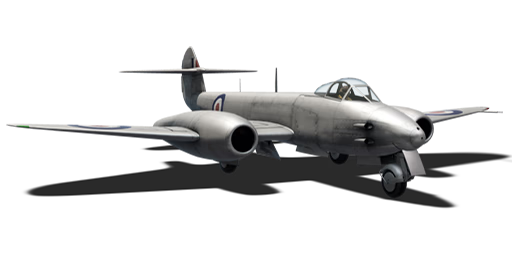
The Meteor F Mk 4 type G.41F is a rank British jet fighter with a battle rating of (AB), (RB), and (SB). It has been in the game since the start of the Open Beta Test prior to Update 1.27.
General info
Flight performance
The Meteor F Mk 4 G.41F performs far better than the Meteor F Mk 3; it is very similar to the Sea Meteor F Mk 3, but better optimised for high speed flight. When compared to the Sea Meteor F Mk 3, at first glance the Meteor F Mk 4 G.41F may seem somewhat unappealing; it has the same mass and thrust, seemingly a very similar airframe, but a higher BR. However on closer inspection the Meteor F Mk 4 G.41F improves upon many of the annoyances of the Sea Meteor. The wing ripping speed has been increased by ~150 km/h and the wings have been strengthened reducing the risk of wing ripping in turns; the high speed handling has been improved (via increased in the control surface effective speeds), and drag reduced. These changes allow the Meteor F Mk 4 G.41F to achieve higher speeds than the Sea Meteor, and mean you will no longer exceed your wing ripping speed in level flight; and make the aircraft more enjoyable to fly at high speeds.
| Characteristics | Max Speed (km/h at 600 m) |
Max altitude (metres) |
Turn time (seconds) |
Rate of climb (metres/second) |
Take-off run (metres) | |||
|---|---|---|---|---|---|---|---|---|
| AB | RB | AB | RB | AB | RB | |||
| Stock | 904 | 877 | 20.2 | 21.4 | 30.8 | 29.2 | 325 | |
| Upgraded | 976 | 945 | 19.8 | 20.0 | 43.7 | 37.0 | ||
Details
| Features | |||||
|---|---|---|---|---|---|
| Combat flaps | Take-off flaps | Landing flaps | Air brakes | Arrestor gear | Drogue chute |
| ✓ | ✓ | ✓ | ✓ | X | X |
| Limits | ||||||
|---|---|---|---|---|---|---|
| Wings (km/h) | Gear (km/h) | Flaps (km/h) | Max Static G | |||
| Combat | Take-off | Landing | + | - | ||
| 999 | 495 | 462 | 290 | ~8 | ~4 | |
| Optimal velocities (km/h) | |||
|---|---|---|---|
| Ailerons | Rudder | Elevators | Radiator |
| < 500 | < 600 | < 590 | N/A |
Engine performance
| Engine | Aircraft mass | ||||
|---|---|---|---|---|---|
| Engine name | Number | Basic mass | Wing loading (full fuel) | ||
| Rolls-Royce Derwent 5 | 2 | 5,629 kg | 197 kg/m2 | ||
| Engine characteristics | Mass with fuel (no weapons load) | Max Takeoff Weight | |||
| Weight (each) | Type | 5m fuel | 19m fuel | ||
| 443 kg | Centrifugal-flow turbojet | 5,989 kg | 6,829 kg | 6,940 kg | |
| Maximum engine thrust @ 0 m (RB/SB) | Thrust to weight ratio @ 0 m (100%) | ||||
| Condition | 100% | WEP | 5m fuel | 19m fuel | MTOW |
| Stationary | 1,587 kgf | N/A | 0.53 | 0.46 | 0.46 |
| Optimal | 1,587 kgf (0 km/h) |
N/A | 0.53 | 0.46 | 0.46 |
Survivability and armour

- Armour
- 38 mm Bulletproof glass in cockpit front.
- 12.7 mm Steel plate behind the pilot.
- 12.7 mm Steel plate in the nose.
- Modules
- Critical components are located at the front of the aircraft (fuel, pilot, engine, controls).
Modifications and economy
Armaments
Offensive armament
The Meteor F Mk 4 G.41F is armed with:
- 4 x 20 mm Hispano Mk.II cannons, nose-mounted (180 rpg = 720 total)
Suspended armament
The Meteor F Mk 4 G.41F can be outfitted with the following ordnance:
- Without load
- 2 x 1,000 lb H.E. M.C. Mk.13 bombs (2,000 lb total)
Usage in battles
The Meteor F Mk 4 G.41F flies very similarly to the Sea Meteor F Mk 3, maintaining the Sea Meteor's good acceleration, speed and climb rate. Flying the Meteor F Mk 4 G.41F feels a lot like flying the Sea Meteor and two should be played in the much the same way. Where the Meteor F Mk 4 G.41F excels over the sea meteor is in high speed flight , the wing ripping speed has been substantially improved, a high speed handling is better. The wings are also stronger, so while you do still have to be careful at higher speeds you can feel more confident in your manoeuvres than in the Sea Meteor.
In general boom and zoom attacks work well in the Meteor F Mk 4 G.41F, you can dive on enemy aircraft and use your good acceleration and climb rate to get away quickly. If you need to slow yourself down when diving on enemy aircraft the airbrakes should be your first port of call, by keeping the engines spooled up you allow yourself to rapidly accelerate away from your target after an attack. While turn fighting is not generally recommended in jets the Meteor F Mk 4 G.41F (like all meteors) does have very good manoeuvrability, which can be used to your advantage in low latitude dog fights. The Meteor F Mk 4 G.41F can also be used as a bomber hunter, being fast enough to deal with early jet bombers, and having the climb rate to be able to intercept high altitude piston engine bombers (like the Tu-4); however the cannons can leave something to be desired when trying to deal with tougher bombers (particularly if you have the stock ammo belts).
Pros and cons
Pros:
- Good acceleration
- High top speed
- Good energy retention
- Good at turning below 650 km/h
- Good climb rate
- Excellent ammo capacity for cannons (190 RPG for two of the cannons, 200 RPG for the other two)
- Easy to fly missing half a wing
- Will not rip wings in level flight, unlike the Sea Meteor F Mk 3
Cons:
- Compression
- Loses manoeuvrability over 700 km/h significantly
- Rips easily if pulled hard at high speeds
- Limited visibility out of the rear of the cockpit
- Lacklustre roll rate
History
| Archive of the in-game description | |
|---|---|
|
In 1946 the Gloster Meteor F.Mk.4 was introduced; a variant intended to replace the F.Mk.3. The prototype F.Mk.4 flew for the first time on May 17th 1945; the new variant was powered by Rolls-Royce Derwent Mk.5 turbojet engines, producing 1,590 kg of thrust (more than twice as much as the Derwent Mk.1). The engines were fitted in new extended nacelles, which reduced drag, and a strengthened airframe design was incorporated to harness the increased power. Fitted with the new engines, the Meteor F.Mk.4 would go on to set two world air speed records in November 1945 and then again in September 1946. Further modifications to the Meteor F.Mk.4 included its ailerons and adjustments to its rudder trim tab to reduce snaking. The cockpit was now fully pressurized and ventilated; previous versions of the Meteor had had a non-pressurized cockpit. Trials of the prototype Gloster Meteor F.Mk.4 fighter showed that its maximum speed was increased by 180 km/h, but that this additional speed produced excessive stress on the wings. The wing panels, therefore, were made shorter from the ninth production aircraft onwards. This reduced the stress and improved horizontal manoeuvrability but reduced the rate of climb and the service ceiling. Type G.41F became the designation for the long-wing aircraft, and Type G.41G for the short-wing variant. The Gloster Meteor F.Mk.4 represented a significant leap in terms of performance and was produced in large numbers, including as an export fighter. Based on the F.Mk.4, the two-seat T.Mk.7 trainer was developed. By 1948 the F.Mk.4 had completely replaced the F.Mk.3 in the RAF and In May 1947, an export version was purchased by Argentina, followed by orders from Denmark, Egypt, Belgium and the Netherlands. 535 Gloster Meteor F.Mk.4 were produced for the RAF, with a further 168 aircraft being exported. | |
Media
- Skins
See also
- Related development
External links
- Official data sheet - more details about the performance
- [Wikipedia] Gloster Meteor
- [Air Vectors] The Gloster Meteor
| Gloster Aircraft Company, Limited | |
|---|---|
| Fighters | Gladiator Mk II · Sea Gladiator Mk I · Gladiator Mk IIF · Gladiator Mk IIS · Tuck's Gladiator Mk II |
| Jet Fighters | Meteor F Mk 3 · Sea Meteor F Mk 3 · Meteor F Mk 4 G.41F · Meteor F Mk 4 G.41G · Meteor F Mk 8 G.41K · Meteor F Mk.8 Reaper |
| Javelin F.(A.W.) Mk.9 | |
| Export | J8A · Iacobi's J8A · ␗Gladiator Mk I · ▄Gladiator Mk I |
| ▄Meteor F Mk.8 · Meteor F.8 · Meteor NF.13 | |
| See Also | Fokker |
| Britain jet aircraft | |
|---|---|
| Blackburn | Buccaneer S.1 · Buccaneer S.2 · Buccaneer S.2B |
| British Aerospace | Harrier GR.7 · Sea Harrier FRS.1 (e) · Sea Harrier FRS.1 · Sea Harrier FA 2 |
| British Aircraft Corporation | Strikemaster Mk.88 |
| English Electric | Canberra B Mk 2 · Canberra B (I) Mk 6 · Lightning F.6 · Lightning F.53 |
| Gloster | Meteor F Mk 3 · Sea Meteor F Mk 3 · Meteor F Mk 4 G.41F · Meteor F Mk 4 G.41G · Meteor F Mk 8 G.41K · Meteor F Mk.8 Reaper |
| Javelin F.(A.W.) Mk.9 | |
| de Havilland | Vampire F.B.5 · Venom FB.4 · Sea Venom FAW 20 · Sea Vixen F.A.W. Mk.2 |
| Hawker | Sea Hawk FGA.6 · Hunter F.1 · Hunter F.6 · Hunter FGA.9 · Harrier GR.1 · Harrier GR.3 |
| Panavia | Tornado GR.1 · Tornado GR.4 · Tornado F.3 · Tornado F.3 Late |
| SEPECAT | Jaguar GR.1 · Jaguar GR.1A · Jaguar IS |
| Supermarine | Attacker FB 1 · Attacker FB.2 · Scimitar F Mk.1 · Swift F.1 · Swift F.7 |
| Foreign | Phantom FG.1 (USA) · Phantom FGR.2 (USA) · F-4J(UK) Phantom II (USA) |
| Australia | F-111C |
| India | ▄MiG-21 Bison |
| South Africa | ▄JAS39C |