Difference between revisions of "Tornado F.3 Late"
(Edits) |
U139526562 (talk | contribs) (Added some history and usefull links for more info.) (Tag: Visual edit) |
||
| (9 intermediate revisions by 6 users not shown) | |||
| Line 1: | Line 1: | ||
| − | |||
| − | |||
| − | |||
| − | |||
| − | |||
{{Specs-Card | {{Specs-Card | ||
|code=tornado_f3_late | |code=tornado_f3_late | ||
| Line 11: | Line 6: | ||
== Description == | == Description == | ||
<!-- ''In the description, the first part should be about the history of and the creation and combat usage of the aircraft, as well as its key features. In the second part, tell the reader about the aircraft in the game. Insert a screenshot of the vehicle, so that if the novice player does not remember the vehicle by name, he will immediately understand what kind of vehicle the article is talking about.'' --> | <!-- ''In the description, the first part should be about the history of and the creation and combat usage of the aircraft, as well as its key features. In the second part, tell the reader about the aircraft in the game. Insert a screenshot of the vehicle, so that if the novice player does not remember the vehicle by name, he will immediately understand what kind of vehicle the article is talking about.'' --> | ||
| − | + | The '''{{Specs|name}}''' is a rank {{Specs|rank}} British jet fighter {{Battle-rating}}. It was introduced in [[Update "Seek & Destroy"]]. | |
| − | |||
| − | The '''{{Specs|name}}''' is a British jet fighter- | ||
== General info == | == General info == | ||
| Line 23: | Line 16: | ||
{| class="wikitable" style="text-align:center" width="70%" | {| class="wikitable" style="text-align:center" width="70%" | ||
! rowspan="2" | Characteristics | ! rowspan="2" | Characteristics | ||
| − | ! colspan="2" | Max speed<br>(km/h at | + | ! colspan="2" | Max speed<br>(km/h at _,___ m) |
! rowspan="2" | Max altitude<br>(metres) | ! rowspan="2" | Max altitude<br>(metres) | ||
! colspan="2" | Turn time<br>(seconds) | ! colspan="2" | Turn time<br>(seconds) | ||
| Line 32: | Line 25: | ||
|- | |- | ||
! Stock | ! Stock | ||
| − | | | + | | ___ || ___ || rowspan="2" | {{Specs|ceiling}} || __._ || __._ || __._ || __._ || rowspan="2" | ___ |
|- | |- | ||
! Upgraded | ! Upgraded | ||
| Line 42: | Line 35: | ||
{| class="wikitable" style="text-align:center" width="50%" | {| class="wikitable" style="text-align:center" width="50%" | ||
|- | |- | ||
| − | ! colspan=" | + | ! colspan="6" | Features |
|- | |- | ||
| − | ! Combat flaps !! Take-off flaps !! Landing flaps !! Air brakes !! Arrestor gear !! Drogue chute | + | ! Combat flaps !! Take-off flaps !! Landing flaps !! Air brakes !! Arrestor gear !! Drogue chute |
|- | |- | ||
| − | | | + | | _ || _ || _ || _ || _ || _ <!-- ✓ --> |
|- | |- | ||
|} | |} | ||
| − | {| class="wikitable" style="text-align:center" width=" | + | {| class="wikitable" style="text-align:center" width="50%" |
| + | |- | ||
| + | ! colspan="7" | Limits | ||
|- | |- | ||
| − | |||
! rowspan="2" | Wings (km/h) | ! rowspan="2" | Wings (km/h) | ||
! rowspan="2" | Gear (km/h) | ! rowspan="2" | Gear (km/h) | ||
| Line 60: | Line 54: | ||
! Combat !! Take-off !! Landing !! + !! - | ! Combat !! Take-off !! Landing !! + !! - | ||
|- | |- | ||
| − | + | | {{Specs|destruction|body}} || {{Specs|destruction|gear}} || ___ || ___ || ___ || ~__ || ~__ | |
| − | | | ||
| − | |||
| − | |||
| − | |||
|- | |- | ||
|} | |} | ||
| Line 74: | Line 64: | ||
! Ailerons !! Rudder !! Elevators !! Radiator | ! Ailerons !! Rudder !! Elevators !! Radiator | ||
|- | |- | ||
| − | | < | + | | < ___ || < ___ || < ___ || - |
|- | |- | ||
|} | |} | ||
| Line 82: | Line 72: | ||
|- | |- | ||
! colspan="3" | Engine | ! colspan="3" | Engine | ||
| − | ! colspan=" | + | ! colspan="4" | Aircraft mass |
|- | |- | ||
! colspan="2" | Engine name || Number | ! colspan="2" | Engine name || Number | ||
| − | ! colspan=" | + | ! colspan="2" | {{Annotation|Basic mass|Mass of the aircraft with pilot and engine oil, but no fuel or weapons load}} || colspan="2" | Wing loading (full fuel) |
|- | |- | ||
| − | | colspan="2" | | + | | colspan="2" | _____ || _ |
| − | | colspan=" | + | | colspan="2" | _,___ kg || colspan="2" | ___ kg/m<sup>2</sup> |
|- | |- | ||
! colspan="3" | Engine characteristics | ! colspan="3" | Engine characteristics | ||
| − | ! colspan=" | + | ! colspan="3" | Mass with fuel (no weapons load) || rowspan="2" | {{Annotation|Max Gross<br>Weight|Mass of the fully equipped aircraft with heaviest weapons load}} |
|- | |- | ||
! Weight (each) || colspan="2" | Type | ! Weight (each) || colspan="2" | Type | ||
| − | ! | + | ! _m fuel || __m fuel || __m fuel |
|- | |- | ||
| − | | | + | | ___ kg || colspan="2" | ___ |
| − | | | + | | _,___ kg || _,___ kg || _,___ kg || _,___ kg |
|- | |- | ||
! colspan="3" | {{Annotation|Maximum engine thrust @ 0 m (RB/SB)|The maximum thrust produced by each engine, while mounted in the aircraft. NOTE: Thrust varies significantly depending on speed & altitude.}} | ! colspan="3" | {{Annotation|Maximum engine thrust @ 0 m (RB/SB)|The maximum thrust produced by each engine, while mounted in the aircraft. NOTE: Thrust varies significantly depending on speed & altitude.}} | ||
| − | ! colspan=" | + | ! colspan="4" | Thrust to weight ratio @ 0 m (___%/WEP) |
|- | |- | ||
| − | ! Condition || 100% || WEP | + | ! Condition || 100% || ___%/WEP |
| − | ! | + | ! _m fuel || __m fuel || __m fuel || MGW |
|- | |- | ||
| − | | ''Stationary'' || | + | | ''Stationary'' || ___ kgf || ___ kgf |
| − | | | + | | _.__ || _.__ || _.__ || _.__ |
|- | |- | ||
| − | | ''Optimal'' || | + | | ''Optimal'' || ___ kgf<br>(_ km/h) || ___ kgf<br>(_ km/h) |
| − | | | + | | _.__ || _.__ || _.__ || _.__ |
|- | |- | ||
|} | |} | ||
| Line 145: | Line 135: | ||
{{Specs-Avia-Suspended}} | {{Specs-Avia-Suspended}} | ||
<!-- ''Describe the aircraft's suspended armament: additional cannons under the wings, bombs, rockets and torpedoes. This section is especially important for bombers and attackers. If there is no suspended weaponry remove this subsection.'' --> | <!-- ''Describe the aircraft's suspended armament: additional cannons under the wings, bombs, rockets and torpedoes. This section is especially important for bombers and attackers. If there is no suspended weaponry remove this subsection.'' --> | ||
| − | + | ''Describe the aircraft's suspended armament: additional cannons under the wings, bombs, rockets and torpedoes. This section is especially important for bombers and attackers. If there is no suspended weaponry remove this subsection.'' | |
| − | |||
| − | |||
| − | |||
| − | |||
| − | |||
| − | |||
| − | |||
| − | |||
| − | |||
| − | |||
| − | |||
| − | |||
| − | |||
| − | |||
| − | |||
| − | |||
| − | |||
| − | |||
| − | |||
| − | |||
| − | |||
| − | |||
| − | |||
| − | |||
| − | |||
| − | |||
| − | |||
| − | |||
| − | |||
| − | |||
| − | |||
{{Navigation-Start|Default weapon presets}} | {{Navigation-Start|Default weapon presets}} | ||
| Line 182: | Line 141: | ||
* 2 x 330 gal drop tanks | * 2 x 330 gal drop tanks | ||
| − | * | + | * 1 x 495 gal drop tank + 1 x 495 gal drop tank |
| − | * 2 x AIM-9L Sidewinder | + | * 2 x AIM-9L Sidewinder missiles |
* 4 x AIM-9L Sidewinder missiles + 320 x countermeasures | * 4 x AIM-9L Sidewinder missiles + 320 x countermeasures | ||
| − | * 4 x AIM-9M Sidewinder missiles | + | * 320 x countermeasures + 4 x AIM-9M Sidewinder missiles |
* 4 x Skyflash SuperTEMP missiles | * 4 x Skyflash SuperTEMP missiles | ||
* 4 x AIM-120B missiles | * 4 x AIM-120B missiles | ||
| Line 196: | Line 155: | ||
=== Pros and cons === | === Pros and cons === | ||
<!-- ''Summarise and briefly evaluate the vehicle in terms of its characteristics and combat effectiveness. Mark its pros and cons in the bulleted list. Try not to use more than 6 points for each of the characteristics. Avoid using categorical definitions such as "bad", "good" and the like - use substitutions with softer forms such as "inadequate" and "effective".'' --> | <!-- ''Summarise and briefly evaluate the vehicle in terms of its characteristics and combat effectiveness. Mark its pros and cons in the bulleted list. Try not to use more than 6 points for each of the characteristics. Avoid using categorical definitions such as "bad", "good" and the like - use substitutions with softer forms such as "inadequate" and "effective".'' --> | ||
| + | ''Summarise and briefly evaluate the vehicle in terms of its characteristics and combat effectiveness. Mark its pros and cons in the bulleted list. Try not to use more than 6 points for each of the characteristics. Avoid using categorical definitions such as "bad", "good" and the like - use substitutions with softer forms such as "inadequate" and "effective".'' | ||
| + | |||
'''Pros:''' | '''Pros:''' | ||
| − | * | + | * |
| − | |||
| − | |||
| − | |||
| − | |||
'''Cons:''' | '''Cons:''' | ||
| − | * | + | * |
| − | |||
| − | |||
| − | |||
== History == | == History == | ||
| − | The Tornado F3, a crucial part of the RAF's air defense, underwent significant changes throughout its service, facing structural challenges and essential upgrades. Following the Gulf War, the Tornado F3 experienced accelerated fatigue due to intense combat conditions, which exceeded its initial design expectations. As a result, the airframes began wearing out faster than anticipated. Initially, BAe Systems was contracted to upgrade 15 airframes, but the subsequent batch was awarded to Airwork Services, which performed the upgrades at St Athan. | + | ''The Tornado F3, a crucial part of the RAF's air defense, underwent significant changes throughout its service, facing structural challenges and essential upgrades. Following the Gulf War, the Tornado F3 experienced accelerated fatigue due to intense combat conditions, which exceeded its initial design expectations. As a result, the airframes began wearing out faster than anticipated. Initially, BAe Systems was contracted to upgrade 15 airframes, but the subsequent batch was awarded to Airwork Services, which performed the upgrades at St Athan.'' |
| − | Soon after, the first four upgraded Tornado F3s (ZE292, ZE295, ZE343, and ZE728) exhibited structural problems. Pilots reported abnormal behavior, leading to the discovery of significant damage. Further inspections revealed 12 additional damaged airframes. Though scrapping these aircraft was initially considered, an innovative solution emerged: using the center sections of F2 airframes in storage at St Athan. This successful modification, starting with ZE154 and F2 ZD901, allowed the damaged F3s to return to service. | + | ''Soon after, the first four upgraded Tornado F3s (ZE292, ZE295, ZE343, and ZE728) exhibited structural problems. Pilots reported abnormal behavior, leading to the discovery of significant damage. Further inspections revealed 12 additional damaged airframes. Though scrapping these aircraft was initially considered, an innovative solution emerged: using the center sections of F2 airframes in storage at St Athan. This successful modification, starting with ZE154 and F2 ZD901, allowed the damaged F3s to return to service.'' |
| − | On March 24, 1993, a significant milestone was reached when the RAF accepted ZH559, the last Tornado built for the RAF, which remained in service until 2008. The next major upgrade involved fitting the F3 with AMRAAM and ASRAAM missiles under the Capability Sustainment Programme (CSP) awarded to BAe in 1997. This £125 million program upgraded the missile management system and main computer, providing the F3 with fire-and-forget capability and enhancing its combat effectiveness. Additional upgrades included towed radar decoys and trials with ALARM missiles on 11 Squadron aircraft. | + | ''On March 24, 1993, a significant milestone was reached when the RAF accepted ZH559, the last Tornado built for the RAF, which remained in service until 2008. The next major upgrade involved fitting the F3 with AMRAAM and ASRAAM missiles under the Capability Sustainment Programme (CSP) awarded to BAe in 1997. This £125 million program upgraded the missile management system and main computer, providing the F3 with fire-and-forget capability and enhancing its combat effectiveness. Additional upgrades included towed radar decoys and trials with ALARM missiles on 11 Squadron aircraft.'' |
== Media == | == Media == | ||
| Line 226: | Line 180: | ||
* ''reference to the series of the aircraft;'' | * ''reference to the series of the aircraft;'' | ||
* ''links to approximate analogues of other nations and research trees.'' --> | * ''links to approximate analogues of other nations and research trees.'' --> | ||
| + | ''Links to the articles on the War Thunder Wiki that you think will be useful for the reader, for example:'' | ||
| − | + | * ''[[Tornado (Family)|Tornado Family]]'' | |
| − | * [[Tornado (Family)]] | + | * ''Identical performance-wise to the [[Tornado F.3|Tornado]]'' [[Tornado F.3|F.3]] |
== External links == | == External links == | ||
| Line 236: | Line 191: | ||
''Paste links to sources and external resources, such as:'' | ''Paste links to sources and external resources, such as:'' | ||
| − | * | + | * https://warthunder.com/en/news/8953-meet-major-update-seek-destroy-en |
| − | * | + | * https://dokumen.pub/qdownload/haynes-raf-tornado-owners-workshop-manual-0857332473-9780857882479.html |
| − | |||
{{Britain jet aircraft}} | {{Britain jet aircraft}} | ||
Revision as of 14:17, 19 June 2024

Contents
Description
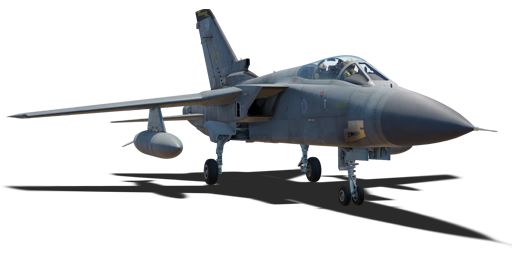
The Tornado F.3 Late is a rank British jet fighter with a battle rating of (AB), (RB), and (SB). It was introduced in Update "Seek & Destroy".
General info
Flight performance
Describe how the aircraft behaves in the air. Speed, manoeuvrability, acceleration and allowable loads - these are the most important characteristics of the vehicle.
| Characteristics | Max speed (km/h at _,___ m) |
Max altitude (metres) |
Turn time (seconds) |
Rate of climb (metres/second) |
Take-off run (metres) | |||
|---|---|---|---|---|---|---|---|---|
| AB | RB | AB | RB | AB | RB | |||
| Stock | ___ | ___ | __._ | __._ | __._ | __._ | ___ | |
| Upgraded | ___ | ___ | __._ | __._ | __._ | __._ | ||
Details
| Features | |||||
|---|---|---|---|---|---|
| Combat flaps | Take-off flaps | Landing flaps | Air brakes | Arrestor gear | Drogue chute |
| _ | _ | _ | _ | _ | _ |
| Limits | ||||||
|---|---|---|---|---|---|---|
| Wings (km/h) | Gear (km/h) | Flaps (km/h) | Max Static G | |||
| Combat | Take-off | Landing | + | - | ||
| ___ | ___ | ___ | ~__ | ~__ | ||
| Optimal velocities (km/h) | |||
|---|---|---|---|
| Ailerons | Rudder | Elevators | Radiator |
| < ___ | < ___ | < ___ | - |
Engine performance
| Engine | Aircraft mass | |||||
|---|---|---|---|---|---|---|
| Engine name | Number | Basic mass | Wing loading (full fuel) | |||
| _____ | _ | _,___ kg | ___ kg/m2 | |||
| Engine characteristics | Mass with fuel (no weapons load) | Max Gross Weight | ||||
| Weight (each) | Type | _m fuel | __m fuel | __m fuel | ||
| ___ kg | ___ | _,___ kg | _,___ kg | _,___ kg | _,___ kg | |
| Maximum engine thrust @ 0 m (RB/SB) | Thrust to weight ratio @ 0 m (___%/WEP) | |||||
| Condition | 100% | ___%/WEP | _m fuel | __m fuel | __m fuel | MGW |
| Stationary | ___ kgf | ___ kgf | _.__ | _.__ | _.__ | _.__ |
| Optimal | ___ kgf (_ km/h) |
___ kgf (_ km/h) |
_.__ | _.__ | _.__ | _.__ |
Survivability and armour
Examine the survivability of the aircraft. Note how vulnerable the structure is and how secure the pilot is, whether the fuel tanks are armoured, etc. Describe the armour, if there is any, and also mention the vulnerability of other critical aircraft systems.
Modifications and economy
Armaments
| Ballistic Computer | ||||
|---|---|---|---|---|
| CCIP (Guns) | CCIP (Rockets) | CCIP (Bombs) | CCRP (Bombs) | EEGS |
 |
 |
|
|
|
Offensive armament
The Tornado F.3 Late is armed with:
- 1 x 27 mm Mauser BK27 cannon, nose-mounted (180 rpg)
- 32 x large calibre countermeasures
Suspended armament
Describe the aircraft's suspended armament: additional cannons under the wings, bombs, rockets and torpedoes. This section is especially important for bombers and attackers. If there is no suspended weaponry remove this subsection.
| Default weapon presets | |
|---|---|
| |
Usage in battles
Describe the tactics of playing in the aircraft, the features of using aircraft in a team and advice on tactics. Refrain from creating a "guide" - do not impose a single point of view, but instead, give the reader food for thought. Examine the most dangerous enemies and give recommendations on fighting them. If necessary, note the specifics of the game in different modes (AB, RB, SB).
Pros and cons
Summarise and briefly evaluate the vehicle in terms of its characteristics and combat effectiveness. Mark its pros and cons in the bulleted list. Try not to use more than 6 points for each of the characteristics. Avoid using categorical definitions such as "bad", "good" and the like - use substitutions with softer forms such as "inadequate" and "effective".
Pros:
Cons:
History
The Tornado F3, a crucial part of the RAF's air defense, underwent significant changes throughout its service, facing structural challenges and essential upgrades. Following the Gulf War, the Tornado F3 experienced accelerated fatigue due to intense combat conditions, which exceeded its initial design expectations. As a result, the airframes began wearing out faster than anticipated. Initially, BAe Systems was contracted to upgrade 15 airframes, but the subsequent batch was awarded to Airwork Services, which performed the upgrades at St Athan.
Soon after, the first four upgraded Tornado F3s (ZE292, ZE295, ZE343, and ZE728) exhibited structural problems. Pilots reported abnormal behavior, leading to the discovery of significant damage. Further inspections revealed 12 additional damaged airframes. Though scrapping these aircraft was initially considered, an innovative solution emerged: using the center sections of F2 airframes in storage at St Athan. This successful modification, starting with ZE154 and F2 ZD901, allowed the damaged F3s to return to service.
On March 24, 1993, a significant milestone was reached when the RAF accepted ZH559, the last Tornado built for the RAF, which remained in service until 2008. The next major upgrade involved fitting the F3 with AMRAAM and ASRAAM missiles under the Capability Sustainment Programme (CSP) awarded to BAe in 1997. This £125 million program upgraded the missile management system and main computer, providing the F3 with fire-and-forget capability and enhancing its combat effectiveness. Additional upgrades included towed radar decoys and trials with ALARM missiles on 11 Squadron aircraft.
Media
Excellent additions to the article would be video guides, screenshots from the game, and photos.
See also
Links to the articles on the War Thunder Wiki that you think will be useful for the reader, for example:
- Tornado Family
- Identical performance-wise to the Tornado F.3
External links
Paste links to sources and external resources, such as:
- https://warthunder.com/en/news/8953-meet-major-update-seek-destroy-en
- https://dokumen.pub/qdownload/haynes-raf-tornado-owners-workshop-manual-0857332473-9780857882479.html
| Britain jet aircraft | |
|---|---|
| Blackburn | Buccaneer S.1 · Buccaneer S.2 · Buccaneer S.2B |
| British Aerospace | Harrier GR.7 · Sea Harrier FRS.1 (e) · Sea Harrier FRS.1 · Sea Harrier FA 2 |
| British Aircraft Corporation | Strikemaster Mk.88 |
| English Electric | Canberra B Mk 2 · Canberra B (I) Mk 6 · Lightning F.6 · Lightning F.53 |
| Gloster | Meteor F Mk 3 · Sea Meteor F Mk 3 · Meteor F Mk 4 G.41F · Meteor F Mk 4 G.41G · Meteor F Mk 8 G.41K · Meteor F Mk.8 Reaper |
| Javelin F.(A.W.) Mk.9 | |
| de Havilland | Vampire F.B.5 · Venom FB.4 · Sea Venom FAW 20 · Sea Vixen F.A.W. Mk.2 |
| Hawker | Sea Hawk FGA.6 · Hunter F.1 · Hunter F.6 · Hunter FGA.9 · Harrier GR.1 · Harrier GR.3 |
| Panavia | Tornado GR.1 · Tornado GR.4 · Tornado F.3 · Tornado F.3 Late |
| SEPECAT | Jaguar GR.1 · Jaguar GR.1A · Jaguar IS |
| Supermarine | Attacker FB 1 · Attacker FB.2 · Scimitar F Mk.1 · Swift F.1 · Swift F.7 |
| Foreign | Phantom FG.1 (USA) · Phantom FGR.2 (USA) · F-4J(UK) Phantom II (USA) |
| Australia | F-111C |
| India | ▄MiG-21 Bison |
| South Africa | ▄JAS39C |