Difference between pages "Wellington Mk Ic (Germany)" and "Typhoon Mk Ib"
(Added premium navtable) |
m (Changed flap limits to match current in game values. Above 261 km/h IAS they are blocked.) (Tag: Visual edit) |
||
| Line 1: | Line 1: | ||
| − | |||
{{About | {{About | ||
| − | | about = | + | | about = British fighter '''{{PAGENAME}}''' |
| − | | other | + | | usage = other versions |
| − | | | + | | link = Typhoon (Family) |
| − | + | }} | |
| − | | | + | {{Specs-Card |
| − | | | + | |code=typhoon_mk1b |
| + | |images={{Specs-Card-Image|GarageImage_{{PAGENAME}}.jpg}} | ||
}} | }} | ||
== Description == | == Description == | ||
<!-- ''In the description, the first part should be about the history of and the creation and combat usage of the aircraft, as well as its key features. In the second part, tell the reader about the aircraft in the game. Insert a screenshot of the vehicle, so that if the novice player does not remember the vehicle by name, he will immediately understand what kind of vehicle the article is talking about.'' --> | <!-- ''In the description, the first part should be about the history of and the creation and combat usage of the aircraft, as well as its key features. In the second part, tell the reader about the aircraft in the game. Insert a screenshot of the vehicle, so that if the novice player does not remember the vehicle by name, he will immediately understand what kind of vehicle the article is talking about.'' --> | ||
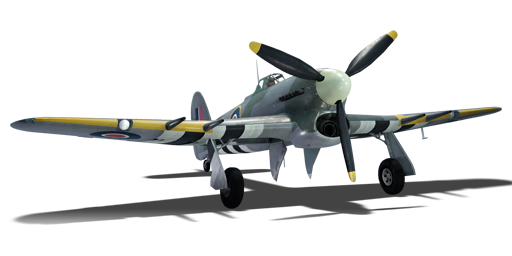
| − | + | The '''{{Specs|name}}''' is a premium gift rank {{Specs|rank}} British fighter {{Battle-rating}}. It has been in the game as a premium pack since the start of the Open Beta Test prior to Update 1.27 but was removed from the store after the [[wt:en/news/5232-shop-winter-sales-special-bundle-and-gift-certificates-en|2017 Winter Sale]]. It has since been made available for purchase with Golden Eagles {{ge}} for the [[wt:en/news/5438-raf-100-royal-air-force-centenary-en|2018 "Royal Air Force Centenary"]], the [[wt:en/news/6759-special-d-day-en|2020 D-Day]], the [[wt:en/news/8171-special-royal-air-force-day-en|2023 "Royal Air Force Day"]], and the [[wt:en/news/8834-special-get-a-decal-for-the-anniversary-of-the-royal-air-force-en|2024 "Anniversary of the Royal Air Force"]] mini-events. It also has been made available again in the store episodically for the [[wt:en/news/5232-shop-winter-sales-special-bundle-and-gift-certificates-en|2018 Winter Sale]], the [[wt:en/news/6866-special-80-year-anniversary-of-battle-of-britain-en|2020 "80<sup>th</sup> Anniversary of the Battle of Britain"]] event and as part of the [[wt:en/news/6759/current|2020]] and [[wt:en/news/7205-shop-d-day-bundles-en|2021]] D-Day Sales. | |
| − | |||
| − | The '''{{Specs|name}}''' is a premium rank {{Specs|rank}} | ||
| − | |||
| − | |||
| − | |||
| − | |||
| − | + | While the {{Specs|name}} is slightly inferior compared to the Mk Ib/late in regards to flight performance and engine power, the main difference from the Mk Ia is the vastly upgraded armament options, including 4 x 20 mm Hispano Mk II cannons and larger bombs and rockets. | |
== General info == | == General info == | ||
| − | === Flight | + | === Flight performance === |
| − | ''Describe how the aircraft behaves in the air. Speed, manoeuvrability, acceleration and allowable loads - these are the most important characteristics of the vehicle.'' | + | {{Specs-Avia-Flight}} |
| + | <!--''Describe how the aircraft behaves in the air. Speed, manoeuvrability, acceleration and allowable loads - these are the most important characteristics of the vehicle.''--> | ||
| − | {| class="wikitable" style="text-align:center" | + | {| class="wikitable" style="text-align:center" width="70%" |
| − | + | ! rowspan="2" | Characteristics | |
| − | + | ! colspan="2" | Max Speed<br>(km/h at 6,340 m) | |
| − | + | ! rowspan="2" | Max altitude<br>(metres) | |
| − | ! | ||
| − | |||
| − | ! colspan="2" | Max Speed<br>(km/h at | ||
| − | ! rowspan="2" | Max altitude<br>( | ||
! colspan="2" | Turn time<br>(seconds) | ! colspan="2" | Turn time<br>(seconds) | ||
| − | ! colspan="2" | Rate of climb<br>( | + | ! colspan="2" | Rate of climb<br>(metres/second) |
| − | ! rowspan="2" | Take-off run<br>( | + | ! rowspan="2" | Take-off run<br>(metres) |
|- | |- | ||
| − | ! AB | + | ! AB !! RB !! AB !! RB !! AB !! RB |
| − | ! RB | ||
| − | ! AB | ||
| − | ! RB | ||
| − | ! AB | ||
| − | ! RB | ||
|- | |- | ||
| − | | | + | ! Stock |
| + | | 618 || 605 || rowspan="2" | {{Specs|ceiling}} || 21.8 || 22.1 || 14.7 || 14.7 || rowspan="2" | 580 | ||
|- | |- | ||
| − | ! | + | ! Upgraded |
| − | | | + | | 670 || 644 || 19.4 || 20.6 || 23.4 || 17.3 |
| − | |||
| − | |||
| − | |||
| − | |||
| − | |||
| − | |||
| − | |||
| − | |||
| − | |||
| − | |||
| − | |||
| − | |||
| − | |||
| − | |||
|- | |- | ||
|} | |} | ||
| − | ====Details==== | + | ==== Details ==== |
| − | {| class="wikitable" style="text-align:center" | + | {| class="wikitable" style="text-align:center" width="50%" |
|- | |- | ||
! colspan="5" | Features | ! colspan="5" | Features | ||
|- | |- | ||
| − | ! Combat flaps | + | ! Combat flaps !! Take-off flaps !! Landing flaps !! Air brakes !! Arrestor gear |
| − | ! Take-off flaps | ||
| − | ! Landing flaps | ||
| − | ! Air brakes | ||
| − | ! Arrestor gear | ||
|- | |- | ||
| ✓ || ✓ || ✓ || X || X <!-- ✓ --> | | ✓ || ✓ || ✓ || X || X <!-- ✓ --> | ||
| Line 80: | Line 49: | ||
|} | |} | ||
| − | {| class="wikitable" style="text-align:center" | + | {| class="wikitable" style="text-align:center" width="50%" |
|- | |- | ||
| − | ! colspan=" | + | ! colspan="7" | Limits |
|- | |- | ||
| − | ! rowspan="2" | | + | ! rowspan="2" | Wings (km/h) |
| − | ! rowspan="2" | Gear | + | ! rowspan="2" | Gear (km/h) |
| − | ! | + | ! colspan="3" | Flaps (km/h) |
! colspan="2" | Max Static G | ! colspan="2" | Max Static G | ||
|- | |- | ||
| − | ! + | + | ! Combat !! Take-off !! Landing !! + !! - |
| − | ! - | ||
|- | |- | ||
| − | | {{Specs|destruction| | + | | {{Specs|destruction|body}} || {{Specs|destruction|gear}} || 261 || 261 || 250 || ~11 || ~5 |
|- | |- | ||
|} | |} | ||
| Line 98: | Line 66: | ||
{| class="wikitable" style="text-align:center" | {| class="wikitable" style="text-align:center" | ||
|- | |- | ||
| − | ! colspan="4" | Optimal velocities | + | ! colspan="4" | Optimal velocities (km/h) |
|- | |- | ||
| − | ! Ailerons | + | ! Ailerons !! Rudder !! Elevators !! Radiator |
| − | ! Rudder | ||
| − | ! Elevators | ||
| − | ! Radiator | ||
|- | |- | ||
| − | | < | + | | < 390 || < 440 || < 480 || > 337 |
|- | |- | ||
|} | |} | ||
| Line 119: | Line 84: | ||
! WEP Engine power | ! WEP Engine power | ||
|- | |- | ||
| − | | | + | | 1,447 m || 1,960 hp || 2,077 hp |
|- | |- | ||
! colspan="3" | Setting 2 | ! colspan="3" | Setting 2 | ||
| Line 127: | Line 92: | ||
! WEP Engine power | ! WEP Engine power | ||
|- | |- | ||
| − | | | + | | 4,981 m || 1,650 hp || 1,749 hp |
|- | |- | ||
|} | |} | ||
=== Survivability and armour === | === Survivability and armour === | ||
| − | ''Examine the survivability of the aircraft. Note how vulnerable the structure is and how secure the pilot is, whether the fuel tanks are armoured, etc. Describe the armour, if there is any, and also mention the vulnerability of other critical aircraft systems.'' | + | {{Specs-Avia-Armour}} |
| + | <!-- ''Examine the survivability of the aircraft. Note how vulnerable the structure is and how secure the pilot is, whether the fuel tanks are armoured, etc. Describe the armour, if there is any, and also mention the vulnerability of other critical aircraft systems.'' --> | ||
| + | |||
| + | * 42.8 mm Bulletproof glass in cockpit front. | ||
| + | * 12.7 mm Steel plate behind the pilot. | ||
| + | * 1 mm Steel plate in the fuselage. | ||
| + | * 3 mm Steel plate behind the propeller. | ||
| + | |||
| + | === Modifications and economy === | ||
| + | {{Specs-Economy}} | ||
== Armaments == | == Armaments == | ||
| + | {{Specs-Avia-Armaments}} | ||
| + | === Offensive armament === | ||
| + | {{Specs-Avia-Offensive}} | ||
| + | <!-- ''Describe the offensive armament of the aircraft, if any. Describe how effective the cannons and machine guns are in a battle, and also what belts or drums are better to use. If there is no offensive weaponry, delete this subsection.'' --> | ||
| + | {{main|Hispano Mk.II (20 mm)}} | ||
| + | |||
| + | The '''''{{PAGENAME}}''''' is armed with: | ||
| + | |||
| + | * 4 x 20 mm Hispano Mk.II cannons, wing-mounted (145 rpg outer + 143 rpg inner = 576 total) | ||
| + | |||
=== Suspended armament === | === Suspended armament === | ||
| + | {{Specs-Avia-Suspended}} | ||
<!-- ''Describe the aircraft's suspended armament: additional cannons under the wings, bombs, rockets and torpedoes. This section is especially important for bombers and attackers. If there is no suspended weaponry remove this subsection.'' --> | <!-- ''Describe the aircraft's suspended armament: additional cannons under the wings, bombs, rockets and torpedoes. This section is especially important for bombers and attackers. If there is no suspended weaponry remove this subsection.'' --> | ||
| − | {{main|G.P. | + | {{main|G.P. Mk.IV (250 lb)|G.P. Mk.IV (500 lb)|S.A.P. Mk.II (500 lb)|M.C. Mk.I (1,000 lb)|RP-3}} |
The '''''{{PAGENAME}}''''' can be outfitted with the following ordnance: | The '''''{{PAGENAME}}''''' can be outfitted with the following ordnance: | ||
| − | |||
| − | |||
| − | + | * Without load | |
| − | + | * 2 x 250 lb G.P. Mk.IV bombs (500 lb total) | |
| − | + | * 2 x 500 lb G.P. Mk.IV bombs (1,000 lb total) | |
| − | + | * 2 x 500 lb S.A.P. Mk.II bombs (1,000 lb total) | |
| − | + | * 2 x 1,000 lb M.C. Mk.I bombs (2,000 lb total) | |
| − | * 2 x | + | * 8 x RP-3 rockets |
| − | * 2 x | ||
| − | * | ||
== Usage in battles == | == Usage in battles == | ||
| − | <!-- ''Describe the tactics of playing in | + | <!-- ''Describe the tactics of playing in the aircraft, the features of using aircraft in a team and advice on tactics. Refrain from creating a "guide" - do not impose a single point of view, but instead, give the reader food for thought. Examine the most dangerous enemies and give recommendations on fighting them. If necessary, note the specifics of the game in different modes (AB, RB, SB).'' --> |
| − | + | As a fighter, it is mainly a BnZ aircraft with lethal armament, especially the stealthy Air targets belts. Roll rate is below average but turn performance is decent for such a large aircraft. Where the Typhoon shines, as in real life, is in ground attack roles with 2 x 1000lbs bombs or 8 x RP-3 rockets. Used in this role the Typhoon can strike very fast and accurately and use its speed to disengage. Climb early in the battle as performance is maintained even with 2 x 1000 bombs underneath, select the target and bomb in a shallow dive. Disengage with a shallow climb at great speed away from enemy fighters. Softer targets can be destroyed easily with the cannons. This aircraft can be a real lion farmer used in a mixed role of fighter bomber attacking unsuspecting slower enemy aircraft, or blasting through furballs at high speed. The Air Targets belts will reward the good shot. Performance is best below 6 km (20000 ft). When manoeuvring keeps the speed up, this is a heavy aircraft and will not easily regain energy lost by high loads, making it vulnerable. | |
| − | |||
| − | |||
| − | |||
| − | |||
| − | |||
| − | |||
| − | + | === Manual Engine Control === | |
| − | |||
| − | ===Manual Engine Control=== | ||
{| class="wikitable" style="text-align:center" | {| class="wikitable" style="text-align:center" | ||
|- | |- | ||
| Line 175: | Line 148: | ||
! rowspan="2" | Turbocharger | ! rowspan="2" | Turbocharger | ||
|- | |- | ||
| − | ! Oil | + | ! Oil !! Water !! Type |
| − | ! Water | ||
| − | ! Type | ||
|- | |- | ||
| − | | | + | | Controllable || Controllable<br>Not auto controlled || Not controllable<br>Not auto controlled || Controllable<br>Auto control available || Combined || Controllable<br>2 gears || Not controllable |
| − | |||
| − | |||
| − | |||
| − | |||
| − | |||
| − | |||
| − | |||
| − | |||
| − | |||
| − | |||
| − | |||
| − | |||
| − | |||
| − | |||
| − | |||
| − | |||
| − | |||
| − | |||
| − | |||
| − | |||
| − | |||
| − | |||
| − | |||
| − | |||
| − | |||
| − | |||
| − | |||
| − | |||
| − | |||
| − | |||
| − | |||
| − | |||
| − | |||
|- | |- | ||
|} | |} | ||
=== Pros and cons === | === Pros and cons === | ||
| − | <!-- '' | + | <!-- ''Summarise and briefly evaluate the vehicle in terms of its characteristics and combat effectiveness. Mark its pros and cons in the bulleted list. Try not to use more than 6 points for each of the characteristics. Avoid using categorical definitions such as "bad", "good" and the like - use substitutions with softer forms such as "inadequate" and "effective".'' --> |
'''Pros:''' | '''Pros:''' | ||
| − | * Good | + | |
| − | * | + | * Good diving speed |
| + | * Excellent armament | ||
| + | * Above average armour | ||
| + | * Can withstand tough loads | ||
| + | * Good speed | ||
| + | * Good climb rate | ||
'''Cons:''' | '''Cons:''' | ||
| − | * | + | |
| − | * | + | * Water overheats if too much WEP applied |
| + | * Low roll rate | ||
| + | * Big target for a fighter | ||
| + | * Limited cockpit visibility | ||
| + | * The takeoff acceleration is lower than most counterparts. | ||
== History == | == History == | ||
| − | <!-- ''Describe the history of the creation and combat usage of the aircraft in more detail than in the introduction. If the historical reference turns out to be too | + | <!-- ''Describe the history of the creation and combat usage of the aircraft in more detail than in the introduction. If the historical reference turns out to be too long, take it to a separate article, taking a link to the article about the vehicle and adding a block "/History" (example: <nowiki>https://wiki.warthunder.com/(Vehicle-name)/History</nowiki>) and add a link to it here using the <code>main</code> template. Be sure to reference text and sources by using <code><nowiki><ref></ref></nowiki></code>, as well as adding them at the end of the article with <code><nowiki><references /></nowiki></code>. This section may also include the vehicle's dev blog entry (if applicable) and the in-game encyclopedia description (under <code><nowiki>=== In-game description ===</nowiki></code>, also if applicable).'' --> |
| − | |||
| − | + | The Typhoon Mk Ib was an evolution on the earlier Mk Ia on a quest for better overall performance. An upgraded engine that could take higher boost settings and aerodynamic improvements on the fuselage and wings increased speed and climb capability. The four cannons and the improved hardpoints under the wings made it ideal for the ground attack tactics employed by the RAF in 1943 over France. The Spitfires and Hurricanes were quickly replaced by the Typhoons in this very dangerous mission profile, flying close to the ground and exposed to AA. The Typhoon was also used in a defensive role as interceptor against fast German fighter bombers coming across the Channel. | |
| − | |||
| − | The | + | The Typhoon was not the easiest aircraft to fly and came as a shock to the pilots used to the much lighter and nimbler Spitfires and Hurricanes. Problems were engine reliability and vibrations, a swing (turn) on take-off due to the huge torque from the engine and propeller even with full opposite rudder applied. In the cockpit before the introduction of the later bubble canopy, visibility was limited and carbon monoxide from the exhaust would find its way in, use of oxygen at all times became mandatory. While flying missions crossing the English Channel, the danger of ditching was always present and the configuration of the scoop air intake below the engine made the success of such an event highly doubtful. |
| − | + | {{break}} | |
| + | {{Navigation-Start|{{Annotation|Archive of the in-game description|An archive of the historical description of the vehicle that was presented in-game prior to Update 1.55 'Royal Armour'}}}} | ||
| + | {{Navigation-First-Simple-Line}} | ||
| + | The Hawker Typhoon Mk.IB was a single engine, single seat fighter which entered service with the RAF in 1941. The Mk.IB differed mainly from the Mk.IA in its armament; the fighter was equipped with four 20 mm British Hispano Mk.I magazine-fed cannons, with 75 rounds each. | ||
| + | |||
| + | Already plagued with several early problems, the seepage of exhaust gases from the engine into the pilot's cockpit became a serious issue for the Hawker Typhoon. Although the sealed partition between the cockpit and the engine compartment was improved and the engine's exhaust pipes were lengthened, this problem was never entirely solved and Typhoon pilots had to operate their fighters from engine start to shut down with their oxygen masks on. | ||
| + | |||
| + | Another problem was the lack of reliability of Napier Sabre Mk.IIA engines at the initial stage of operation. The engine was prone to overheating and it could jam when the aircraft climbed. Cases when the engine caught fire on take off were also frequent. It was only by mid 1943 that engineers managed to overcome these problems and bring the engine's reliability to an acceptable level. | ||
| + | |||
| + | Early on in the Typhoon's combat career, it was discovered that metal fatigue in the tail often caused the entire tail unit to detach in a high speed dive. As an interim measure, reinforcing straps were fitted across the joint of the tail section and the fuselage. Subsequently it was discovered that these structural failures were caused by elevator flutter which occurred at relatively low speeds. The flutter itself was caused by the fatigue failure of the small ring holding the balance weight assembly. The flutter could also lead to a failure of the tailplane spar, so this also urgently needed to be reinforced. | ||
| + | |||
| + | In early 1942, Hawker had embarked on equipping the Typhoon with external fittings. Drop tanks were added to increase the aircraft's range. | ||
| + | |||
| + | Two 500 lb (227 kg) bombs could be fitted instead of drop tanks; later these were replaced with heavier American 1,000 lb (454 kg) bombs. | ||
| − | + | An important step in enhancing the Typhoon's firepower was equipping it with rockets. By the end of 1942, 3 inch (76 mm) rockets equipped with a 27 kg warhead were produced in large quantities. They were inexpensive, easy to manufacture and proved reliable although they were not particularly accurate. The Typhoon was equipped with eight rails for these rockets, four under each wing. Rocket rails and bomb racks were introduced across in service Typhoons throughout 1943. | |
| − | + | Whilst the Typhoon had a disappointing high altitude performance, its low altitude performance was more impressive, leading to the aircraft being considered for employment in other roles. From November 1942, Typhoons were used as fighter bombers to hit ground targets on the Continent. However, in general the Typhoon was not a huge success as an interceptor, but found its forte as a rugged ground attack aircraft, capable of dealing a good deal of damage with bombs, rockets and its 20mm cannons. Over 3,300 Typhoons were manufactured during the war, the vast majority being the Mk. IB variant. | |
| + | {{Navigation-End}} | ||
== Media == | == Media == | ||
<!-- ''Excellent additions to the article would be video guides, screenshots from the game, and photos.'' --> | <!-- ''Excellent additions to the article would be video guides, screenshots from the game, and photos.'' --> | ||
| − | [ | + | |
| − | + | ;Skins | |
| + | |||
| + | * [https://live.warthunder.com/feed/camouflages/?vehicle=typhoon_mk1b Skins and camouflages for the {{PAGENAME}} from live.warthunder.com.] | ||
== See also == | == See also == | ||
''Links to the articles on the War Thunder Wiki that you think will be useful for the reader, for example:'' | ''Links to the articles on the War Thunder Wiki that you think will be useful for the reader, for example:'' | ||
| + | |||
* ''reference to the series of the aircraft;'' | * ''reference to the series of the aircraft;'' | ||
* ''links to approximate analogues of other nations and research trees.'' | * ''links to approximate analogues of other nations and research trees.'' | ||
| Line 254: | Line 216: | ||
== External links == | == External links == | ||
''Paste links to sources and external resources, such as:'' | ''Paste links to sources and external resources, such as:'' | ||
| + | |||
* ''topic on the official game forum;'' | * ''topic on the official game forum;'' | ||
| − | |||
* ''other literature.'' | * ''other literature.'' | ||
| − | {{AirManufacturer | + | {{AirManufacturer Hawker}} |
| − | {{ | + | {{Britain fighters}} |
| − | {{ | + | {{Britain premium aircraft}} |
Latest revision as of 19:15, 6 June 2024
| This page is about the British fighter Typhoon Mk Ib. For other versions, see Typhoon (Family). |

Contents
Description
The Typhoon Mk Ib is a premium gift rank British fighter
with a battle rating of (AB), (RB), and (SB). It has been in the game as a premium pack since the start of the Open Beta Test prior to Update 1.27 but was removed from the store after the 2017 Winter Sale. It has since been made available for purchase with Golden Eagles  for the 2018 "Royal Air Force Centenary", the 2020 D-Day, the 2023 "Royal Air Force Day", and the 2024 "Anniversary of the Royal Air Force" mini-events. It also has been made available again in the store episodically for the 2018 Winter Sale, the 2020 "80th Anniversary of the Battle of Britain" event and as part of the 2020 and 2021 D-Day Sales.
While the Typhoon Mk Ib is slightly inferior compared to the Mk Ib/late in regards to flight performance and engine power, the main difference from the Mk Ia is the vastly upgraded armament options, including 4 x 20 mm Hispano Mk II cannons and larger bombs and rockets.
General info
Flight performance
| Characteristics | Max Speed (km/h at 6,340 m) |
Max altitude (metres) |
Turn time (seconds) |
Rate of climb (metres/second) |
Take-off run (metres) | |||
|---|---|---|---|---|---|---|---|---|
| AB | RB | AB | RB | AB | RB | |||
| Stock | 618 | 605 | 21.8 | 22.1 | 14.7 | 14.7 | 580 | |
| Upgraded | 670 | 644 | 19.4 | 20.6 | 23.4 | 17.3 | ||
Details
| Features | ||||
|---|---|---|---|---|
| Combat flaps | Take-off flaps | Landing flaps | Air brakes | Arrestor gear |
| ✓ | ✓ | ✓ | X | X |
| Limits | ||||||
|---|---|---|---|---|---|---|
| Wings (km/h) | Gear (km/h) | Flaps (km/h) | Max Static G | |||
| Combat | Take-off | Landing | + | - | ||
| 261 | 261 | 250 | ~11 | ~5 | ||
| Optimal velocities (km/h) | |||
|---|---|---|---|
| Ailerons | Rudder | Elevators | Radiator |
| < 390 | < 440 | < 480 | > 337 |
| Compressor (RB/SB) | ||
|---|---|---|
| Setting 1 | ||
| Optimal altitude | 100% Engine power | WEP Engine power |
| 1,447 m | 1,960 hp | 2,077 hp |
| Setting 2 | ||
| Optimal altitude | 100% Engine power | WEP Engine power |
| 4,981 m | 1,650 hp | 1,749 hp |
Survivability and armour
- 42.8 mm Bulletproof glass in cockpit front.
- 12.7 mm Steel plate behind the pilot.
- 1 mm Steel plate in the fuselage.
- 3 mm Steel plate behind the propeller.
Modifications and economy
Armaments
Offensive armament
The Typhoon Mk Ib is armed with:
- 4 x 20 mm Hispano Mk.II cannons, wing-mounted (145 rpg outer + 143 rpg inner = 576 total)
Suspended armament
The Typhoon Mk Ib can be outfitted with the following ordnance:
- Without load
- 2 x 250 lb G.P. Mk.IV bombs (500 lb total)
- 2 x 500 lb G.P. Mk.IV bombs (1,000 lb total)
- 2 x 500 lb S.A.P. Mk.II bombs (1,000 lb total)
- 2 x 1,000 lb M.C. Mk.I bombs (2,000 lb total)
- 8 x RP-3 rockets
Usage in battles
As a fighter, it is mainly a BnZ aircraft with lethal armament, especially the stealthy Air targets belts. Roll rate is below average but turn performance is decent for such a large aircraft. Where the Typhoon shines, as in real life, is in ground attack roles with 2 x 1000lbs bombs or 8 x RP-3 rockets. Used in this role the Typhoon can strike very fast and accurately and use its speed to disengage. Climb early in the battle as performance is maintained even with 2 x 1000 bombs underneath, select the target and bomb in a shallow dive. Disengage with a shallow climb at great speed away from enemy fighters. Softer targets can be destroyed easily with the cannons. This aircraft can be a real lion farmer used in a mixed role of fighter bomber attacking unsuspecting slower enemy aircraft, or blasting through furballs at high speed. The Air Targets belts will reward the good shot. Performance is best below 6 km (20000 ft). When manoeuvring keeps the speed up, this is a heavy aircraft and will not easily regain energy lost by high loads, making it vulnerable.
Manual Engine Control
| MEC elements | ||||||
|---|---|---|---|---|---|---|
| Mixer | Pitch | Radiator | Supercharger | Turbocharger | ||
| Oil | Water | Type | ||||
| Controllable | Controllable Not auto controlled |
Not controllable Not auto controlled |
Controllable Auto control available |
Combined | Controllable 2 gears |
Not controllable |
Pros and cons
Pros:
- Good diving speed
- Excellent armament
- Above average armour
- Can withstand tough loads
- Good speed
- Good climb rate
Cons:
- Water overheats if too much WEP applied
- Low roll rate
- Big target for a fighter
- Limited cockpit visibility
- The takeoff acceleration is lower than most counterparts.
History
The Typhoon Mk Ib was an evolution on the earlier Mk Ia on a quest for better overall performance. An upgraded engine that could take higher boost settings and aerodynamic improvements on the fuselage and wings increased speed and climb capability. The four cannons and the improved hardpoints under the wings made it ideal for the ground attack tactics employed by the RAF in 1943 over France. The Spitfires and Hurricanes were quickly replaced by the Typhoons in this very dangerous mission profile, flying close to the ground and exposed to AA. The Typhoon was also used in a defensive role as interceptor against fast German fighter bombers coming across the Channel.
The Typhoon was not the easiest aircraft to fly and came as a shock to the pilots used to the much lighter and nimbler Spitfires and Hurricanes. Problems were engine reliability and vibrations, a swing (turn) on take-off due to the huge torque from the engine and propeller even with full opposite rudder applied. In the cockpit before the introduction of the later bubble canopy, visibility was limited and carbon monoxide from the exhaust would find its way in, use of oxygen at all times became mandatory. While flying missions crossing the English Channel, the danger of ditching was always present and the configuration of the scoop air intake below the engine made the success of such an event highly doubtful.
| Archive of the in-game description | |
|---|---|
|
The Hawker Typhoon Mk.IB was a single engine, single seat fighter which entered service with the RAF in 1941. The Mk.IB differed mainly from the Mk.IA in its armament; the fighter was equipped with four 20 mm British Hispano Mk.I magazine-fed cannons, with 75 rounds each. Already plagued with several early problems, the seepage of exhaust gases from the engine into the pilot's cockpit became a serious issue for the Hawker Typhoon. Although the sealed partition between the cockpit and the engine compartment was improved and the engine's exhaust pipes were lengthened, this problem was never entirely solved and Typhoon pilots had to operate their fighters from engine start to shut down with their oxygen masks on. Another problem was the lack of reliability of Napier Sabre Mk.IIA engines at the initial stage of operation. The engine was prone to overheating and it could jam when the aircraft climbed. Cases when the engine caught fire on take off were also frequent. It was only by mid 1943 that engineers managed to overcome these problems and bring the engine's reliability to an acceptable level. Early on in the Typhoon's combat career, it was discovered that metal fatigue in the tail often caused the entire tail unit to detach in a high speed dive. As an interim measure, reinforcing straps were fitted across the joint of the tail section and the fuselage. Subsequently it was discovered that these structural failures were caused by elevator flutter which occurred at relatively low speeds. The flutter itself was caused by the fatigue failure of the small ring holding the balance weight assembly. The flutter could also lead to a failure of the tailplane spar, so this also urgently needed to be reinforced. In early 1942, Hawker had embarked on equipping the Typhoon with external fittings. Drop tanks were added to increase the aircraft's range. Two 500 lb (227 kg) bombs could be fitted instead of drop tanks; later these were replaced with heavier American 1,000 lb (454 kg) bombs. An important step in enhancing the Typhoon's firepower was equipping it with rockets. By the end of 1942, 3 inch (76 mm) rockets equipped with a 27 kg warhead were produced in large quantities. They were inexpensive, easy to manufacture and proved reliable although they were not particularly accurate. The Typhoon was equipped with eight rails for these rockets, four under each wing. Rocket rails and bomb racks were introduced across in service Typhoons throughout 1943. Whilst the Typhoon had a disappointing high altitude performance, its low altitude performance was more impressive, leading to the aircraft being considered for employment in other roles. From November 1942, Typhoons were used as fighter bombers to hit ground targets on the Continent. However, in general the Typhoon was not a huge success as an interceptor, but found its forte as a rugged ground attack aircraft, capable of dealing a good deal of damage with bombs, rockets and its 20mm cannons. Over 3,300 Typhoons were manufactured during the war, the vast majority being the Mk. IB variant. | |
Media
- Skins
See also
Links to the articles on the War Thunder Wiki that you think will be useful for the reader, for example:
- reference to the series of the aircraft;
- links to approximate analogues of other nations and research trees.
External links
Paste links to sources and external resources, such as:
- topic on the official game forum;
- other literature.
| Hawker Aircraft Limited | |
|---|---|
| Biplane fighters | |
| Fury | Fury Mk I · Fury Mk II |
| Nimrod | Nimrod Mk I · Nimrod Mk II |
| Scout plane | Osprey Mk IV |
| Piston fighters | |
| Hurricane | Hurricane Mk I/L · Hurricane Mk.I/L FAA M · Sea Hurricane Mk IB · Sea Hurricane Mk IC · Hurricane Mk IIB/Trop · Hurricane Mk IV |
| Typhoon | Typhoon Mk Ia · Typhoon Mk Ib · Typhoon Mk Ib/L |
| Tempest | Tempest Mk V · Tempest Mk V (Vickers P) · Tempest Mk II |
| Fury | Sea Fury FB 11 |
| Jet fighters | |
| Hunter | Hunter F.1 · Hunter F.6 · Hunter FGA.9 |
| Sea Hawk | Sea Hawk FGA.6 |
| Harrier | Harrier GR.1 · Harrier GR.3 |
| Export | ▄Hurricane Mk I/L · ▂Hurricane Mk IIB · ◘Sea Fury FB 51 |
| ◘Sea Hawk Mk.50 · ◄Sea Hawk Mk.100 · ◘Hunter F.6 · ◌Hunter F.58 · J34 · AV-8A · AV-8C · ▄AV-8S | |
| Captured | ▀Tempest Mk V |
| See Also | Fokker |
| Britain premium aircraft | |
|---|---|
| Fighters | Tuck's Gladiator Mk II · ▄Boomerang Mk I · ▄Boomerang Mk II · ▄D.520 |
| ▄Martlet Mk IV · ▄Corsair F Mk II · ▄Hellcat Mk II · ▄Thunderbolt Mk.1 · ▄Mustang Mk IA | |
| Hurricane Mk.I/L FAA M · Spitfire Mk.IIa Venture I · Spitfire F Mk IXc · Plagis' Spitfire LF Mk IXc · Spitfire F Mk XIVc · Prendergast's Spitfire FR Mk XIVe | |
| Typhoon Mk Ib · MB.5 | |
| Twin-engine fighters | Hornet Mk.I · Whirlwind P.9 |
| Jet fighters | Attacker FB.2 · Hunter FGA.9 · Lightning F.53 · Meteor F Mk.8 Reaper · Sea Vixen F.A.W. Mk.2 · F-4J(UK) Phantom II · ▄MiG-21 Bison |
| Strike aircraft | ▄Wirraway · Beaufighter Mk I (40-mm) · Wyvern S4 |
| Harrier GR.1 · Strikemaster Mk.88 | |
| Bombers | ▄Avenger Mk II · ▄Boston Mk I · ▄Catalina Mk IIIa · ▄DB-7 · ▄Havoc Mk I · ▄Hudson Mk V · Swordfish Mk II |