Difference between pages "TBD-1" and "Somua SM"
(Edits) |
U103691029 (talk | contribs) m (→Main armament: Autoloader) (Tag: Visual edit) |
||
| Line 1: | Line 1: | ||
{{Specs-Card | {{Specs-Card | ||
| − | |code= | + | |code=fr_somua_sm |
| − | | | + | |images={{Specs-Card-Image|GarageImage_{{PAGENAME}}.jpg|StoreImage_{{PAGENAME}}_001.jpg|StoreImage_{{PAGENAME}}_005.jpg}} |
| + | |store=9313 | ||
}} | }} | ||
== Description == | == Description == | ||
| − | <!-- ''In the description, the first part should be about the history of | + | <!-- ''In the description, the first part should be about the history of the creation and combat usage of the vehicle, as well as its key features. In the second part, tell the reader about the ground vehicle in the game. Insert a screenshot of the vehicle, so that if the novice player does not remember the vehicle by name, he will immediately understand what kind of vehicle the article is talking about.'' --> |
| − | + | The '''{{Specs|name}}''' was originally developed as part of a competition between AMX and SOMUA to produce a heavily armoured tank that shared similar components and parts, due to the French army forcing both companies to work under identical specifications. The order to build a prototype was given in 1946, but the vehicle was only delivered in October 1951, weighing 56 tonnes but still lacking an engine. In contrast, the [[AMX-50 (Family)|AMX-50]], the SOMUA SM's direct competitor, had already been tested, and a variant of the AMX-50 with a 120 mm cannon was already being designed. Ultimately, the SOMUA SM was not tested until 1953, by which point the [[AMX-50 Surbaissé]] had already been delivered for testing, and the [[AMX-50 (TOA100)]] had been deemed insufficient due to its armament. These delays would doom the project, leading to eventual cancellation of the project and scrapping of the only constructed prototype. | |
| − | |||
| − | The '''{{Specs|name}}''' | ||
| − | + | Introduced in [[Update "Raining Fire"]] as a [[wt:en/news/6852-news-meet-major-update-raining-fire-en|premium pack]] in the Gaijin store, the '''{{Specs|name}}''' will be a familiar tank to French players; it possesses the excellent [[SA47 L/58 (100 mm)|100 mm SA47 L/58]] autoloaded cannon that is equipped on both the [[Lorraine 40t]] and [[AMX-50 (TOA100)]], while featuring similar mobility. Unlike the tanks previously mentioned, however, the Somua SM possesses decent armour, capable of bouncing almost all APCBC and even some APDS rounds aimed to its hull and upper turret front. The armour on the Souma SM, combined with the slightly larger ready rack for the gun compared to the Lorraine and AMX-50, allows the player to use the tank more aggressively. | |
| − | + | == General info == | |
| + | === Survivability and armour === | ||
| + | {{Specs-Tank-Armour}} | ||
| + | <!-- ''Describe armour protection. Note the most well protected and key weak areas. Appreciate the layout of modules as well as the number and location of crew members. Is the level of armour protection sufficient, is the placement of modules helpful for survival in combat? If necessary use a visual template to indicate the most secure and weak zones of the armour.'' --> | ||
| + | The upper glacis of the hull and the turret (aside from an area beneath the gun) are the only well-protected areas, which will give you good protection against most conventional rounds, especially from far ranges. However, the rest of the armour is very weak and can be easily penetrated by pretty much everything, and you will still be vulnerable against HEAT-FS, ATGMs, APFSDS and such. Your best bet is to flank the enemy and take them out with your auto-loading gun before they can get a hit on you. If an enemy spots you, face them so they can only hit the front of the tank, and hope that they don't hit the very weak bottom portion of your turret. Try not to angle your tank as the sides can easily be penetrated. Since you have 5 crew members, with 2 in the front of the hull and 3 in the turret, and come equipped with a handy autoloader, you can take a few hits and lose a couple of crew members without much effect on combat performance. Additionally, the Somua SM features Commander Aiming, which allows your Commander to take over control of the gun quickly in the case that your Gunner is knocked out. | ||
| + | |||
| + | '''Armour type:''' | ||
| − | + | * Rolled homogeneous armour (hull, turret roof) | |
| − | + | * Cast homogeneous armour (oscillating turret, turret base, cupola) | |
| − | |||
| − | + | {| class="wikitable" | |
| − | |||
| − | |||
| − | |||
| − | |||
| − | {| class="wikitable" | ||
| − | |||
| − | |||
| − | |||
| − | |||
| − | |||
| − | |||
| − | |||
| − | |||
| − | |||
| − | |||
| − | |||
| − | |||
| − | |||
| − | |||
| − | |||
| − | |||
| − | |||
| − | |||
| − | |||
|- | |- | ||
| − | ! | + | ! Armour !! Front (Slope angle) !! Sides !! Rear !! Roof |
|- | |- | ||
| − | + | | Hull || 150 mm (55°) ''Front glacis'' <br> 60 mm (55°) ''Lower glacis'' || 40 mm (25°) ''Top'' <br> 40 mm ''Bottom'' || 40 mm (30°) || 5 - 20 mm | |
| − | |||
| − | |||
| − | |||
| − | |||
|- | |- | ||
| − | + | | Turret || 120 mm ''Turret front'' and ring <br> 200 mm ''Gun mantlet'' || 40 - 60 mm ''Top'' | |
| − | + | 120 mm ''Bottom'' | |
| − | + | | 40 mm || 30 mm | |
| − | |||
| − | |||
| − | |||
|- | |- | ||
| − | | | + | | Cupola || 30 mm || 30 mm || 30 mm || 30 mm |
|- | |- | ||
|} | |} | ||
| + | '''Notes:''' | ||
| + | |||
| + | * Suspension wheels, tracks and torsion bars are 20 mm thick. | ||
| + | |||
| + | === Mobility === | ||
| + | {{Specs-Tank-Mobility}} | ||
| + | <!-- ''Write about the mobility of the ground vehicle. Estimate the specific power and manoeuvrability, as well as the maximum speed forwards and backwards.'' --> | ||
| + | Although heavier and not as mobile as the [[AMX-50]] or [[Lorraine 40t]], the Somua SM is still pretty mobile for a heavy tank. You will still want to flank the enemy as much as possible and take them out quickly with your auto-loading gun, but don't be afraid to take a few hits from the front. However, your reverse speed is pretty slow and will not save you, so watch out for that. | ||
| + | |||
| + | {{tankMobility|abMinHp=1291|rbMinHp=884}} | ||
| + | |||
| + | === Modifications and economy === | ||
| + | {{Specs-Economy}} | ||
| − | ==== | + | == Armaments == |
| − | { | + | {{Specs-Tank-Armaments}} |
| − | + | === Main armament === | |
| − | + | {{Specs-Tank-Weapon|1}} | |
| − | + | <!-- ''Give the reader information about the characteristics of the main gun. Assess its effectiveness in a battle based on the reloading speed, ballistics and the power of shells. Do not forget about the flexibility of the fire, that is how quickly the cannon can be aimed at the target, open fire on it and aim at another enemy. Add a link to the main article on the gun: <code><nowiki>{{main|Name of the weapon}}</nowiki></code>. Describe in general terms the ammunition available for the main gun. Give advice on how to use them and how to fill the ammunition storage.'' --> | |
| − | ! | + | {{main|SA47 L/58 (100 mm)}} |
| − | |||
| − | |||
| − | |||
| − | |||
| − | |||
| − | | | ||
| − | | | ||
| − | |||
| − | {| class="wikitable" style="text-align:center" | + | {| class="wikitable" style="text-align:center" width="100%" |
|- | |- | ||
| − | ! colspan="5" | | + | ! colspan="5" | [[SA47 L/58 (100 mm)|100 mm SA47 L/58]] || colspan="5" | Turret rotation speed (°/s) || Reloading rate (seconds) |
|- | |- | ||
| − | ! | + | ! Mode !! Capacity !! Vertical !! Horizontal !! Stabilizer |
| − | ! | + | ! Stock !! Upgraded !! Full !! Expert !! Aced |
| − | ! | + | !Autoloader |
| − | ! | ||
|- | |- | ||
| − | ! | + | ! ''Arcade'' |
| − | + | | rowspan="2" | 50 || rowspan="2" | -8°/+15° || rowspan="2" | ±180° || rowspan="2" | N/A ||24.3||33.6||40.8||45.1||48.0|| rowspan="2" | 4.00 | |
|- | |- | ||
| − | | | + | ! ''Realistic'' |
| + | |17.9||21.0||25.5||28.2||30.0 | ||
|- | |- | ||
|} | |} | ||
| + | ==== Ammunition ==== | ||
| + | {{:SA47 L/58 (100 mm)/Ammunition|100 mm Obus de rupture, 100 mm Obus explosif}} | ||
| + | |||
| + | ==== [[Ammo racks]] ==== | ||
| + | <!-- '''Last updated: 1.101.1.16''' --> | ||
{| class="wikitable" style="text-align:center" | {| class="wikitable" style="text-align:center" | ||
|- | |- | ||
| − | ! | + | ! Full<br>ammo |
| − | + | ! 1st<br>rack empty | |
| − | ! | + | ! 2nd<br>rack empty |
| − | ! | + | ! 3rd<br>rack empty |
| − | ! | + | ! 4th<br>rack empty |
| − | ! | + | ! 5th<br>rack empty |
| + | ! 6th<br>rack empty | ||
| + | ! 7th<br>rack empty | ||
| + | ! 8th<br>rack empty | ||
| + | ! 9th<br>rack empty | ||
| + | ! Visual<br>discrepancy | ||
|- | |- | ||
| − | | | + | | '''50''' || 46 ''(+4)'' || 39 ''(+11)'' || 32 ''(+18)'' || 25 ''(+25)'' || 18 ''(+32)'' || 14 ''(+36)'' || 10 ''(+40)'' || 9 ''(+41)'' || 1 ''(+49)'' || No |
|- | |- | ||
|} | |} | ||
| + | [[File:Ammoracks_{{PAGENAME}}.png|right|thumb|x250px|[[Ammo racks]] of the {{PAGENAME}}]] | ||
| + | '''Notes''': | ||
| + | |||
| + | * Shells are modelled individually and disappear after having been shot or loaded. | ||
| + | * Rack 9* (autoloader magazine) is a first stage ammo rack. It totals 9 shells. | ||
| + | ** This rack gets filled first when loading up the tank and is also emptied first. | ||
| + | * As it is equipped with an autoloader, manual reloading of the gun is not possible. | ||
| + | * Once the autoloader magazine has been depleted, you can't shoot until the loader has restocked the autoloader. The restocking time is longer than the normal reload time of the gun. Take this into account when playing. | ||
| + | * Simply not firing when the gun is loaded will move ammo from racks 1 to 8 into rack 9*. Firing will interrupt the restocking of the ready racks. | ||
| + | * The depletion order at full capacity is: 9 - 1 - 2 - up to 8. | ||
| + | |||
| + | === Machine guns === | ||
| + | {{Specs-Tank-Weapon|2}} | ||
| + | <!-- ''Offensive and anti-aircraft machine guns not only allow you to fight some aircraft but also are effective against lightly armoured vehicles. Evaluate machine guns and give recommendations on its use.'' --> | ||
| + | {{main|MAC 31 (7.5 mm)}} | ||
| − | {| class="wikitable" style="text-align:center" | + | {| class="wikitable" style="text-align:center" width="50%" |
| − | |||
| − | |||
|- | |- | ||
| − | ! colspan=" | + | ! colspan="5" | [[MAC 31 (7.5 mm)|7.5 mm MAC 31]] |
|- | |- | ||
| − | ! | + | ! Mount !! Capacity (Belt) !! Fire rate !! Vertical !! Horizontal |
| − | ! | ||
| − | ! | ||
|- | |- | ||
| − | | | + | | Coaxial || 4,800 (150) || 551 || N/A || N/A |
|- | |- | ||
|} | |} | ||
| + | The small calibre of the MAC 31 machine gun makes it largely ineffective against all armoured vehicles but the ones with an open compartment. It still can be used to ping targets as a rangefinding help. | ||
| − | == | + | == Usage in battles == |
| − | <!-- '' | + | <!-- ''Describe the tactics of playing in the vehicle, the features of using vehicles in the team and advice on tactics. Refrain from creating a "guide" - do not impose a single point of view but instead give the reader food for thought. Describe the most dangerous enemies and give recommendations on fighting them. If necessary, note the specifics of the game in different modes (AB, RB, SB).'' --> |
| + | Try to play the Somua SM quite aggressively because it has a very strong autoloader. Hardly anyone else on the battlefield owns an autoloader like the French do at this battle rating. | ||
| − | + | It's best to find a good, but safe position close to the front to get good shots onto targets. If encountering an enemy tank with good turret armor like a Tiger II, try to shoot the weak spots. Though the gun should be sufficient for front penetration, the {{PAGENAME}} can drive around to hit the target's side armour do to its semi-good mobility. If the enemy tank tries to drive away, shoot it in the tracks to immobilise it. | |
| − | |||
| − | |||
| − | + | Though the 4-second autoloader is the {{PAGENAME}}'s greatest asset, try not to fire too quickly as the autoloader can only carry 8 rounds at a time. Refilling the autoloader can take a long time. Once the 8 shots are depleted, look for a safe position behind the terrain or other cover and wait until the autoloader is refilled with shells. | |
| − | |||
| − | |||
| − | |||
| − | |||
| − | + | A {{PAGENAME}}'s main worry on the battlefield is its own armour, as while the hull front is somewhat good, everywhere else is easy to penetrate by most tank shells being shot at the {{PAGENAME}}. This is especially the case when encountering tanks with HEAT rounds, as then nowhere on the tank is safe from a penetration. Always make sure that no one shoots the {{PAGENAME}} from the side because the damage can be very serious due to the ammunition stowage. | |
| − | + | When fighting at the front lines, always try to drive with other tanks so that the {{PAGENAME}} does not get as much focus. Attacking the enemies while they are attacking allies is the best way to catch them off guard with the 100 mm cannon. With its autoloader, the {{PAGENAME}} can be a deadly machine by picking off the enemies one by one before they can react. | |
| − | + | Plan carefully your moves as there is no good way to get out of a bad position without having either to expose its weak sides or to reverse at a very slow speed. | |
| − | |||
| − | |||
| − | |||
| − | |||
| − | |||
| − | |||
| − | |||
| − | |||
| − | |||
| − | |||
| − | |||
| − | |||
| − | |||
| − | |||
| − | |||
| − | |||
| − | |||
| − | |||
| − | |||
| − | |||
| − | |||
| − | |||
| − | |||
| − | |||
| − | |||
| − | |||
| − | |||
| − | |||
| − | |||
| − | |||
| − | |||
| − | |||
| − | |||
| − | |||
| − | |||
| − | |||
| − | |||
| − | |||
| − | |||
| − | |||
| − | |||
| − | |||
| − | |||
| − | |||
| − | |||
| − | |||
| − | |||
| − | |||
| − | |||
| − | |||
| − | |||
| − | |||
| − | |||
| − | |||
| − | |||
| − | |||
| − | |||
| − | |||
| − | |||
| − | |||
| − | |||
| − | |||
| − | |||
| − | |||
| − | |||
| − | |||
| − | |||
| − | |||
| − | |||
| − | |||
| − | |||
| − | |||
| − | |||
| − | |||
| − | |||
| − | |||
| − | |||
| − | |||
| − | |||
| − | |||
| − | |||
| − | |||
=== Pros and cons === | === Pros and cons === | ||
| − | <!-- ''Summarise and briefly evaluate the vehicle in terms of its characteristics and combat effectiveness. Mark its pros and cons in | + | <!-- ''Summarise and briefly evaluate the vehicle in terms of its characteristics and combat effectiveness. Mark its pros and cons in a bulleted list. Try not to use more than 6 points for each of the characteristics. Avoid using categorical definitions such as "bad", "good" and the like - use substitutions with softer forms such as "inadequate" and "effective".'' --> |
'''Pros:''' | '''Pros:''' | ||
| − | * | + | * Great 100 mm gun |
| − | * | + | * Equipped with a huge 9-shell autoloader, making this one of the best tanks to attack multiple enemies at once |
| − | * | + | *Unlike most French tanks, the SOMUA has good frontal armour; the upper turret and upper plate are basically immune to all conventional rounds |
| − | * | + | * Due to the frontal armour and nine shot autoloader, the tank is not only great at flanking and ambushing, but also very good at brawling |
| − | * | + | * The strong upper turret coupled with the eight degrees of gun depression makes this tank great at hull-down fighting and cresting ridgelines |
| − | * | + | * Due to how tall this tank is and how high the gun is placed, it can shoot over obstacles that many tanks have trouble seeing over |
| − | * | + | * Quick and manoeuvrable for a heavy tank |
| − | * | + | * This tank has a high level of survivability thanks to the spacious crew compartment and a five-man crew |
| − | * | + | * Good set of optics with 6x magnification |
| − | + | * The APCBC round has a tendency to cause lots of spalling upon penetration | |
| − | |||
'''Cons:''' | '''Cons:''' | ||
| − | * | + | * Absolutely huge tank. Longer, wider, and taller than a Tiger II. Finding proper concealment is difficult |
| − | + | * The neck of the turret a prime weak spot that's hard to effectively hide | |
| − | * | + | * The lower plate is as weak as British lower plates. Any APHE shell that enters here will likely knock out the whole crew |
| − | * | + | * Will face a lot of enemies that fire APDS and HEAT, the upper turret and upper plate just can't absorb those kinds of shells |
| − | * | + | * Terrible side armour, side-scraping or angling the tank is extremely hazardous |
| − | * | + | * Is much slower than the Lorraine and AMX-50 |
| − | * | + | * Mediocre elevation angles thanks to the inherent nature of oscillating turrets |
| − | * | + | * Once the autoloader is expended, reloading the magazine takes a considerable amount of time |
| − | * | + | * Because of the 4.0s reload, you can quite easily empty the 9 round magazine |
| − | * | ||
| − | |||
| − | |||
== History == | == History == | ||
| − | <!--''Describe the history of the creation and combat usage of the | + | <!-- ''Describe the history of the creation and combat usage of the vehicle in more detail than in the introduction. If the historical reference turns out to be too long, take it to a separate article, taking a link to the article about the vehicle and adding a block "/History" (example: <nowiki>https://wiki.warthunder.com/(Vehicle-name)/History</nowiki>) and add a link to it here using the <code>main</code> template. Be sure to reference text and sources by using <code><nowiki><ref></ref></nowiki></code>, as well as adding them at the end of the article with <code><nowiki><references /></nowiki></code>. This section may also include the vehicle's dev blog entry (if applicable) and the in-game encyclopedia description (under <code><nowiki>=== In-game description ===</nowiki></code>, also if applicable).'' --> |
| + | At the end of WW2, the French army realized that they needed a new modern heavy tank. The SOMUA Company competed with AMX to design a new heavy tank for France, and they were given the order to build a prototype in 1946. The hull of the tank was based off the German Tiger II, and the tank used an oscillating turret armed with an auto-loading 100 mm gun. Because the two companies were forced to make a new design with the same requirements, the Somua SM design looked similar to the AMX 50, and both tanks had equipped the 100 mm gun. The prototype was delivered in October of 1951 but was still lacking an engine and some other parts. Due to delays, the prototype was not tested until 1953, but it was already too late. The SOMUA's design was rejected in favour of the AMX 50. | ||
| − | + | === [[wt:en/news/6825-development-somua-sm-heavy-weight-fighter-en|Devblog]] === | |
| + | In 1946, at the same time when AMX was given the order to develop what would eventually become the AMX-50 tank, SOMUA was instructed to come up with a competing design that would act as an alternative to the AMX. | ||
| − | + | Due to both companies being issued identical technical requirements by the French Army and taking much inspiration from the German "King Tiger" at the same time, both designs turned out to be very similar. In fact, SOMUA's design stood out from AMX's only in increased mass, coming as a result of heavier protection, and in its more simple running gear. | |
| − | + | The SOMUA SM, as it became known, was presented for the first time to army officials in October 1951, albeit without its engine installed. At the same time, prototypes of the AMX-50 had already been tested. By 1953, SOMUA had completed the construction of its SM tank, subsequently conducting trials. | |
| − | + | During testing however, several design issues were revealed. Because of this and the fact that the upgunned version of the AMX-50 with a 120mm gun was already available, the decision was made to cancel further work on the project. As a result, the SOMUA SM never left the prototype stage and the only constructed vehicle was scrapped shortly after the project's cancellation. | |
== Media == | == Media == | ||
| − | ''Excellent additions to the article would be video guides, screenshots from the game, and photos.'' | + | <!-- ''Excellent additions to the article would be video guides, screenshots from the game, and photos.'' --> |
| + | |||
| + | ;Skins | ||
| + | |||
| + | * [https://live.warthunder.com/feed/camouflages/?vehicle=fr_somua_sm Skins and camouflages for the {{PAGENAME}} from live.warthunder.com.] | ||
| + | |||
| + | ;Images | ||
| + | <gallery mode="packed" caption="Somua SM Devblog Images" heights="150"> | ||
| + | File:Somua SM WTWallpaper 001.jpg| | ||
| + | File:Somua SM WTWallpaper 002.jpg| | ||
| + | File:Somua SM WTWallpaper 003.jpg| | ||
| + | File:Somua SM WTWallpaper 004.jpg| | ||
| + | File:Somua SM WTWallpaper 005.jpg| | ||
| + | File:Somua SM WTWallpaper 006.jpg| | ||
| + | </gallery> | ||
| + | |||
| + | ;Videos | ||
| + | {{Youtube-gallery|KSaBs_8yOno|'''Premium Vehicles: Somua SM''' - ''War Thunder Wiki''|cj5yjwMfmAM|'''The Shooting Range #217''' - ''Metal Beasts'' section at 00:30 discusses the {{PAGENAME}}.|vQQSE0uTjnM|'''Should You Buy The {{PAGENAME}}?''' - ''Sako Sniper''|5aOvTs0novk|'''Frenchtastic - {{PAGENAME}} new French Heavy''' - ''Napalmratte''|wXLZaDh0uEQ|'''Should You Buy: {{PAGENAME}}''' - ''ConeOfArc''}} | ||
== See also == | == See also == | ||
| − | ''Links to the articles on the War Thunder Wiki that you think will be useful for the reader, for example:'' | + | <!--''Links to the articles on the War Thunder Wiki that you think will be useful for the reader, for example:'' |
| + | * ''reference to the series of the vehicles;'' | ||
| + | * ''links to approximate analogues of other nations and research trees.''--> | ||
| − | * | + | * [[AMX-50_Surbaisse|AMX-50 Surbaissé]] |
| − | * | + | * [[AMX-50_Surblinde|AMX-50 Surblindé]] |
== External links == | == External links == | ||
| − | ''Paste links to sources and external resources, such as:'' | + | <!-- ''Paste links to sources and external resources, such as:'' |
| + | * ''topic on the official game forum;'' | ||
| + | * ''other literature.'' --> | ||
| − | * | + | * [[wt:en/news/6825-development-somua-sm-heavy-weight-fighter-en|[Devblog] SOMUA SM: Heavy Weight Fighter]] |
| − | |||
| − | |||
| − | {{ | + | {{France heavy tanks}} |
| − | {{ | + | {{France premium ground vehicles}} |
Latest revision as of 02:36, 17 April 2024


Contents
Description
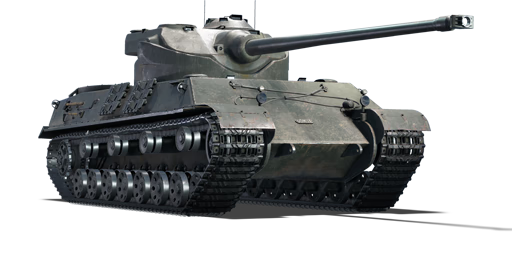
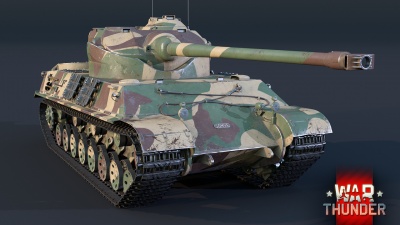
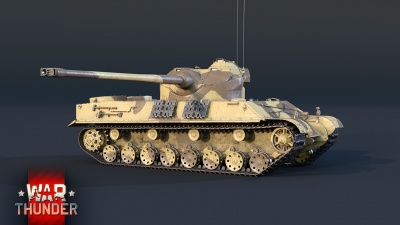
The Somua SM was originally developed as part of a competition between AMX and SOMUA to produce a heavily armoured tank that shared similar components and parts, due to the French army forcing both companies to work under identical specifications. The order to build a prototype was given in 1946, but the vehicle was only delivered in October 1951, weighing 56 tonnes but still lacking an engine. In contrast, the AMX-50, the SOMUA SM's direct competitor, had already been tested, and a variant of the AMX-50 with a 120 mm cannon was already being designed. Ultimately, the SOMUA SM was not tested until 1953, by which point the AMX-50 Surbaissé had already been delivered for testing, and the AMX-50 (TOA100) had been deemed insufficient due to its armament. These delays would doom the project, leading to eventual cancellation of the project and scrapping of the only constructed prototype.
Introduced in Update "Raining Fire" as a premium pack in the Gaijin store, the Somua SM will be a familiar tank to French players; it possesses the excellent 100 mm SA47 L/58 autoloaded cannon that is equipped on both the Lorraine 40t and AMX-50 (TOA100), while featuring similar mobility. Unlike the tanks previously mentioned, however, the Somua SM possesses decent armour, capable of bouncing almost all APCBC and even some APDS rounds aimed to its hull and upper turret front. The armour on the Souma SM, combined with the slightly larger ready rack for the gun compared to the Lorraine and AMX-50, allows the player to use the tank more aggressively.
General info
Survivability and armour
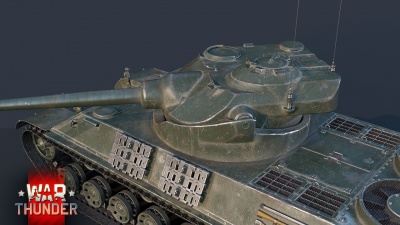
The upper glacis of the hull and the turret (aside from an area beneath the gun) are the only well-protected areas, which will give you good protection against most conventional rounds, especially from far ranges. However, the rest of the armour is very weak and can be easily penetrated by pretty much everything, and you will still be vulnerable against HEAT-FS, ATGMs, APFSDS and such. Your best bet is to flank the enemy and take them out with your auto-loading gun before they can get a hit on you. If an enemy spots you, face them so they can only hit the front of the tank, and hope that they don't hit the very weak bottom portion of your turret. Try not to angle your tank as the sides can easily be penetrated. Since you have 5 crew members, with 2 in the front of the hull and 3 in the turret, and come equipped with a handy autoloader, you can take a few hits and lose a couple of crew members without much effect on combat performance. Additionally, the Somua SM features Commander Aiming, which allows your Commander to take over control of the gun quickly in the case that your Gunner is knocked out.
Armour type:
- Rolled homogeneous armour (hull, turret roof)
- Cast homogeneous armour (oscillating turret, turret base, cupola)
| Armour | Front (Slope angle) | Sides | Rear | Roof |
|---|---|---|---|---|
| Hull | 150 mm (55°) Front glacis 60 mm (55°) Lower glacis |
40 mm (25°) Top 40 mm Bottom |
40 mm (30°) | 5 - 20 mm |
| Turret | 120 mm Turret front and ring 200 mm Gun mantlet |
40 - 60 mm Top
120 mm Bottom |
40 mm | 30 mm |
| Cupola | 30 mm | 30 mm | 30 mm | 30 mm |
Notes:
- Suspension wheels, tracks and torsion bars are 20 mm thick.
Mobility
Although heavier and not as mobile as the AMX-50 or Lorraine 40t, the Somua SM is still pretty mobile for a heavy tank. You will still want to flank the enemy as much as possible and take them out quickly with your auto-loading gun, but don't be afraid to take a few hits from the front. However, your reverse speed is pretty slow and will not save you, so watch out for that.
| Game Mode | Max Speed (km/h) | Weight (tons) | Engine power (horsepower) | Power-to-weight ratio (hp/ton) | |||
|---|---|---|---|---|---|---|---|
| Forward | Reverse | Stock | Upgraded | Stock | Upgraded | ||
| Arcade | Expression error: Unexpected * operator. | 1291 | Expression error: Unexpected round operator. | __.__ | |||
| Realistic | 884 | Expression error: Unexpected round operator. | __.__ | ||||
Modifications and economy
Armaments
Main armament
| 100 mm SA47 L/58 | Turret rotation speed (°/s) | Reloading rate (seconds) | ||||||||
|---|---|---|---|---|---|---|---|---|---|---|
| Mode | Capacity | Vertical | Horizontal | Stabilizer | Stock | Upgraded | Full | Expert | Aced | Autoloader |
| Arcade | 50 | -8°/+15° | ±180° | N/A | 24.3 | 33.6 | 40.8 | 45.1 | 48.0 | 4.00 |
| Realistic | 17.9 | 21.0 | 25.5 | 28.2 | 30.0 | |||||
Ammunition
| Penetration statistics | |||||||
|---|---|---|---|---|---|---|---|
| Ammunition | Type of warhead |
Penetration @ 0° Angle of Attack (mm) | |||||
| 10 m | 100 m | 500 m | 1,000 m | 1,500 m | 2,000 m | ||
| Obus de rupture | APCBC | 273 | 270 | 257 | 242 | 228 | 215 |
| Obus explosif | HE | 30 | 30 | 28 | 26 | 24 | 22 |
| Shell details | ||||||||||||
|---|---|---|---|---|---|---|---|---|---|---|---|---|
| Ammunition | Type of warhead |
Velocity (m/s) |
Projectile mass (kg) |
Fuse delay (m) |
Fuse sensitivity (mm) |
Explosive mass (TNT equivalent) (kg) |
Ricochet | |||||
| 0% | 50% | 100% | ||||||||||
| Obus de rupture | APCBC | 1,000 | 15 | - | - | - | 48° | 63° | 71° | |||
| Obus explosif | HE | 1,000 | 14.8 | 0.2 | 0.1 | 1.4 | 79° | 80° | 81° | |||
Ammo racks
| Full ammo |
1st rack empty |
2nd rack empty |
3rd rack empty |
4th rack empty |
5th rack empty |
6th rack empty |
7th rack empty |
8th rack empty |
9th rack empty |
Visual discrepancy |
|---|---|---|---|---|---|---|---|---|---|---|
| 50 | 46 (+4) | 39 (+11) | 32 (+18) | 25 (+25) | 18 (+32) | 14 (+36) | 10 (+40) | 9 (+41) | 1 (+49) | No |

Notes:
- Shells are modelled individually and disappear after having been shot or loaded.
- Rack 9* (autoloader magazine) is a first stage ammo rack. It totals 9 shells.
- This rack gets filled first when loading up the tank and is also emptied first.
- As it is equipped with an autoloader, manual reloading of the gun is not possible.
- Once the autoloader magazine has been depleted, you can't shoot until the loader has restocked the autoloader. The restocking time is longer than the normal reload time of the gun. Take this into account when playing.
- Simply not firing when the gun is loaded will move ammo from racks 1 to 8 into rack 9*. Firing will interrupt the restocking of the ready racks.
- The depletion order at full capacity is: 9 - 1 - 2 - up to 8.
Machine guns
| 7.5 mm MAC 31 | ||||
|---|---|---|---|---|
| Mount | Capacity (Belt) | Fire rate | Vertical | Horizontal |
| Coaxial | 4,800 (150) | 551 | N/A | N/A |
The small calibre of the MAC 31 machine gun makes it largely ineffective against all armoured vehicles but the ones with an open compartment. It still can be used to ping targets as a rangefinding help.
Usage in battles
Try to play the Somua SM quite aggressively because it has a very strong autoloader. Hardly anyone else on the battlefield owns an autoloader like the French do at this battle rating.
It's best to find a good, but safe position close to the front to get good shots onto targets. If encountering an enemy tank with good turret armor like a Tiger II, try to shoot the weak spots. Though the gun should be sufficient for front penetration, the Somua SM can drive around to hit the target's side armour do to its semi-good mobility. If the enemy tank tries to drive away, shoot it in the tracks to immobilise it.
Though the 4-second autoloader is the Somua SM's greatest asset, try not to fire too quickly as the autoloader can only carry 8 rounds at a time. Refilling the autoloader can take a long time. Once the 8 shots are depleted, look for a safe position behind the terrain or other cover and wait until the autoloader is refilled with shells.
A Somua SM's main worry on the battlefield is its own armour, as while the hull front is somewhat good, everywhere else is easy to penetrate by most tank shells being shot at the Somua SM. This is especially the case when encountering tanks with HEAT rounds, as then nowhere on the tank is safe from a penetration. Always make sure that no one shoots the Somua SM from the side because the damage can be very serious due to the ammunition stowage.
When fighting at the front lines, always try to drive with other tanks so that the Somua SM does not get as much focus. Attacking the enemies while they are attacking allies is the best way to catch them off guard with the 100 mm cannon. With its autoloader, the Somua SM can be a deadly machine by picking off the enemies one by one before they can react.
Plan carefully your moves as there is no good way to get out of a bad position without having either to expose its weak sides or to reverse at a very slow speed.
Pros and cons
Pros:
- Great 100 mm gun
- Equipped with a huge 9-shell autoloader, making this one of the best tanks to attack multiple enemies at once
- Unlike most French tanks, the SOMUA has good frontal armour; the upper turret and upper plate are basically immune to all conventional rounds
- Due to the frontal armour and nine shot autoloader, the tank is not only great at flanking and ambushing, but also very good at brawling
- The strong upper turret coupled with the eight degrees of gun depression makes this tank great at hull-down fighting and cresting ridgelines
- Due to how tall this tank is and how high the gun is placed, it can shoot over obstacles that many tanks have trouble seeing over
- Quick and manoeuvrable for a heavy tank
- This tank has a high level of survivability thanks to the spacious crew compartment and a five-man crew
- Good set of optics with 6x magnification
- The APCBC round has a tendency to cause lots of spalling upon penetration
Cons:
- Absolutely huge tank. Longer, wider, and taller than a Tiger II. Finding proper concealment is difficult
- The neck of the turret a prime weak spot that's hard to effectively hide
- The lower plate is as weak as British lower plates. Any APHE shell that enters here will likely knock out the whole crew
- Will face a lot of enemies that fire APDS and HEAT, the upper turret and upper plate just can't absorb those kinds of shells
- Terrible side armour, side-scraping or angling the tank is extremely hazardous
- Is much slower than the Lorraine and AMX-50
- Mediocre elevation angles thanks to the inherent nature of oscillating turrets
- Once the autoloader is expended, reloading the magazine takes a considerable amount of time
- Because of the 4.0s reload, you can quite easily empty the 9 round magazine
History
At the end of WW2, the French army realized that they needed a new modern heavy tank. The SOMUA Company competed with AMX to design a new heavy tank for France, and they were given the order to build a prototype in 1946. The hull of the tank was based off the German Tiger II, and the tank used an oscillating turret armed with an auto-loading 100 mm gun. Because the two companies were forced to make a new design with the same requirements, the Somua SM design looked similar to the AMX 50, and both tanks had equipped the 100 mm gun. The prototype was delivered in October of 1951 but was still lacking an engine and some other parts. Due to delays, the prototype was not tested until 1953, but it was already too late. The SOMUA's design was rejected in favour of the AMX 50.
Devblog
In 1946, at the same time when AMX was given the order to develop what would eventually become the AMX-50 tank, SOMUA was instructed to come up with a competing design that would act as an alternative to the AMX.
Due to both companies being issued identical technical requirements by the French Army and taking much inspiration from the German "King Tiger" at the same time, both designs turned out to be very similar. In fact, SOMUA's design stood out from AMX's only in increased mass, coming as a result of heavier protection, and in its more simple running gear.
The SOMUA SM, as it became known, was presented for the first time to army officials in October 1951, albeit without its engine installed. At the same time, prototypes of the AMX-50 had already been tested. By 1953, SOMUA had completed the construction of its SM tank, subsequently conducting trials.
During testing however, several design issues were revealed. Because of this and the fact that the upgunned version of the AMX-50 with a 120mm gun was already available, the decision was made to cancel further work on the project. As a result, the SOMUA SM never left the prototype stage and the only constructed vehicle was scrapped shortly after the project's cancellation.
Media
- Skins
- Images
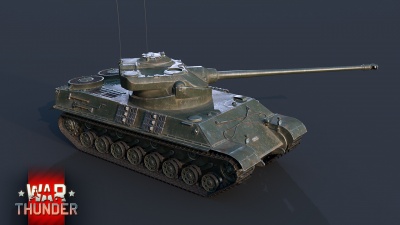
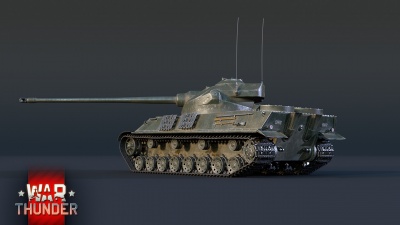
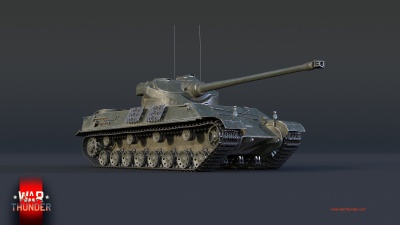
- Somua SM Devblog Images


- Videos
See also
External links
| France heavy tanks | |
|---|---|
| B1 | B1 bis · B1 ter |
| 2C | 2C · 2C bis |
| ARL-44 | ARL-44 (ACL-1) |
| AMX-50 | Somua SM · AMX-50 Surbaissé · AMX-50 Surblindé |
| USA | ▄M4A3E2 |
| France premium ground vehicles | |
|---|---|
| Light tanks | AMD.35 (SA35) · H.39 "Cambronne" · LVT-4/40 · AMX-13 (SS.11) · AMX-13-M24 · E.B.R. (1954) · E.B.R. (1963) · VBCI-2 (MCT30) |
| Medium tanks | M4A1 (FL10) · Panther "Dauphiné" · AMX-30 · AMX-30 Super · AMX-50 (TO90/930) |
| Heavy tanks | B1 ter · 2C bis · Somua SM |
| Tank destroyers | Lorraine 155 Mle.50 |