Difference between revisions of "2S25"
(added missing info) (Tag: Visual edit) |
U103691029 (talk | contribs) m (→Main armament: Autoloader) (Tag: Visual edit) |
||
| (7 intermediate revisions by 5 users not shown) | |||
| Line 12: | Line 12: | ||
<!-- ''In the description, the first part should be about the history of the creation and combat usage of the vehicle, as well as its key features. In the second part, tell the reader about the ground vehicle in the game. Insert a screenshot of the vehicle, so that if the novice player does not remember the vehicle by name, he will immediately understand what kind of vehicle the article is talking about.'' The text within these arrows are not to be deleted --> | <!-- ''In the description, the first part should be about the history of the creation and combat usage of the vehicle, as well as its key features. In the second part, tell the reader about the ground vehicle in the game. Insert a screenshot of the vehicle, so that if the novice player does not remember the vehicle by name, he will immediately understand what kind of vehicle the article is talking about.'' The text within these arrows are not to be deleted --> | ||
The '''{{Specs|name}}''' is a rank {{Specs|rank}} Soviet light tank {{Battle-rating}}. It was introduced in [[Update "Direct Hit"]]. | The '''{{Specs|name}}''' is a rank {{Specs|rank}} Soviet light tank {{Battle-rating}}. It was introduced in [[Update "Direct Hit"]]. | ||
| + | |||
| + | The 2S25 "Sprut-SD" is a modern entry in the long line of Soviet amphibious tanks started by the [[PT-76B]]. It uses the lightweight chassis of the BMD-3 airborne IFV, which offers a great power-to-weight ratio, a hydropneumatic suspension, and equal mobility in both forward and reverse at the cost of extremely light protection and a rather large profile. The oddly-shaped turret packs a full-size 125 mm gun with autoloader, giving the Sprut the same firepower as the [[T-72B]]. Using this vehicle effectively can be tricky because it is significantly easier to spot and destroy than contemporary Soviet MBTs while lacking access to thermal optics for easy target acquisition, so it's important to make the most out of the high mobility to ambush enemies and retreat from danger. | ||
== General info == | == General info == | ||
| Line 45: | Line 47: | ||
{{Specs-Tank-Mobility}} | {{Specs-Tank-Mobility}} | ||
<!-- ''Write about the mobility of the ground vehicle. Estimate the specific power and manoeuvrability, as well as the maximum speed forwards and backwards.'' The text within these arrows are not to be deleted --> | <!-- ''Write about the mobility of the ground vehicle. Estimate the specific power and manoeuvrability, as well as the maximum speed forwards and backwards.'' The text within these arrows are not to be deleted --> | ||
| − | + | ''Write about the mobility of the ground vehicle. Estimate the specific power and manoeuvrability, as well as the maximum speed forwards and backwards.'' | |
{{tankMobility|abMinHp=790|rbMinHp=451}} | {{tankMobility|abMinHp=790|rbMinHp=451}} | ||
| Line 57: | Line 59: | ||
{{Specs-Tank-Weapon|1}} | {{Specs-Tank-Weapon|1}} | ||
<!-- ''Give the reader information about the characteristics of the main gun. Assess its effectiveness in a battle based on the reloading speed, ballistics and the power of shells. Do not forget about the flexibility of the fire, that is how quickly the cannon can be aimed at the target, open fire on it and aim at another enemy. Add a link to the main article on the gun: <code><nowiki>{{main|Name of the weapon}}</nowiki></code>. Describe in general terms the ammunition available for the main gun. Give advice on how to use them and how to fill the ammunition storage.'' The text within these arrows are not to be deleted --> | <!-- ''Give the reader information about the characteristics of the main gun. Assess its effectiveness in a battle based on the reloading speed, ballistics and the power of shells. Do not forget about the flexibility of the fire, that is how quickly the cannon can be aimed at the target, open fire on it and aim at another enemy. Add a link to the main article on the gun: <code><nowiki>{{main|Name of the weapon}}</nowiki></code>. Describe in general terms the ammunition available for the main gun. Give advice on how to use them and how to fill the ammunition storage.'' The text within these arrows are not to be deleted --> | ||
| − | {{main|2A75 (125 mm)}}The Sprut-D is armed with a 2A75 125 mm smoothbore cannon, a similar cannon in performance as the T series tanks capable of firing the same munitions. It has access to the 3BM42 'Mango' dart, the same dart seen in the early T-72s and T-64s. While it lacks penetration compared to other rounds at the battle-rating (such as M900), it has very decent performance against anything it faces. It lacks punch when it comes to fighting in up-tiers as the dart might not be able to penetrate the frontal plates or mantlet of the MBTs. However, any well placed side shot should be more than enough to dispatch a target with no more than a single shot. | + | {{main|2A75 (125 mm)}} |
| + | |||
| + | The Sprut-D is armed with a 2A75 125 mm smoothbore cannon, a similar cannon in performance as the T series tanks capable of firing the same munitions. It has access to the 3BM42 'Mango' dart, the same dart seen in the early T-72s and T-64s. While it lacks penetration compared to other rounds at the battle-rating (such as M900), it has very decent performance against anything it faces. It lacks punch when it comes to fighting in up-tiers as the dart might not be able to penetrate the frontal plates or mantlet of the MBTs. However, any well placed side shot should be more than enough to dispatch a target with no more than a single shot. | ||
{| class="wikitable" style="text-align:center" width="100%" | {| class="wikitable" style="text-align:center" width="100%" | ||
|- | |- | ||
| − | ! colspan="5" | [[2A75 (125 mm)|125 mm 2A75]] || colspan="5" | Turret rotation speed (°/s) | | + | ! colspan="5" | [[2A75 (125 mm)|125 mm 2A75]] || colspan="5" | Turret rotation speed (°/s) || Reloading rate (seconds) |
|- | |- | ||
! Mode !! Capacity !! Vertical !! Horizontal !! Stabilizer | ! Mode !! Capacity !! Vertical !! Horizontal !! Stabilizer | ||
! Stock !! Upgraded !! Full !! Expert !! Aced | ! Stock !! Upgraded !! Full !! Expert !! Aced | ||
| − | ! | + | !Autoloader |
|- | |- | ||
! ''Arcade'' | ! ''Arcade'' | ||
| − | | rowspan="2" | 40 || rowspan="2" | -5°/+15° || rowspan="2" | ±180° || rowspan="2" | Two-plane || 33.3 || 46.1 || 56.0 || 61.9 || 65.9 | + | | rowspan="2" | 40 || rowspan="2" | -5°/+15° || rowspan="2" | ±180° || rowspan="2" | Two-plane || 33.3 || 46.1 || 56.0 || 61.9 || 65.9 || rowspan="2" | 7.10 |
|- | |- | ||
! ''Realistic'' | ! ''Realistic'' | ||
| Line 76: | Line 80: | ||
==== Ammunition ==== | ==== Ammunition ==== | ||
| − | { | + | {{:2A75 (125 mm)/Ammunition|3BK18M, 3OF26, 3BM22, 9M119, 3BM42}} |
| − | |||
| − | |||
| − | |||
| − | |||
| − | |||
| − | |||
| − | |||
| − | |||
| − | |||
| − | |||
| − | |||
| − | |||
| − | |||
| − | |||
| − | |||
| − | |||
| − | |||
| − | |||
| − | |||
| − | |||
| − | |||
| − | |||
| − | |||
| − | |||
| − | |||
| − | |||
| − | |||
| − | |||
| − | |||
| − | |||
| − | |||
| − | |||
| − | |||
| − | | 3BK18M | ||
| − | |||
| − | |||
| − | |||
| − | |||
| − | |||
| − | |||
| − | |||
| − | |||
| − | |||
| − | |||
==== [[Ammo racks]] ==== | ==== [[Ammo racks]] ==== | ||
| Line 157: | Line 117: | ||
== Usage in battles == | == Usage in battles == | ||
<!-- ''Describe the tactics of playing in the vehicle, the features of using vehicles in the team and advice on tactics. Refrain from creating a "guide" - do not impose a single point of view but instead give the reader food for thought. Describe the most dangerous enemies and give recommendations on fighting them. If necessary, note the specifics of the game in different modes (AB, RB, SB).'' The text within these arrows are not to be deleted --> | <!-- ''Describe the tactics of playing in the vehicle, the features of using vehicles in the team and advice on tactics. Refrain from creating a "guide" - do not impose a single point of view but instead give the reader food for thought. Describe the most dangerous enemies and give recommendations on fighting them. If necessary, note the specifics of the game in different modes (AB, RB, SB).'' The text within these arrows are not to be deleted --> | ||
| − | + | ''Describe the tactics of playing in the vehicle, the features of using vehicles in the team and advice on tactics. Refrain from creating a "guide" - do not impose a single point of view but instead give the reader food for thought. Describe the most dangerous enemies and give recommendations on fighting them. If necessary, note the specifics of the game in different modes (AB, RB, SB).'' | |
| − | |||
| − | |||
| − | |||
| − | |||
| − | |||
| − | |||
| − | |||
| − | |||
| − | |||
| − | |||
| − | |||
=== Pros and cons === | === Pros and cons === | ||
| Line 190: | Line 139: | ||
== History == | == History == | ||
<!-- ''Describe the history of the creation and combat usage of the vehicle in more detail than in the introduction. If the historical reference turns out to be too long, take it to a separate article, taking a link to the article about the vehicle and adding a block "/History" (example: <nowiki>https://wiki.warthunder.com/(Vehicle-name)/History</nowiki>) and add a link to it here using the <code>main</code> template. Be sure to reference text and sources by using <code><nowiki><ref></ref></nowiki></code>, as well as adding them at the end of the article with <code><nowiki><references /></nowiki></code>. This section may also include the vehicle's dev blog entry (if applicable) and the in-game encyclopedia description (under <code><nowiki>=== In-game description ===</nowiki></code>, also if applicable).'' --> | <!-- ''Describe the history of the creation and combat usage of the vehicle in more detail than in the introduction. If the historical reference turns out to be too long, take it to a separate article, taking a link to the article about the vehicle and adding a block "/History" (example: <nowiki>https://wiki.warthunder.com/(Vehicle-name)/History</nowiki>) and add a link to it here using the <code>main</code> template. Be sure to reference text and sources by using <code><nowiki><ref></ref></nowiki></code>, as well as adding them at the end of the article with <code><nowiki><references /></nowiki></code>. This section may also include the vehicle's dev blog entry (if applicable) and the in-game encyclopedia description (under <code><nowiki>=== In-game description ===</nowiki></code>, also if applicable).'' --> | ||
| − | + | The creation of a self-propelled anti-tank gun for the needs of the airborne forces began in the USSR in the 70s. In 1985, the requirements for the future vehicle were specified - in particular, the main weapon of the vehicle was to be a 125-mm smoothbore gun, unified with the shells of the T-72 tank. Work on the creation of the Sprut (Russian for ‘big octopus’) dragged on for 20 long years, but in September 2005, the vehicle, created on the basis of the BMD-3 IFV, was put into service. After the bankruptcy of the initial manufacturer, the 2S25 project, together with the BMD-4 produced in the same place, passed to the Kurganmashzavod, where the machine was unified with the BMD-4M and under the designation 2S25M "Sprut-SDM1" exists only in the form of prototypes. In total, from 2005 to 2010, the Russian army purchased more than 30 units of the 2S25 self-propelled anti-tank gun. | |
| + | |||
| + | ''- From [[wt:en/news/7295-development-2s25-sprut-sd-anti-tank-paratrooper-en|Devblog]]'' | ||
== Media == | == Media == | ||
| Line 206: | Line 157: | ||
* ''reference to the series of the vehicles;'' | * ''reference to the series of the vehicles;'' | ||
* ''links to approximate analogues of other nations and research trees.'' --> | * ''links to approximate analogues of other nations and research trees.'' --> | ||
| − | |||
| − | * | + | * [[2S25M]] |
| − | * | + | * [[Object 685]] |
== External links == | == External links == | ||
Latest revision as of 01:52, 17 April 2024
| This page is about the Russian light tank 2S25. For the other version, see 2S25M. |

Contents
Description
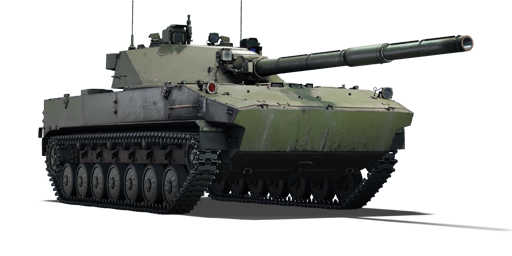
The 2S25 "Sprut-SD" is a rank Soviet light tank with a battle rating of (AB), (RB), and (SB). It was introduced in Update "Direct Hit".
The 2S25 "Sprut-SD" is a modern entry in the long line of Soviet amphibious tanks started by the PT-76B. It uses the lightweight chassis of the BMD-3 airborne IFV, which offers a great power-to-weight ratio, a hydropneumatic suspension, and equal mobility in both forward and reverse at the cost of extremely light protection and a rather large profile. The oddly-shaped turret packs a full-size 125 mm gun with autoloader, giving the Sprut the same firepower as the T-72B. Using this vehicle effectively can be tricky because it is significantly easier to spot and destroy than contemporary Soviet MBTs while lacking access to thermal optics for easy target acquisition, so it's important to make the most out of the high mobility to ambush enemies and retreat from danger.
General info
Survivability and armour
The 2S25 design consists fully of special alloy with lesser armour effectiveness than RHA (rolled homogeneous armour). This means that .50 cal rounds can pass through the 40 mm plate up to 500 m away and 20 mm autocannons rounds 8MBT-70, KPZ-70 and Leopard 2k) can pass through the 40 mm plate up to 1,000 m away. Other parts of the frontal armour are sufficiently angled to deflect .50 cal rounds and 20 mm shells at any range. Due to the weak armour, the rear and the sides and should always be hidden from the enemy as .50 cal rounds and 20 mm shells can go through at any range. Any other IFV armed with an autocannon will be able to destroy the 2S25 from any angle.
The 2S25 has a total of 3 crew members which makes the survivability of the vehicle is very low as any penetrating rounds will very likely destroy it in one shot.
The thin armour of the 2S25 makes it highly susceptible to large-calibre HE shells that will be able to overpressure the 2S25 even if it lands next to it.
Armour type:
- Alloy ABT-102 (Front, Side, Roof)
| Armour | Front (Slope angle) | Sides | Rear | Roof |
|---|---|---|---|---|
| Hull | 18 mm (72°) + 10 mm Upper Glacis 40 mm (35°) Lower Glacis 23 mm (63°) Bottom |
20 mm Top 20 mm Bottom |
20 mm | 15 mm |
| Turret | 20 - 43 mm Turret front 20 mm Gun mantlet |
20 mm | 20 mm | 15 mm |
Notes:
- Turret Ring - 15 mm
- Tracks - 15 mm
- Suspension - 20 mm
Mobility
Write about the mobility of the ground vehicle. Estimate the specific power and manoeuvrability, as well as the maximum speed forwards and backwards.
| Game Mode | Max Speed (km/h) | Weight (tons) | Engine power (horsepower) | Power-to-weight ratio (hp/ton) | |||
|---|---|---|---|---|---|---|---|
| Forward | Reverse | Stock | Upgraded | Stock | Upgraded | ||
| Arcade | Expression error: Unexpected * operator. | 790 | Expression error: Unexpected round operator. | __.__ | |||
| Realistic | 451 | Expression error: Unexpected round operator. | __.__ | ||||
Modifications and economy
Armaments
Main armament
The Sprut-D is armed with a 2A75 125 mm smoothbore cannon, a similar cannon in performance as the T series tanks capable of firing the same munitions. It has access to the 3BM42 'Mango' dart, the same dart seen in the early T-72s and T-64s. While it lacks penetration compared to other rounds at the battle-rating (such as M900), it has very decent performance against anything it faces. It lacks punch when it comes to fighting in up-tiers as the dart might not be able to penetrate the frontal plates or mantlet of the MBTs. However, any well placed side shot should be more than enough to dispatch a target with no more than a single shot.
| 125 mm 2A75 | Turret rotation speed (°/s) | Reloading rate (seconds) | ||||||||
|---|---|---|---|---|---|---|---|---|---|---|
| Mode | Capacity | Vertical | Horizontal | Stabilizer | Stock | Upgraded | Full | Expert | Aced | Autoloader |
| Arcade | 40 | -5°/+15° | ±180° | Two-plane | 33.3 | 46.1 | 56.0 | 61.9 | 65.9 | 7.10 |
| Realistic | 20.8 | 24.5 | 29.8 | 32.9 | 35.0 | |||||
Ammunition
| Penetration statistics | |||||||
|---|---|---|---|---|---|---|---|
| Ammunition | Type of warhead |
Penetration @ 0° Angle of Attack (mm) | |||||
| 10 m | 100 m | 500 m | 1,000 m | 1,500 m | 2,000 m | ||
| 3BK18M | HEATFS | 550 | 550 | 550 | 550 | 550 | 550 |
| 3OF26 | HE | 42 | 42 | 42 | 42 | 42 | 42 |
| 3BM22 | APFSDS | 425 | 420 | 415 | 405 | 393 | 380 |
| 9M119 | ATGM | 700 | 700 | 700 | 700 | 700 | 700 |
| 3BM42 | APFSDS | 457 | 454 | 445 | 431 | 419 | 406 |
| Shell details | ||||||||||||
|---|---|---|---|---|---|---|---|---|---|---|---|---|
| Ammunition | Type of warhead |
Velocity (m/s) |
Projectile mass (kg) |
Fuse delay (m) |
Fuse sensitivity (mm) |
Explosive mass (TNT equivalent) (kg) |
Ricochet | |||||
| 0% | 50% | 100% | ||||||||||
| 3BK18M | HEATFS | 905 | 19 | 0.05 | 0.1 | 2.79 | 65° | 72° | 77° | |||
| 3OF26 | HE | 850 | 23 | 0.3 | 0.1 | 5.24 | 79° | 80° | 81° | |||
| 3BM22 | APFSDS | 1,760 | 4.83 | - | - | - | 76° | 77° | 80° | |||
| 3BM42 | APFSDS | 1,700 | 4.85 | - | - | - | 78° | 80° | 81° | |||
| Missile details | ||||||||||||
|---|---|---|---|---|---|---|---|---|---|---|---|---|
| Ammunition | Type of warhead |
Velocity (m/s) |
Range (m) |
Projectile mass (kg) |
Fuse delay (m) |
Fuse sensitivity (mm) |
Explosive mass (TNT equivalent) (kg) |
Ricochet | ||||
| 0% | 50% | 100% | ||||||||||
| 9M119 | ATGM | 445 | 4,000 | 16.5 | 0.05 | 0.1 | 5.72 | 80° | 82° | 90° | ||
Ammo racks
| Full ammo |
1st rack empty |
2nd rack empty |
3rd rack empty |
4th rack empty |
5th rack empty |
6th rack empty |
Visual discrepancy |
|---|---|---|---|---|---|---|---|
| 40 | __ (+__) | __ (+__) | __ (+__) | __ (+__) | __ (+__) | __ (+__) | __ |
Machine guns
| 7.62 mm PKT | ||||
|---|---|---|---|---|
| Mount | Capacity (Belt) | Fire rate | Vertical | Horizontal |
| Coaxial | 2,000 (250) | 700 | N/A | N/A |
Usage in battles
Describe the tactics of playing in the vehicle, the features of using vehicles in the team and advice on tactics. Refrain from creating a "guide" - do not impose a single point of view but instead give the reader food for thought. Describe the most dangerous enemies and give recommendations on fighting them. If necessary, note the specifics of the game in different modes (AB, RB, SB).
Pros and cons
Pros:
- Fairly mobile, decent turn rate
- Adjustable suspension allowing for clearance height adjustment
- Good ammunition choices for its BR: 3BM42 and 9M119 are more than good enough to handle most enemies it faces
- Access to the excellent 3OF26 HEF-T explosive round which can disable or destroy targets behind cover if the top of their turret is visible
- Access to laser rangefinder allowing for quick long-range shots
Cons:
- Lack of thermals for both the gunner and commander mean you cannot effectively hunt for targets at dusk or during night battles
- Relatively slow reload rate of 7.1 seconds
- Very thin armour, which does little to stop anything but MG fire and autocannon rounds at a distance
History
The creation of a self-propelled anti-tank gun for the needs of the airborne forces began in the USSR in the 70s. In 1985, the requirements for the future vehicle were specified - in particular, the main weapon of the vehicle was to be a 125-mm smoothbore gun, unified with the shells of the T-72 tank. Work on the creation of the Sprut (Russian for ‘big octopus’) dragged on for 20 long years, but in September 2005, the vehicle, created on the basis of the BMD-3 IFV, was put into service. After the bankruptcy of the initial manufacturer, the 2S25 project, together with the BMD-4 produced in the same place, passed to the Kurganmashzavod, where the machine was unified with the BMD-4M and under the designation 2S25M "Sprut-SDM1" exists only in the form of prototypes. In total, from 2005 to 2010, the Russian army purchased more than 30 units of the 2S25 self-propelled anti-tank gun.
- From Devblog
Media
- Skins
- Videos
See also
External links
| USSR light tanks | |
|---|---|
| T-26 | T-26 · T-26 (1st Gv.T.Br.) · T-26-4 · T-26E |
| BT | BT-5 · RBT-5 · BT-7 · BT-7 TD · BT-7M · BT-7A (F-32) |
| T-50 | T-126 · T-50 |
| T-70 | T-70 · T-80 |
| PT-76 | PT-76B · PT-76-57 · Object 906 |
| BMP | BMP-1 · BMP-2 · BMP-2M · BMP-3 |
| BMD | BMD-4 |
| 2S25 | 2S25 · 2S25M |
| Wheeled | BA-11 · BTR-80A |
| Other | T-60 · Object 685 · 2S38 |
| China | ▂Type 62 |