Difference between pages "Tornado IDS MFG (Germany)" and "VB.10C-1"
U133583408 (talk | contribs) (→Flight performance) (Tag: Visual edit) |
(Edits) |
||
| Line 1: | Line 1: | ||
{{About | {{About | ||
| − | | about = | + | | about = French twin-engine fighter '''{{PAGENAME}}''' |
| − | | usage = other | + | | usage = the other version |
| − | | link = | + | | link = VB.10-02 |
}} | }} | ||
{{Specs-Card | {{Specs-Card | ||
| − | |code= | + | |code=vb_10c1 |
| − | |images={{Specs-Card-Image|GarageImage_{{PAGENAME}}.jpg}} | + | |images={{Specs-Card-Image|GarageImage_{{PAGENAME}}.jpg|ArtImage_{{PAGENAME}}.png}} |
| − | |||
}} | }} | ||
== Description == | == Description == | ||
<!-- ''In the description, the first part should be about the history of and the creation and combat usage of the aircraft, as well as its key features. In the second part, tell the reader about the aircraft in the game. Insert a screenshot of the vehicle, so that if the novice player does not remember the vehicle by name, he will immediately understand what kind of vehicle the article is talking about.'' --> | <!-- ''In the description, the first part should be about the history of and the creation and combat usage of the aircraft, as well as its key features. In the second part, tell the reader about the aircraft in the game. Insert a screenshot of the vehicle, so that if the novice player does not remember the vehicle by name, he will immediately understand what kind of vehicle the article is talking about.'' --> | ||
| − | + | The '''{{Specs|name}}''' was a heavy fighter designed in France, based in the [[V.G.33C-1|V.G.33]] that failed to enter production in WWII due to the capitulation of France in 1940. The aircraft was meant for post-war service with 200 aircraft ordered in 1946, however this was reduced to only 50 a few years later. Powered by two Hispano-Suiza HS 12Z Ars 15/16 engines, the aircraft was armed with four 20 mm cannons, although further versions also added six 12.7 mm HMGs. However, in the end, the order for this aircraft was cancelled, with the French Air Force deciding to rely on Allied aircraft such as the F6F, F8F, and F4U while their own jet-powered aircraft were being developed. | |
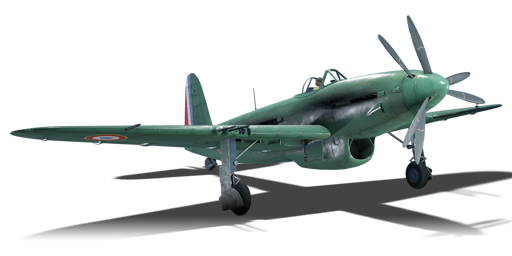
| − | + | It was introduced in [[Update 1.73 "Vive la France"]]. The VB.10 is a twin-engine fighter, with the second engine hidden behind the pilot driving its own set of propellers. Owing to its sleek design and contra-rotating propellers, it might appear as a single-engine super-prop fighter. With 2 engines, the plane can achieve high speeds but it is heavy and does not fare well in dogfights. It has access to a powerful offensive armament in the form of four 20 mm cannons, this paired with its good top speed, makes the aircraft great for boom and zoom, however for this, side climbing at the start of the match is highly recommended. | |
== General info == | == General info == | ||
=== Flight performance === | === Flight performance === | ||
{{Specs-Avia-Flight}} | {{Specs-Avia-Flight}} | ||
| − | <!-- ''Describe how the aircraft behaves in the air. Speed, manoeuvrability, acceleration and allowable loads - these are the most important characteristics of the vehicle.'' --> | + | <!--''Describe how the aircraft behaves in the air. Speed, manoeuvrability, acceleration and allowable loads - these are the most important characteristics of the vehicle.''--> |
| + | |||
| + | The flight performance of the VB.10C-1 is as you would expect of an interceptor/heavy fighter. Although its manoeuvrability is generally sluggish and its turn rate poor, it does have many advantages that fit its playstyle well. Important among these is its strong rate of climb, which allows you to reach high climbing bombers. This couples well with the aircraft's high dive speed provided by its twin engines and aerodynamic contours. It also has a high straight-line speed to its advantage, which allows players of the VB.10 C-1 to outrun many opponents that could out-turn it (i.e. most single-engine fighters and some heavy fighters). This high speed also allows it to catch up to bombers on its level, although this is not recommended as this will often lead to a slower approach than attacking from above. | ||
{| class="wikitable" style="text-align:center" width="70%" | {| class="wikitable" style="text-align:center" width="70%" | ||
! rowspan="2" | Characteristics | ! rowspan="2" | Characteristics | ||
| − | ! colspan="2" | Max | + | ! colspan="2" | Max Speed<br>(km/h at 7,000 m) |
! rowspan="2" | Max altitude<br>(metres) | ! rowspan="2" | Max altitude<br>(metres) | ||
! colspan="2" | Turn time<br>(seconds) | ! colspan="2" | Turn time<br>(seconds) | ||
| Line 32: | Line 33: | ||
|- | |- | ||
! Stock | ! Stock | ||
| − | | | + | | 679 || 659 || rowspan="2" | {{Specs|ceiling}} || 25.4 || 26.5 || 11.7 || 11.7 || rowspan="2" | 700 |
|- | |- | ||
! Upgraded | ! Upgraded | ||
| − | | | + | | 739 || 710 || 22.8 || 24.0 || 19.3 || 15.4 |
|- | |- | ||
|} | |} | ||
| − | ==== Details ==== | + | ====Details==== |
{| class="wikitable" style="text-align:center" width="50%" | {| class="wikitable" style="text-align:center" width="50%" | ||
|- | |- | ||
| − | ! colspan=" | + | ! colspan="5" | Features |
|- | |- | ||
| − | ! Combat flaps !! Take-off flaps !! Landing flaps !! Air brakes !! Arrestor gear | + | ! Combat flaps !! Take-off flaps !! Landing flaps !! Air brakes !! Arrestor gear |
|- | |- | ||
| − | | ✓ || ✓ || ✓ || | + | | ✓ || ✓ || ✓ || X || X <!-- ✓ --> |
|- | |- | ||
|} | |} | ||
| − | {| class="wikitable" style="text-align:center" width=" | + | {| class="wikitable" style="text-align:center" width="50%" |
| + | |- | ||
| + | ! colspan="7" | Limits | ||
|- | |- | ||
| − | |||
! rowspan="2" | Wings (km/h) | ! rowspan="2" | Wings (km/h) | ||
! rowspan="2" | Gear (km/h) | ! rowspan="2" | Gear (km/h) | ||
| Line 60: | Line 62: | ||
! Combat !! Take-off !! Landing !! + !! - | ! Combat !! Take-off !! Landing !! + !! - | ||
|- | |- | ||
| − | + | | {{Specs|destruction|body}} || {{Specs|destruction|gear}} || 498 || 469 || 320 || ~11 || ~6 | |
| − | | | ||
| − | |||
| − | |||
| − | |||
|- | |- | ||
|} | |} | ||
| Line 74: | Line 72: | ||
! Ailerons !! Rudder !! Elevators !! Radiator | ! Ailerons !! Rudder !! Elevators !! Radiator | ||
|- | |- | ||
| − | | < | + | | < 380 || < 380 || < 540 || > 340 |
|- | |- | ||
|} | |} | ||
| − | |||
{| class="wikitable" style="text-align:center" | {| class="wikitable" style="text-align:center" | ||
|- | |- | ||
| − | ! colspan="3" | | + | ! colspan="3" | Compressor (RB/SB) |
| − | |||
| − | |||
| − | |||
| − | |||
| − | |||
| − | |||
| − | |||
| − | |||
| − | |||
| − | |||
| − | |||
| − | |||
| − | |||
| − | |||
| − | |||
| − | |||
| − | |||
| − | |||
| − | |||
|- | |- | ||
| − | ! | + | ! colspan="3" | Setting 1 |
| − | |||
|- | |- | ||
| − | + | ! Optimal altitude | |
| − | + | ! 100% Engine power | |
| + | ! WEP Engine power | ||
|- | |- | ||
| − | | | + | | 6,400 m ||1,315 hp||1,500 hp |
| − | |||
|- | |- | ||
|} | |} | ||
| Line 116: | Line 93: | ||
{{Specs-Avia-Armour}} | {{Specs-Avia-Armour}} | ||
<!-- ''Examine the survivability of the aircraft. Note how vulnerable the structure is and how secure the pilot is, whether the fuel tanks are armoured, etc. Describe the armour, if there is any, and also mention the vulnerability of other critical aircraft systems.'' --> | <!-- ''Examine the survivability of the aircraft. Note how vulnerable the structure is and how secure the pilot is, whether the fuel tanks are armoured, etc. Describe the armour, if there is any, and also mention the vulnerability of other critical aircraft systems.'' --> | ||
| − | + | ||
| + | The aircraft is generally quite survivable. Although there are no armour plates, only 50 mm of glass in front of the pilot, the position of the engines in front of and behind the pilot provides them with a protective sandwich, meaning that they are less likely to be taken out by a stray bullet. However, the plane's tail structure is also quite weak, meaning it is vulnerable to structural damage from behind, and also to fires. | ||
| + | |||
| + | * 50 mm Bulletproof glass in front and rear of the cockpit. | ||
=== Modifications and economy === | === Modifications and economy === | ||
| Line 123: | Line 103: | ||
== Armaments == | == Armaments == | ||
{{Specs-Avia-Armaments}} | {{Specs-Avia-Armaments}} | ||
| − | |||
| − | |||
| − | |||
| − | |||
| − | |||
| − | |||
| − | |||
| − | |||
| − | |||
=== Offensive armament === | === Offensive armament === | ||
{{Specs-Avia-Offensive}} | {{Specs-Avia-Offensive}} | ||
<!-- ''Describe the offensive armament of the aircraft, if any. Describe how effective the cannons and machine guns are in a battle, and also what belts or drums are better to use. If there is no offensive weaponry, delete this subsection.'' --> | <!-- ''Describe the offensive armament of the aircraft, if any. Describe how effective the cannons and machine guns are in a battle, and also what belts or drums are better to use. If there is no offensive weaponry, delete this subsection.'' --> | ||
| − | {{main| | + | {{main|Hispano 404 (20 mm)}} |
The '''''{{PAGENAME}}''''' is armed with: | The '''''{{PAGENAME}}''''' is armed with: | ||
| − | * | + | * 4 x 20 mm Hispano 404 cannons, wing-mounted (150 rpg = 600 total) |
| − | + | The offensive armament of the VB.10C-1 is one of its strongest suits. Although the 20mm Hispano cannons' damage can be inconsistent, particularly when stock, their performance improves greatly once the armament modifications are researched. These modifications will reduce the spread of the cannons as well as improve their damage, improving their potency against targets. The most potent belt is the stealth belt, although using this against manoeuvrable fighters will require some leading practice. | |
| − | |||
| − | |||
| − | + | == Usage in battles == | |
| + | <!-- ''Describe the tactics of playing in an aircraft, the features of using vehicles in a team and advice on tactics. Refrain from creating a "guide" - do not impose a single point of view, but instead, give the reader food for thought. Examine the most dangerous enemies and give recommendations on fighting them. If necessary, note the specifics of the game in different modes (AB, RB, SB).'' --> | ||
| + | The VB.10C-1, like most heavy fighters, is reliant on side climbing to engage enemy fighters, however this isn't the only way to play the VB.10C-1, if you decide to side climb and wait for enemy planes to drop down to lower altitudes they will find themselves in peril when a experienced pilot in a VB.10C-1 comes booming past with its quick dive rate and deadly armament of 4 x 20 mm Hispano 404 cannons. The best tactic when flying solo is Boom & Zoom and play as the team's support fighter, as its great acceleration and heavy weight can allow you to make fast attacks against unsuspecting enemy fighters at lower altitudes that are pre-occupied with fighting friendly aircraft. The heavy weight can also help carry the planes speed when extending and helps retain a bit of speed when going back into a climb, be aware however that the VB.10C-1's size and weight makes it a considerable target if you happen to miss your engagement. The best tactic when flying in a group of two or more is to help teammates that are struggling in a dogfight with enemy fighters, as a large target the VB.10C-1 can distract enemy fighters and outrun most using its advantage in weight and energy which allows teammates to slide onto the enemies six o'clock and finish them off. | ||
| − | {| class="wikitable" style="text-align:center | + | If you need to do a quick turn, set combat flaps and reduce the power of the engine to around 50%, then turn and close the combat flaps when half-finished with your manoeuvre. Be aware that turning in the VB.10C-1 is a way to intentionally or unintentionally bleed off any built-up energy. Conserve energy when possible in the VB.10C-1 as it lacks the capabilities to dogfight other fighters in fast or slow turning engagements. |
| + | |||
| + | ===Manual Engine Control=== | ||
| + | {| class="wikitable" style="text-align:center" | ||
|- | |- | ||
| − | ! | + | ! colspan="7" | MEC elements |
| − | |||
|- | |- | ||
| − | ! | + | ! rowspan="2" | Mixer |
| − | + | ! rowspan="2" | Pitch | |
| + | ! colspan="3" | Radiator | ||
| + | ! rowspan="2" | Supercharger | ||
| + | ! rowspan="2" | Turbocharger | ||
|- | |- | ||
| − | ! | + | ! Oil |
| − | + | ! Water | |
| + | ! Type | ||
|- | |- | ||
| − | + | | Controllable || rowspan="2" | Controllable<br>Not auto controlled || rowspan="2" | Controllable<br>Not auto controlled || rowspan="2" | Controllable<br>Not auto controlled || rowspan="2" | Separate || rowspan="2" | Not controllable<br>1 gear || rowspan="2" | Not controllable | |
| − | | || | ||
| − | |||
| − | |||
| − | |||
| − | |||
| − | |||
| − | |||
| − | |||
| − | |||
| − | |||
| − | |||
| − | |||
|- | |- | ||
|} | |} | ||
| − | + | === Pros and cons === | |
| − | + | <!-- ''Summarize and briefly evaluate the vehicle in terms of its characteristics and combat effectiveness. Mark its pros and cons in the bulleted list. Try not to use more than 6 points for each of the characteristics. Avoid using categorical definitions such as "bad", "good" and the like - use substitutions with softer forms such as "inadequate" and "effective".'' --> | |
| − | |||
| − | |||
| − | |||
| − | |||
| − | |||
| − | |||
| − | |||
| − | |||
| − | |||
| − | |||
| − | |||
| − | |||
| − | |||
| − | |||
| − | |||
| − | |||
| − | |||
| − | |||
| − | |||
| − | |||
| − | |||
| − | |||
'''Pros:''' | '''Pros:''' | ||
| − | * | + | * Very fast at all altitudes, especially in a dive |
| − | * | + | * Competitive climb rate at most altitudes |
| − | * | + | * Good turn rate for it size |
| − | * | + | * Good cockpit visibility (important for simulator battle players) |
| − | * | + | * Can fly well with one engine, improving its chance to limp back to the airfield for repairs |
| − | + | * Gets an airspawn | |
| − | * | ||
| − | |||
| − | |||
| − | |||
| − | '''Cons | + | '''Cons''' |
| − | * | + | * The hidden rear-mounted engine can be hit by a chasing enemy |
| − | * | + | * Heavy plane, resulting into poor flat acceleration and roll rate |
| − | * | + | * Rudder is unresponsive at high speeds |
| − | * | + | * Guns are mounted far from the centre, can make lining up shot difficult |
| − | * | + | * Relatively low ammo count |
== History == | == History == | ||
| − | <!-- ''Describe the history of the creation and combat usage of the aircraft in more detail than in the introduction. If the historical reference turns out to be too | + | <!-- ''Describe the history of the creation and combat usage of the aircraft in more detail than in the introduction. If the historical reference turns out to be too big, take it to a separate article, taking a link to the article about the vehicle and adding a block "/ History" (example: <nowiki>https://wiki.warthunder.com/(Vehicle-name)/History</nowiki>) and add a link to it here using the <code>main</code> template. Be sure to reference text and sources by using <code><nowiki><ref></ref></nowiki></code>, as well as adding them at the end of the article with <code><nowiki><references /></nowiki></code>. This section may also include the vehicle's dev blog entry (if applicable) and the in-game encyclopedia description (under <code><nowiki>=== Encyclopedia Info ===</nowiki></code>, also if applicable).'' --> |
| − | + | '''Development''' | |
| − | |||
| − | |||
| − | |||
| − | |||
| − | |||
| − | |||
| − | |||
| − | |||
| − | + | The Arsenal VB-10 was a continuation in development from the earlier [[V.G.33C-1|VG-33]] aircraft designed during the early war period but unable to be manufactured in great numbers before the Battle of France which began in May 1940. | |
| − | + | Under the Vichy government, the prior prototypes were reconsidered, and updated designs needed to be produced. Thus, the VB-10's distinctive design of liquid cooled tandem engines were born. This was a method of circumnavigating the lack of a 2,000 HP engine with two 1,000 HP engines<ref name="Hartmann" />. The new design was higher performance than two similar American interceptor projects; the XP-62<ref name="Bowers" /> and XP-67<ref name="Francillion" />, the twinned engine system producing a higher top speed and competitive rates of climb and service range during a test flight in July 1945.<ref name="Green" /> | |
| − | + | '''Production''' | |
| − | + | An initial order for 200 aircraft was placed after a test flight of the second prototype in September 1946 to enter service post-war, though this was reduced to 50 within three years. The first VB-10 took flight on 3<sup>rd</sup> November 1947 with Hispano-Suiza HS 12Z Ars 15/16 engines and the now standard armament for the prototype, four 20 mm cannons, replacing the prototypes' prior 12.7 mm machine guns. | |
| − | + | The order was cancelled in September 1948 after just four of the aircraft were completed and tested. During the tests, mechanical failures caused two serious crashes, one of which was fatal and the aircraft were scrapped. The French Air Force would rely on foreign Allied fighter aircraft until the national production of jet-powered fighters began.<ref name="Green" /> | |
| − | |||
| − | |||
| − | |||
| − | The | ||
== Media == | == Media == | ||
| Line 251: | Line 178: | ||
;Skins | ;Skins | ||
| − | * [https://live.warthunder.com/feed/camouflages/?vehicle= | + | * [https://live.warthunder.com/feed/camouflages/?vehicle=vb_10c1 Skins and camouflages for the {{PAGENAME}} from live.warthunder.com.] |
;Videos | ;Videos | ||
| − | {{Youtube-gallery| | + | {{Youtube-gallery|NuacwZrhw3M|'''The Shooting Range #159''' - ''Pages of History'' section at 04:28 discusses the VB.10.}} |
== See also == | == See also == | ||
| Line 261: | Line 188: | ||
* ''links to approximate analogues of other nations and research trees.'' --> | * ''links to approximate analogues of other nations and research trees.'' --> | ||
| − | + | * [[V.G.33C-1]] | |
| − | |||
| − | |||
| − | * [[ | ||
== External links == | == External links == | ||
| − | <!-- ''Paste links to sources and external resources, such as:'' | + | <!--''Paste links to sources and external resources, such as:'' |
* ''topic on the official game forum;'' | * ''topic on the official game forum;'' | ||
| − | * ''other literature.'' --> | + | * ''other literature.''--> |
| + | |||
| + | * [https://forum.warthunder.com/index.php?/topic/385704-vb-10c-1/ Official data sheet - more details about the performance] | ||
| + | |||
| + | === References === | ||
| + | |||
| + | ;Citations | ||
| + | <references> | ||
| + | <ref name="Hartmann">Hartmann, G. (2007)</ref> | ||
| + | <ref name="Bowers">Bowers, P. (1979)</ref> | ||
| + | <ref name="Francillion">Francillion, R. (1988)</ref> | ||
| + | <ref name="Green">Green, W., Swanborough, G. (2001)</ref> | ||
| + | </references> | ||
| + | |||
| + | ;Bibliography | ||
| − | * [https:// | + | *Hartman, Gérard. (2007). Dossiers historiques et techniques aéronautique française. On-Line at [https://www.hydroretro.net/etudegh/arsenal_de_l_aeronautique.pdf Hydroretro.net - L'Arsenal de l'aéronautique.pdf]. Retreived 13 August 2021 |
| − | * [ | + | *Bowers, Peter. (1987). Curtiss Aircraft, 1907-1947. London: Putnam, pp.327-331. LCCN:[https://lccn.loc.gov/87062882# 87062882] |
| + | *Francillion, René. (1988). McDonnell Douglas Aircraft Since 1920. (Vol. 2). London: Putnam Aeronautical Books, p.372. On-Line at [https://archive.org/details/mcdonnelldouglas0002fran Archive.org - McDonnel Douglas Aircraft Since 1920] | ||
| + | *Green, William; Swanborough, Gordon. (2001). The Complete Book of Fighters: An Illustrated Encyclopedia of Every Fighter Aircraft Built and Flown. London: Salamander Books Ltd., pp. 30-31. | ||
| − | {{AirManufacturer | + | {{AirManufacturer Arsenal}} |
| − | {{ | + | {{France twin-engine fighters and attackers}} |
Latest revision as of 20:32, 15 April 2024
| This page is about the French twin-engine fighter VB.10C-1. For the other version, see VB.10-02. |


Contents
Description
The VB.10C-1 was a heavy fighter designed in France, based in the V.G.33 that failed to enter production in WWII due to the capitulation of France in 1940. The aircraft was meant for post-war service with 200 aircraft ordered in 1946, however this was reduced to only 50 a few years later. Powered by two Hispano-Suiza HS 12Z Ars 15/16 engines, the aircraft was armed with four 20 mm cannons, although further versions also added six 12.7 mm HMGs. However, in the end, the order for this aircraft was cancelled, with the French Air Force deciding to rely on Allied aircraft such as the F6F, F8F, and F4U while their own jet-powered aircraft were being developed.
It was introduced in Update 1.73 "Vive la France". The VB.10 is a twin-engine fighter, with the second engine hidden behind the pilot driving its own set of propellers. Owing to its sleek design and contra-rotating propellers, it might appear as a single-engine super-prop fighter. With 2 engines, the plane can achieve high speeds but it is heavy and does not fare well in dogfights. It has access to a powerful offensive armament in the form of four 20 mm cannons, this paired with its good top speed, makes the aircraft great for boom and zoom, however for this, side climbing at the start of the match is highly recommended.
General info
Flight performance
The flight performance of the VB.10C-1 is as you would expect of an interceptor/heavy fighter. Although its manoeuvrability is generally sluggish and its turn rate poor, it does have many advantages that fit its playstyle well. Important among these is its strong rate of climb, which allows you to reach high climbing bombers. This couples well with the aircraft's high dive speed provided by its twin engines and aerodynamic contours. It also has a high straight-line speed to its advantage, which allows players of the VB.10 C-1 to outrun many opponents that could out-turn it (i.e. most single-engine fighters and some heavy fighters). This high speed also allows it to catch up to bombers on its level, although this is not recommended as this will often lead to a slower approach than attacking from above.
| Characteristics | Max Speed (km/h at 7,000 m) |
Max altitude (metres) |
Turn time (seconds) |
Rate of climb (metres/second) |
Take-off run (metres) | |||
|---|---|---|---|---|---|---|---|---|
| AB | RB | AB | RB | AB | RB | |||
| Stock | 679 | 659 | 25.4 | 26.5 | 11.7 | 11.7 | 700 | |
| Upgraded | 739 | 710 | 22.8 | 24.0 | 19.3 | 15.4 | ||
Details
| Features | ||||
|---|---|---|---|---|
| Combat flaps | Take-off flaps | Landing flaps | Air brakes | Arrestor gear |
| ✓ | ✓ | ✓ | X | X |
| Limits | ||||||
|---|---|---|---|---|---|---|
| Wings (km/h) | Gear (km/h) | Flaps (km/h) | Max Static G | |||
| Combat | Take-off | Landing | + | - | ||
| 498 | 469 | 320 | ~11 | ~6 | ||
| Optimal velocities (km/h) | |||
|---|---|---|---|
| Ailerons | Rudder | Elevators | Radiator |
| < 380 | < 380 | < 540 | > 340 |
| Compressor (RB/SB) | ||
|---|---|---|
| Setting 1 | ||
| Optimal altitude | 100% Engine power | WEP Engine power |
| 6,400 m | 1,315 hp | 1,500 hp |
Survivability and armour
The aircraft is generally quite survivable. Although there are no armour plates, only 50 mm of glass in front of the pilot, the position of the engines in front of and behind the pilot provides them with a protective sandwich, meaning that they are less likely to be taken out by a stray bullet. However, the plane's tail structure is also quite weak, meaning it is vulnerable to structural damage from behind, and also to fires.
- 50 mm Bulletproof glass in front and rear of the cockpit.
Modifications and economy
Armaments
Offensive armament
The VB.10C-1 is armed with:
- 4 x 20 mm Hispano 404 cannons, wing-mounted (150 rpg = 600 total)
The offensive armament of the VB.10C-1 is one of its strongest suits. Although the 20mm Hispano cannons' damage can be inconsistent, particularly when stock, their performance improves greatly once the armament modifications are researched. These modifications will reduce the spread of the cannons as well as improve their damage, improving their potency against targets. The most potent belt is the stealth belt, although using this against manoeuvrable fighters will require some leading practice.
Usage in battles
The VB.10C-1, like most heavy fighters, is reliant on side climbing to engage enemy fighters, however this isn't the only way to play the VB.10C-1, if you decide to side climb and wait for enemy planes to drop down to lower altitudes they will find themselves in peril when a experienced pilot in a VB.10C-1 comes booming past with its quick dive rate and deadly armament of 4 x 20 mm Hispano 404 cannons. The best tactic when flying solo is Boom & Zoom and play as the team's support fighter, as its great acceleration and heavy weight can allow you to make fast attacks against unsuspecting enemy fighters at lower altitudes that are pre-occupied with fighting friendly aircraft. The heavy weight can also help carry the planes speed when extending and helps retain a bit of speed when going back into a climb, be aware however that the VB.10C-1's size and weight makes it a considerable target if you happen to miss your engagement. The best tactic when flying in a group of two or more is to help teammates that are struggling in a dogfight with enemy fighters, as a large target the VB.10C-1 can distract enemy fighters and outrun most using its advantage in weight and energy which allows teammates to slide onto the enemies six o'clock and finish them off.
If you need to do a quick turn, set combat flaps and reduce the power of the engine to around 50%, then turn and close the combat flaps when half-finished with your manoeuvre. Be aware that turning in the VB.10C-1 is a way to intentionally or unintentionally bleed off any built-up energy. Conserve energy when possible in the VB.10C-1 as it lacks the capabilities to dogfight other fighters in fast or slow turning engagements.
Manual Engine Control
| MEC elements | ||||||
|---|---|---|---|---|---|---|
| Mixer | Pitch | Radiator | Supercharger | Turbocharger | ||
| Oil | Water | Type | ||||
| Controllable | Controllable Not auto controlled |
Controllable Not auto controlled |
Controllable Not auto controlled |
Separate | Not controllable 1 gear |
Not controllable |
Pros and cons
Pros:
- Very fast at all altitudes, especially in a dive
- Competitive climb rate at most altitudes
- Good turn rate for it size
- Good cockpit visibility (important for simulator battle players)
- Can fly well with one engine, improving its chance to limp back to the airfield for repairs
- Gets an airspawn
Cons
- The hidden rear-mounted engine can be hit by a chasing enemy
- Heavy plane, resulting into poor flat acceleration and roll rate
- Rudder is unresponsive at high speeds
- Guns are mounted far from the centre, can make lining up shot difficult
- Relatively low ammo count
History
Development
The Arsenal VB-10 was a continuation in development from the earlier VG-33 aircraft designed during the early war period but unable to be manufactured in great numbers before the Battle of France which began in May 1940.
Under the Vichy government, the prior prototypes were reconsidered, and updated designs needed to be produced. Thus, the VB-10's distinctive design of liquid cooled tandem engines were born. This was a method of circumnavigating the lack of a 2,000 HP engine with two 1,000 HP engines[1]. The new design was higher performance than two similar American interceptor projects; the XP-62[2] and XP-67[3], the twinned engine system producing a higher top speed and competitive rates of climb and service range during a test flight in July 1945.[4]
Production
An initial order for 200 aircraft was placed after a test flight of the second prototype in September 1946 to enter service post-war, though this was reduced to 50 within three years. The first VB-10 took flight on 3rd November 1947 with Hispano-Suiza HS 12Z Ars 15/16 engines and the now standard armament for the prototype, four 20 mm cannons, replacing the prototypes' prior 12.7 mm machine guns.
The order was cancelled in September 1948 after just four of the aircraft were completed and tested. During the tests, mechanical failures caused two serious crashes, one of which was fatal and the aircraft were scrapped. The French Air Force would rely on foreign Allied fighter aircraft until the national production of jet-powered fighters began.[4]
Media
- Skins
- Videos
See also
External links
References
- Citations
- Bibliography
- Hartman, Gérard. (2007). Dossiers historiques et techniques aéronautique française. On-Line at Hydroretro.net - L'Arsenal de l'aéronautique.pdf. Retreived 13 August 2021
- Bowers, Peter. (1987). Curtiss Aircraft, 1907-1947. London: Putnam, pp.327-331. LCCN:87062882
- Francillion, René. (1988). McDonnell Douglas Aircraft Since 1920. (Vol. 2). London: Putnam Aeronautical Books, p.372. On-Line at Archive.org - McDonnel Douglas Aircraft Since 1920
- Green, William; Swanborough, Gordon. (2001). The Complete Book of Fighters: An Illustrated Encyclopedia of Every Fighter Aircraft Built and Flown. London: Salamander Books Ltd., pp. 30-31.
| Arsenal Aeronautical (Arsenal de l'Aéronautique) | |
|---|---|
| Fighters | VB.10-02 · VB.10C-1 |
| V.G.33C-1 | |
| France twin-engine fighters and strike aircraft | |
|---|---|
| Twin-engine fighters | Potez 630 · Potez 631 · VB.10C-1 · VB.10-02 |
| Strike aircraft | Br.693AB2 · ▄AD-4 · ▄AD-4NA |
| Netherlands | |
| Twin-engine fighters | ◗Fokker G.IA |
| Strike aircraft | ◘Firefly F.Mk.IV |