Difference between pages "He 111 H-6" and "He 111 H-3"
m (→Details) |
(Undo revision 184818 by U140753025 (talk)) |
||
| Line 1: | Line 1: | ||
{{About | {{About | ||
| about = German bomber '''{{PAGENAME}}''' | | about = German bomber '''{{PAGENAME}}''' | ||
| − | | usage = other | + | | usage = other versions |
| link = He 111 (Family) | | link = He 111 (Family) | ||
}} | }} | ||
{{Specs-Card | {{Specs-Card | ||
| − | |code=he-111h- | + | |code=he-111h-2 |
|images={{Specs-Card-Image|GarageImage_{{PAGENAME}}.jpg}} | |images={{Specs-Card-Image|GarageImage_{{PAGENAME}}.jpg}} | ||
}} | }} | ||
| Line 13: | Line 13: | ||
The '''{{Specs|name}}''' is a rank {{Specs|rank}} German bomber {{Battle-rating}}. It has been in the game since the start of the Open Beta Test prior to Update 1.27. | The '''{{Specs|name}}''' is a rank {{Specs|rank}} German bomber {{Battle-rating}}. It has been in the game since the start of the Open Beta Test prior to Update 1.27. | ||
| − | + | The He 111 H-3 will often find itself in light vehicle battles due to its battle rating. The sole purpose of the He 111 H-3 is to destroy as many ground targets as it possibly can to aid in winning the match. | |
== General info == | == General info == | ||
| Line 19: | Line 19: | ||
{{Specs-Avia-Flight}} | {{Specs-Avia-Flight}} | ||
<!-- ''Describe how the aircraft behaves in the air. Speed, manoeuvrability, acceleration and allowable loads - these are the most important characteristics of the vehicle.'' --> | <!-- ''Describe how the aircraft behaves in the air. Speed, manoeuvrability, acceleration and allowable loads - these are the most important characteristics of the vehicle.'' --> | ||
| − | |||
{| class="wikitable" style="text-align:center" width="70%" | {| class="wikitable" style="text-align:center" width="70%" | ||
! rowspan="2" | Characteristics | ! rowspan="2" | Characteristics | ||
| − | ! colspan="2" | Max Speed<br>(km/h at | + | ! colspan="2" | Max Speed<br>(km/h at 6,000 m) |
! rowspan="2" | Max altitude<br>(metres) | ! rowspan="2" | Max altitude<br>(metres) | ||
! colspan="2" | Turn time<br>(seconds) | ! colspan="2" | Turn time<br>(seconds) | ||
| Line 32: | Line 31: | ||
|- | |- | ||
! Stock | ! Stock | ||
| − | | | + | | 416 || 402 || rowspan="2" | {{Specs|ceiling}} || 34.0 || 34.7 || 3.7 || 3.7 || rowspan="2" | 510 |
|- | |- | ||
! Upgraded | ! Upgraded | ||
| − | | | + | | 463 || 435 || 32.1 || 33.0 || 9.9 || 6.3 |
|- | |- | ||
|} | |} | ||
| Line 61: | Line 60: | ||
! Combat !! Take-off !! Landing !! + !! - | ! Combat !! Take-off !! Landing !! + !! - | ||
|- | |- | ||
| − | | {{Specs|destruction|body}} || {{Specs|destruction|gear}} || 402 || 379 || 260 || ~4 || ~3 | + | | 480 <!-- {{Specs|destruction|body}} --> || {{Specs|destruction|gear}} || 402 || 379 || 260 || ~4 || ~3 |
|- | |- | ||
|} | |} | ||
| Line 71: | Line 70: | ||
! Ailerons !! Rudder !! Elevators !! Radiator | ! Ailerons !! Rudder !! Elevators !! Radiator | ||
|- | |- | ||
| − | | < 310 || < 300 || < 270 || > | + | | < 310 || < 300 || < 270 || > 332 |
| − | |||
| − | |||
| − | |||
| − | |||
| − | |||
| − | |||
| − | |||
| − | |||
| − | |||
| − | |||
| − | |||
| − | |||
| − | |||
| − | |||
|- | |- | ||
|} | |} | ||
| Line 93: | Line 78: | ||
<!-- ''Examine the survivability of the aircraft. Note how vulnerable the structure is and how secure the pilot is, whether the fuel tanks are armoured, etc. Describe the armour, if there is any, and also mention the vulnerability of other critical aircraft systems.'' --> | <!-- ''Examine the survivability of the aircraft. Note how vulnerable the structure is and how secure the pilot is, whether the fuel tanks are armoured, etc. Describe the armour, if there is any, and also mention the vulnerability of other critical aircraft systems.'' --> | ||
| + | * 10 mm Steel plate in the pilot's seat | ||
* 5 mm Steel plate under nose gunner | * 5 mm Steel plate under nose gunner | ||
| − | * | + | * 6 mm Steel plate under ventral gunner |
* 8 mm Steel plate in front of the dorsal gunner | * 8 mm Steel plate in front of the dorsal gunner | ||
| − | * | + | * 8 mm Steel plates in the fuselage |
| − | * | + | * 8.5 mm Steel plate angled in the fuselage |
=== Modifications and economy === | === Modifications and economy === | ||
| Line 107: | Line 93: | ||
{{Specs-Avia-Suspended}} | {{Specs-Avia-Suspended}} | ||
<!-- ''Describe the aircraft's suspended armament: additional cannons under the wings, bombs, rockets and torpedoes. This section is especially important for bombers and attackers. If there is no suspended weaponry remove this subsection.'' --> | <!-- ''Describe the aircraft's suspended armament: additional cannons under the wings, bombs, rockets and torpedoes. This section is especially important for bombers and attackers. If there is no suspended weaponry remove this subsection.'' --> | ||
| − | {{main|SC50JA (50 kg)|SC250JA (250 kg)| | + | {{main|SC50JA (50 kg)|SC250JA (250 kg)|Flam C 250 incendiary}} |
The '''''{{PAGENAME}}''''' can be outfitted with the following ordnance: | The '''''{{PAGENAME}}''''' can be outfitted with the following ordnance: | ||
| Line 113: | Line 99: | ||
* 32 x 50 kg SC50JA bombs (1,600 kg total) | * 32 x 50 kg SC50JA bombs (1,600 kg total) | ||
* 8 x 250 kg SC250JA bombs (2,000 kg total) | * 8 x 250 kg SC250JA bombs (2,000 kg total) | ||
| − | * | + | * 8 x Flam C 250 incendiary bombs |
| − | |||
| − | |||
| − | |||
=== Defensive armament === | === Defensive armament === | ||
{{Specs-Avia-Defensive}} | {{Specs-Avia-Defensive}} | ||
<!-- ''Defensive armament with turret machine guns or cannons, crewed by gunners. Examine the number of gunners and what belts or drums are better to use. If defensive weaponry is not available, remove this subsection.'' --> | <!-- ''Defensive armament with turret machine guns or cannons, crewed by gunners. Examine the number of gunners and what belts or drums are better to use. If defensive weaponry is not available, remove this subsection.'' --> | ||
| − | {{main|MG 15 | + | {{main|MG 15 (7.92 mm)}} |
The '''''{{PAGENAME}}''''' is defended by: | The '''''{{PAGENAME}}''''' is defended by: | ||
| − | * 1 x 7.92 mm MG 15 machine gun, nose turret ( | + | * 1 x 7.92 mm MG 15 machine gun, 2 x nose turret (375 rpg) |
| − | * 1 x 7.92 mm MG 15 machine gun, dorsal turret ( | + | * 1 x 7.92 mm MG 15 machine gun, dorsal turret (750 rpg) |
| − | * 1 x 7.92 mm MG 15 machine gun, 2 x beam | + | * 1 x 7.92 mm MG 15 machine gun, 2 x beam turret (375 rpg) |
| − | + | * 1 x 7.92 mm MG 15 machine gun, 2 x ventral turret (375 rpg front-facing + 750 rpg rear-facing) | |
| − | * 1 x 7.92 mm MG 15 machine gun, | ||
| − | |||
== Usage in battles == | == Usage in battles == | ||
<!-- ''Describe the tactics of playing in the aircraft, the features of using aircraft in a team and advice on tactics. Refrain from creating a "guide" - do not impose a single point of view, but instead, give the reader food for thought. Examine the most dangerous enemies and give recommendations on fighting them. If necessary, note the specifics of the game in different modes (AB, RB, SB).'' --> | <!-- ''Describe the tactics of playing in the aircraft, the features of using aircraft in a team and advice on tactics. Refrain from creating a "guide" - do not impose a single point of view, but instead, give the reader food for thought. Examine the most dangerous enemies and give recommendations on fighting them. If necessary, note the specifics of the game in different modes (AB, RB, SB).'' --> | ||
| + | Upon spawning, you should put the plane into a slight climb, so it gains speed and altitude. Head immediately to nearest key ground targets. Ask your teammates to provide escort, the He 111 H-3 is quite durable and can absorb a lot of damage from a pursuing fighter but not several. Next, drop your payload into the targets. Here, it is better to use the 8 x Flam C 250 incendiary bombs, as they can easily take out multiple bases in a single run at this BR. | ||
| − | + | In battles without bases, it would be wise to immediately head toward and carpet bomb targets after spawning, either until you are dead or have destroyed all key targets in an area. Most of your adversaries won't be equipped with cannons, so if enemy fighters decide to attack you, you can act as a distraction while your teammates eliminate key targets. | |
| − | |||
| − | |||
| − | |||
| − | |||
| − | |||
| − | |||
| − | |||
| − | |||
| − | |||
| − | |||
| − | |||
| − | |||
| − | + | In ground strike maps with tanks, equip the 8 x 250 kg bombs and either do high altitude base bombing or go for their tanks, ships or pillboxes. A bombing run with the 8 x 250 kg will be enough to destroy a bombing point, and a single direct hit from a 250 kg bomb will surely destroy any ground targets like pillboxes and heavy tanks. Lead the targets before dropping your bombs; it's not easy but becomes easier with practice. If you're not used to bombing moving targets, hit static ones like pillboxes. | |
| − | + | You can do the same thing as stated for Arcade mode, which also works well in Realistic/Simulator Battles, or just go for bases with the 8 x 250 kg loadout. 2,000 kg will be enough to destroy a bombing point. Just ensure that you stay alive during your trip back to the base. | |
| − | |||
| − | |||
| − | + | In Ground RB, carry the bomb load of 32 x 50 kg load out, as at your BR most enemies will be lightly armoured and only 2 or 3 bombs will be required to take them out. A good strategy when using this plane is to fly over enemy and allied capture points, as this is where most of your targets will be. Use your bombsight to pinpoint targets on the ground, then bombs away! Remember not to spend all your bombs on one target which is what most beginner pilots will do in this plane. Instead, drop around 5 bombs in a straight line near the target(s). Do this until your bomb load is exhausted. | |
=== Manual Engine Control === | === Manual Engine Control === | ||
| Line 179: | Line 147: | ||
'''Pros:''' | '''Pros:''' | ||
| − | * | + | * Resilient against small arms fire, which is common at the rank |
| − | * | + | * Amazing stock bomb load of 32 x 50 kg bombs |
| − | + | * Good roll and turn rate for a bomber | |
| − | * | + | * Decent speed |
| − | * | + | * Can carry an efficient maximum 2,000 kg of payload |
| − | * | + | * Defensive armament is decent against biplanes |
| − | * | + | * All payload options are internal |
| + | * Provides a very good learning curve to the next H-6 and H-16 models | ||
'''Cons:''' | '''Cons:''' | ||
| − | * Defensive armament is | + | * Defensive armament is inadequate against planes when up-tiered |
| − | * | + | * Like all He 111 models, it suffers from poor gunner placements |
| − | * | + | * Cannot dive bomb like the [[Ju 88 A-4]] |
| − | * | + | * Has a cockpit made almost entirely of glass, which provides almost no protection for the pilot |
| − | + | * Tail controls can be easily damaged | |
| − | + | * Cannons with high explosive filler are a threat | |
| − | * | ||
| − | * | ||
== History == | == History == | ||
<!-- ''Describe the history of the creation and combat usage of the aircraft in more detail than in the introduction. If the historical reference turns out to be too long, take it to a separate article, taking a link to the article about the vehicle and adding a block "/History" (example: <nowiki>https://wiki.warthunder.com/(Vehicle-name)/History</nowiki>) and add a link to it here using the <code>main</code> template. Be sure to reference text and sources by using <code><nowiki><ref></ref></nowiki></code>, as well as adding them at the end of the article with <code><nowiki><references /></nowiki></code>. This section may also include the vehicle's dev blog entry (if applicable) and the in-game encyclopedia description (under <code><nowiki>=== In-game description ===</nowiki></code>, also if applicable).'' --> | <!-- ''Describe the history of the creation and combat usage of the aircraft in more detail than in the introduction. If the historical reference turns out to be too long, take it to a separate article, taking a link to the article about the vehicle and adding a block "/History" (example: <nowiki>https://wiki.warthunder.com/(Vehicle-name)/History</nowiki>) and add a link to it here using the <code>main</code> template. Be sure to reference text and sources by using <code><nowiki><ref></ref></nowiki></code>, as well as adding them at the end of the article with <code><nowiki><references /></nowiki></code>. This section may also include the vehicle's dev blog entry (if applicable) and the in-game encyclopedia description (under <code><nowiki>=== In-game description ===</nowiki></code>, also if applicable).'' --> | ||
| + | First appearing in November 1939, the He 111 H3 was intended for level bombing as well as anti-shipping work. The type was supplied to Romania and also license-built in that country. The subsequent H-4 and 5 variants were powered by improved engines and featured increased bomb loads.<ref>Green, William. Warplanes of the Third Reich. New York: Galahad Books, 1990</ref> | ||
| − | + | {{break}} | |
| − | The Heinkel He 111 was a German monoplane medium bomber (also torpedo bomber and attack bomber). The | + | {{Navigation-Start|{{Annotation|Archive of the in-game description|An archive of the historical description of the vehicle that was presented in-game prior to Update 1.55 'Royal Armour'}}|expand=true}} |
| + | {{Navigation-First-Simple-Line}} | ||
| + | The Heinkel He 111 was a German monoplane medium bomber (also torpedo bomber and attack bomber). The He 111 H-3 entered production in November 1939 and could also be used in a naval bomber role. However, its defensive armament was not particularly effective, with limited defensive arcs and a very low rate of fire of only 540 rounds per minute. | ||
| − | + | The He 111 H-3 had a crew of five, but when used in a maritime role, this would usually be increased to six. The bomber was powered by Jumo 211 D-1 engines with a takeoff power of 1,200 HP. Up to 2,000 kg of bombs could be housed in the bomb bay; the left section of the bay could also house extra fuel tanks. | |
| + | {{Navigation-End}} | ||
== Media == | == Media == | ||
| Line 210: | Line 181: | ||
;Skins | ;Skins | ||
| − | |||
| − | + | * [https://live.warthunder.com/feed/camouflages/?vehicle=he-111h-2 Skins and camouflages for the {{PAGENAME}} from live.warthunder.com.] | |
| − | |||
| − | |||
| − | |||
| − | |||
== See also == | == See also == | ||
| Line 222: | Line 188: | ||
* ''reference to the series of the aircraft;'' | * ''reference to the series of the aircraft;'' | ||
* ''links to approximate analogues of other nations and research trees.'' --> | * ''links to approximate analogues of other nations and research trees.'' --> | ||
| − | |||
| − | |||
| − | |||
;Aircraft of comparable role, configuration and era | ;Aircraft of comparable role, configuration and era | ||
| − | * Tupolev [[SB 2M (Family)|SB]] | + | * Tupolev [[SB 2M (Family)|SB 2M]] |
| − | * | + | * [[Martin 167-A3]] Maryland |
| − | * Mitsubishi [[Ki-21 | + | * Mitsubishi [[Ki-21 (Family)|Ki-21]] |
| − | * Martin [[B-10B | + | * Martin [[B-10B]] |
| − | * | + | * [[Martin 139WC]] |
| − | * Fiat [[BR.20 DR | + | * Fiat [[BR.20 DR]] |
== External links == | == External links == | ||
| Line 240: | Line 203: | ||
* ''other literature.'' --> | * ''other literature.'' --> | ||
| − | + | * [https://forum.warthunder.com/index.php?/topic/504143-heinkel-he-111h-3/ Official data sheet - more details about the performance] | |
| − | * [https://forum.warthunder.com/index.php?/topic/ | + | |
| + | === References === | ||
| + | <references /> | ||
{{AirManufacturer Heinkel}} | {{AirManufacturer Heinkel}} | ||
{{Germany bombers}} | {{Germany bombers}} | ||
Latest revision as of 20:06, 9 April 2024
| This page is about the German bomber He 111 H-3. For other versions, see He 111 (Family). |

Contents
Description
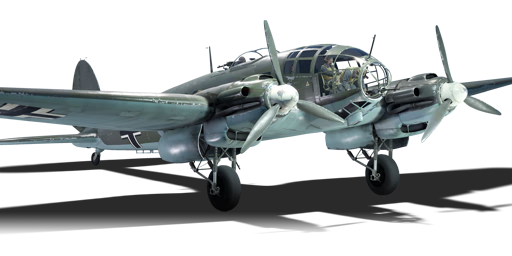
The He 111 H-3 is a rank German bomber with a battle rating of (AB), (RB), and (SB). It has been in the game since the start of the Open Beta Test prior to Update 1.27.
The He 111 H-3 will often find itself in light vehicle battles due to its battle rating. The sole purpose of the He 111 H-3 is to destroy as many ground targets as it possibly can to aid in winning the match.
General info
Flight performance
| Characteristics | Max Speed (km/h at 6,000 m) |
Max altitude (metres) |
Turn time (seconds) |
Rate of climb (metres/second) |
Take-off run (metres) | |||
|---|---|---|---|---|---|---|---|---|
| AB | RB | AB | RB | AB | RB | |||
| Stock | 416 | 402 | 34.0 | 34.7 | 3.7 | 3.7 | 510 | |
| Upgraded | 463 | 435 | 32.1 | 33.0 | 9.9 | 6.3 | ||
Details
| Features | ||||
|---|---|---|---|---|
| Combat flaps | Take-off flaps | Landing flaps | Air brakes | Arrestor gear |
| ✓ | ✓ | ✓ | X | X |
| Limits | ||||||
|---|---|---|---|---|---|---|
| Wings (km/h) | Gear (km/h) | Flaps (km/h) | Max Static G | |||
| Combat | Take-off | Landing | + | - | ||
| 480 | 402 | 379 | 260 | ~4 | ~3 | |
| Optimal velocities (km/h) | |||
|---|---|---|---|
| Ailerons | Rudder | Elevators | Radiator |
| < 310 | < 300 | < 270 | > 332 |
Survivability and armour
- 10 mm Steel plate in the pilot's seat
- 5 mm Steel plate under nose gunner
- 6 mm Steel plate under ventral gunner
- 8 mm Steel plate in front of the dorsal gunner
- 8 mm Steel plates in the fuselage
- 8.5 mm Steel plate angled in the fuselage
Modifications and economy
Armaments
Suspended armament
The He 111 H-3 can be outfitted with the following ordnance:
- 32 x 50 kg SC50JA bombs (1,600 kg total)
- 8 x 250 kg SC250JA bombs (2,000 kg total)
- 8 x Flam C 250 incendiary bombs
Defensive armament
The He 111 H-3 is defended by:
- 1 x 7.92 mm MG 15 machine gun, 2 x nose turret (375 rpg)
- 1 x 7.92 mm MG 15 machine gun, dorsal turret (750 rpg)
- 1 x 7.92 mm MG 15 machine gun, 2 x beam turret (375 rpg)
- 1 x 7.92 mm MG 15 machine gun, 2 x ventral turret (375 rpg front-facing + 750 rpg rear-facing)
Usage in battles
Upon spawning, you should put the plane into a slight climb, so it gains speed and altitude. Head immediately to nearest key ground targets. Ask your teammates to provide escort, the He 111 H-3 is quite durable and can absorb a lot of damage from a pursuing fighter but not several. Next, drop your payload into the targets. Here, it is better to use the 8 x Flam C 250 incendiary bombs, as they can easily take out multiple bases in a single run at this BR.
In battles without bases, it would be wise to immediately head toward and carpet bomb targets after spawning, either until you are dead or have destroyed all key targets in an area. Most of your adversaries won't be equipped with cannons, so if enemy fighters decide to attack you, you can act as a distraction while your teammates eliminate key targets.
In ground strike maps with tanks, equip the 8 x 250 kg bombs and either do high altitude base bombing or go for their tanks, ships or pillboxes. A bombing run with the 8 x 250 kg will be enough to destroy a bombing point, and a single direct hit from a 250 kg bomb will surely destroy any ground targets like pillboxes and heavy tanks. Lead the targets before dropping your bombs; it's not easy but becomes easier with practice. If you're not used to bombing moving targets, hit static ones like pillboxes.
You can do the same thing as stated for Arcade mode, which also works well in Realistic/Simulator Battles, or just go for bases with the 8 x 250 kg loadout. 2,000 kg will be enough to destroy a bombing point. Just ensure that you stay alive during your trip back to the base.
In Ground RB, carry the bomb load of 32 x 50 kg load out, as at your BR most enemies will be lightly armoured and only 2 or 3 bombs will be required to take them out. A good strategy when using this plane is to fly over enemy and allied capture points, as this is where most of your targets will be. Use your bombsight to pinpoint targets on the ground, then bombs away! Remember not to spend all your bombs on one target which is what most beginner pilots will do in this plane. Instead, drop around 5 bombs in a straight line near the target(s). Do this until your bomb load is exhausted.
Manual Engine Control
| MEC elements | ||||||
|---|---|---|---|---|---|---|
| Mixer | Pitch | Radiator | Supercharger | Turbocharger | ||
| Oil | Water | Type | ||||
| Not controllable | Controllable Not auto controlled |
Controllable Auto control available |
Controllable Auto control available |
Separate | Not controllable 1 gear |
Not controllable |
Pros and cons
Pros:
- Resilient against small arms fire, which is common at the rank
- Amazing stock bomb load of 32 x 50 kg bombs
- Good roll and turn rate for a bomber
- Decent speed
- Can carry an efficient maximum 2,000 kg of payload
- Defensive armament is decent against biplanes
- All payload options are internal
- Provides a very good learning curve to the next H-6 and H-16 models
Cons:
- Defensive armament is inadequate against planes when up-tiered
- Like all He 111 models, it suffers from poor gunner placements
- Cannot dive bomb like the Ju 88 A-4
- Has a cockpit made almost entirely of glass, which provides almost no protection for the pilot
- Tail controls can be easily damaged
- Cannons with high explosive filler are a threat
History
First appearing in November 1939, the He 111 H3 was intended for level bombing as well as anti-shipping work. The type was supplied to Romania and also license-built in that country. The subsequent H-4 and 5 variants were powered by improved engines and featured increased bomb loads.[1]
| Archive of the in-game description | |
|---|---|
|
The Heinkel He 111 was a German monoplane medium bomber (also torpedo bomber and attack bomber). The He 111 H-3 entered production in November 1939 and could also be used in a naval bomber role. However, its defensive armament was not particularly effective, with limited defensive arcs and a very low rate of fire of only 540 rounds per minute. The He 111 H-3 had a crew of five, but when used in a maritime role, this would usually be increased to six. The bomber was powered by Jumo 211 D-1 engines with a takeoff power of 1,200 HP. Up to 2,000 kg of bombs could be housed in the bomb bay; the left section of the bay could also house extra fuel tanks. | |
Media
- Skins
See also
- Aircraft of comparable role, configuration and era
- Tupolev SB 2M
- Martin 167-A3 Maryland
- Mitsubishi Ki-21
- Martin B-10B
- Martin 139WC
- Fiat BR.20 DR
External links
References
- ↑ Green, William. Warplanes of the Third Reich. New York: Galahad Books, 1990
| Heinkel Aircraft Company (Heinkel Flugzeugwerke) | |
|---|---|
| Fighters | He 51 A-1 · He 51 B-1 · He 51 B-2/H · He 51 C-1 · He 51 C-1/L |
| He 100 D-1 | |
| He 112 A-0 · He 112 B-0 · He 112 V-5 | |
| Jet fighters | He 162 A-1 · He 162 A-2 |
| Twin-engine fighters | He 219 A-7 |
| Bombers | He 111 H-3 · He 111 H-6 · He 111 H-16 |
| He 115 C-1 | |
| He 177 A-3 · He 177 A-5 | |
| Export | He 112 B-1/U2(Hungary) · He 112 B-1/U2(Romania) · He 112 B-2/U2 · A7He1 |
| T 2 | |
| Germany bombers | |
|---|---|
| Arado | Ar 196 A-3 |
| Blohm & Voss | BV 138 C-1 · BV 238 |
| Dornier | Do 17 E-1 · Do 17 Z-2 · Do 217 E-2 · Do 217 E-4 · Do 217 K-1 · Do 217 M-1 |
| Focke-Wulf | Fw 189 A-1 · Fw 200 C-1 |
| Henschel | Hs 123 A-1 |
| Heinkel | He 111 H-3 · He 111 H-6 · He 111 H-16 · He 115 C-1 · He 177 A-3 · He 177 A-5 |
| Junkers | Ju 87 B-2 · Ju 87 R-2 · Ju 87 R-2 Libya · Ju 87 D-3 · Ju 87 D-5 · Ju 88 A-1 · Ju 88 A-4 · Ju 188 A-2 · Ju 288 C |
| Messerschmitt | Me 264 |
| Savoia-Marchetti | ▀S.M.79 serie 1 · ▀S.M.79 B · ▀S.M.79 serie 4 · ▀S.M.79 serie 8 |
| ▀S.M.79 AS · ▀S.M.79 bis/N · ▀S.M.79 bis/T.M | |
| Trophies | ▀Wellington Mk Ic |