Difference between revisions of "IJN Sendai"
(→External links: Added Devblog) |
m |
||
| (17 intermediate revisions by 10 users not shown) | |||
| Line 1: | Line 1: | ||
| − | {{Specs-Card|code=jp_cruiser_sendai}} | + | {{Specs-Card |
| + | |code=jp_cruiser_sendai | ||
| + | |images={{Specs-Card-Image|GarageImage_{{PAGENAME}}.jpg}} | ||
| + | }} | ||
== Description == | == Description == | ||
| − | <!-- ''In the first part of the description, cover the history of the ship's creation and military application. In the second part, tell the reader about using this ship in the game. Add a screenshot | + | <!-- ''In the first part of the description, cover the history of the ship's creation and military application. In the second part, tell the reader about using this ship in the game. Add a screenshot: if a beginner player has a hard time remembering vehicles by name, a picture will help them identify the ship in question.'' --> |
| − | + | The '''{{Specs|name}}''' (川内, [[Abbreviations#.28JP.29_Naval|namesake]]: Sendai River) is a rank {{Specs|rank}} Japanese light cruiser {{Battle-rating}}. It was introduced in [[Update 1.95 "Northern Wind"]]. | |
| − | |||
| − | The '''{{Specs|name}}''' is a rank {{Specs|rank}} Japanese cruiser {{Battle-rating}}. It was introduced in [[Update 1.95 "Northern Wind"]]. | ||
== General info == | == General info == | ||
=== Survivability and armour === | === Survivability and armour === | ||
| + | {{Specs-Fleet-Armour}} | ||
''Talk about the vehicle's armour. Note the most well-defended and most vulnerable zones, e.g. the ammo magazine. Evaluate the composition of components and assemblies responsible for movement and manoeuvrability. Evaluate the survivability of the primary and secondary armaments separately. Don't forget to mention the size of the crew, which plays an important role in fleet mechanics. Save tips on preserving survivability for the "Usage in battles" section. If necessary, use a graphical template to show the most well-protected or most vulnerable points in the armour.'' | ''Talk about the vehicle's armour. Note the most well-defended and most vulnerable zones, e.g. the ammo magazine. Evaluate the composition of components and assemblies responsible for movement and manoeuvrability. Evaluate the survivability of the primary and secondary armaments separately. Don't forget to mention the size of the crew, which plays an important role in fleet mechanics. Save tips on preserving survivability for the "Usage in battles" section. If necessary, use a graphical template to show the most well-protected or most vulnerable points in the armour.'' | ||
=== Mobility === | === Mobility === | ||
| + | {{Specs-Fleet-Mobility}} | ||
''Write about the ship's mobility. Evaluate its power and manoeuvrability, rudder rerouting speed, stopping speed at full tilt, with its maximum forward and reverse speed.'' | ''Write about the ship's mobility. Evaluate its power and manoeuvrability, rudder rerouting speed, stopping speed at full tilt, with its maximum forward and reverse speed.'' | ||
| + | |||
| + | {{NavalMobility}} | ||
| + | |||
| + | === Modifications and economy === | ||
| + | {{Specs-Economy}} | ||
== Armament == | == Armament == | ||
| + | {{Specs-Fleet-Armaments}} | ||
=== Primary armament === | === Primary armament === | ||
| + | {{Specs-Fleet-Primary}} | ||
{{main|140 mm/50 3rd Year Type (140 mm)}} | {{main|140 mm/50 3rd Year Type (140 mm)}} | ||
| − | |||
| + | ''Provide information about the characteristics of the primary armament. Evaluate their efficacy in battle based on their reload speed, ballistics and the capacity of their shells. Add a link to the main article about the weapon: <code><nowiki>{{main|Weapon name (calibre)}}</nowiki></code>. Broadly describe the ammunition available for the primary armament, and provide recommendations on how to use it and which ammunition to choose.'' | ||
| + | {{:140 mm/50 3rd Year Type (140 mm)/Ammunition|140 mm type 0 HE, 140 mm type 2 SAP, 140 mm type 0 HE-TF, 140 mm mod 1 SAP}} | ||
=== Secondary armament === | === Secondary armament === | ||
| + | {{Specs-Fleet-Secondary}} | ||
{{main|25 mm/60 Type 96 (25 mm)}} | {{main|25 mm/60 Type 96 (25 mm)}} | ||
| + | |||
''Some ships are fitted with weapons of various calibres. Secondary armaments are defined as weapons chosen with the control <code>Select secondary weapon</code>. Evaluate the secondary armaments and give advice on how to use them. Describe the ammunition available for the secondary armament. Provide recommendations on how to use them and which ammunition to choose. Remember that any anti-air armament, even heavy calibre weapons, belong in the next section. If there is no secondary armament, remove this section.'' | ''Some ships are fitted with weapons of various calibres. Secondary armaments are defined as weapons chosen with the control <code>Select secondary weapon</code>. Evaluate the secondary armaments and give advice on how to use them. Describe the ammunition available for the secondary armament. Provide recommendations on how to use them and which ammunition to choose. Remember that any anti-air armament, even heavy calibre weapons, belong in the next section. If there is no secondary armament, remove this section.'' | ||
=== Anti-aircraft armament === | === Anti-aircraft armament === | ||
| + | {{Specs-Fleet-AA}} | ||
{{main|Type 93 (13.2 mm)|Type 92 (7.7 mm)}} | {{main|Type 93 (13.2 mm)|Type 92 (7.7 mm)}} | ||
| + | |||
''An important part of the ship's armament responsible for air defence. Anti-aircraft armament is defined by the weapon chosen with the control <code>Select anti-aircraft weapons</code>. Talk about the ship's anti-air cannons and machine guns, the number of guns and their positions, their effective range, and about their overall effectiveness – including against surface targets. If there are no anti-aircraft armaments, remove this section.'' | ''An important part of the ship's armament responsible for air defence. Anti-aircraft armament is defined by the weapon chosen with the control <code>Select anti-aircraft weapons</code>. Talk about the ship's anti-air cannons and machine guns, the number of guns and their positions, their effective range, and about their overall effectiveness – including against surface targets. If there are no anti-aircraft armaments, remove this section.'' | ||
| − | === | + | === Additional armament === |
| − | {{main|Type | + | {{Specs-Fleet-Additional}} |
| − | '' | + | {{main|Type 8 No.2 (610 mm)|Type 95 depth charge}} |
| + | |||
| + | ''Describe the available additional armaments of the ship: depth charges, mines, torpedoes. Talk about their positions, available ammunition and launch features such as dead zones of torpedoes. If there is no additional armament, remove this section.'' | ||
| + | |||
| + | === Scout plane === | ||
| + | {{Specs-Fleet-Plane}} | ||
| − | + | Located aft is a catapult with one E7K2 scout plane which provides unique offensive and defensive abilities, expanding tactical options. Ship-launched scout planes fly just like regular tree units but lack munition choices and cockpit views. The E7K2 is equipped with only defensive machine gun turrets (ventral as well as dorsal) but it does carry 4 x 60 kg bombs. It also has the scout plane ability to cap zones and lay down smoke cover (up to 3 times). Captains will be wise to remember to utilise the aircraft and consider when best to use it, for example to cap a point early or late in the match, to create a smoke screen to stymie enemy bombardment and repair, to attack enemy units directly, or perhaps something completely new! Carrying a heavier bomb load than most other scout planes, this unit has a very good chance to sink enemy boats or even a destroyer. | |
| − | |||
| − | |||
== Usage in battles == | == Usage in battles == | ||
| Line 39: | Line 57: | ||
=== Pros and cons === | === Pros and cons === | ||
| − | ''Summarise and briefly evaluate the vehicle in terms of its characteristics and combat effectiveness. Mark its pros and cons in the bulleted list. Try not to use more than 6 points for each of the characteristics. Avoid using categorical definitions such as "bad", "good" and the like - use substitutions with softer forms such as "inadequate" and "effective".'' | + | <!-- ''Summarise and briefly evaluate the vehicle in terms of its characteristics and combat effectiveness. Mark its pros and cons in the bulleted list. Try not to use more than 6 points for each of the characteristics. Avoid using categorical definitions such as "bad", "good" and the like - use substitutions with softer forms such as "inadequate" and "effective".'' --> |
'''Pros:''' | '''Pros:''' | ||
| − | * | + | |
| + | * Fast | ||
| + | * Turrets are placed along whole ship which makes them hard to disable | ||
| + | * SAPBC ammo have very good penetration values | ||
| + | * 16 long range torpedoes (with torpedo modification) | ||
| + | * One scout plane. | ||
'''Cons:''' | '''Cons:''' | ||
| − | * | + | |
| + | * Low crew amount for its size | ||
| + | * Almost all of her crew compartments were located on the deck, making them extremely vulnerable to HE shells | ||
| + | * Mediocre AA armament | ||
| + | * Can't release all torpedoes to one side | ||
== History == | == History == | ||
| − | ''Describe the history of the creation and combat usage of the ship in more detail than in the introduction. If the historical reference turns out to be too long, take it to a separate article, taking a link to the article about the ship and adding a block "/History" (example: <nowiki>https://wiki.warthunder.com/(Ship-name)/History</nowiki>) and add a link to it here using the <code>main</code> template. Be sure to reference text and sources by using <code><nowiki><ref></ref></nowiki></code>, as well as adding them at the end of the article with <code><nowiki><references /></nowiki></code>. This section may also include the ship's dev blog entry (if applicable) and the in-game encyclopedia description (under <code><nowiki>=== In-game description ===</nowiki></code>, also if applicable).'' | + | <!-- ''Describe the history of the creation and combat usage of the ship in more detail than in the introduction. If the historical reference turns out to be too long, take it to a separate article, taking a link to the article about the ship and adding a block "/History" (example: <nowiki>https://wiki.warthunder.com/(Ship-name)/History</nowiki>) and add a link to it here using the <code>main</code> template. Be sure to reference text and sources by using <code><nowiki><ref></ref></nowiki></code>, as well as adding them at the end of the article with <code><nowiki><references /></nowiki></code>. This section may also include the ship's dev blog entry (if applicable) and the in-game encyclopedia description (under <code><nowiki>=== In-game description ===</nowiki></code>, also if applicable).'' --> |
| + | [[File:IJN Sendai.jpg|thumb|480x480px|IJN Sendai, date unknown. Note the seaplane and catapult mounted above her rear guns.]] | ||
| + | IJN Sendai was the lead ship of the ''Sendai'' class, a class of three light cruisers built for the Imperial Japanese Navy following the end of World War 1. Designed to serve as leaders of destroyer flotillas, the ships were built in the early 1920s. ''Sendai'' saw service during the second Sino-Japanese war, and later served as the flagship of Destroyer Squadron 3 during the Second World War. She participated in numerous conflicts including the Battles of Guadalcanal, and was sunk during the Battle of Empress Augusta bay, having been critically damaged by American light cruisers. | ||
| + | |||
| + | '''Design and development''' | ||
| + | |||
| + | The Sendai-class cruisers were a class of three light cruisers, built as a follow-up to the previous Nagara class. As destroyer flotilla flagships, they were essentially enlarged destroyers, and displaced just 5,500 tons full. ''Sendai'' was armed with seven 140 mm (5.5 inch) guns, mounted in single mounts. The turrets were mounted in an unusual arrangement, with two guns fore, two guns on either side of the bridge, and three guns aft. ''Sendai's'' secondary and anti-aircraft suite was extremely sparse, with several 25 mm and 13.2 mm guns. ''Sendai'', similar to the previous ''Nagara'' class, carried sixteen 610 mm "Long Lance" torpedoes, with four dual launchers and eight reloads. Her top speed was 35.6 knots, extremely fast for a cruiser - this allowed ''Sendai'' to maintain speed with the destroyers that she would command. She was also able to carry a reconnaissance seaplane, being fitted with a catapult and seaplane recovery facilities. | ||
| + | |||
| + | ''Sendai'' was ordered in the early 1920s, and completed by April 1924. Before the outbreak of war, she served extensively in the East China Sea, and participated in the second Sino-Japanese war. | ||
| + | |||
| + | '''World War II Service''' | ||
| + | |||
| + | Following the outbreak of the Second World War, ''Sendai'' served as the flagship of Destroyer Squadron 3. At the time of the Pearl Harbour attack, she was escorting troops to the invasion of Malaya. Sendai covered troop landings for most of early 1942, and later served as part of the main fleet cover during the attack on Midway. | ||
| + | |||
| + | In July of 1942, ''Sendai'' attacked American troops landing at Guadalcanal; she participated in both of the battles of Guadalcanal. During the second battle, she was shelled by the battleship USS Washington, but survived without damage. In March of 1943, Sendai was reassigned to the eight fleet as an escort; during her time there, the fleet was repeatedly attacked by American aircraft. She survived these attacks unscathed. However, ''Sendai'' ultimately met her demise at the Battle of Empress Augusta bay, where the Japanese force (composed of cruisers ''Myoko'', ''Haguro'', ''[[IJN Agano|Agano]]'' and herself, as well as several destroyers) were attacked by the American cruisers ''[[USS Cleveland (CL-55)|Cleveland]]'', ''Columbia'', ''Montpellier'' and ''Denver'', along with several destroyers of their own. Hit by concentrated fire from all four American cruisers, she sank with the loss of 184 crew members; the remaining 230 were rescued by her escorts. | ||
| + | |||
| + | === [[wt:en/news/6514-development-sendai-the-night-raider-en|Devblog]] === | ||
| + | The Sendai-class of light cruisers were a further development of the preceding Nagara-class, which itself was the successor to the Kuma-class. All ships of these classes were part of the Japanese 5,500 ton light cruiser design conceived in the years following WWI, with the Sendai-class being planned as the final ships to be based on this design. | ||
| + | |||
| + | To this extent, initial plans foresaw the construction of 8 vessels of the Sendai-class, however, with the signing of the Washington Naval Treaty in 1922, Japan was forced to cut back on these plans. This resulted in 4 ships being cancelled and one being broken up on the slipway, while the remaining ships did in fact see completion. | ||
| + | |||
| + | Sendai, as the lead ship of her class, was laid down in February 1922 and saw completion in April 1924. With the outbreak of hostilities in Asia in the late 1930s, Sendai took part in the Second Sino-Japanese War, participating in the Battle of Shanghai and providing support for Japanese land units. | ||
| + | |||
| + | During WWII, Sendai's early war service mostly consisted of escorting convoys around Malaya and Indochina while the ship also formally took part in the Battle of Midway, though not actively engaging Allied forces. | ||
| + | |||
| + | Sendai saw the height of her service career during the Solomon Islands campaign, taking part in both naval battles for Guadalcanal. Roughly a year later, in November 1943, Sendai was involved in the major naval battle of Empress Augusta Bay. There, Sendai would meet her fate, being heavily damaged by concentrated gunfire from four US cruisers, sinking on the following day on 3rd November, 1943. | ||
== Media == | == Media == | ||
| − | ''Excellent additions to the article would be video guides, screenshots from the game, and photos.'' | + | <!-- ''Excellent additions to the article would be video guides, screenshots from the game, and photos.'' --> |
| + | |||
| + | ;Skins | ||
| + | * [https://live.warthunder.com/feed/camouflages/?vehicle=jp_cruiser_sendai Skins and camouflages for the {{PAGENAME}} from live.warthunder.com.] | ||
| + | |||
| + | ;Images | ||
| + | <gallery mode="packed-hover" heights="200"> | ||
| + | File:IJN Sendai WTWallpaper 01.jpg| | ||
| + | File:IJN Sendai WTWallpaper 02.jpg| | ||
| + | File:IJN Sendai WTWallpaper 03.jpg| | ||
| + | File:IJN Sendai WTWallpaper 04.jpg| | ||
| + | File:IJN Sendai WTWallpaper 05.jpg| | ||
| + | File:IJN Sendai WTWallpaper 06.jpg| | ||
| + | </gallery> | ||
== See also == | == See also == | ||
| Line 59: | Line 124: | ||
== External links == | == External links == | ||
| − | <!--Paste links to sources and external resources, such as: | + | <!-- ''Paste links to sources and external resources, such as:'' |
* ''topic on the official game forum;'' | * ''topic on the official game forum;'' | ||
| − | + | * ''other literature.'' --> | |
| − | * ''other literature.''--> | ||
* [[wt:en/news/6514-development-sendai-the-night-raider-en|[Devblog] Sendai: The Night Raider]] | * [[wt:en/news/6514-development-sendai-the-night-raider-en|[Devblog] Sendai: The Night Raider]] | ||
| + | === References === | ||
| + | |||
| + | * Hackett, B. (1997). IJN Sendai: Tabular table of movement. Retrieved January 02, 2021, from <nowiki>http://www.combinedfleet.com/sendai_t.htm</nowiki> | ||
| + | |||
| + | * Budge, K. G. (2007). Sendai Class, Japanese Light Cruisers. Retrieved January 02, 2021, from <nowiki>http://pwencycl.kgbudge.com/S/e/Sendai_class.htm</nowiki> | ||
| + | |||
| + | {{ShipManufacturer Mitsubishi Shipbuilding}} | ||
{{Japan light cruisers}} | {{Japan light cruisers}} | ||
Revision as of 06:16, 14 February 2024

Contents
Description
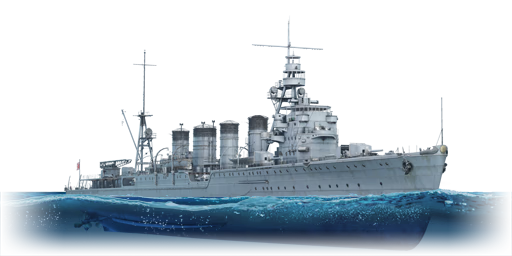
The Sendai-class, IJN Sendai, 1942 (川内, namesake: Sendai River) is a rank Japanese light cruiser with a battle rating of (AB), (RB), and (SB). It was introduced in Update 1.95 "Northern Wind".
General info
Survivability and armour
Talk about the vehicle's armour. Note the most well-defended and most vulnerable zones, e.g. the ammo magazine. Evaluate the composition of components and assemblies responsible for movement and manoeuvrability. Evaluate the survivability of the primary and secondary armaments separately. Don't forget to mention the size of the crew, which plays an important role in fleet mechanics. Save tips on preserving survivability for the "Usage in battles" section. If necessary, use a graphical template to show the most well-protected or most vulnerable points in the armour.
Mobility
Write about the ship's mobility. Evaluate its power and manoeuvrability, rudder rerouting speed, stopping speed at full tilt, with its maximum forward and reverse speed.
| Mobility Characteristics | |||
|---|---|---|---|
| Game Mode | Upgrade Status | Maximum Speed (km/h) | |
| Forward | Reverse | ||
| AB | |||
| Upgraded | |||
| RB/SB | |||
| Upgraded | |||
Modifications and economy
Armament
Primary armament
Provide information about the characteristics of the primary armament. Evaluate their efficacy in battle based on their reload speed, ballistics and the capacity of their shells. Add a link to the main article about the weapon: {{main|Weapon name (calibre)}}. Broadly describe the ammunition available for the primary armament, and provide recommendations on how to use it and which ammunition to choose.
| Penetration statistics | |||||||
|---|---|---|---|---|---|---|---|
| Ammunition | Type of warhead |
Penetration @ 0° Angle of Attack (mm) | |||||
| 1,000 m | 2,500 m | 5,000 m | 7,500 m | 10,000 m | 15,000 m | ||
| Type 0 HE | HE | 35 | 35 | 35 | 35 | 35 | 35 |
| Type 2 SAP | SAP | 61 | 53 | 43 | 35 | 35 | 35 |
| Type 0 HE-TF | HE-TF | 35 | 35 | 35 | 35 | 35 | 35 |
| Mod 1 SAP | SAPBC | 115 | 100 | 81 | 65 | 54 | 40 |
| Shell details | ||||||||||||
|---|---|---|---|---|---|---|---|---|---|---|---|---|
| Ammunition | Type of warhead |
Velocity (m/s) |
Projectile mass (kg) |
Fuse delay (s) |
Fuse sensitivity (mm) |
Explosive mass (TNT equivalent) (kg) |
Ricochet | |||||
| 0% | 50% | 100% | ||||||||||
| Type 0 HE | HE | 840 | 37.87 | 0 | 0.1 | 3.15 | 79° | 80° | 81° | |||
| Type 2 SAP | SAP | 701 | 37.9 | 0.05 | 6 | 2.96 | 47° | 60° | 65° | |||
| Type 0 HE-TF | HE-TF | 850 | 37.9 | 0 | 0.1 | 3.15 | 79° | 80° | 81° | |||
| Mod 1 SAP | SAPBC | 855 | 37.87 | 0.05 | 6 | 2.21 | 48° | 63° | 71° | |||
Secondary armament
Some ships are fitted with weapons of various calibres. Secondary armaments are defined as weapons chosen with the control Select secondary weapon. Evaluate the secondary armaments and give advice on how to use them. Describe the ammunition available for the secondary armament. Provide recommendations on how to use them and which ammunition to choose. Remember that any anti-air armament, even heavy calibre weapons, belong in the next section. If there is no secondary armament, remove this section.
Anti-aircraft armament
An important part of the ship's armament responsible for air defence. Anti-aircraft armament is defined by the weapon chosen with the control Select anti-aircraft weapons. Talk about the ship's anti-air cannons and machine guns, the number of guns and their positions, their effective range, and about their overall effectiveness – including against surface targets. If there are no anti-aircraft armaments, remove this section.
Additional armament
Describe the available additional armaments of the ship: depth charges, mines, torpedoes. Talk about their positions, available ammunition and launch features such as dead zones of torpedoes. If there is no additional armament, remove this section.
Scout plane
Located aft is a catapult with one E7K2 scout plane which provides unique offensive and defensive abilities, expanding tactical options. Ship-launched scout planes fly just like regular tree units but lack munition choices and cockpit views. The E7K2 is equipped with only defensive machine gun turrets (ventral as well as dorsal) but it does carry 4 x 60 kg bombs. It also has the scout plane ability to cap zones and lay down smoke cover (up to 3 times). Captains will be wise to remember to utilise the aircraft and consider when best to use it, for example to cap a point early or late in the match, to create a smoke screen to stymie enemy bombardment and repair, to attack enemy units directly, or perhaps something completely new! Carrying a heavier bomb load than most other scout planes, this unit has a very good chance to sink enemy boats or even a destroyer.
Usage in battles
Describe the technique of using this ship, the characteristics of her use in a team and tips on strategy. Abstain from writing an entire guide – don't try to provide a single point of view, but give the reader food for thought. Talk about the most dangerous opponents for this vehicle and provide recommendations on fighting them. If necessary, note the specifics of playing with this vehicle in various modes (AB, RB, SB).
Pros and cons
Pros:
- Fast
- Turrets are placed along whole ship which makes them hard to disable
- SAPBC ammo have very good penetration values
- 16 long range torpedoes (with torpedo modification)
- One scout plane.
Cons:
- Low crew amount for its size
- Almost all of her crew compartments were located on the deck, making them extremely vulnerable to HE shells
- Mediocre AA armament
- Can't release all torpedoes to one side
History

IJN Sendai was the lead ship of the Sendai class, a class of three light cruisers built for the Imperial Japanese Navy following the end of World War 1. Designed to serve as leaders of destroyer flotillas, the ships were built in the early 1920s. Sendai saw service during the second Sino-Japanese war, and later served as the flagship of Destroyer Squadron 3 during the Second World War. She participated in numerous conflicts including the Battles of Guadalcanal, and was sunk during the Battle of Empress Augusta bay, having been critically damaged by American light cruisers.
Design and development
The Sendai-class cruisers were a class of three light cruisers, built as a follow-up to the previous Nagara class. As destroyer flotilla flagships, they were essentially enlarged destroyers, and displaced just 5,500 tons full. Sendai was armed with seven 140 mm (5.5 inch) guns, mounted in single mounts. The turrets were mounted in an unusual arrangement, with two guns fore, two guns on either side of the bridge, and three guns aft. Sendai's secondary and anti-aircraft suite was extremely sparse, with several 25 mm and 13.2 mm guns. Sendai, similar to the previous Nagara class, carried sixteen 610 mm "Long Lance" torpedoes, with four dual launchers and eight reloads. Her top speed was 35.6 knots, extremely fast for a cruiser - this allowed Sendai to maintain speed with the destroyers that she would command. She was also able to carry a reconnaissance seaplane, being fitted with a catapult and seaplane recovery facilities.
Sendai was ordered in the early 1920s, and completed by April 1924. Before the outbreak of war, she served extensively in the East China Sea, and participated in the second Sino-Japanese war.
World War II Service
Following the outbreak of the Second World War, Sendai served as the flagship of Destroyer Squadron 3. At the time of the Pearl Harbour attack, she was escorting troops to the invasion of Malaya. Sendai covered troop landings for most of early 1942, and later served as part of the main fleet cover during the attack on Midway.
In July of 1942, Sendai attacked American troops landing at Guadalcanal; she participated in both of the battles of Guadalcanal. During the second battle, she was shelled by the battleship USS Washington, but survived without damage. In March of 1943, Sendai was reassigned to the eight fleet as an escort; during her time there, the fleet was repeatedly attacked by American aircraft. She survived these attacks unscathed. However, Sendai ultimately met her demise at the Battle of Empress Augusta bay, where the Japanese force (composed of cruisers Myoko, Haguro, Agano and herself, as well as several destroyers) were attacked by the American cruisers Cleveland, Columbia, Montpellier and Denver, along with several destroyers of their own. Hit by concentrated fire from all four American cruisers, she sank with the loss of 184 crew members; the remaining 230 were rescued by her escorts.
Devblog
The Sendai-class of light cruisers were a further development of the preceding Nagara-class, which itself was the successor to the Kuma-class. All ships of these classes were part of the Japanese 5,500 ton light cruiser design conceived in the years following WWI, with the Sendai-class being planned as the final ships to be based on this design.
To this extent, initial plans foresaw the construction of 8 vessels of the Sendai-class, however, with the signing of the Washington Naval Treaty in 1922, Japan was forced to cut back on these plans. This resulted in 4 ships being cancelled and one being broken up on the slipway, while the remaining ships did in fact see completion.
Sendai, as the lead ship of her class, was laid down in February 1922 and saw completion in April 1924. With the outbreak of hostilities in Asia in the late 1930s, Sendai took part in the Second Sino-Japanese War, participating in the Battle of Shanghai and providing support for Japanese land units.
During WWII, Sendai's early war service mostly consisted of escorting convoys around Malaya and Indochina while the ship also formally took part in the Battle of Midway, though not actively engaging Allied forces.
Sendai saw the height of her service career during the Solomon Islands campaign, taking part in both naval battles for Guadalcanal. Roughly a year later, in November 1943, Sendai was involved in the major naval battle of Empress Augusta Bay. There, Sendai would meet her fate, being heavily damaged by concentrated gunfire from four US cruisers, sinking on the following day on 3rd November, 1943.
Media
- Skins
- Images


See also
Links to articles on the War Thunder Wiki that you think will be useful for the reader, for example:
- reference to the series of the ship;
- links to approximate analogues of other nations and research trees.
External links
References
- Hackett, B. (1997). IJN Sendai: Tabular table of movement. Retrieved January 02, 2021, from http://www.combinedfleet.com/sendai_t.htm
- Budge, K. G. (2007). Sendai Class, Japanese Light Cruisers. Retrieved January 02, 2021, from http://pwencycl.kgbudge.com/S/e/Sendai_class.htm
| Mitsubishi Shipbuilding Company Ltd. | |
|---|---|
| Light Cruisers (CL) | |
| Kuma-class | IJN Tama |
| Sendai-class | IJN Sendai |
| Mogami-class | IJN Mikuma |
| Heavy Cruisers (CA) | |
| Furutaka-class | IJN Furutaka |
| Aoba-class | IJN Aoba |
| Myōkō-class | IJN Haguro |
| Tone-class | IJN Tone |
| Battleships (BB) | |
| Ise-class | IJN Hyuga |
| See also | Mitsubishi Heavy Industries, Ltd. (Post-War) |
| Japan light cruisers | |
|---|---|
| Kuma-class | IJN Tama |
| IJN Yubari* | |
| Nagara-class | IJN Isuzu |
| Sendai-class | IJN Sendai |
| Agano-class | IJN Agano |
| Mogami-class | IJN Mikuma · IJN Suzuya |
| * Unique ship | |