Difference between pages "G-5 (ShVAK)" and "Rooivalk Mk1F CSH"
m |
(→Armaments) |
||
| Line 1: | Line 1: | ||
| − | |||
| − | |||
| − | |||
| − | |||
| − | |||
{{Specs-Card | {{Specs-Card | ||
| − | |code= | + | |code=ah_2_rooivalk |
| − | |images={{Specs-Card-Image|GarageImage_{{PAGENAME}}.jpg}} | + | |images={{Specs-Card-Image|GarageImage_{{PAGENAME}}.jpg|StoreImage_{{PAGENAME}}_003.jpg}} |
}} | }} | ||
== Description == | == Description == | ||
| − | <!-- ''In the first part | + | <!-- ''In the description, the first part should be about the history of and the creation and combat usage of the helicopter, as well as its key features. In the second part, tell the reader about the helicopter in the game. Insert a screenshot of the vehicle, so that if the novice player does not remember the vehicle by name, he will immediately understand what kind of vehicle the article is talking about.'' --> |
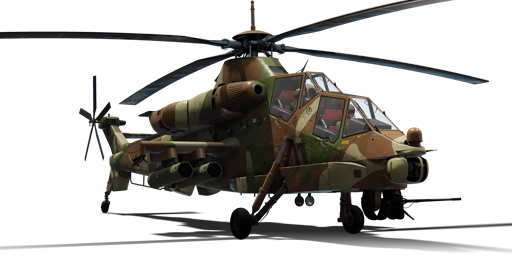
| − | + | In the early 1980s, the South African Defence Force realised the need during the South African Border War for a dedicated attack helicopter to conduct strike missions against armour and anti-air positions, and escort helicopter transports. However, under a UN arms embargo at the time, South Africa had to look to domestic designers to fulfil these requirements. Thus, in 1984, development of the Denel Rooivalk began, from the basis of the Aérospatiale SA 330 Puma. While it would have its first flight in 1990, budget limitations and desires for increasingly advanced capabilities would mean that it would only enter service in 2011. Originally also planned for export, new development was ceased after the design lost to the Italian [[T129|A129 Mangusta]] in Turkey in 2007. 11 helicopters are presently operated by the South African Air Force, flown by 16 Squadron from AFB Bloemspruit, Bloemfontein. They have seen service in a number of UN operations, including in the Democratic Republic of the Congo. | |
| − | + | Introduced in [[Update "Drone Age"]] but was removed from the Gaijin store after the [[wt:en/news/8580-shop-war-thunders-birthday-sale-in-the-gaijinnet-store-en|War Thunder 11th Anniversary sale]]. The Rooivalk provides a fearsome attack helicopter addition to the British tech tree. Equipped with armaments and systems that rival the vaunted Apache helicopter family, with considerable air-to-air defensive capabilities and hard-hitting ground attack loadouts, the Roovialk Mk1F CSH can be a devastating asset available to employ by British helicopter pilots. Equipped with laser warning systems, MAWS systems, and NVG/thermal vision, pilots can focus on delivering hard-hitting ordnance without having to have their heads on a constant swivel. The deadly Mokopa ATGMs with tandem warheads provide an efficient means of dispatching enemy ground targets, while Mistral AAMs pose a serious threat to enemy aircraft within the Rooivalk's airspace, providing all-aspect IR missiles replete with ECCM features. Last but not least, a fast firing and reliable 20 mm gun mounted under the nose can be used to deal with softer targets and slow-moving enemy aircraft. | |
== General info == | == General info == | ||
| + | === Flight performance === | ||
| + | {{Specs-Heli-Flight}} | ||
| + | <!-- ''Describe how the helicopter behaves in the air. Speed, manoeuvrability, acceleration and allowable loads - these are the most important characteristics of the vehicle.'' --> | ||
| + | |||
| + | The Rooivalk handles well for a helicopter, with competitive forward speed and suitable agility to enable the aircraft to deliver its payload and evade incoming ordnance. While it lacks the superb agility of the Lynx helicopters also fielded in the British tech tree, it can certainly hold up to what is required of it on the battlefield and perform aerobatics like rolling to dump altitude. | ||
| + | |||
| + | In forward flight, pushing the collective and dumping altitude will allow you to push the aircraft up to around 315 km/h. It is advisable that pushing the Rooivalk to such speeds will cause the tail rotor to struggle and lock up the aircraft similar to compression seen in planes. Making any sort of emergency manoeuvre will often result in pitching the aircraft down into the ground or nearby objects if flying low. | ||
| + | |||
| + | Keeping a low collective when performing manoeuvres will reward the pilot with enough agility to get the job done when employing masking strategies, even while carrying a full load of munitions. | ||
| + | |||
| + | The Rooivalk is able to lift off and maintain stable flight with a full fuel tank and a full load of munitions on both wings should more fuel than minimum ever be required. | ||
| + | |||
| + | {| class="wikitable" style="text-align:center" | ||
| + | |- | ||
| + | ! rowspan="2" | Characteristics | ||
| + | ! colspan="2" | Max Speed<br>(km/h at 1,000 m) | ||
| + | ! rowspan="2" | Max altitude<br>(metres) | ||
| + | |- | ||
| + | ! AB !! RB | ||
| + | |- | ||
| + | ! Stock | ||
| + | | 265 || 249 || rowspan="2" | {{Specs|ceiling}} | ||
| + | |- | ||
| + | ! Upgraded | ||
| + | | 307 || 285 | ||
| + | |- | ||
| + | |} | ||
| + | |||
=== Survivability and armour === | === Survivability and armour === | ||
| − | {{Specs- | + | {{Specs-Heli-Armour}} |
| − | <!-- '' | + | <!-- ''Examine the survivability of the helicopter. Note how vulnerable the structure is and how secure the pilot is, whether the fuel tanks are armoured, etc. Describe the armour, if there is any, and also mention the vulnerability of other critical systems.'' --> |
| − | |||
| − | The | + | The Rooivalk possesses no armour except for armoured Kevlar boron carbide panelling behind and under the pilot seats. These will provide modest protection against ground fire up to around 12.7 mm and possibly 20 mm at higher ranges but only insofar as keeping the pilots alive. |
| − | + | The aircraft contains all of its fuel in three self-sealing fuel tanks within the centre of the helicopter's main body, with its engines and transmission just above those tanks. Much of the aircraft is empty space and players will often find themselves taking ground fire and seeing their damage display light up while no actual considerable damage is done to essential systems. The engines are both relatively small for the airframe and harder to hit, and in the event that they are, the Rooivalk possesses an EFS (Engine Fire System) that can be used to douse these fires and maintain flight. | |
| − | |||
| − | |||
| − | |||
| − | + | It is possible for the Rooivalk to limp back to an airfield on a single engine, however it is advisable to dump munition pylons if need be to reduce the strain on the remaining engine. | |
=== Modifications and economy === | === Modifications and economy === | ||
{{Specs-Economy}} | {{Specs-Economy}} | ||
| − | == | + | As a premium aircraft all modifications are unlocked upon purchase. |
| − | {{Specs- | + | |
| − | === | + | == Armaments == |
| − | {{Specs- | + | {{Specs-Heli-Armaments}} |
| − | <!-- '' | + | {| class="wikitable" style="text-align:center" |
| − | {{main| | + | |- |
| + | ! colspan="3" | [[Ballistic Computer]] | ||
| + | |- | ||
| + | ! CCIP (Guns) !! CCIP (Rockets) !! CCIP (Bombs) | ||
| + | |- | ||
| + | | {{Tick}} || {{Tick}} || {{Cross}} | ||
| + | |- | ||
| + | |} | ||
| + | === Offensive armament === | ||
| + | {{Specs-Heli-Offensive}} | ||
| + | <!-- ''Describe the offensive armament of the helicopter, if any. Describe how effective the cannons and machine guns are in battle, also what ammunition belts or drums are better to use. If there is no offensive weaponry, delete this subsection.'' --> | ||
| + | {{main|GI2 (20 mm)}} | ||
| − | The | + | The '''''{{PAGENAME}}''''' is armed with: |
| − | + | * 1 x 20 mm GI2 cannon, nose turret (700 rpg) | |
| + | * 120 x countermeasures | ||
| − | + | === Suspended armament === | |
| − | + | {{Specs-Heli-Suspended}} | |
| − | + | <!-- ''Describe the helicopter's suspended armament: additional cannons under the winglets, any bombs, and rockets. Since any helicopter is essentially only a platform for suspended weaponry, this section is significant and deserves your special attention. If there is no suspended weaponry remove this subsection.'' --> | |
| − | {{ | + | The '''''{{PAGENAME}}''''' can be outfitted with the following ordnance: |
| − | === | + | {| class="wikitable" style="text-align:center" width="100%" |
| − | {{ | + | |- |
| − | + | ! !! width="7%" | 1 !! width="7%" | 2 !! width="7%" | 3 !! width="7%" | 4 !! width="7%" | 5 !! width="7%" | 6 | |
| − | + | | rowspan="4" width="25%" | <div class="ttx-image">[[File:Hardpoints_{{PAGENAME}}.png]]</div> | |
| + | |- | ||
| + | ! [[FZ49]] rockets | ||
| + | | || 19 || 19 || 19 || 19 || | ||
| + | |- | ||
| + | ! [[Mistral]] missiles | ||
| + | | 2 || || || || || 2 | ||
| + | |- | ||
| + | ! [[ZT-6 Mokopa]] missiles | ||
| + | | || 4 || 4 || 4 || 4 || | ||
| + | |- | ||
| + | |} | ||
| − | + | {{Navigation-Start|Default weapon presets}} | |
| + | {{Navigation-First-Simple-Line}} | ||
| + | * 76 x FZ49 rockets | ||
| + | * 4 x Mistral missiles | ||
| + | * 4 x Mistral missiles + 76 x FZ49 rockets | ||
| + | * 16 x ZT-6 Mokopa missiles | ||
| + | * 16 x ZT-6 Mokopa missiles + 4 x Mistral missiles | ||
| + | * 8 x ZT-6 Mokopa missiles + 4 x Mistral missiles + 38 x FZ49 rockets | ||
| + | {{Navigation-End}} | ||
== Usage in battles == | == Usage in battles == | ||
| − | <!-- ''Describe the | + | <!-- ''Describe the tactics of playing in a helicopter, the features of using the helicopter in a team and advice on tactics. Refrain from creating a "guide" - do not impose a single point of view, but instead, give the reader food for thought. Examine the most dangerous enemies and give recommendations on fighting them. If necessary, note the specifics of the game in different modes (AB, RB, SB).'' --> |
| − | + | The Rooivalk does not have the agility of many of its peers like the Apache, so while it is possible it is not advisable to rely or focus on using this aircraft for rocket pod strikes. However in argument to this point; the Rooivalk can take a beating and may survive enough to deploy its rocket pods so pilots may take both into consideration when deciding upon a loadout. The Rooivalk can find itself being most devastating when serving as a ranged ATGM platform, able to take a full load of up to 16 Mokopa missiles with effective ranges of 10 km, allowing the Rooivalk to sit at the fringe of most SPAAs' retaliation ranges and rain havoc. | |
| − | The | ||
| − | |||
| − | |||
| − | |||
| − | |||
| − | It is | + | It is recommended to employ 'masking' tactics with the Rooivalk, finding a suitable piece of terrain to act as cover and peeking just over to loose a missile at a target. The Mokopa are not Fire and Forget (FAF) but they do have In-ordnance Guidance (IOG) which means they will continue to track to their last designated position if the laser is cut. However, if the target moves they will not follow as they cannot acquire their own locks and a warning will flash up on gunner sights to 'enable laser now' to re-designate the target for the missile to resume tracking. So there is a brief window to duck down behind cover if engaged and then still successfully deliver the missile. Alternatively, the missiles can be used as makeshift FAF if you are confident the target will not move and the missile can be abandoned to guide itself to the last designated point. The Mokopa missile possess a tandem warhead and enough penetration to pierce the armour of anything encountered on the ground, with careful aiming tanks can be dispatched by puncturing through traditionally reinforced areas and to the very vital spots that reinforcement was put in place for. |
| − | + | For self defence, the Rooivalk sports an LWS, MAWS, and Mistral AAMs. The LWS is effective for detecting rangefinders from vehicles with VT munitions such as the Russian 2S38 which poses a very common and often overlooked threat at the Battle Rating. The MAWS system will automatically deploy chaff and flares upon a detected missile launch. But as most SPAA use a radar for purely detecting and guide their munitions by laser it is advisable to keep the countermeasures mix as primarily or entirely flares. Be aware the MAWS system looks for the IR flare of a launched missile, so even friendly missiles being launched in proximity of the Rooivalk will elicit a MAWS response. An option to toggle the MAWS on and off can be hotkeyed. | |
| − | The | + | The Mistral AAMs are reliable when it comes to engaging enemy aircraft, primarily jets due to their tendency to generate a lot of heat. The Mistrals are all aspect and can acquire locks up to as far as 6 km away also possessing ECCM for some flare resistance. However they can only manoeuvre up to 12Gs so any competent pilot will be able to shrug off the missiles. |
=== Pros and cons === | === Pros and cons === | ||
| Line 77: | Line 122: | ||
'''Pros:''' | '''Pros:''' | ||
| − | * | + | * Effective anti-tank options; Mokopa missiles are fast and sport tandem warheads for defeating ERA and over 1000 mm of armour. |
| − | + | * Powerful engines allow evasive flight with full combat loads | |
| − | + | * LWS and MAWS allow for detection and action against IRST-based SPAA systems and IR launches more effectively | |
| − | * | + | * Gen 3 thermal imaging in gunner sights |
| − | * | ||
| − | * | ||
'''Cons:''' | '''Cons:''' | ||
| − | * | + | * Not as agile as some of its contemporaries |
| − | * | + | * Short range air-to-air capabilities for its BR. Unlikely to win an engagement with another helicopter such as a KA-50 with Vikhrs which will be its most commonly encountered opponent. |
| − | * | + | * 20 mm cannon can be inaccurate and doesn't have access to ammunition sufficient to penetrate even the tops of most MBTs at its BR. |
== History == | == History == | ||
| − | <!-- ''Describe the history of the creation and combat usage of the | + | <!-- ''Describe the history of the creation and combat usage of the helicopter in more detail than in the introduction. If the historical reference turns out to be too long, take it to a separate article, taking a link to the article about the vehicle and adding a block "/History" (example: <nowiki>https://wiki.warthunder.com/(Vehicle-name)/History</nowiki>) and add a link to it here using the <code>main</code> template. Be sure to reference text and sources by using <code><nowiki><ref></ref></nowiki></code>, as well as adding them at the end of the article with <code><nowiki><references /></nowiki></code>. This section may also include the vehicle's dev blog entry (if applicable) and the in-game encyclopedia description (under <code><nowiki>=== In-game description ===</nowiki></code>, also if applicable).'' --> |
| − | + | The combat experience gained by the SAAF during the conventional phase of the South African Border War revealed the need for a dedicated attack helicopter designed specifically to destroy enemy tanks. | |
| + | |||
| + | The NATO arms embargo forced South Africa to start its own research programs to create this type of helicopter, along with its own helicopter industry as a whole. Two parallel programs were initiated to develop helicopter production technologies - one based on the SA 326B Alouette III (airframe, engine, propeller), the second - based on the SA 330J Puma (avionics, weapons). | ||
| + | |||
| + | In 1990, after four years of development and testing, the first experimental prototype of the attack helicopter Rooivalk (Afrikaans "red kestrel") took to the skies - a completely domestic South African attack helicopter with avionics, electronics, sighting system and world-class weapons. An advanced prototype, modified to the requirements of the US Army with perspectives for possible export, was presented to the public at an air show in Dubai in 1993, and a year later, the helicopter was bidding for the British Ministry of Defence tender. | ||
| + | |||
| + | As for the internal needs of South Africa, an ordered series of 12 aircraft began entering service in 1998. During this time, continuous research and technological improvements were applied. A large-scale upgrade was undertaken as the Rooivalk Mk1 program, which included 130 improvements during the construction stage of the first six helicopters. Of the 12 Rooivalk Mk1 CSH (Combat Support Helicopter) units produced, 11 are currently in service with the SAAF 16th Squadron in Bloemfontein. | ||
| + | |||
| + | ''- From [[wt:en/news/7863-development-rooivalk-mk1f-csh-heavy-accent-en|Devblog]]'' | ||
== Media == | == Media == | ||
| Line 99: | Line 150: | ||
;Skins | ;Skins | ||
| − | * [https://live.warthunder.com/feed/camouflages/?vehicle= | + | * [https://live.warthunder.com/feed/camouflages/?vehicle=ah_2_rooivalk Skins and camouflages for the {{PAGENAME}} from live.warthunder.com.] |
| − | ; | + | ;Videos |
| − | + | {{Youtube-gallery|moOQcE1Alb0|'''Rooivalk: A Daring Idea''' - ''War Thunder Official Channel''|Ah9gpdy7IPI|'''The Shooting Range #333''' - ''Metal Beasts'' section at 00:27 discusses the {{PAGENAME}}.}} | |
| − | |||
| − | |||
== See also == | == See also == | ||
| − | <!-- ''Links to articles on the War Thunder Wiki that you think will be useful for the reader, for example:'' | + | <!-- ''Links to the articles on the War Thunder Wiki that you think will be useful for the reader, for example:'' |
| − | * ''reference to the series of the | + | * ''reference to the series of the helicopter;'' |
* ''links to approximate analogues of other nations and research trees.'' --> | * ''links to approximate analogues of other nations and research trees.'' --> | ||
| + | ''Links to the articles on the War Thunder Wiki that you think will be useful for the reader, for example:'' | ||
| − | ; | + | * ''reference to the series of the helicopter;'' |
| − | + | * ''links to approximate analogues of other nations and research trees.'' | |
| − | * | ||
== External links == | == External links == | ||
| Line 120: | Line 169: | ||
* ''other literature.'' --> | * ''other literature.'' --> | ||
| − | * [[wt:en/news/ | + | * [[wt:en/news/7863-development-rooivalk-mk1f-csh-heavy-accent-en|[Devblog] Rooivalk Mk1F CSH: Heavy Accent]] |
| − | {{ | + | {{AirManufacturer Denel Aviation}} |
| − | {{ | + | {{Britain helicopters}} |
Latest revision as of 20:18, 2 February 2024


Contents
Description
In the early 1980s, the South African Defence Force realised the need during the South African Border War for a dedicated attack helicopter to conduct strike missions against armour and anti-air positions, and escort helicopter transports. However, under a UN arms embargo at the time, South Africa had to look to domestic designers to fulfil these requirements. Thus, in 1984, development of the Denel Rooivalk began, from the basis of the Aérospatiale SA 330 Puma. While it would have its first flight in 1990, budget limitations and desires for increasingly advanced capabilities would mean that it would only enter service in 2011. Originally also planned for export, new development was ceased after the design lost to the Italian A129 Mangusta in Turkey in 2007. 11 helicopters are presently operated by the South African Air Force, flown by 16 Squadron from AFB Bloemspruit, Bloemfontein. They have seen service in a number of UN operations, including in the Democratic Republic of the Congo.
Introduced in Update "Drone Age" but was removed from the Gaijin store after the War Thunder 11th Anniversary sale. The Rooivalk provides a fearsome attack helicopter addition to the British tech tree. Equipped with armaments and systems that rival the vaunted Apache helicopter family, with considerable air-to-air defensive capabilities and hard-hitting ground attack loadouts, the Roovialk Mk1F CSH can be a devastating asset available to employ by British helicopter pilots. Equipped with laser warning systems, MAWS systems, and NVG/thermal vision, pilots can focus on delivering hard-hitting ordnance without having to have their heads on a constant swivel. The deadly Mokopa ATGMs with tandem warheads provide an efficient means of dispatching enemy ground targets, while Mistral AAMs pose a serious threat to enemy aircraft within the Rooivalk's airspace, providing all-aspect IR missiles replete with ECCM features. Last but not least, a fast firing and reliable 20 mm gun mounted under the nose can be used to deal with softer targets and slow-moving enemy aircraft.
General info
Flight performance
The Rooivalk handles well for a helicopter, with competitive forward speed and suitable agility to enable the aircraft to deliver its payload and evade incoming ordnance. While it lacks the superb agility of the Lynx helicopters also fielded in the British tech tree, it can certainly hold up to what is required of it on the battlefield and perform aerobatics like rolling to dump altitude.
In forward flight, pushing the collective and dumping altitude will allow you to push the aircraft up to around 315 km/h. It is advisable that pushing the Rooivalk to such speeds will cause the tail rotor to struggle and lock up the aircraft similar to compression seen in planes. Making any sort of emergency manoeuvre will often result in pitching the aircraft down into the ground or nearby objects if flying low.
Keeping a low collective when performing manoeuvres will reward the pilot with enough agility to get the job done when employing masking strategies, even while carrying a full load of munitions.
The Rooivalk is able to lift off and maintain stable flight with a full fuel tank and a full load of munitions on both wings should more fuel than minimum ever be required.
| Characteristics | Max Speed (km/h at 1,000 m) |
Max altitude (metres) | |
|---|---|---|---|
| AB | RB | ||
| Stock | 265 | 249 | |
| Upgraded | 307 | 285 | |
Survivability and armour
The Rooivalk possesses no armour except for armoured Kevlar boron carbide panelling behind and under the pilot seats. These will provide modest protection against ground fire up to around 12.7 mm and possibly 20 mm at higher ranges but only insofar as keeping the pilots alive.
The aircraft contains all of its fuel in three self-sealing fuel tanks within the centre of the helicopter's main body, with its engines and transmission just above those tanks. Much of the aircraft is empty space and players will often find themselves taking ground fire and seeing their damage display light up while no actual considerable damage is done to essential systems. The engines are both relatively small for the airframe and harder to hit, and in the event that they are, the Rooivalk possesses an EFS (Engine Fire System) that can be used to douse these fires and maintain flight.
It is possible for the Rooivalk to limp back to an airfield on a single engine, however it is advisable to dump munition pylons if need be to reduce the strain on the remaining engine.
Modifications and economy
As a premium aircraft all modifications are unlocked upon purchase.
Armaments
| Ballistic Computer | ||
|---|---|---|
| CCIP (Guns) | CCIP (Rockets) | CCIP (Bombs) |
 |
|

|
Offensive armament
The Rooivalk Mk1F CSH is armed with:
- 1 x 20 mm GI2 cannon, nose turret (700 rpg)
- 120 x countermeasures
Suspended armament
The Rooivalk Mk1F CSH can be outfitted with the following ordnance:
| 1 | 2 | 3 | 4 | 5 | 6 |  | |
|---|---|---|---|---|---|---|---|
| FZ49 rockets | 19 | 19 | 19 | 19 | |||
| Mistral missiles | 2 | 2 | |||||
| ZT-6 Mokopa missiles | 4 | 4 | 4 | 4 |
| Default weapon presets | |
|---|---|
| |
Usage in battles
The Rooivalk does not have the agility of many of its peers like the Apache, so while it is possible it is not advisable to rely or focus on using this aircraft for rocket pod strikes. However in argument to this point; the Rooivalk can take a beating and may survive enough to deploy its rocket pods so pilots may take both into consideration when deciding upon a loadout. The Rooivalk can find itself being most devastating when serving as a ranged ATGM platform, able to take a full load of up to 16 Mokopa missiles with effective ranges of 10 km, allowing the Rooivalk to sit at the fringe of most SPAAs' retaliation ranges and rain havoc.
It is recommended to employ 'masking' tactics with the Rooivalk, finding a suitable piece of terrain to act as cover and peeking just over to loose a missile at a target. The Mokopa are not Fire and Forget (FAF) but they do have In-ordnance Guidance (IOG) which means they will continue to track to their last designated position if the laser is cut. However, if the target moves they will not follow as they cannot acquire their own locks and a warning will flash up on gunner sights to 'enable laser now' to re-designate the target for the missile to resume tracking. So there is a brief window to duck down behind cover if engaged and then still successfully deliver the missile. Alternatively, the missiles can be used as makeshift FAF if you are confident the target will not move and the missile can be abandoned to guide itself to the last designated point. The Mokopa missile possess a tandem warhead and enough penetration to pierce the armour of anything encountered on the ground, with careful aiming tanks can be dispatched by puncturing through traditionally reinforced areas and to the very vital spots that reinforcement was put in place for.
For self defence, the Rooivalk sports an LWS, MAWS, and Mistral AAMs. The LWS is effective for detecting rangefinders from vehicles with VT munitions such as the Russian 2S38 which poses a very common and often overlooked threat at the Battle Rating. The MAWS system will automatically deploy chaff and flares upon a detected missile launch. But as most SPAA use a radar for purely detecting and guide their munitions by laser it is advisable to keep the countermeasures mix as primarily or entirely flares. Be aware the MAWS system looks for the IR flare of a launched missile, so even friendly missiles being launched in proximity of the Rooivalk will elicit a MAWS response. An option to toggle the MAWS on and off can be hotkeyed.
The Mistral AAMs are reliable when it comes to engaging enemy aircraft, primarily jets due to their tendency to generate a lot of heat. The Mistrals are all aspect and can acquire locks up to as far as 6 km away also possessing ECCM for some flare resistance. However they can only manoeuvre up to 12Gs so any competent pilot will be able to shrug off the missiles.
Pros and cons
Pros:
- Effective anti-tank options; Mokopa missiles are fast and sport tandem warheads for defeating ERA and over 1000 mm of armour.
- Powerful engines allow evasive flight with full combat loads
- LWS and MAWS allow for detection and action against IRST-based SPAA systems and IR launches more effectively
- Gen 3 thermal imaging in gunner sights
Cons:
- Not as agile as some of its contemporaries
- Short range air-to-air capabilities for its BR. Unlikely to win an engagement with another helicopter such as a KA-50 with Vikhrs which will be its most commonly encountered opponent.
- 20 mm cannon can be inaccurate and doesn't have access to ammunition sufficient to penetrate even the tops of most MBTs at its BR.
History
The combat experience gained by the SAAF during the conventional phase of the South African Border War revealed the need for a dedicated attack helicopter designed specifically to destroy enemy tanks.
The NATO arms embargo forced South Africa to start its own research programs to create this type of helicopter, along with its own helicopter industry as a whole. Two parallel programs were initiated to develop helicopter production technologies - one based on the SA 326B Alouette III (airframe, engine, propeller), the second - based on the SA 330J Puma (avionics, weapons).
In 1990, after four years of development and testing, the first experimental prototype of the attack helicopter Rooivalk (Afrikaans "red kestrel") took to the skies - a completely domestic South African attack helicopter with avionics, electronics, sighting system and world-class weapons. An advanced prototype, modified to the requirements of the US Army with perspectives for possible export, was presented to the public at an air show in Dubai in 1993, and a year later, the helicopter was bidding for the British Ministry of Defence tender.
As for the internal needs of South Africa, an ordered series of 12 aircraft began entering service in 1998. During this time, continuous research and technological improvements were applied. A large-scale upgrade was undertaken as the Rooivalk Mk1 program, which included 130 improvements during the construction stage of the first six helicopters. Of the 12 Rooivalk Mk1 CSH (Combat Support Helicopter) units produced, 11 are currently in service with the SAAF 16th Squadron in Bloemfontein.
- From Devblog
Media
- Skins
- Videos
See also
Links to the articles on the War Thunder Wiki that you think will be useful for the reader, for example:
- reference to the series of the helicopter;
- links to approximate analogues of other nations and research trees.
External links
| Denel Aviation | |
|---|---|
| Helicopters | |
| Attack | Rooivalk Mk1F CSH |
| Britain helicopters | |
|---|---|
| Attack | AH Mk.1 Apache · Rooivalk Mk1F CSH · Superhind |
| Utility | Wessex HU Mk.5 · Scout AH.Mk.1 · Wasp HAS.Mk.1 · Lynx AH.Mk.1 · G-LYNX |