Difference between revisions of "Type 81 (C)"
m (→External links: Manufacturer) |
U107109980 (talk | contribs) (Included additional details about loss of tracking capabilties in inclement weather in usage in battles, added additional cons) (Tag: Visual edit) |
||
| (11 intermediate revisions by 4 users not shown) | |||
| Line 6: | Line 6: | ||
== Description == | == Description == | ||
<!-- ''In the description, the first part should be about the history of the creation and combat usage of the vehicle, as well as its key features. In the second part, tell the reader about the ground vehicle in the game. Insert a screenshot of the vehicle, so that if the novice player does not remember the vehicle by name, he will immediately understand what kind of vehicle the article is talking about.'' --> | <!-- ''In the description, the first part should be about the history of the creation and combat usage of the vehicle, as well as its key features. In the second part, tell the reader about the ground vehicle in the game. Insert a screenshot of the vehicle, so that if the novice player does not remember the vehicle by name, he will immediately understand what kind of vehicle the article is talking about.'' --> | ||
| − | The '''{{Specs|name}}''' is an upgraded version of the Type 81 Surface-to-Air Missile (81式短距離地対空誘導弾) or Tan-SAM ( | + | The '''{{Specs|name}}''' is an upgraded version of the Type 81 Surface-to-Air Missile (81式短距離地対空誘導弾) or Tan-SAM (短SAM), a Japanese developed surface-to-air missile currently in service with the Japan Ground Self-Defense Force. The development of the Tan-SAM Kai started in 1989 as a intermediate SAM missile was needed between the short-range FIM-92 Stinger & the MIM-23 Hawk missile system, and the upgraded system was designated as SAM-1C in 1995. The Tan-SAM missile has a new phased array active radar seeker that can receive mid-course guidance updates from the Fire Control Systems vehicle. This enhances the missile's range to 14 kilometers, but also increases its weight to 105 kilograms. The missile also has a new smokeless motor with better thrust, replacing the old one. The Fire Control Systems vehicle has a thermal imager to operate better in an ECM-heavy environment. |
It was introduced in [[Update "Kings of Battle"]]. The Type 81C can be considered the bigger brother of the [[Type 93]], offering bigger, meaner, and larger both vehicle and missiles. While it's larger, the missile itself still offers great missile guidance with a maximum overload of 35 G, 955 m/s on top of a visual guidance mode which will further increase its hit probability against IRCM/ECM jammers present on high-end helicopters. One problem the Type 81 retains from the Type 93 is the lack of radar, while it offers a thermal camera making the visual spotting of aircraft easier, it still requires situational awareness to find to targets. | It was introduced in [[Update "Kings of Battle"]]. The Type 81C can be considered the bigger brother of the [[Type 93]], offering bigger, meaner, and larger both vehicle and missiles. While it's larger, the missile itself still offers great missile guidance with a maximum overload of 35 G, 955 m/s on top of a visual guidance mode which will further increase its hit probability against IRCM/ECM jammers present on high-end helicopters. One problem the Type 81 retains from the Type 93 is the lack of radar, while it offers a thermal camera making the visual spotting of aircraft easier, it still requires situational awareness to find to targets. | ||
| Line 14: | Line 14: | ||
{{Specs-Tank-Armour}} | {{Specs-Tank-Armour}} | ||
<!-- ''Describe armour protection. Note the most well protected and key weak areas. Appreciate the layout of modules as well as the number and location of crew members. Is the level of armour protection sufficient, is the placement of modules helpful for survival in combat? If necessary use a visual template to indicate the most secure and weak zones of the armour.'' --> | <!-- ''Describe armour protection. Note the most well protected and key weak areas. Appreciate the layout of modules as well as the number and location of crew members. Is the level of armour protection sufficient, is the placement of modules helpful for survival in combat? If necessary use a visual template to indicate the most secure and weak zones of the armour.'' --> | ||
| − | + | ''Describe armour protection. Note the most well protected and key weak areas. Appreciate the layout of modules as well as the number and location of crew members. Is the level of armour protection sufficient, is the placement of modules helpful for survival in combat? If necessary use a visual template to indicate the most secure and weak zones of the armour.'' | |
| − | |||
| − | |||
'''Armour type:''' <!-- The types of armour present on the vehicle and their general locations --> | '''Armour type:''' <!-- The types of armour present on the vehicle and their general locations --> | ||
<!-- Example: * Rolled homogeneous armour (Front, Side, Rear, Hull roof) | <!-- Example: * Rolled homogeneous armour (Front, Side, Rear, Hull roof) | ||
* Cast homogeneous armour (Turret, Transmission area) --> | * Cast homogeneous armour (Turret, Transmission area) --> | ||
| − | |||
| − | |||
{| class="wikitable" | {| class="wikitable" | ||
| Line 28: | Line 24: | ||
! Armour !! Front (Slope angle) !! Sides !! Rear !! Roof | ! Armour !! Front (Slope angle) !! Sides !! Rear !! Roof | ||
|- | |- | ||
| − | | Hull || | + | | Hull || ___ mm || ___ mm ''Top'' <br> ___ mm ''Bottom'' || ___ mm || ___ - ___ mm |
| + | |- | ||
| + | | Turret || ___ - ___ mm ''Turret front'' <br> ___ mm ''Gun mantlet'' || ___ - ___ mm || ___ - ___ mm || ___ - ___ mm | ||
|- | |- | ||
| − | | | + | | Cupola || ___ mm || ___ mm || ___ mm || ___ mm |
|- | |- | ||
|} | |} | ||
| Line 36: | Line 34: | ||
'''Notes:''' <!-- Any additional notes which the user needs to be aware of --> | '''Notes:''' <!-- Any additional notes which the user needs to be aware of --> | ||
<!-- Example: * Suspension wheels are 20 mm thick, tracks are 30 mm thick, and torsion bars are 60 mm thick. --> | <!-- Example: * Suspension wheels are 20 mm thick, tracks are 30 mm thick, and torsion bars are 60 mm thick. --> | ||
| − | |||
| − | |||
| − | |||
=== Mobility === | === Mobility === | ||
{{Specs-Tank-Mobility}} | {{Specs-Tank-Mobility}} | ||
<!-- ''Write about the mobility of the ground vehicle. Estimate the specific power and manoeuvrability, as well as the maximum speed forwards and backwards.'' --> | <!-- ''Write about the mobility of the ground vehicle. Estimate the specific power and manoeuvrability, as well as the maximum speed forwards and backwards.'' --> | ||
| − | + | ''Write about the mobility of the ground vehicle. Estimate the specific power and manoeuvrability, as well as the maximum speed forwards and backwards.'' | |
| − | {{tankMobility | + | {{tankMobility}} |
=== Modifications and economy === | === Modifications and economy === | ||
| Line 57: | Line 52: | ||
{{main|Type 81 SAM-1C}} | {{main|Type 81 SAM-1C}} | ||
| − | + | ''Give the reader information about the characteristics of the main gun. Assess its effectiveness in a battle based on the reloading speed, ballistics and the power of shells. Do not forget about the flexibility of the fire, that is how quickly the cannon can be aimed at the target, open fire on it and aim at another enemy. Add a link to the main article on the gun: <code><nowiki>{{main|Name of the weapon}}</nowiki></code>. Describe in general terms the ammunition available for the main gun. Give advice on how to use them and how to fill the ammunition storage.'' | |
{| class="wikitable" style="text-align:center" width="100%" | {| class="wikitable" style="text-align:center" width="100%" | ||
| Line 68: | Line 63: | ||
|- | |- | ||
! ''Arcade'' | ! ''Arcade'' | ||
| − | | rowspan="2" | 8 (4) || rowspan="2" | -5°/+85° || rowspan="2" | ±180° || rowspan="2" | - || | + | | rowspan="2" | 8 (4) || rowspan="2" | -5°/+85° || rowspan="2" | ±180° || rowspan="2" | - || __._ || __._ || __._ || __._ || __._ || rowspan="2" | _.__ || rowspan="2" | _.__ || rowspan="2" | _.__ || rowspan="2" | _.__ |
|- | |- | ||
! ''Realistic'' | ! ''Realistic'' | ||
| − | | | + | | __._ || __._ || __._ || __._ || __._ |
|- | |- | ||
|} | |} | ||
| Line 87: | Line 82: | ||
! Visual<br>discrepancy | ! Visual<br>discrepancy | ||
|- | |- | ||
| − | | '''2''' || 1 ''(+1)'' || Yes | + | | '''2''' || 1 ''(+1)'' || Yes |
|- | |- | ||
|} | |} | ||
| Line 93: | Line 88: | ||
== Usage in battles == | == Usage in battles == | ||
<!-- ''Describe the tactics of playing in the vehicle, the features of using vehicles in the team and advice on tactics. Refrain from creating a "guide" - do not impose a single point of view but instead give the reader food for thought. Describe the most dangerous enemies and give recommendations on fighting them. If necessary, note the specifics of the game in different modes (AB, RB, SB).'' --> | <!-- ''Describe the tactics of playing in the vehicle, the features of using vehicles in the team and advice on tactics. Refrain from creating a "guide" - do not impose a single point of view but instead give the reader food for thought. Describe the most dangerous enemies and give recommendations on fighting them. If necessary, note the specifics of the game in different modes (AB, RB, SB).'' --> | ||
| − | The Type 81 (C) is a missile launcher mounted on an Isuzu truck that | + | The Type 81 (C) is a missile launcher mounted on an Isuzu truck that operates from a safe distance behind the front lines. It is not designed for direct combat, but rather for launching powerful missiles at aerial targets. The truck is large and vulnerable, so it should avoid enemy fire by staying in cover or hiding at the edge of the map. The Type 81 (C) has a longer range than the Type 93, but it still benefits from closing the gap to the air threats. To fire a missile, the truck must come to a full stop and wait for 4 seconds to activate the missile. The truck does not have a radar, so it must rely on manual spotting of the targets. The Type 81 (C) has an advantage over some enemies that use IRCM, such as Kamov and Mi-24 helicopters, because it can track them visually without depending on their IR signature (which can be jammed or flared). However, the visual tracking has a shorter range than the IR tracking, so the launcher may lose lock or fail to lock on some targets depending if it uses only visual, only IR or auto mode. It should be worthy to note that the Type 81 (C) can lose IRST tracking on fast flying aircraft and helicopters that fly through inclement weather, typically in stormy and cloudy maps. |
| − | |||
| − | |||
| − | |||
| − | |||
| − | |||
| − | However, visual tracking has a shorter range than IR tracking, so the launcher may lose lock or fail to lock on some targets depending if it uses only visual, only IR | ||
| − | |||
| − | |||
=== Pros and cons === | === Pros and cons === | ||
| Line 108: | Line 95: | ||
'''Pros:''' | '''Pros:''' | ||
| − | * Highly capable fire-and-forget | + | * Highly capable fire-and-forget IR/Visual missiles |
** 35 G max overload | ** 35 G max overload | ||
** 11 km rear aspect - 6 km all-aspect | ** 11 km rear aspect - 6 km all-aspect | ||
** 5 kg explosive warhead | ** 5 kg explosive warhead | ||
| − | * Can scout targets | + | *Can scout targets |
'''Cons:''' | '''Cons:''' | ||
| − | * | + | * Lacks radar |
* Cannot fire missiles on the move | * Cannot fire missiles on the move | ||
* Visual targeting mode is entirely negated in maps with storm/cloudy weather | * Visual targeting mode is entirely negated in maps with storm/cloudy weather | ||
| Line 123: | Line 110: | ||
** Only 2 crew | ** Only 2 crew | ||
** Can be over-pressured by bombs, rockets, missiles | ** Can be over-pressured by bombs, rockets, missiles | ||
| − | ** | + | ** Small caliber MG's can be deadly, even the MG4 (5.56mm) |
* Missile racks on sides can be snagged on obstacles and obstructions | * Missile racks on sides can be snagged on obstacles and obstructions | ||
| − | * | + | * Slow and sluggish maneuverability |
| − | ** Requires a wide turning circle, not suitable for maps with narrow streets or terrain | + | ** Requires a wide turning circle, not suitable for maps with narrow streets or terrain |
| − | == History == | + | == History ==<!-- ''Describe the history of the creation and combat usage of the vehicle in more detail than in the introduction. If the historical reference turns out to be too long, take it to a separate article, taking a link to the article about the vehicle and adding a block "/History" (example: <nowiki>https://wiki.warthunder.com/(Vehicle-name)/History</nowiki>) and add a link to it here using the <code>main</code> template. Be sure to reference text and sources by using <code><nowiki><ref></ref></nowiki></code>, as well as adding them at the end of the article with <code><nowiki><references /></nowiki></code>. This section may also include the vehicle's dev blog entry (if applicable) and the in-game encyclopedia description (under <code><nowiki>=== In-game description ===</nowiki></code>, also if applicable).'' --> |
| − | <!-- ''Describe the history of the creation and combat usage of the vehicle in more detail than in the introduction. If the historical reference turns out to be too long, take it to a separate article, taking a link to the article about the vehicle and adding a block "/History" (example: <nowiki>https://wiki.warthunder.com/(Vehicle-name)/History</nowiki>) and add a link to it here using the <code>main</code> template. Be sure to reference text and sources by using <code><nowiki><ref></ref></nowiki></code>, as well as adding them at the end of the article with <code><nowiki><references /></nowiki></code>. This section may also include the vehicle's dev blog entry (if applicable) and the in-game encyclopedia description (under <code><nowiki>=== In-game description ===</nowiki></code>, also if applicable).'' --> | ||
| − | === | + | === Devblog History === |
In 1966, Japanese engineers began work on developing a new short-range anti-air system capable of intercepting targets beyond fire distance of AA artillery. Furthermore, the new system was envisioned as a modern replacement to dated anti-air systems already in use with the JSDF such as the American M51 Skysweeper and M15A1 SPAAG. In order to fulfill these requirements, the decision was made to mount the missile system onto the Isuzu Type 73 truck chassis. | In 1966, Japanese engineers began work on developing a new short-range anti-air system capable of intercepting targets beyond fire distance of AA artillery. Furthermore, the new system was envisioned as a modern replacement to dated anti-air systems already in use with the JSDF such as the American M51 Skysweeper and M15A1 SPAAG. In order to fulfill these requirements, the decision was made to mount the missile system onto the Isuzu Type 73 truck chassis. | ||
| − | With development in full swing, the first prototypes had been constructed by the mid 1970s while field trials followed later in the decade. As the test produced positive results, the new SAM system entered service with the JSDF in 1980 under the designation TAN-SAM-1C | + | With development in full swing, the first prototypes had been constructed by the mid 1970s while field trials followed later in the decade. As the test produced positive results, the new SAM system entered service with the JSDF in 1980 under the designation TAN-SAM-1C “Tan-SAM”. However, even after the vehicle entered production, engineers continued tweaking the design, coming up with improved variants by the end of the decade. |
| − | The TAN-SAM-1C | + | The TAN-SAM-1C “Tam-SAM Kai” was one of these variants introduced in 1989, featuring not only improved missiles but also an updated vehicle chassis. This variant entered service with the JSDF in 1995 and continued being produced up until 2006. Thanks to its advanced design and continuous improvements, the TAN-SAM-1C remains in service with the JSDF to this day. |
== Media == | == Media == | ||
<!-- ''Excellent additions to the article would be video guides, screenshots from the game, and photos.'' --> | <!-- ''Excellent additions to the article would be video guides, screenshots from the game, and photos.'' --> | ||
| − | + | ''Excellent additions to the article would be video guides, screenshots from the game, and photos.'' | |
| − | |||
| − | |||
== See also == | == See also == | ||
| Line 148: | Line 132: | ||
* ''reference to the series of the vehicles;'' | * ''reference to the series of the vehicles;'' | ||
* ''links to approximate analogues of other nations and research trees.'' --> | * ''links to approximate analogues of other nations and research trees.'' --> | ||
| + | ''Links to the articles on the War Thunder Wiki that you think will be useful for the reader, for example:'' | ||
| − | ; | + | * ''reference to the series of the vehicles;'' |
| − | + | * ''links to approximate analogues of other nations and research trees.'' | |
| − | |||
| − | |||
| − | |||
| − | |||
| − | |||
| − | |||
== External links == | == External links == | ||
| Line 165: | Line 144: | ||
* [[wt:en/news/8529-development-tan-sam-1c-vital-air-defense-en|[Devblog] TAN-SAM-1C: Vital Air Defense]] | * [[wt:en/news/8529-development-tan-sam-1c-vital-air-defense-en|[Devblog] TAN-SAM-1C: Vital Air Defense]] | ||
| + | {{Japan anti-aircraft vehicles}} | ||
{{TankManufacturer Isuzu}} | {{TankManufacturer Isuzu}} | ||
| − | |||
[[Category:Wheeled ground vehicles]] | [[Category:Wheeled ground vehicles]] | ||
Revision as of 18:34, 1 December 2023
.jpg)
Contents
Description
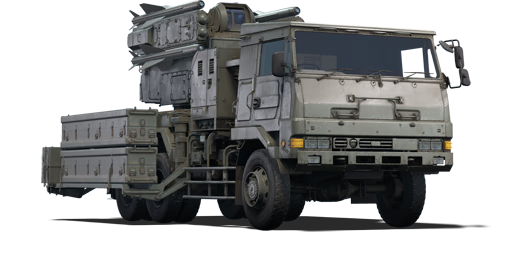
The Type 81 (C) Tan-SAM kai is an upgraded version of the Type 81 Surface-to-Air Missile (81式短距離地対空誘導弾) or Tan-SAM (短SAM), a Japanese developed surface-to-air missile currently in service with the Japan Ground Self-Defense Force. The development of the Tan-SAM Kai started in 1989 as a intermediate SAM missile was needed between the short-range FIM-92 Stinger & the MIM-23 Hawk missile system, and the upgraded system was designated as SAM-1C in 1995. The Tan-SAM missile has a new phased array active radar seeker that can receive mid-course guidance updates from the Fire Control Systems vehicle. This enhances the missile's range to 14 kilometers, but also increases its weight to 105 kilograms. The missile also has a new smokeless motor with better thrust, replacing the old one. The Fire Control Systems vehicle has a thermal imager to operate better in an ECM-heavy environment.
It was introduced in Update "Kings of Battle". The Type 81C can be considered the bigger brother of the Type 93, offering bigger, meaner, and larger both vehicle and missiles. While it's larger, the missile itself still offers great missile guidance with a maximum overload of 35 G, 955 m/s on top of a visual guidance mode which will further increase its hit probability against IRCM/ECM jammers present on high-end helicopters. One problem the Type 81 retains from the Type 93 is the lack of radar, while it offers a thermal camera making the visual spotting of aircraft easier, it still requires situational awareness to find to targets.
General info
Survivability and armour
Describe armour protection. Note the most well protected and key weak areas. Appreciate the layout of modules as well as the number and location of crew members. Is the level of armour protection sufficient, is the placement of modules helpful for survival in combat? If necessary use a visual template to indicate the most secure and weak zones of the armour.
Armour type:
| Armour | Front (Slope angle) | Sides | Rear | Roof |
|---|---|---|---|---|
| Hull | ___ mm | ___ mm Top ___ mm Bottom |
___ mm | ___ - ___ mm |
| Turret | ___ - ___ mm Turret front ___ mm Gun mantlet |
___ - ___ mm | ___ - ___ mm | ___ - ___ mm |
| Cupola | ___ mm | ___ mm | ___ mm | ___ mm |
Notes:
Mobility
Write about the mobility of the ground vehicle. Estimate the specific power and manoeuvrability, as well as the maximum speed forwards and backwards.
| Game Mode | Max Speed (km/h) | Weight (tons) | Engine power (horsepower) | Power-to-weight ratio (hp/ton) | |||
|---|---|---|---|---|---|---|---|
| Forward | Reverse | Stock | Upgraded | Stock | Upgraded | ||
| Arcade | Expression error: Unexpected * operator. | _,___ | __.__ | __.__ | |||
| Realistic | _,___ | __.__ | __.__ | ||||
Modifications and economy
Armaments
Main armament
Give the reader information about the characteristics of the main gun. Assess its effectiveness in a battle based on the reloading speed, ballistics and the power of shells. Do not forget about the flexibility of the fire, that is how quickly the cannon can be aimed at the target, open fire on it and aim at another enemy. Add a link to the main article on the gun: {{main|Name of the weapon}}. Describe in general terms the ammunition available for the main gun. Give advice on how to use them and how to fill the ammunition storage.
| Type 81 SAM-1C missile | Turret rotation speed (°/s) | Reloading rate (seconds) | |||||||||||
|---|---|---|---|---|---|---|---|---|---|---|---|---|---|
| Mode | Capacity (Belt) | Vertical | Horizontal | Stabilizer | Stock | Upgraded | Full | Expert | Aced | Stock | Full | Expert | Aced |
| Arcade | 8 (4) | -5°/+85° | ±180° | - | __._ | __._ | __._ | __._ | __._ | _.__ | _.__ | _.__ | _.__ |
| Realistic | __._ | __._ | __._ | __._ | __._ | ||||||||
Ammunition
| Shell details | ||||||||||||
|---|---|---|---|---|---|---|---|---|---|---|---|---|
| Ammunition | Type of warhead |
Velocity (m/s) |
Range (m) |
Projectile mass (kg) |
Fuse delay (m) |
Fuse sensitivity (mm) |
Arming distance (m) |
Trigger radius (m) |
Explosive mass (TNT equivalent) (kg) |
Ricochet | ||
| 0% | 50% | 100% | ||||||||||
| Type 81C | SAM | 955 | 10,000 | 105 | 1 | 0.1 | 0 | 7 | 5.4 | 79° | 80° | 81° |
Ammo racks
| Full ammo |
1st rack empty |
Visual discrepancy |
|---|---|---|
| 2 | 1 (+1) | Yes |
Usage in battles
The Type 81 (C) is a missile launcher mounted on an Isuzu truck that operates from a safe distance behind the front lines. It is not designed for direct combat, but rather for launching powerful missiles at aerial targets. The truck is large and vulnerable, so it should avoid enemy fire by staying in cover or hiding at the edge of the map. The Type 81 (C) has a longer range than the Type 93, but it still benefits from closing the gap to the air threats. To fire a missile, the truck must come to a full stop and wait for 4 seconds to activate the missile. The truck does not have a radar, so it must rely on manual spotting of the targets. The Type 81 (C) has an advantage over some enemies that use IRCM, such as Kamov and Mi-24 helicopters, because it can track them visually without depending on their IR signature (which can be jammed or flared). However, the visual tracking has a shorter range than the IR tracking, so the launcher may lose lock or fail to lock on some targets depending if it uses only visual, only IR or auto mode. It should be worthy to note that the Type 81 (C) can lose IRST tracking on fast flying aircraft and helicopters that fly through inclement weather, typically in stormy and cloudy maps.
Pros and cons
Pros:
- Highly capable fire-and-forget IR/Visual missiles
- 35 G max overload
- 11 km rear aspect - 6 km all-aspect
- 5 kg explosive warhead
- Can scout targets
Cons:
- Lacks radar
- Cannot fire missiles on the move
- Visual targeting mode is entirely negated in maps with storm/cloudy weather
- Cannot lock onto aircraft that pass through clouds
- Large, unprotected target
- Only 2 crew
- Can be over-pressured by bombs, rockets, missiles
- Small caliber MG's can be deadly, even the MG4 (5.56mm)
- Missile racks on sides can be snagged on obstacles and obstructions
- Slow and sluggish maneuverability
- Requires a wide turning circle, not suitable for maps with narrow streets or terrain
History
Devblog History
In 1966, Japanese engineers began work on developing a new short-range anti-air system capable of intercepting targets beyond fire distance of AA artillery. Furthermore, the new system was envisioned as a modern replacement to dated anti-air systems already in use with the JSDF such as the American M51 Skysweeper and M15A1 SPAAG. In order to fulfill these requirements, the decision was made to mount the missile system onto the Isuzu Type 73 truck chassis.
With development in full swing, the first prototypes had been constructed by the mid 1970s while field trials followed later in the decade. As the test produced positive results, the new SAM system entered service with the JSDF in 1980 under the designation TAN-SAM-1C “Tan-SAM”. However, even after the vehicle entered production, engineers continued tweaking the design, coming up with improved variants by the end of the decade.
The TAN-SAM-1C “Tam-SAM Kai” was one of these variants introduced in 1989, featuring not only improved missiles but also an updated vehicle chassis. This variant entered service with the JSDF in 1995 and continued being produced up until 2006. Thanks to its advanced design and continuous improvements, the TAN-SAM-1C remains in service with the JSDF to this day.
Media
Excellent additions to the article would be video guides, screenshots from the game, and photos.
See also
Links to the articles on the War Thunder Wiki that you think will be useful for the reader, for example:
- reference to the series of the vehicles;
- links to approximate analogues of other nations and research trees.
External links
| Japan anti-aircraft vehicles | |
|---|---|
| Ke-Ni Derivatives | Ta-Se · So-Ki |
| Wheeled | Type 94 |
| Tracked | SUB-I-II |
| Radar SPAAG | Type 87 |
| Missile SPAA | Type 93 · Type 81 (C) |
| USA | ▅M16 MGMC · ▅M19A1 · ▅M42 |
| Isuzu Motors, Ltd. (いすゞ自動車株式会社) | |
|---|---|
| SPAA | Type 94 |
| SAM | Type 81 (C) |