Difference between revisions of "Ostwind II"
m (Minor updates) (Tag: Visual edit) |
(→Description) |
||
| Line 11: | Line 11: | ||
== Description == | == Description == | ||
<!-- ''In the description, the first part should be about the history of the creation and combat usage of the vehicle, as well as its key features. In the second part, tell the reader about the ground vehicle in the game. Insert a screenshot of the vehicle, so that if the novice player does not remember the vehicle by name, he will immediately understand what kind of vehicle the article is talking about.'' --> | <!-- ''In the description, the first part should be about the history of the creation and combat usage of the vehicle, as well as its key features. In the second part, tell the reader about the ground vehicle in the game. Insert a screenshot of the vehicle, so that if the novice player does not remember the vehicle by name, he will immediately understand what kind of vehicle the article is talking about.'' --> | ||
| − | The '''Flakpanzer IV "Ostwind II"''' is an up-gunned modification of the [[Ostwind|Flakpanzer IV "Ostwind"]], which is the second variant of the [[Flakpanzer IV (Disambiguation)| | + | The '''Flakpanzer IV "Ostwind II"''' is an up-gunned modification of the [[Ostwind|Flakpanzer IV "Ostwind"]], which is the second variant of the [[Flakpanzer IV (Disambiguation)|Flakpanzer IV self-propelled anti-aircraft gun family]]. To increase the firing rate, the Flakpanzer IV "Ostwind" was redesigned with two 37 mm Flugzeugabwehrkanone 43 cannons. A single prototype was built, but World War II ended before it could be fully completed. |
Introduced in [[Update 1.91 "Night Vision"]], the Flakpanzer IV "Ostwind II" is an improvement over its predecessors. The increased firepower is useful against aircraft that are much faster in its rank. Due to the sheer destructive power of the ammunition, most enemy aircraft can be brought down with a single hit. The platform, however, remains lightly armoured and should only be used to engage enemy ground units if absolutely necessary. | Introduced in [[Update 1.91 "Night Vision"]], the Flakpanzer IV "Ostwind II" is an improvement over its predecessors. The increased firepower is useful against aircraft that are much faster in its rank. Due to the sheer destructive power of the ammunition, most enemy aircraft can be brought down with a single hit. The platform, however, remains lightly armoured and should only be used to engage enemy ground units if absolutely necessary. | ||
Latest revision as of 10:30, 21 November 2023
| This page is about the German SPAA Ostwind II. For the single-barelled version, see Ostwind. |


Contents
Description
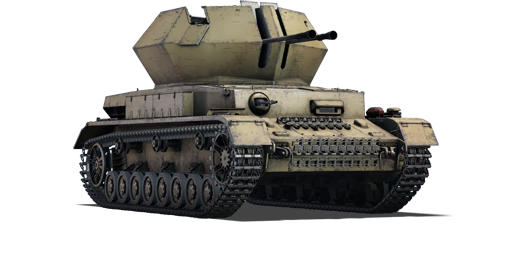
The Flakpanzer IV "Ostwind II" is an up-gunned modification of the Flakpanzer IV "Ostwind", which is the second variant of the Flakpanzer IV self-propelled anti-aircraft gun family. To increase the firing rate, the Flakpanzer IV "Ostwind" was redesigned with two 37 mm Flugzeugabwehrkanone 43 cannons. A single prototype was built, but World War II ended before it could be fully completed.
Introduced in Update 1.91 "Night Vision", the Flakpanzer IV "Ostwind II" is an improvement over its predecessors. The increased firepower is useful against aircraft that are much faster in its rank. Due to the sheer destructive power of the ammunition, most enemy aircraft can be brought down with a single hit. The platform, however, remains lightly armoured and should only be used to engage enemy ground units if absolutely necessary.
General info
Survivability and armour

The frontal hull armour (80 mm) is quite well protected against small-calibre weapons and .50 cal HMGs, the sides (30 mm) and rear (20 mm) are not as well protected.
The turret is open at the top and has a rectangular recess in the right, frontal turret armour, because of the optics.
In addition, the steel of the turret (25 mm) is very weakly armoured, as well as the hull roof (10-12 mm).
Since the vehicle has a crew of six, with the driver and the machine gunner/radio operator in the hull, it usually survives the first attack from enemy aircraft as well as a shot into the turret.
Mobility
| Game Mode | Max Speed (km/h) | Weight (tons) | Engine power (horsepower) | Power-to-weight ratio (hp/ton) | |||
|---|---|---|---|---|---|---|---|
| Forward | Reverse | Stock | Upgraded | Stock | Upgraded | ||
| Arcade | Expression error: Unexpected * operator. | 426 | Expression error: Unexpected round operator. | __.__ | |||
| Realistic | 265 | Expression error: Unexpected round operator. | __.__ | ||||
The Ostwind II does not have that great average speed, which means that the 39 km/h will be rare on the battlefield. Forget about trying to turn on the spot as this vehicle does not have neutral steering. Even worse is attempting to use the reverse gear (-7 km/h) which is extremely insufficient presenting an easy target if having to back out of a tight situation.
Modifications and economy
Armaments
Main armament
| 37 mm FlaK44 (x2) | Turret rotation speed (°/s) | Reloading rate (seconds) | ||||||||||||
|---|---|---|---|---|---|---|---|---|---|---|---|---|---|---|
| Mode | Capacity (Belt) | Fire rate | Vertical | Horizontal | Stabilizer | Stock | Upgraded | Full | Expert | Aced | Stock | Full | Expert | Aced |
| Arcade | 992 (8) | 250 | -10°/+87° | ±180° | N/A | 30.82 | 42.66 | 51.80 | 57.28 | 60.94 | 0.31 | 0.27 | 0.25 | 0.24 |
| Realistic | 20.83 | 24.50 | 29.75 | 32.90 | 35.00 | |||||||||
Ammunition
- Default: APHE · FI-T
- Sprgr. 18: FI-T
- PzGr: APHE
- M.Gr.18: HEI-T
| Penetration statistics | |||||||
|---|---|---|---|---|---|---|---|
| Ammunition | Penetration @ 0° Angle of Attack (mm) | ||||||
| 10 m | 100 m | 500 m | 1,000 m | 1,500 m | 2,000 m | ||
| FI-T | 7 | 7 | 5 | 4 | 3 | 3 | |
| APHE | 49 | 46 | 33 | 22 | 14 | 10 | |
| HEI-T | 7 | 7 | 6 | 4 | 4 | 4 | |
| Shell details | ||||||||||||
|---|---|---|---|---|---|---|---|---|---|---|---|---|
| Ammunition | Velocity (m/s) |
Projectile mass (kg) |
Fuse delay (m) |
Fuse sensitivity (mm) |
Explosive mass (TNT equivalent) (g) |
Ricochet | ||||||
| 0% | 50% | 100% | ||||||||||
| FI-T | 820 | 0.62 | 0.1 | 0.1 | 49.3 | 79° | 80° | 81° | ||||
| APHE | 770 | 0.69 | 1.2 | 9 | 22.1 | 47° | 60° | 65° | ||||
| HEI-T | 914 | 0.55 | 0.1 | 0.1 | 108 | 79° | 80° | 81° | ||||
Ammo racks

| Full ammo |
1st rack empty |
2nd rack empty |
3rd rack empty |
4th rack empty |
5th rack empty |
6th rack empty |
Visual discrepancy |
|---|---|---|---|---|---|---|---|
| 124 | 92 (+32) | 62 (+62) | 30 (+94) | 6 (+118) | 2 (+122) | 0 (+124) | Yes |
Machine guns
| 7.92 mm MG34 | ||||
|---|---|---|---|---|
| Mount | Capacity (Belt) | Fire rate | Vertical | Horizontal |
| Hull | 1,800 (150) | 900 | -5°/+7° | ±10° |
Usage in battles
- Realistic Battles
The Ostwind II should be held in reserve, for towards the end of the game when there tends to be a significant amount of enemy aircraft flying. It is best to avoid the front lines or beating feet toward the enemy tanks as the Ostwind II tends to be an easy target for a majority of the other tanks in the game.
If your own team is about to lose or it gets very exciting towards the end and there are not many enemies left alive, you can place your Ostwind II inside an allied capture-point to defend it from enemy light tanks. Due to the location, it is more central to the battlefield and presents a difficult challenge for enemy aircraft to attempt to fly over.
It should also be kept in mind that if impenetrable heavily armoured enemies are encountered and you are left with no other option but to engage them, firing in a sustained manner at their cannon barrel is a semi-viable idea. This is because it is entirely possible that it will result in a damaged cannon barrel for the enemy and a chance to escape for you. Furthermore, you can target the tank tracks as well to leave the enemy both harmless and immobile which may possibly get you a kill assist if a teammate with enough firepower is nearby. Any tank with top mounted machine guns will be sure to ruin the day, as most within the Ostwind's BR range will have plenty of penetrating power to hit anyone inside your turret. Avoidance of most American and Russian armor is highly recommended due to their exterior armaments.
Pros and cons
Pros:
- 2 x 3.7 cm FlaK 44 cannons with a high rate of fire
- M. Gr. 18 rounds have a high muzzle velocity and explosive mass
- Does not need to reload until it is completely out of ammunition
- Enough penetration to destroy enemy light armoured vehicles
- High number of crew members makes it harder to kill this SPAA by knocking out all crew members
Cons:
- Poorer-than-average mobility and top speed (Panzer IV chassis)
- Slower turret rotation compared to earlier German SPAAs
- Open-topped design makes it vulnerable to rockets, artillery strikes, and aircraft machine gun/cannon fire
History
The Ostwind II was a development of the Ostwind. First conceived as early as October 1943, the Ostwind II saw the single 3.7 cm FlaK 43 replaced by a twinned 3.7 cm FlaK Zwilling 44 built by the Gustloff-Werke in Suhl. One single prototype was delivered to the Panzerflak-Ersatz und Ausbildungsabteilung Ohrsdurf/Thühringen in January of 1945 for evaluation purposes, but due to the rapid events of the war it was never taken into production.
Media
- Skins
- Videos
See also
- Related development
- Flakpanzer IV
- Ostwind - Predecessor with a single 37 mm FlaK 43 autocannon.
- Other vehicles of similar configuration and role
- Flakpanzer 341 - Gift vehicle that the Ostwind II substituted in the main tech tree.
External links
| Germany anti-aircraft vehicles | |
|---|---|
| Wheeled | Sd.Kfz.222 |
| Half-track | Sd.Kfz.251/21 · Sd.Kfz. 6/2 |
| Flakpanzer IV | Wirbelwind · Ostwind · Ostwind II · Kugelblitz · Zerstörer 45 |
| Other Flakpanzers | Flakpanzer I · Flakpanzer 38 · Flakpanzer 341 |
| Wiesel AWC | Wiesel 1A4 · Ozelot |
| Radar SPAAG | Gepard · Gepard 1A2 |
| Missile SPAA | FlaRakPz 1 · FlaRakRad |